What are the forex trading sessions?
The forex day runs in four overlapping sessions named after Sydney, Tokyo, London and New York, each following that city's working hours. Together they cover 24 hours from Monday morning in Asia to Friday evening in New York. The busiest stretch is usually the four hours when London and New York are both open.
Nội dung này hiện chỉ có bản tiếng Anh.

At 08:00 in Tokyo, banks there open their dealing desks. As their day winds down, London opens, and New York joins during the London afternoon. Forex trading follows the working day around the globe.
A trading session is the block of hours when one financial centre is open for business. Traders usually name four: Sydney, Tokyo, London and New York.
Why does forex have sessions at all?
A company's shares usually trade on one exchange, which opens and closes at fixed times. Currencies have no such exchange. Forex is an over-the-counter market, where banks, brokers and funds deal with each other over electronic networks.
On a weekday the market never formally closes. What changes through the day is who is at their desk. When a large financial centre starts work, more orders arrive, and when it goes home, fewer do.
The session names are shorthand for those shifts. Tokyo hours are also when dealers in Singapore and Hong Kong are at work, and London hours include centres such as Frankfurt, Paris and Zurich.
What are the four sessions and their hours?
No official body sets session hours, so published tables differ by an hour or two. This lesson uses a simple convention: each session runs from 08:00 to 17:00 local time in its city.
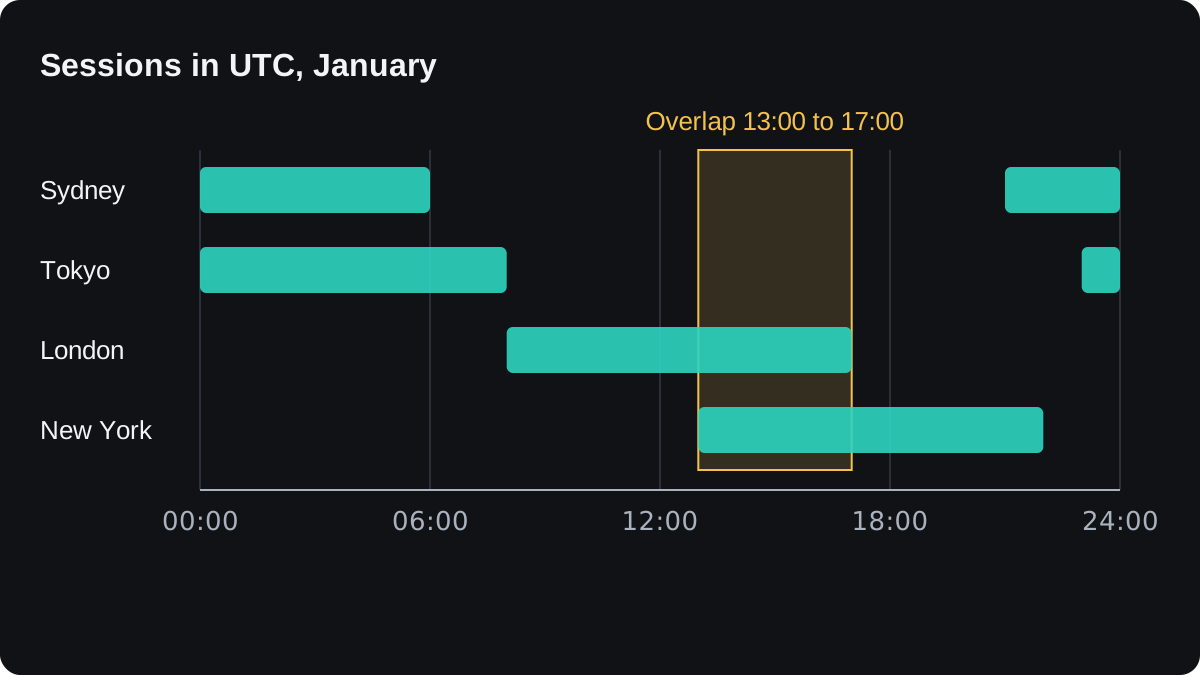
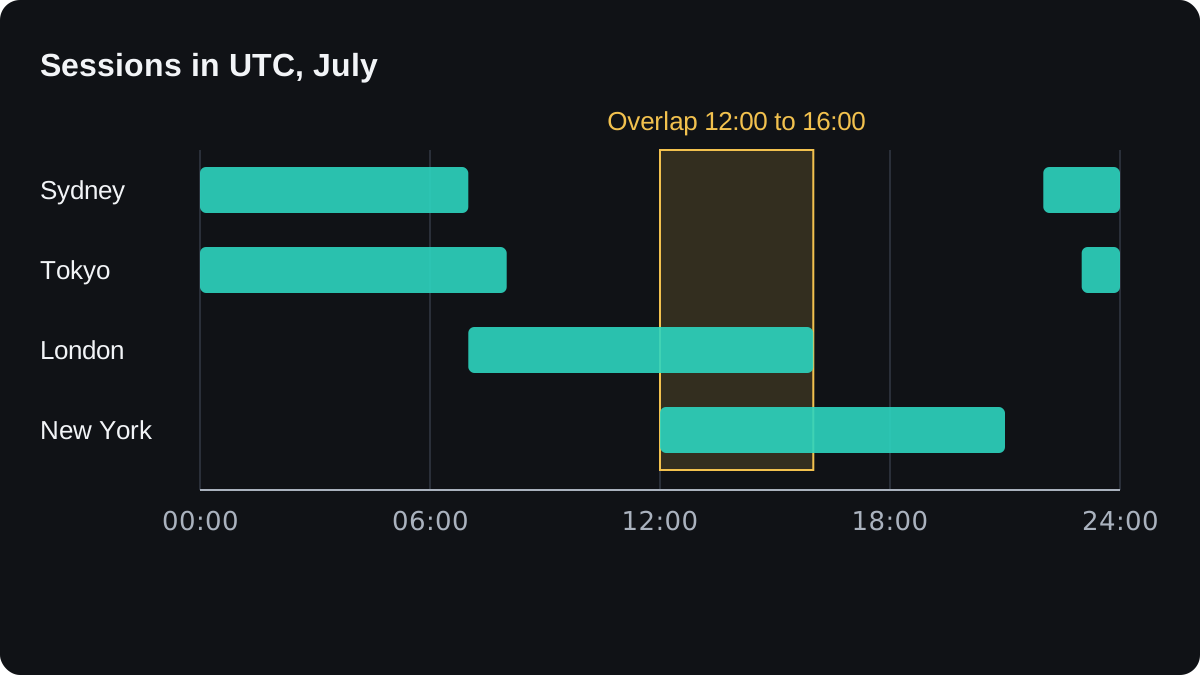
The table gives those hours in UTC, the world reference clock. The local hours stay the same all year, but the UTC hours of three sessions move because their cities change clocks for summer.
| Session | Local hours | UTC in January | UTC in July |
|---|---|---|---|
| Sydney | 08:00 to 17:00 | 21:00 to 06:00 | 22:00 to 07:00 |
| Tokyo | 08:00 to 17:00 | 23:00 to 08:00 | 23:00 to 08:00 |
| London | 08:00 to 17:00 | 08:00 to 17:00 | 07:00 to 16:00 |
| New York | 08:00 to 17:00 | 13:00 to 22:00 | 12:00 to 21:00 |
Sydney and Tokyo start work before midnight UTC, so in UTC their sessions begin on the previous evening.
In January, the London and New York sessions share four hours, from 13:00 to 17:00 UTC. Sydney and Tokyo share seven, from 23:00 to 06:00 UTC.
Each session has currencies that are usually busier in it. Asian hours tend to see more trading in the yen and in the Australian and New Zealand dollars.
London is the largest forex trading centre, and the euro, pound and Swiss franc are often most active there. New York hours bring the reaction to US economic data, many of the main releases coming out at 08:30 New York time.
The lessons on the Tokyo, London and New York sessions cover each one in detail.
How does daylight saving change the times?
Japan does not use daylight saving time, so the Tokyo session stays at 23:00 to 08:00 UTC all year. The other three cities change their clocks, each on its own dates:
- The United States: from the second Sunday in March to the first Sunday in November.
- The United Kingdom: from the last Sunday in March to the last Sunday in October.
- Sydney: from the first Sunday in October to the first Sunday in April.
Summer in the south is winter in the north, so Sydney shifts the opposite way. In July, London and New York open an hour earlier in UTC than in January, and Sydney opens an hour later.
The US and UK dates do not match. For two to three weeks in March and about a week around the start of November, New York is four hours behind London instead of five.
In those weeks the overlap runs from 12:00 to 17:00 UTC, five hours instead of four.
Where do the sessions overlap, and why does it matter?
An overlap is a stretch when two sessions are open at once. More dealers are working, so there are usually more buyers and sellers at each price.
Liquidity, how easily you can trade without moving the price, is therefore often highest in the London and New York overlap. Spreads on major pairs tend to be tight then.
Prices also tend to travel further than in quiet hours. A bigger move cuts both ways: it can reach your target sooner or your stop sooner, and a data release can make prices jump within seconds.
The thinnest hours come around the New York close, when New York has finished and Tokyo has not yet opened. Spreads often widen then, so a trade opened at that time starts further from breakeven.
Whether busy or quiet hours suit your trading is the subject of the best time of day to trade.
How do you convert session times to your own clock?
A UTC table is only useful once you turn it into your own time. Find your offset from UTC, then add it if you are ahead of UTC and subtract it if you are behind.
Take a trader in a city at UTC+7 that does not use daylight saving:
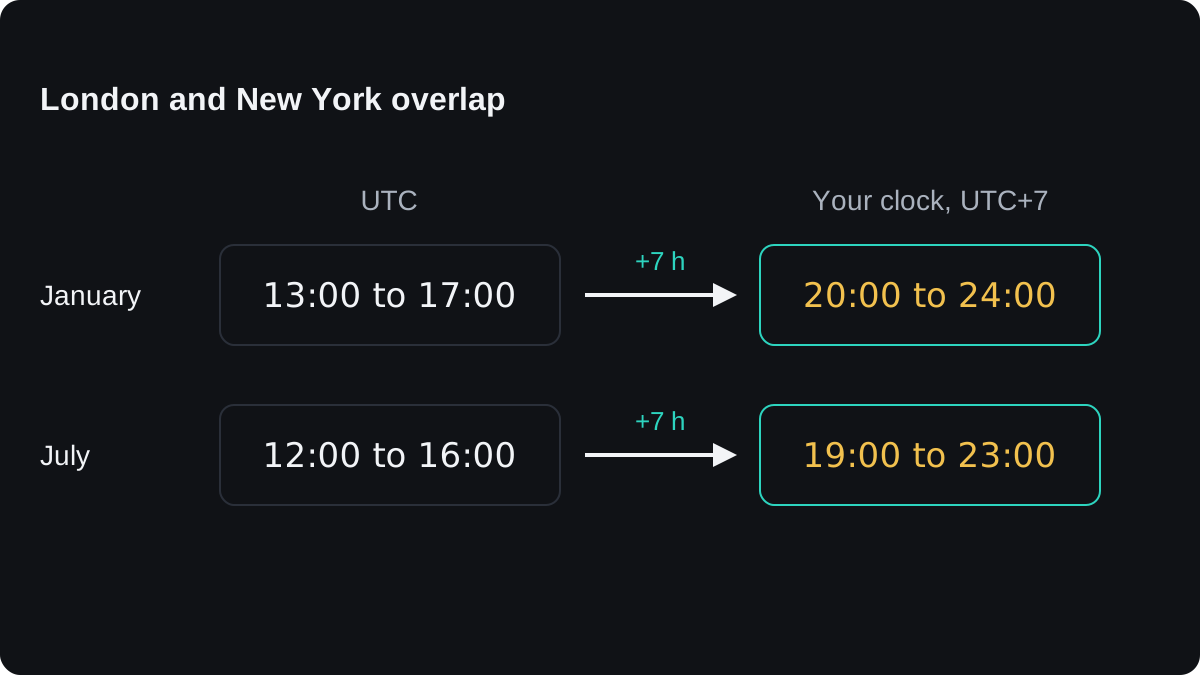
- The January overlap is 13:00 to 17:00 UTC.
- Add 7 hours: 13 + 7 = 20 and 17 + 7 = 24. The overlap runs from 20:00 to midnight local time.
- The July overlap is 12:00 to 16:00 UTC: 12 + 7 = 19 and 16 + 7 = 23, so 19:00 to 23:00 local time.
- The Tokyo session, 23:00 to 08:00 UTC, becomes 06:00 to 15:00 local time: 23 + 7 = 30, and 30 minus 24 = 06:00, while 08 + 7 = 15:00.
If your city moves its clocks in the same direction as a session city, the gap between you mostly stays the same. A trader in New York sees London open at 03:00 local time in both January and July.
During the mismatch weeks in March and around the start of November, London opens at 04:00 New York time.
Your platform may show a third clock, the broker's server time, which is often neither UTC nor your local time. Some brokers set it so that a new daily candle starts at 17:00 New York time.
You can check the sessions against your own clock with the market hours tool.
When does the forex week open and close?
The week opens when the first centres in the Asia Pacific region start work on Monday morning, which is Sunday evening in UTC. It closes at 17:00 New York time on Friday: 22:00 UTC in January and 21:00 UTC in July.
Each broker sets its own exact weekend hours, and they can differ by an hour or so. Check the trading hours in your broker's contract specifications before you plan a Sunday or Friday trade.
At most brokers, 17:00 New York time is also the daily rollover. A position held through it is charged or paid swap, the overnight interest on a trade.
News can still break over the weekend. If it does, Monday's first price can open well away from Friday's close, a jump called a gap.
A stop loss that sits inside the gap is usually filled at the first available price, which can be worse than the level you set.
Câu hỏi thường gặp
What are the four forex trading sessions?
Sydney, Tokyo, London and New York, each named after a financial centre and following its working day. Together they cover 24 hours from Monday morning in Asia to Friday evening in New York.
What time does the London session open?
By this lesson's convention it opens at 08:00 London time, which is 08:00 UTC in winter and 07:00 UTC during British Summer Time. Other sources may put it an hour earlier.
When do the London and New York sessions overlap?
Using 08:00 to 17:00 local hours, from 13:00 to 17:00 UTC in January and from 12:00 to 16:00 UTC in July. In the few weeks when US and UK clock changes do not line up, it runs from 12:00 to 17:00 UTC.
Is the forex market open on weekends?
Trading runs around the clock on weekdays, and brokers generally close spot forex from Friday evening New York time until Sunday evening UTC. Exact hours vary by broker, so check its contract specifications.
Why do session times change during the year?
The United States, the United Kingdom and south-east Australia, including Sydney, move their clocks for daylight saving on different dates, and Japan does not move its clock at all. So the sessions shift against UTC and against each other.
Học tiếp
 Chương 3The Tokyo session: hours and what moves.The Tokyo session is the Asian part of the forex day, roughly 00:00 to 09:00 UTC. Japan does not use daylight saving time, so those hours stay fixed all year. Yen pairs and the Australian and New Zealand dollars are most active, and ranges on European pairs are often smaller than in London.
 Chương 3The London session: hours and what moves.The London session is usually the busiest part of the forex day. By common convention it runs from 08:00 to 17:00 London time, which is 08:00 to 17:00 UTC in winter and 07:00 to 16:00 UTC in summer. Euro, pound and Swiss franc pairs tend to move most, and the overlap with New York usually lasts four hours.
 Chương 3The New York session: hours and what moves.The New York session runs from about 08:00 to 17:00 New York time, which is roughly 13:00 to 22:00 UTC in winter and 12:00 to 21:00 UTC in summer. Its first four hours overlap London, usually the busiest stretch of the day. Much of the major US data comes out at 08:30 New York time.
 Chương 3What is the best time of day to trade forex?For most major pairs the best conditions come when London and New York are both open, about 12:00 to 16:00 UTC in the northern summer and 13:00 to 17:00 UTC in winter. Liquidity is deepest and spreads are usually tightest then, although big US data releases also land in that window.
 Chương 3What are the best days of the week to trade forex?Forex opens around 17:00 New York time on Sunday and closes at the same time on Friday. Monday's first hours are often thin and can gap. Tuesday to Thursday are often busier, with many scheduled releases. Friday afternoons thin out before the close. No day is best for everyone, so check your own pairs.

