 Thuật ngữ · Cơ bản về giao dịch ký quỹ
Stop out
Nội dung này hiện chỉ có bản tiếng Anh.
Stop out is the margin level at which your broker starts closing your positions. The biggest loser usually goes first, because equity no longer covers the margin they need. The exact level depends on the broker and the account type.
A stop out closes trades you did not choose to close. It happens when your margin level falls to a threshold set by your broker.
The margin and stop out lesson works through the full calculation.
How a stop out is triggered
Margin level is equity divided by used margin, times 100%. As losses grow it falls, first to the margin call level, a warning, and then to the stop out level.
At stop out, the broker's server deletes pending orders and closes positions, normally the largest loss first, until margin level is back above the threshold.
There is no universal stop out level. Each broker sets its own, often per account type, and sometimes as an amount of equity rather than a percentage.
A worked example
Prices are illustrative and the 50% level is only an example. A $1,000 account at 1:100 leverage buys 0.50 lot of EUR/USD at 1.10000. The margin is $55,000 ÷ 100 = $550, and each pip is worth $5.
A 50% stop out means equity of 50% × $550 = $275. The trade can lose $1,000 minus $275 = $725 first: $725 ÷ $5 = 145 pips, down to 1.08550.
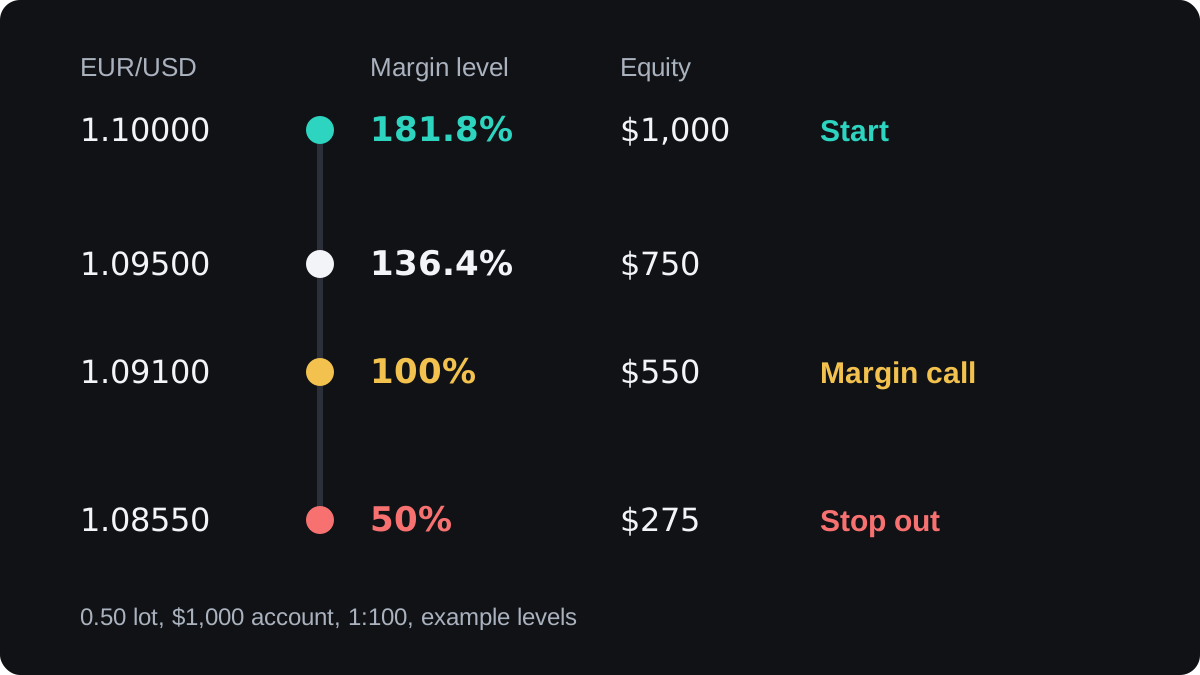
The same account trading 0.10 lot has 945 pips of room. The margin calculator shows what a position will lock before you open it.
Câu hỏi thường gặp
What is the difference between a margin call and a stop out?
A margin call is a warning level. A stop out is the lower level where the broker starts closing positions for you.
Can I lose more than my deposit after a stop out?
In a fast market or a gap, positions can close well past the stop out level and equity can fall below zero. Some brokers then reset a negative balance to zero.
Leverage multiplies losses as well as gains; only trade money you can afford to lose.
Thuật ngữ khác cùng chương
 MarginMargin is the part of your account set aside as a deposit for an open leveraged trade. It equals the position's value divided by your leverage. It is not a fee, and it is released when the trade closes.
 Free marginFree margin is the part of your equity not tied up as margin by open trades. It equals equity minus used margin. You need free margin to open new positions, and it shrinks as open trades lose money.
 EquityEquity is your account's value right now: balance plus or minus floating profit or loss. It counts every open position. Free margin and margin level are both worked out from equity, not from the balance.
 Account balanceYour balance is the money in your account from deposits, withdrawals and closed trades. It does not move with open positions. Their floating profit or loss is counted in equity instead, so balance and equity differ while trades are open.
Học đầy đủ trong bài
Thuật ngữ liên quan