The British pound.
The British pound, or sterling (GBP), moves mainly on Bank of England interest rate expectations and on data from a services-heavy UK economy. GBP/USD, nicknamed cable, is one of the most traded pairs. The pound has often swung further in a day than the euro, so a trade on it may need a wider stop and a smaller position.
本頁目前僅提供英文版。

The British pound is the currency of the United Kingdom. Its code is GBP, and it is also called sterling. On a trading platform you meet it in pairs such as GBP/USD, EUR/GBP and GBP/JPY.
Its price responds mostly to Bank of England decisions and UK economic data. At times it also moves further in a day than other major currencies, which affects how large your trades should be.
What do traders call the pound?
Pound sterling is the full name, and you will see it in official documents. Traders shorten GBP/USD to cable. The nickname comes from the telegraph cable laid under the Atlantic in the 1800s, which carried exchange rates between London and New York.
The pound is the base currency in most of its pairs. An illustrative GBP/USD price of 1.27000 means one pound costs 1.27000 US dollars.
EUR/GBP is the exception, because the euro comes first there and is priced in pounds. The euro profile covers the other side of that pair.
| Pair | What the price says | Pip size |
|---|---|---|
| GBP/USD | Dollars per pound | 0.0001 |
| EUR/GBP | Pounds per euro | 0.0001 |
| GBP/JPY | Yen per pound | 0.01 |
On GBP/JPY the yen is the quote currency, so a pip is 0.01, as on every yen pair.
How does the Bank of England move the pound?
The Bank of England is the UK's central bank. Since 1997 it has set interest rates independently of the government, aiming at an inflation target that the government chooses. That target has been 2% for many years.
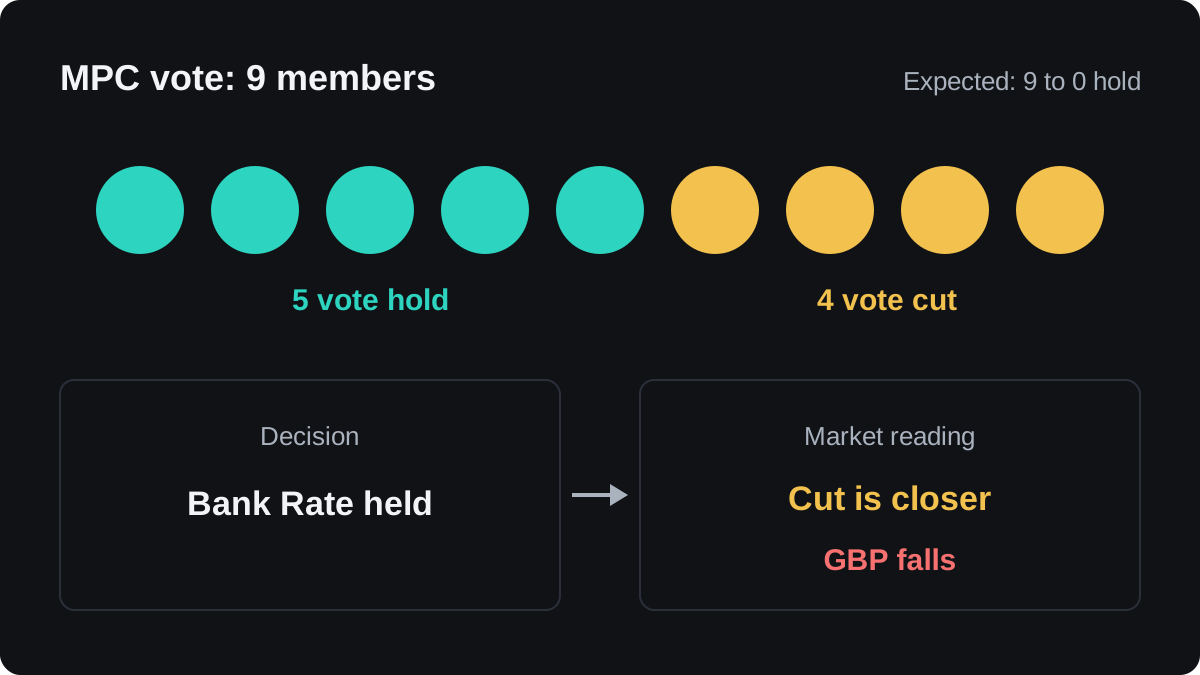
Its policy rate is called Bank Rate. A committee of nine people, the Monetary Policy Committee (MPC), votes on it at eight scheduled meetings a year, and the Bank publishes how each member voted.
Higher expected UK rates tend to support the pound, because they can raise the return on holding sterling assets. The interest rates lesson explains that link and where it weakens.
The vote count can matter as much as the decision. Suppose the market expects a unanimous hold, and the MPC holds Bank Rate by 5 votes to 4, with four members wanting a cut.
The rate is unchanged, yet the close vote suggests a cut is coming sooner than expected. The pound could fall on a decision that changed nothing, and the central banks lesson shows how markets price signals like this.
Why does a services economy matter for sterling?
Services such as finance, retail, health and professional work make up roughly four fifths of UK output. Manufacturing is a much smaller share than in some other large economies.
That shapes what the MPC watches. Services prices depend heavily on wages, so UK wage growth and services inflation can shift rate expectations, and the pound moves with them.
London is also a global financial centre. Surveys by the Bank for International Settlements have repeatedly found the UK to be the largest single centre for forex trading, so much of the world's currency dealing happens in London hours.
The UK has run a current account deficit in most years for decades. More money leaves the country for imports and income payments than comes in, and foreign investors fill the gap by buying UK assets.
While those inflows continue, the deficit causes little trouble. When foreign investors lose confidence in UK policy, the gap becomes harder to fund and the pound can drop quickly.
Which UK releases move the pound?
The Office for National Statistics publishes most official UK data. These releases often move sterling:
- Consumer price inflation (CPI), monthly, including the services figure
- Labour market data, especially growth in average earnings
- GDP, published monthly as well as quarterly
- Business surveys called purchasing managers' indexes (PMIs), produced privately
- Bank of England decisions and its quarterly Monetary Policy Report
The price reacts to the gap between the result and the forecast. The expectations lesson explains why, and the economic calendar guide shows where the forecasts are listed.
Here is a worked example with illustrative prices:
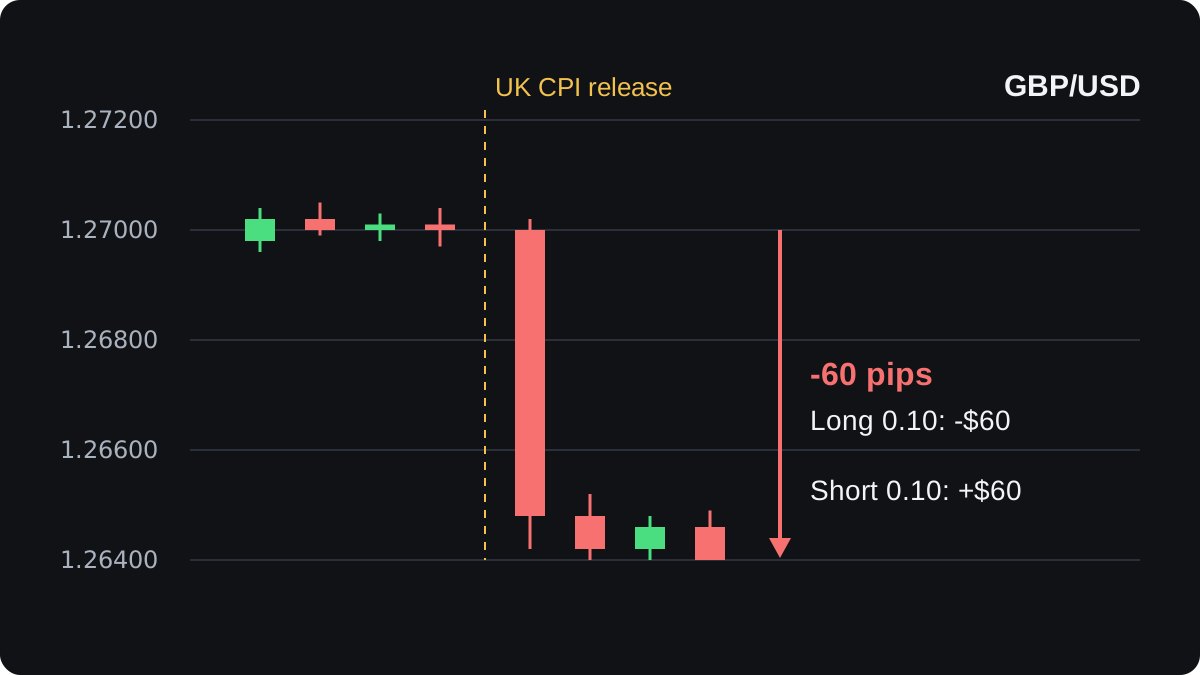
- GBP/USD trades at 1.27000 just before a UK CPI release.
- Inflation comes in below the forecast, so traders expect lower UK rates sooner.
- GBP/USD falls to 1.26400. The move is 1.27000 minus 1.26400 = 0.00600, which is 60 pips.
- On 0.10 lot, which is 10,000 pounds, a pip is worth 10,000 × 0.0001 = $1.
- A long position loses 60 × $1 = $60, and a short position gains $60.
The same surprise does not always bring the same move. If the market had already priced in a soft number, or other news lands at the same moment, the reaction can be small or even reverse.
Why is the pound known for sharp moves?
Sterling has had several large shocks in living memory. On 16 September 1992, a day remembered as Black Wednesday, the UK left the European Exchange Rate Mechanism after failing to hold the pound inside its agreed band.
Overnight after the Brexit referendum of 23 June 2016, the pound fell sharply against the dollar as results came in.
In late September 2022, a government plan for large unfunded tax cuts sent the pound to a record low against the dollar. The Bank of England then stepped in to steady the market for gilts, the UK government bonds.
That episode shows where the simple rate logic breaks. The Bank had been raising rates through 2022, yet the pound fell because investors doubted the government's borrowing plans.
GBP/JPY has often had wider daily ranges than GBP/USD. It combines moves in the pound with moves in the yen, and the two tend to go opposite ways when markets turn fearful.
Calm periods happen too, so measure volatility on current data before you size a trade. The volatility lesson shows how, for example with average true range.
How does pound volatility change your position size?
A pair that swings further needs a wider stop, and a wider stop needs a smaller position if you want to risk the same money. The numbers below are illustrative.
You have a $5,000 account and, as an example, risk 1% per trade, which is $50. You place a 40 pip stop on GBP/USD, and an 80 pip stop on GBP/JPY because it has recently moved about twice as far.
For GBP/USD:
- One lot is 100,000 pounds, so a pip is 100,000 × 0.0001 = $10 per lot.
- Risk per lot at a 40 pip stop: 40 × $10 = $400.
- Size: $50 ÷ $400 = 0.125 lot, rounded down to 0.12 lot.
- Check: 0.12 lot is $1.20 per pip, and 40 × $1.20 = $48.
For GBP/JPY, with USD/JPY at an illustrative 150.00:
- A pip on one lot is 100,000 × 0.01 = 1,000 yen, which is 1,000 ÷ 150.00 = $6.67.
- Risk per lot at an 80 pip stop: 80 × 1,000 = 80,000 yen, which is 80,000 ÷ 150.00 = $533.33.
- Size: $50 ÷ $533.33 = 0.094 lot, rounded down to 0.09 lot.
- Check: 0.09 lot is 90 yen per pip, which is 90 ÷ 150.00 = $0.60, and 80 × $0.60 = $48.
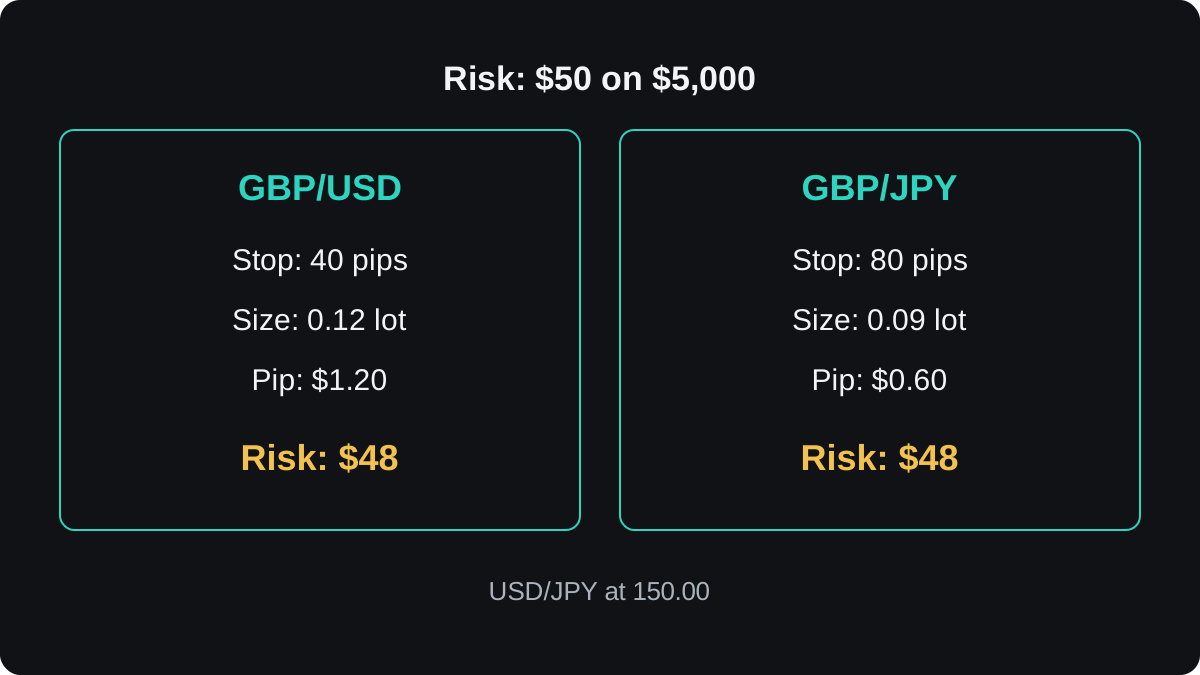
Both trades risk $48. The GBP/JPY position is smaller because each pip is worth less in dollars and the stop sits twice as far away.
The position size lesson walks through this method in full, and the pip value calculator converts yen pip values at the live rate.
常見問題
Why is GBP/USD called cable?
The name comes from the telegraph cable under the Atlantic that carried pound and dollar exchange rates between London and New York in the 1800s. Traders still use it for GBP/USD.
What moves the British pound the most?
No single factor always wins. Bank of England rate expectations, driven by UK inflation and wage data, are a steady influence, while confidence in UK government policy can take over in a crisis.
Is the pound more volatile than the euro?
GBP/USD has often had wider daily ranges than EUR/USD, but the gap changes over time. Check a current measure such as average true range before assuming either way.
Who sets UK interest rates?
The Bank of England's Monetary Policy Committee, whose nine members vote at eight scheduled meetings a year. The government sets the inflation target, and the committee decides Bank Rate.
What is a pip on GBP/JPY?
A pip on GBP/JPY is 0.01, because the yen is the quote currency. On one standard lot that is 1,000 yen per pip.
繼續學習
 第 4 章The US dollar.The US dollar is on one side of most forex trades because it is the main reserve, trade and funding currency. Its value moves largely on what traders expect from the Federal Reserve, and those expectations shift with US jobs, inflation and growth data. In a global panic it often rises.
 第 4 章The euro.The euro is the shared currency of 21 European Union countries, managed by the European Central Bank in Frankfurt. The ECB sets one interest rate for economies that can need different ones, aiming for 2% inflation across the whole area. EUR/USD, the euro against the US dollar, is the world's most traded currency pair.
 第 4 章The Japanese yen.The Japanese yen is shaped by decades of very low interest rates set by the Bank of Japan, which made it a popular funding currency for carry trades. It often rises when markets panic, though not always. Japan's Ministry of Finance sometimes intervenes, and on yen pairs a pip is 0.01.
 第 4 章The Australian, Canadian and New Zealand dollars.The Australian, Canadian and New Zealand dollars are called commodity currencies because their countries export large amounts of raw materials. The Aussie tends to follow metals and Chinese demand, the loonie oil and the US economy, and the kiwi dairy prices. Interest rates and global risk appetite also move all three, and can outweigh commodities.
 第 4 章The Swiss franc.The Swiss franc (CHF) is the currency of Switzerland, a small economy with a currency that investors often buy in times of stress. That safe-haven demand can push the franc too high, so the Swiss National Bank has fought it with negative rates and currency intervention, including a 1.20 floor on EUR/CHF that it dropped without warning in 2015.

