Country risk and currency value.
Country risk is the chance that a country's debts, deficits or politics make its assets less safe to hold. Large current account deficits, heavy debt owed in foreign currency, thin reserves and unstable politics tend to make investors demand higher interest rates or sell the currency. These forces work slowly and give little help with timing trades.
本頁目前僅提供英文版。

Two countries can set the same interest rate and still have very different currencies. One pays for its imports from its own earnings and owes money mostly to its own citizens.
The other borrows abroad every year, and its next election could change the rules for investors. Over months and years, investors tend to demand more from the second country, through higher interest rates, a weaker currency, or both.
What is country risk?
Country risk is the chance that a country's finances or politics will make its assets less safe to hold. For a currency trader, it comes down to one question: will foreign money keep wanting to come in?
The main parts are the country's payments with the rest of the world, its government debt, and the stability of its politics and institutions. They change slowly, which separates them from the sudden shocks covered in geopolitical risk and forex.
Deficits: paying for more than you sell
Picture a country, called Country A here, with round illustrative numbers. Each year it buys 120 billion dollars of goods and services from abroad and sells 100 billion. The 20 billion gap has to be paid in foreign money.
That money can come from foreign loans, from foreigners buying local shares, bonds or property, or from the central bank's reserves.
Country A produces 500 billion dollars a year. That figure is its GDP, the value of everything the economy produces. The gap is therefore 20 ÷ 500 = 4% of GDP.
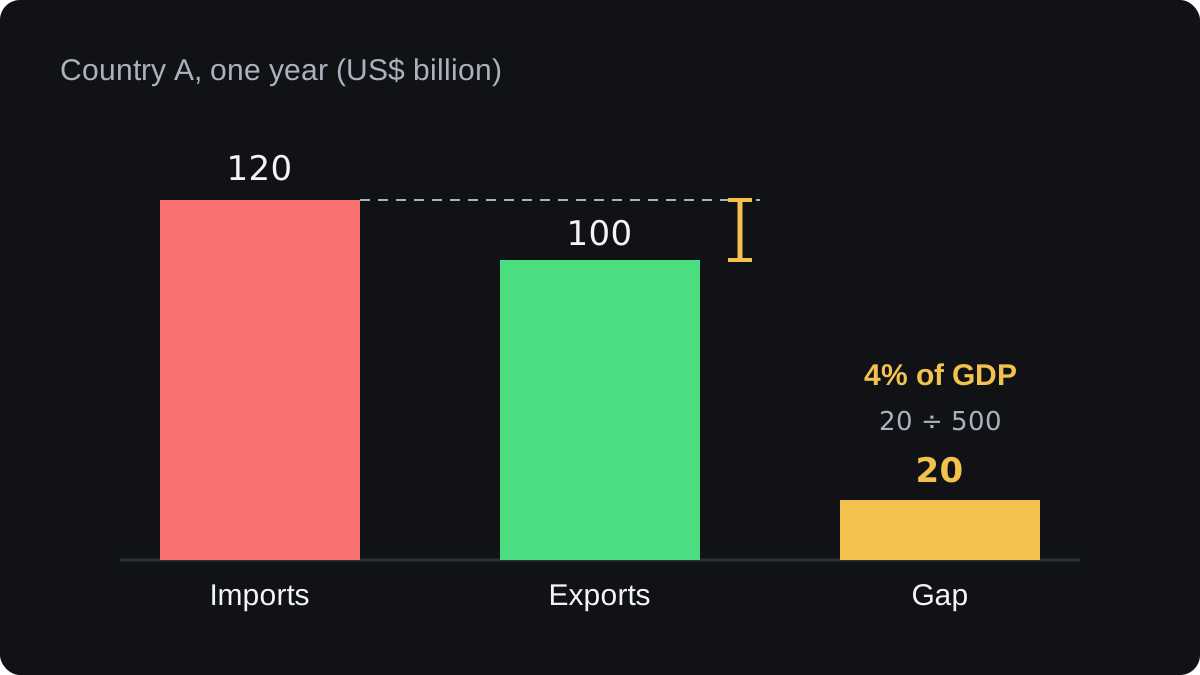
This gap is the core of the current account deficit. The full current account also counts income and transfers, such as interest paid abroad and money sent home by workers, but trade is the easiest part to picture.
A deficit is manageable while foreigners keep lending. If they stop, the gap has to close fast, and the usual way is a falling currency that makes imports dearer until people buy fewer of them.
Economists call that sharp halt in foreign funding a sudden stop.
The government's own budget matters too. A budget deficit means it spends more than it collects in tax and borrows the rest. A country with both kinds of deficit at once is said to run twin deficits.
Government debt and who holds it
Debt is measured against the size of the economy. If Country A's government owes 400 billion and GDP is 500 billion, its debt-to-GDP ratio is 400 ÷ 500 = 80%.
That number alone says little. Two other questions matter more: who lent the money, and in which currency it must be repaid.
Debt in the country's own currency can, in the end, be paid by its central bank creating money. Outright default is less likely, but the risk moves to inflation, which also erodes a currency's value.
That escape exists only for a country with its own central bank. Euro area members borrow in euros but cannot create them on their own.
Debt in a foreign currency is harder, because no country can print another country's money. Say a borrower in Country A owes 10 million US dollars.
XXX is a placeholder code for Country A's currency, and USD/XXX, the price of one dollar in XXX, is 20.00.
- At 20.00 the debt costs 10 million × 20.00 = 200 million XXX.
- The local currency weakens and USD/XXX rises to 25.00.
- The same debt now costs 10 million × 25.00 = 250 million XXX.
- The burden grew by 50 million, or 50 ÷ 200 = 25%, with no new borrowing.
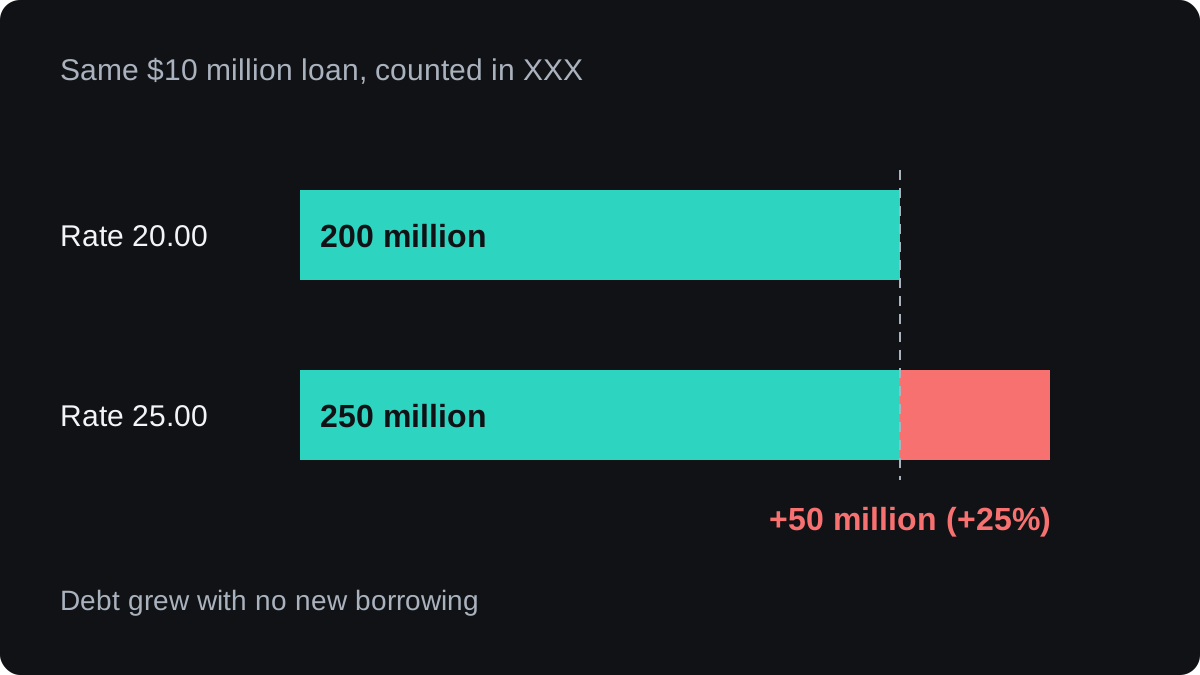
This is how a falling currency can feed on itself. Borrowers rush to buy dollars before the price rises further, and that buying pushes the local currency down again.
A central bank's foreign currency reserves are the buffer. As the currency intervention lesson showed, reserves can be spent to support a currency, but they can run out.
Reserves that look small next to the foreign debt falling due within a year are a common warning sign.
Political stability and institutions
Investors who buy a country's bonds or companies are betting that the rules will still hold years from now. Political risk is anything that puts those rules in doubt.
Typical examples are disputed elections, sudden changes of government, pressure on the central bank to cut rates before a vote, limits on taking money out of the country (capital controls), sanctions and seizures of private assets.
Strong institutions lower the extra return investors ask for. Signs include a central bank that sets rates without political orders, courts that enforce contracts, and official statistics that are published on time and trusted.
Credit rating agencies such as S&P Global, Moody's and Fitch grade government debt. A downgrade can move a currency on the day, although ratings often follow problems the market has already priced.
Bond yields and credit default swap prices give a faster, market-based reading of the same risk, because they change every trading day.
How the market charges for risk
Investors want extra return for holding a riskier currency. The usual form is a higher interest rate, as the interest rates lesson explains, and that extra return is called a risk premium.
Here is the trade-off with round illustrative numbers. A one-year bond in Country A pays 10%, and a US dollar bond pays 4%. You start with $10,000 and USD/XXX is 20.00.
- Convert: $10,000 × 20.00 = 200,000 XXX.
- Earn 10% for a year: 200,000 × 1.10 = 220,000 XXX.
- If the rate is still 20.00, you get back 220,000 ÷ 20.00 = $11,000.
- If the rate has risen to 22.00, you get back 220,000 ÷ 22.00 = $10,000.
- The dollar bond would have returned $10,000 × 1.04 = $10,400.
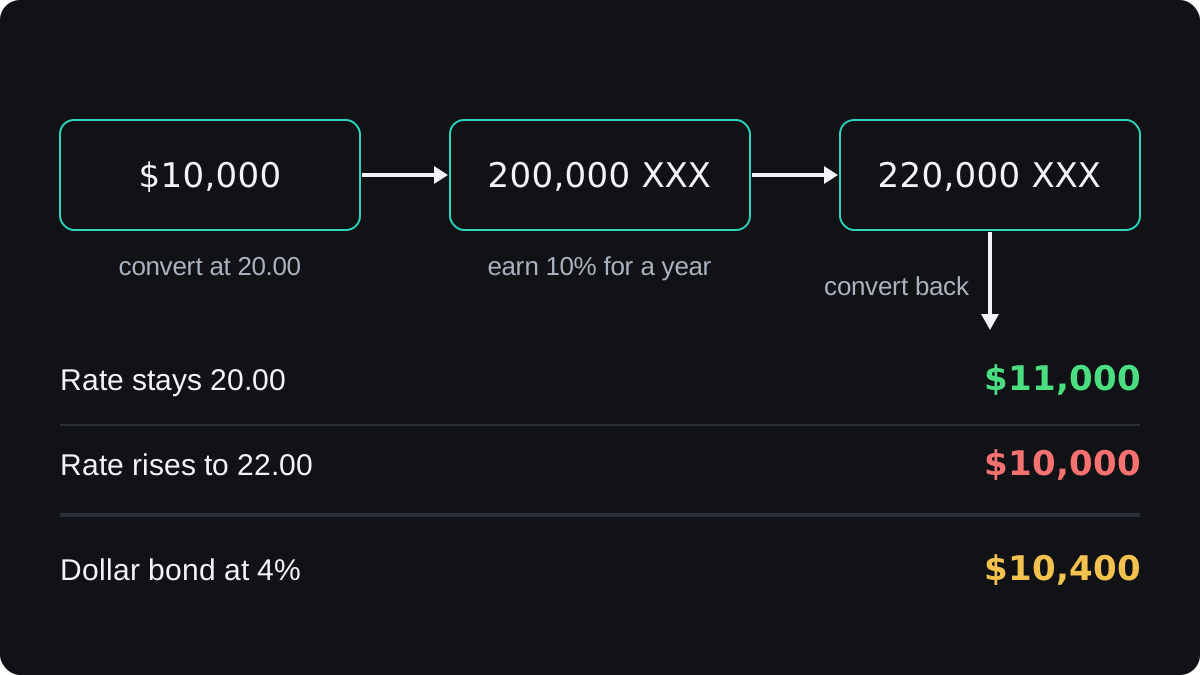
In step 4 the currency's fall erased the whole interest gain. The breakeven rate against the dollar bond is 220,000 ÷ 10,400, about 21.15.
Above that level, the safer bond would have done better. These sums ignore taxes, fees and the bid-ask spread.
The extra 6 percentage points are the price the market sets for the chance of a fall. When country risk rises, investors demand a higher rate, sell the currency, or do both at once.
The carry trade risks lesson covers what happens when many of them sell together.
Where country risk analysis falls short
Country risk builds slowly, but prices react to news and to changes in expectations. A currency with weak finances can rise for years while global investors want yield, then fall sharply within weeks when that appetite fades.
Some countries break the simple rules. The United States has run current account deficits for decades, yet the dollar is held worldwide as a reserve currency.
Japan carries government debt far larger than its yearly output, but most of it is owed in yen to lenders at home.
The evidence on timing is weak. Research going back to the early 1980s has found that exchange rate models built on fundamentals struggle to beat a simple guess of no change over horizons of a few months.
Country risk is best read as background. It tells you which currencies could fall hard if sentiment turns, and how fragile a position might be, while entry timing has to come from other tools.
The next lesson, building a fundamental view, puts these pieces together into a view of one currency.
常見問題
Does high government debt always weaken a currency?
No. It depends on who holds the debt, which currency it is owed in, and whether investors trust the government to manage it. Debt owed at home in the country's own currency is usually less dangerous than a smaller debt owed abroad in dollars.
What is the difference between country risk and geopolitical risk?
Country risk is the slow build-up of weakness in a country's finances, politics and institutions. Geopolitical risk usually means sudden events, such as conflicts or diplomatic crises, that can move many currencies at once.
Why do emerging market currencies fall so fast in a crisis?
Many emerging economies rely on foreign funding, and some owe debt in dollars. When foreign money leaves, the currency falls and dollar debts grow in local terms, so the rush to buy dollars can push the currency down further.
Where can I find a country's debt and deficit figures?
National statistics offices, finance ministries and central banks publish them, and the IMF and World Bank collect them in comparable form. Check the date and the definition, because these figures are often revised.
繼續學習
 第 3 章Geopolitical risk and forex.Geopolitical risk is the chance that elections, conflicts or sanctions change a country's economy or its links with the world. Currencies reprice when that risk shifts, often in sudden jumps. Money tends to leave risk-sensitive currencies such as the Australian dollar and move into safe havens such as the US dollar, Japanese yen and Swiss franc.
 第 3 章Currency intervention.Currency intervention is when a government or its central bank buys or sells currency in the market to push its exchange rate. Buying its own currency with foreign reserves props it up, and selling its own currency weakens it. For traders it means sudden large moves, and stops that can fill far from their price.

