Forex vs futures: what is the difference?
Spot forex and forex CFDs trade over the counter through a broker, in flexible sizes often down to 1,000 units, with no expiry and a nightly swap. Currency futures trade on an exchange in fixed contract sizes, expire on set dates, settle gains and losses every day and build the interest difference into their price.
本頁目前僅提供英文版。
You can bet on the euro rising against the dollar in two common ways. You can buy EUR/USD through a forex broker, or buy a euro futures contract on an exchange.
Both gain if the euro rises. They differ in who stands on the other side and how the contract is built. The ways to trade forex lesson listed futures as one route.
Where does each one trade?
When you buy EUR/USD on a retail platform, you trade with your broker. The broker quotes a price, fills your order and is the other party to your contract.
The broker may keep that risk or offset it with banks and other liquidity providers. This is an over-the-counter (OTC) market: a private deal between two parties, with no central exchange.
Retail spot forex is usually a rolling spot contract or a CFD, a contract that pays the price difference in cash.
A currency future is bought on an exchange. Every order goes into one central order book, where buyers and sellers from many firms meet. You reach it through a futures broker, who passes your order on.
Once a trade matches, a clearing house steps in. It becomes the buyer to every seller and the seller to every buyer, so it is your counterparty whoever placed the other order.
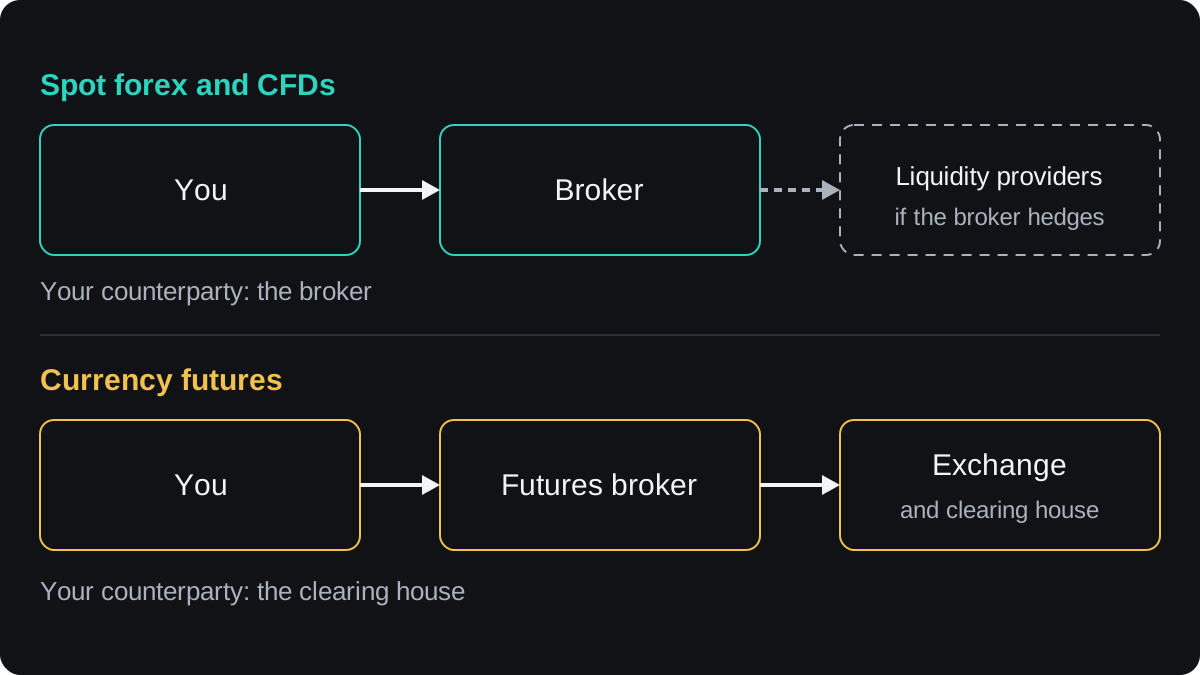
The OTC side is covered in who is on the other side of your trade.
An exchange also publishes the volume traded in each contract. Spot forex has no single venue, so no one can report its full volume in real time.
Flexible lots or fixed contracts?
A forex broker lets you pick almost any size. A standard lot is 100,000 units of the base currency, and many brokers accept 0.01 lot, which is 1,000 units.
A futures contract has one fixed size set by the exchange. The main euro contract at CME Group, a large US futures exchange, covers 125,000 euros. Smaller micro contracts exist for some currencies, at one tenth of that size.
You trade whole contracts only, while a broker account could take 0.37 lot, or 37,000 euros.
The same trade both ways
To compare the price maths fairly, match the sizes. Say you buy 1.25 lots of EUR/USD with a broker, which is 125,000 euros, the size of one futures contract. All prices here are illustrative.
In the broker account:
- You buy 1.25 lots at 1.10000 and close at 1.10500.
- The move is 1.10500 minus 1.10000 = 0.00500, which is 50 pips.
- The pip value is 0.0001 × 125,000 = $12.50.
- The profit is 50 × $12.50 = $625.
Futures traders count in ticks, the smallest price step the exchange allows. On this contract a tick is 0.00005, half a pip, and it is worth 0.00005 × 125,000 = $6.25.
On the exchange:
- You buy one contract at a futures price of 1.10000 and sell it at 1.10500.
- The move is 0.00500, which is 0.00500 ÷ 0.00005 = 100 ticks.
- The profit is 100 × $6.25 = $625.
With the same exposure, both give $625 before costs. For other sizes, the pip value calculator does the spot side of this sum.
What happens when a contract expires?
A spot position has no end date. Each night the broker rolls it forward and charges or pays swap, based on the interest rate gap between the two currencies.
A futures contract has an expiry date. Many currency futures follow a quarterly cycle, expiring in March, June, September and December.
After the last trading day the contract is settled, by delivery of the currencies or in cash, depending on its rules. The exchange's contract specification states which applies.
To stay in a trade longer, you roll it: you close the contract that is about to expire and open the next one. Both legs are trades, so you pay trading costs on each.
Why is the futures price different from spot?
Check EUR/USD spot and the nearest euro future at the same moment and the two prices will not match. The gap comes from interest rates.
Holding dollars earns the dollar rate, and holding euros earns the euro rate. A future fixes an exchange rate for a later date, so its price adjusts until neither side profits from that rate gap.
The interest rates lesson covers why rates move currencies. Here, take illustrative numbers: spot at 1.10000, a dollar rate of 4% a year, a euro rate of 2% a year, and three months (0.25 year) to expiry.
- Dollar growth over three months: 1 + 0.04 × 0.25 = 1.010.
- Euro growth over three months: 1 + 0.02 × 0.25 = 1.005.
- Futures price: 1.10000 × 1.010 ÷ 1.005 = 1.10547, rounded.
The future trades about 54.7 pips above spot. If spot stayed at 1.10000, the gap would shrink as time passed: about 27.4 pips with half the time left, and zero at expiry.
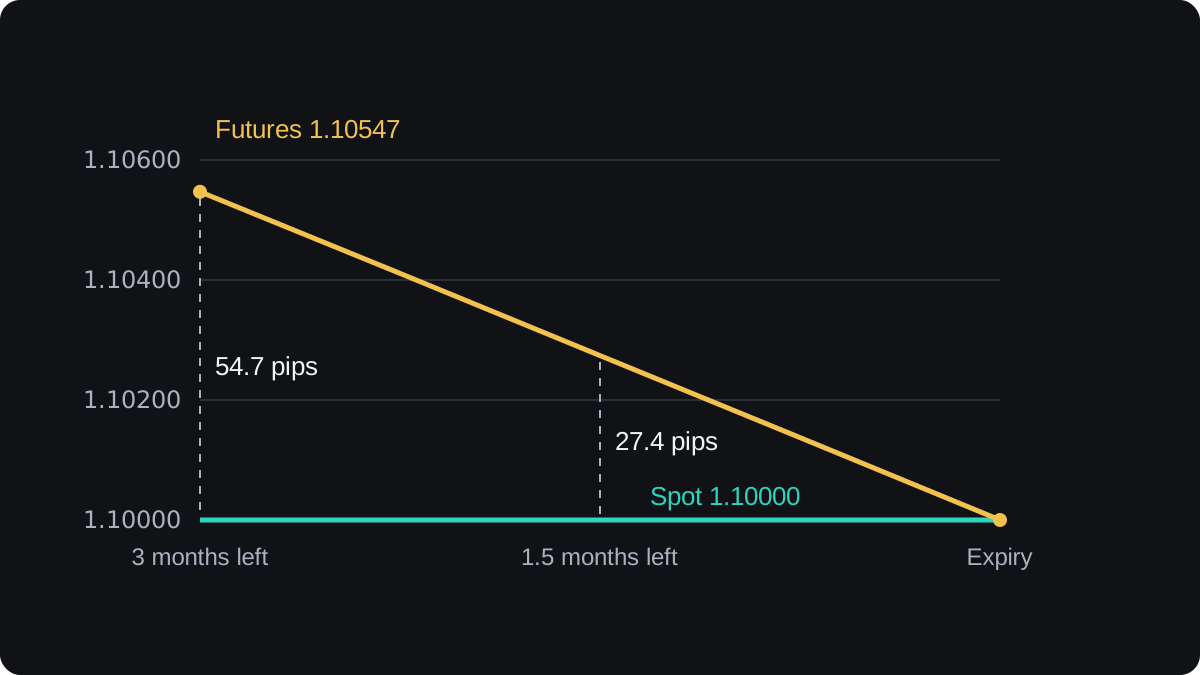
This is how futures carry the cost of holding a position. A spot trader pays or earns swap each night, while a futures trader pays or earns it through the price as the gap closes.
In this example a buyer is on the paying side either way. The long future drifts down toward spot, and a long spot position would pay swap because the euro rate is the lower one.
In theory the two costs come out close. In practice a broker's swap often includes its own charge on top of the interest gap, so compare both if you plan to hold for weeks.
How do margin and daily settlement work?
Both products use margin, a deposit that lets you control a position larger than your cash. The margin trading lesson explains it in full.
With a forex broker, margin follows the leverage on your account. Your profit or loss floats until you close the trade.
On an exchange, the exchange sets an initial margin per contract and can raise it when prices become more volatile. Your futures broker may ask for more than the exchange minimum.
If your account falls below the maintenance margin, a lower level, you must add money or the position may be closed.
Futures also settle daily: the day's gain or loss against the exchange's settlement price moves in or out of your account in cash. This is called marking to market.
Here is the earlier one-contract trade held over three days. Each day's cash is the price change times 125,000 euros.
| Step | Price | Change | Cash that day |
|---|---|---|---|
| Entry | 1.10000 | ||
| Day 1 settlement | 1.10200 | +0.00200 | +$250 |
| Day 2 settlement | 1.09900 | -0.00300 | -$375 |
| Day 3, closed | 1.10500 | +0.00600 | +$750 |
| Total | +0.00500 | +$625 |
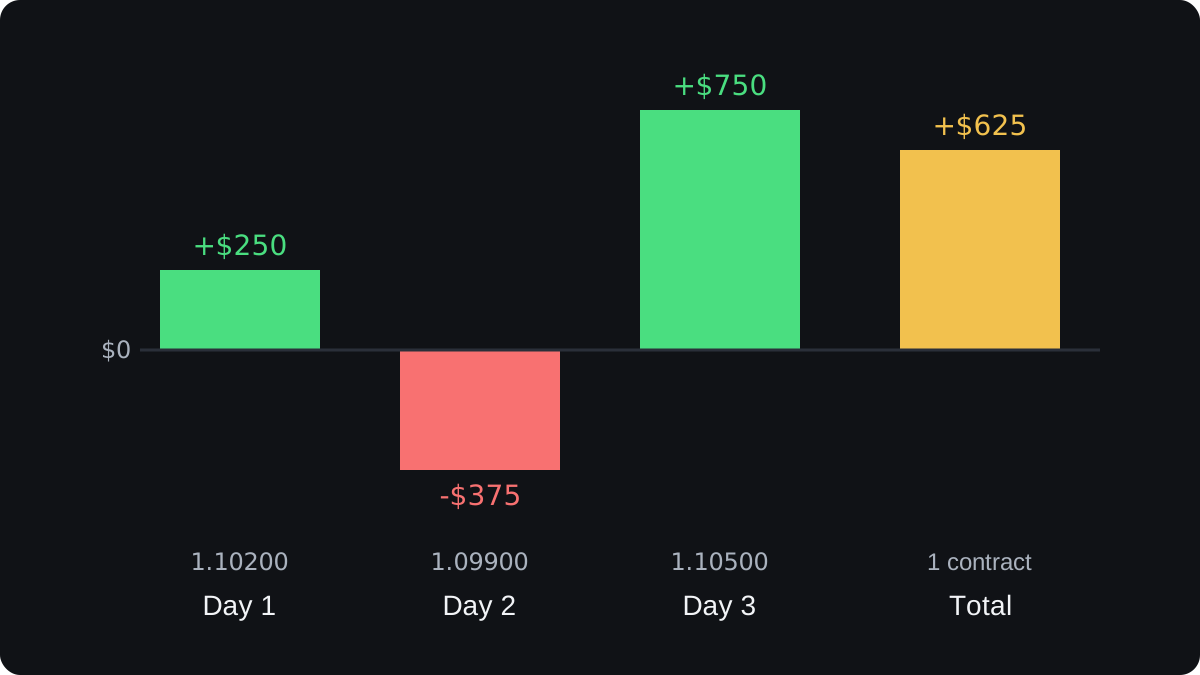
The total matches the spot trade. On Day 2, though, $375 really left the account, so a futures trader needs spare cash for losing days even when the trade ends in profit.
How do costs, hours and quotes compare?
Spot forex costs come as a spread, sometimes plus a commission per lot. Futures costs come as the spread in the order book plus exchange fees and the broker's commission, charged per contract.
Neither is cheaper in every case. Add up a full round trip at the size you actually trade, including swap or roll costs, as the cost of one trade lesson shows.
Quotes can look different too. Some exchanges quote currency futures in US dollars per unit of the other currency, so a yen future shows a small number such as 0.0066667 when USD/JPY is at 150.00.
Buying that yen future gains if the yen rises, which is the same direction as selling USD/JPY.
Spot forex trades around the clock from Monday morning in Asia to Friday evening in New York. Futures follow the exchange's own session times, listed in its contract specification.
| Feature | Spot forex and CFDs | Currency futures |
|---|---|---|
| Where it trades | Over the counter, with a broker | On an exchange, centrally cleared |
| Size | Flexible, often from 0.01 lot | Whole contracts of fixed size |
| Expiry | None, rolled each night | Fixed dates, rolled by you |
| Holding cost | Swap each night | Built into the price |
| Margin | Set by your account leverage | Set by the exchange, settled daily |
| Volume data | No central figure | Published by the exchange |
常見問題
Is forex or futures better for beginners?
It depends on your account size and goals. Spot forex allows much smaller positions, while futures offer central clearing and public volume but need more money per contract.
Do currency futures charge swap?
No overnight swap is charged on a future. The interest difference sits inside the futures price and shows up as the gap to spot shrinking toward expiry.
What happens if I hold a currency future until expiry?
It is settled under the contract's rules, by delivery of the currencies or in cash. If you want neither, close or roll the position before the last trading day.
Are forex CFDs the same as futures?
No. A forex CFD is a private contract with your broker, usually with no expiry, while a future is a standard exchange contract with a fixed size and date. Some brokers also offer CFDs priced from futures contracts, and those usually expire.
繼續學習
 第 5 章Why do people trade forex?People trade forex because the market runs around the clock from Sunday evening to Friday evening, New York time, major pairs are liquid with usually narrow spreads, and selling a pair you expect to fall is as simple as buying one you expect to rise. Small trade sizes and leverage add access, and leverage also makes losses larger.
 第 5 章Forex vs stocks: what is the difference?Stocks are shares in single companies, traded on exchanges with fixed hours. Forex is the trading of one currency against another, over the counter, about 24 hours a day on weekdays. Forex accounts usually offer more leverage and charge or pay overnight swap. Currency prices follow two economies at once, while a share price follows one company.

