What are the best days of the week to trade forex?
Forex opens around 17:00 New York time on Sunday and closes at the same time on Friday. Monday's first hours are often thin and can gap. Tuesday to Thursday are often busier, with many scheduled releases. Friday afternoons thin out before the close. No day is best for everyone, so check your own pairs.
Konten ini baru tersedia dalam bahasa Inggris.

Forex trades through the night, but it stops for the weekend. The market opens on Sunday evening New York time and closes on Friday evening, and each day in between has its own habits.
Which day suits you depends on the pairs you trade and how long you hold a position. The differences between days are often smaller than the differences between hours, which the best time of day lesson covered.
When does the forex trading week start and end?
Forex has no central exchange, so the week starts when banks in the Asia-Pacific region begin dealing. By convention, the retail week opens at about 17:00 New York time on Sunday, which is already Monday morning in Wellington and Sydney.
It closes at about 17:00 New York time on Friday. In UTC both moments fall at 21:00 or 22:00, depending on whether US daylight saving time is in force.
Between those two points the market runs around the clock, as the trading sessions hand over from Asia through Europe to North America.
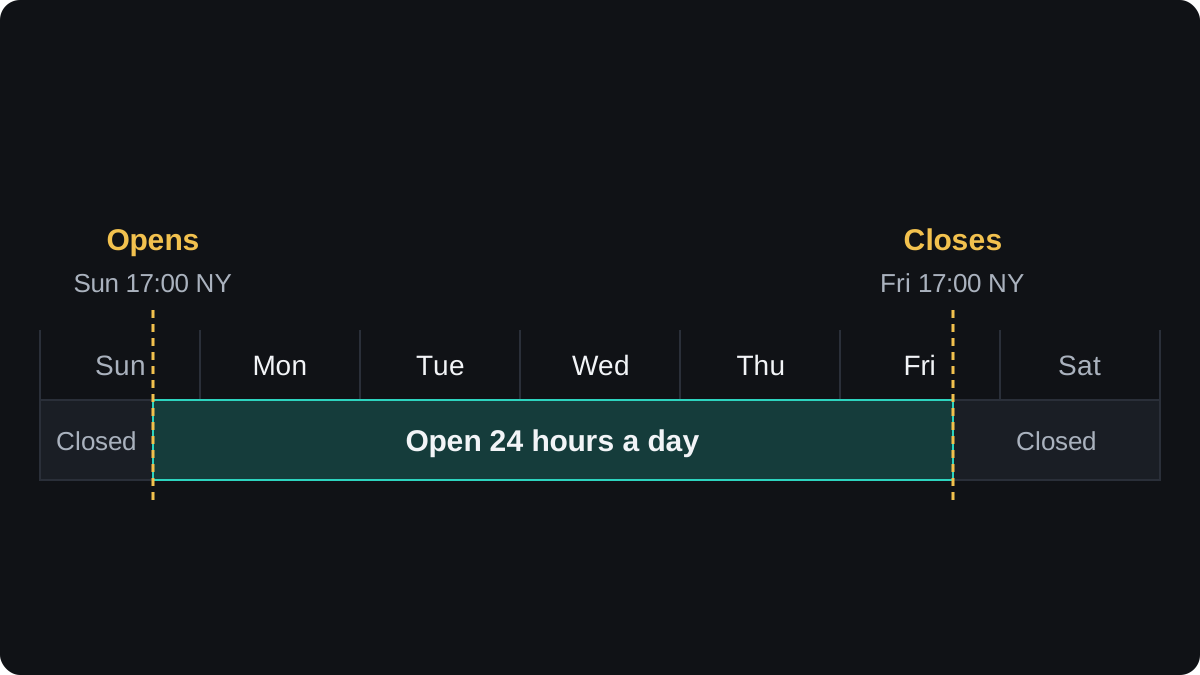
Your platform may show different clock times, because each broker sets its own server time. The market hours tool converts the open and close into your local time.
Each weekday also passes through the daily rollover at 17:00 New York time, when one trading day ends and the next begins. Spreads often widen for a few minutes around it.
Why is Monday often slow, and what is a weekend gap?
The first hours of the week belong to Wellington and Sydney, with Tokyo joining later. Fewer banks are dealing, so prices tend to move less and spreads can be wider than later in the week.
Monday usually becomes a normal trading day once London opens. The main risk at the Sunday open itself is a gap.
A gap is a jump between Friday's last price and the first price of the new week. It happens because news keeps coming at the weekend.
An election result or a policy announcement can change what a currency is worth while the market is shut. The new price then appears all at once when trading resumes.
Here is what a gap does to a trade held over the weekend. The prices are illustrative, and the spread is left out to keep the sums simple.
- You buy 0.50 lot of EUR/USD at 1.10000 on Friday, with a stop loss at 1.09800.
- On 0.50 lot, which is 50,000 euros, one pip is 50,000 × 0.0001 = $5.00.
- The stop is 1.10000 minus 1.09800 = 0.00200 away, which is 20 pips. Your planned loss is 20 × $5.00 = $100.00.
- Friday closes at 1.10000. Bad news hits the euro over the weekend, and Monday's first price is 1.09600.
- Your stop triggers, but no prices were quoted between 1.09800 and 1.09600, so it fills at about 1.09600, or worse.
- The loss is 1.10000 minus 1.09600 = 0.00400, which is 40 pips. Your actual loss is 40 × $5.00 = $200.00.
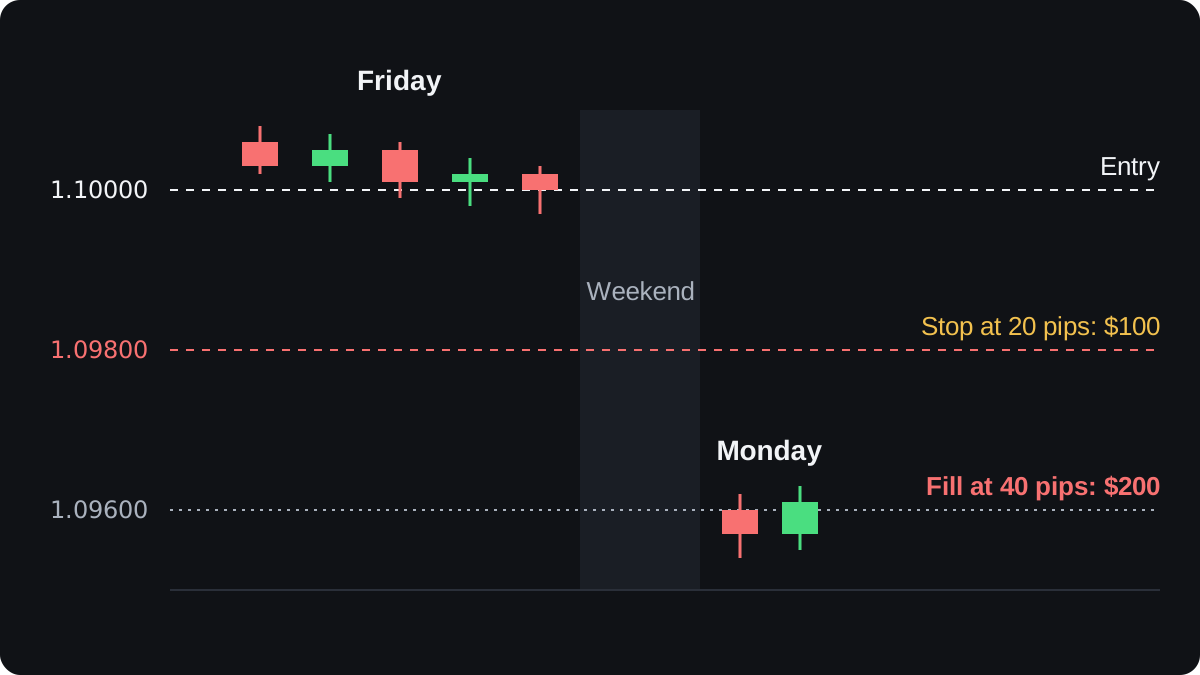
A stop order can only fill at prices the market actually reaches. The difference between your stop and the fill is a form of slippage.
Gaps can also run in your favour, but you cannot choose the direction in advance. Holding over the weekend means accepting a loss that can be larger than the distance to your stop.
Why are Tuesday to Thursday often called the best days?
A common rule of thumb names Tuesday to Thursday as the best days to trade. The reasoning is that every major centre is fully at work, with no weekend on either side to thin the market.
The evidence for a strong weekday pattern is loose. A single big surprise on a Monday or Friday can make that day the busiest of the week.
Scheduled events do tend to cluster midweek. The US Federal Reserve usually announces rate decisions on a Wednesday and the European Central Bank on a Thursday. The economic calendar shows the actual dates, which can shift.
Wednesday matters for another reason if you hold trades overnight. At each 17:00 rollover, an open position pays or earns swap, based on the interest rate difference between the two currencies.
Many brokers charge or pay three days of swap at Wednesday's rollover. A spot deal settles two business days later, so rolling from Wednesday to Thursday moves settlement from Friday across the weekend to Monday.
Take an illustrative swap charge of $6.00 per lot per night on a long position. On 0.50 lot that is 0.50 × $6.00 = $3.00 a night. You open on Monday morning and close just before Friday's rollover:
- The Monday, Tuesday and Thursday rollovers charge one night each: 3 × $3.00 = $9.00.
- The Wednesday rollover charges three nights: 3 × $3.00 = $9.00.
- The total is 6 nights, $9.00 + $9.00 = $18.00. Closing before Friday's rollover means no charge for that night.
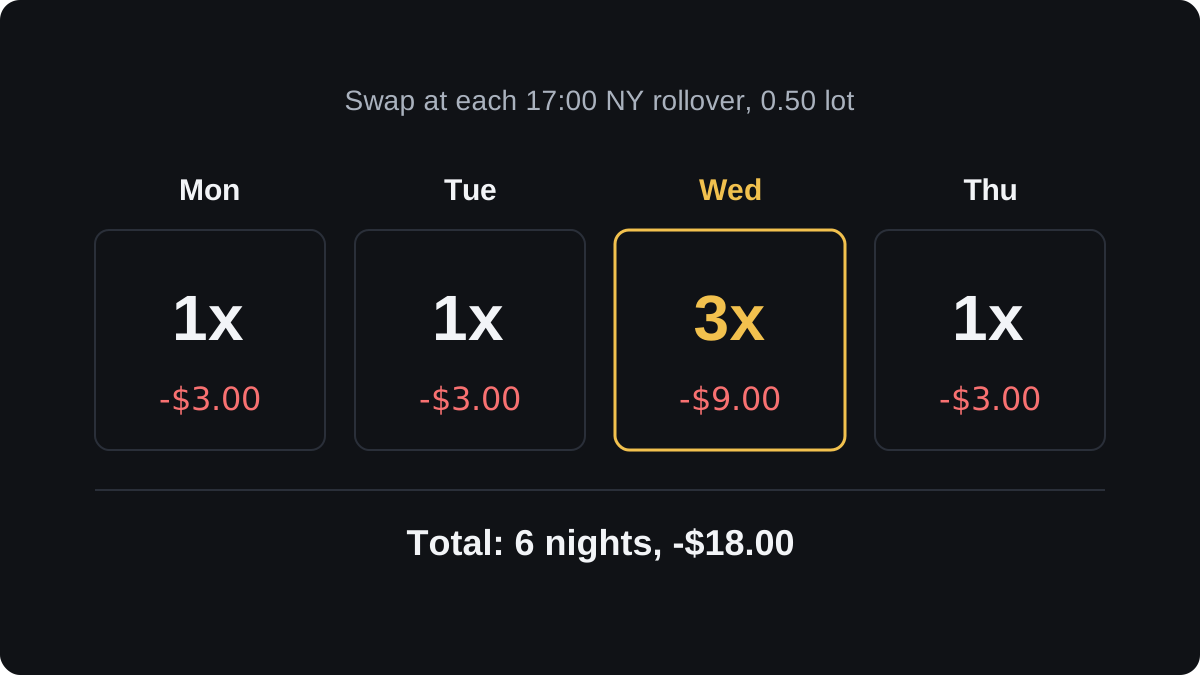
Real swap rates change with interest rates and can be a credit instead of a charge. Some brokers apply the triple day on Friday for certain instruments, so read the contract specification for each one you hold.
What happens on Friday and over the weekend?
Friday morning often trades like any other weekday. On the first Friday of most months, the US jobs report, called nonfarm payrolls, comes out at 8:30 New York time and can move dollar pairs sharply.
Activity usually fades in the New York afternoon. Asian and European banks have finished for the week, and traders who want no weekend risk close their positions.
That leaves thinner liquidity near the close, so spreads may widen and prices can jump on smaller orders. Anything still open at 17:00 then carries the weekend gap risk from the Monday example.
Forex pairs cannot be traded on Saturday, though some brokers offer other instruments then, such as crypto CFDs. Public holidays thin the market in a similar way, for example the days between Christmas and New Year.
How can you find the best days for your own pairs?
You can test the weekday pattern on your own chart with a simple count. Open a daily chart and write down each day's range, the high minus the low, in pips. Then group the ranges by weekday and average them.
With made-up numbers for four weeks of EUR/USD, Monday ranges of 60, 45, 70 and 55 pips add up to 230 pips. The average is 230 ÷ 4 = 57.5 pips.
Tuesday ranges of 80, 75, 90 and 85 pips add up to 330 pips, an average of 330 ÷ 4 = 82.5 pips. Four weeks is far too few to trust, so use several months and leave out holiday weeks.
Check how your broker draws daily candles before you count. If its server day does not end at 17:00 New York time, the chart can show a small Sunday candle that distorts the averages.
A wider average range means a pair moves more on that day, which also means larger swings against you. The count shows when a pair is active, and it says nothing about which way the price will move.
Pertanyaan
Is Monday a bad day to trade forex?
Monday is not a bad day as a rule. The first hours after the Sunday open are often thin and can gap, but trading usually looks normal once London opens.
What is the best day of the week to trade forex?
No day is best for every pair or style. Tuesday to Thursday are often more active, but the average daily range on your own pairs and the week's economic calendar give a better answer.
Should I close my trades before the weekend?
That is a choice for your trading plan. A position held over the weekend can gap past its stop loss, so the possible loss can be larger than the stop distance suggests.
Why is swap charged three times on Wednesday?
Spot trades settle two business days later. Rolling a position from Wednesday to Thursday moves its settlement across the weekend, so many brokers charge or pay three days of swap at Wednesday's rollover.
Can you trade forex on Saturday or Sunday?
Forex pairs do not trade on Saturday. The market reopens around 17:00 New York time on Sunday, which is already Monday morning in the Asia-Pacific region.
Lanjut belajar
 Bab 3What are the forex trading sessions?The forex day runs in four overlapping sessions named after Sydney, Tokyo, London and New York, each following that city's working hours. Together they cover 24 hours from Monday morning in Asia to Friday evening in New York. The busiest stretch is usually the four hours when London and New York are both open.
 Bab 3The Tokyo session: hours and what moves.The Tokyo session is the Asian part of the forex day, roughly 00:00 to 09:00 UTC. Japan does not use daylight saving time, so those hours stay fixed all year. Yen pairs and the Australian and New Zealand dollars are most active, and ranges on European pairs are often smaller than in London.
 Bab 3The London session: hours and what moves.The London session is usually the busiest part of the forex day. By common convention it runs from 08:00 to 17:00 London time, which is 08:00 to 17:00 UTC in winter and 07:00 to 16:00 UTC in summer. Euro, pound and Swiss franc pairs tend to move most, and the overlap with New York usually lasts four hours.
 Bab 3The New York session: hours and what moves.The New York session runs from about 08:00 to 17:00 New York time, which is roughly 13:00 to 22:00 UTC in winter and 12:00 to 21:00 UTC in summer. Its first four hours overlap London, usually the busiest stretch of the day. Much of the major US data comes out at 08:30 New York time.
 Bab 3What is the best time of day to trade forex?For most major pairs the best conditions come when London and New York are both open, about 12:00 to 16:00 UTC in the northern summer and 13:00 to 17:00 UTC in winter. Liquidity is deepest and spreads are usually tightest then, although big US data releases also land in that window.

