What is the best time of day to trade forex?
For most major pairs the best conditions come when London and New York are both open, about 12:00 to 16:00 UTC in the northern summer and 13:00 to 17:00 UTC in winter. Liquidity is deepest and spreads are usually tightest then, although big US data releases also land in that window.
Konten ini baru tersedia dalam bahasa Inggris.

The forex market is open around the clock, from Monday morning in Asia to Friday evening in New York. The hours are far from equal, though.
At some times a pair moves in small, cheap steps, and at others it drifts and costs more to trade.
The busiest stretch for most major pairs is the few hours when London and New York are both open. It usually brings the deepest liquidity and the tightest spreads, and many major US data releases come out inside it.
Why does the time of day matter?
Picture EUR/USD at 03:00 UTC. Most European and American banks are closed, so fewer dealers are quoting the pair and each quote covers a smaller amount.
Liquidity is how much buying and selling a market can absorb without the price jumping. When it is deep, brokers can offer narrow spreads, and orders fill close to the price on your screen.
When liquidity is thin, the spread tends to widen and a single large order can push the price further. Ranges also tend to shrink, because fewer people have a reason to trade at that hour.
Activity follows the working day of the big financial centres. The trading sessions lesson split the day into Sydney, Tokyo, London and New York, and this lesson asks which of those hours give you the best conditions.
When do London and New York overlap?
An overlap is a stretch when two sessions are open at the same time. London is the largest forex trading centre and New York the second largest, so when both are active the most dealers are quoting.
A common convention treats each session as 08:00 to 17:00 local time, with Tokyo at 09:00 to 18:00. Converted to UTC, that gives these hours:
| Session | Local hours | UTC, northern summer | UTC, northern winter |
|---|---|---|---|
| Tokyo | 09:00 to 18:00 | 00:00 to 09:00 | 00:00 to 09:00 |
| London | 08:00 to 17:00 | 07:00 to 16:00 | 08:00 to 17:00 |
| New York | 08:00 to 17:00 | 12:00 to 21:00 | 13:00 to 22:00 |
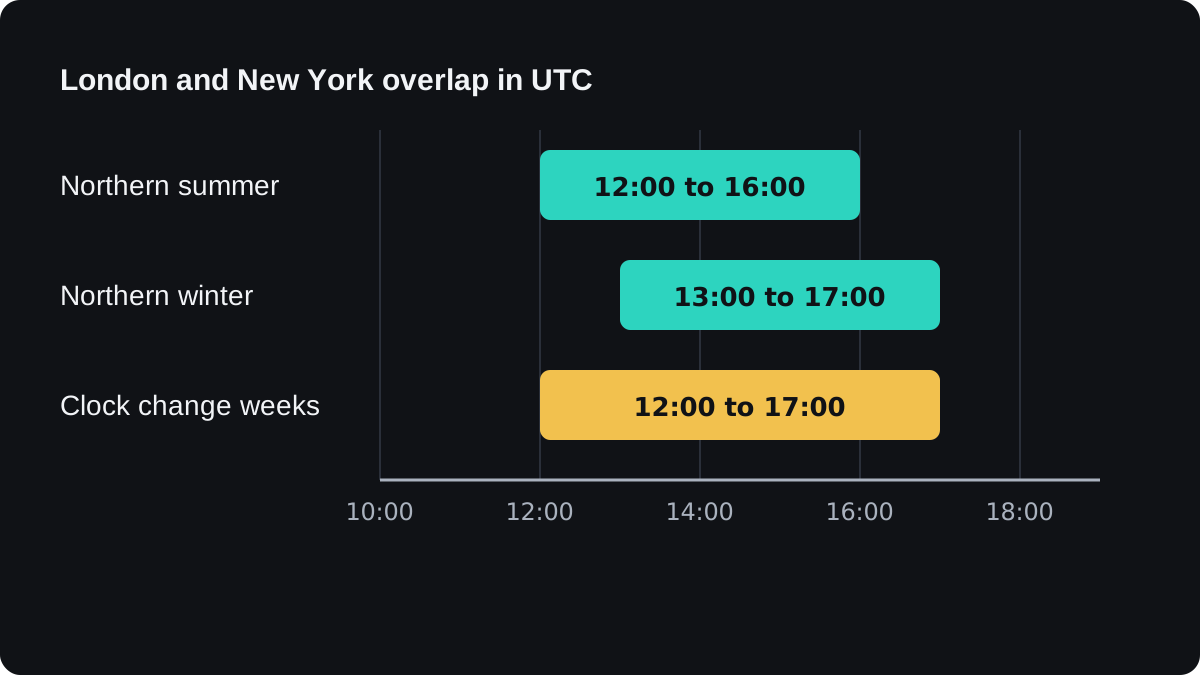
In the northern summer, when both cities use daylight saving time, London and New York overlap from 12:00 to 16:00 UTC. That gives four hours each weekday.
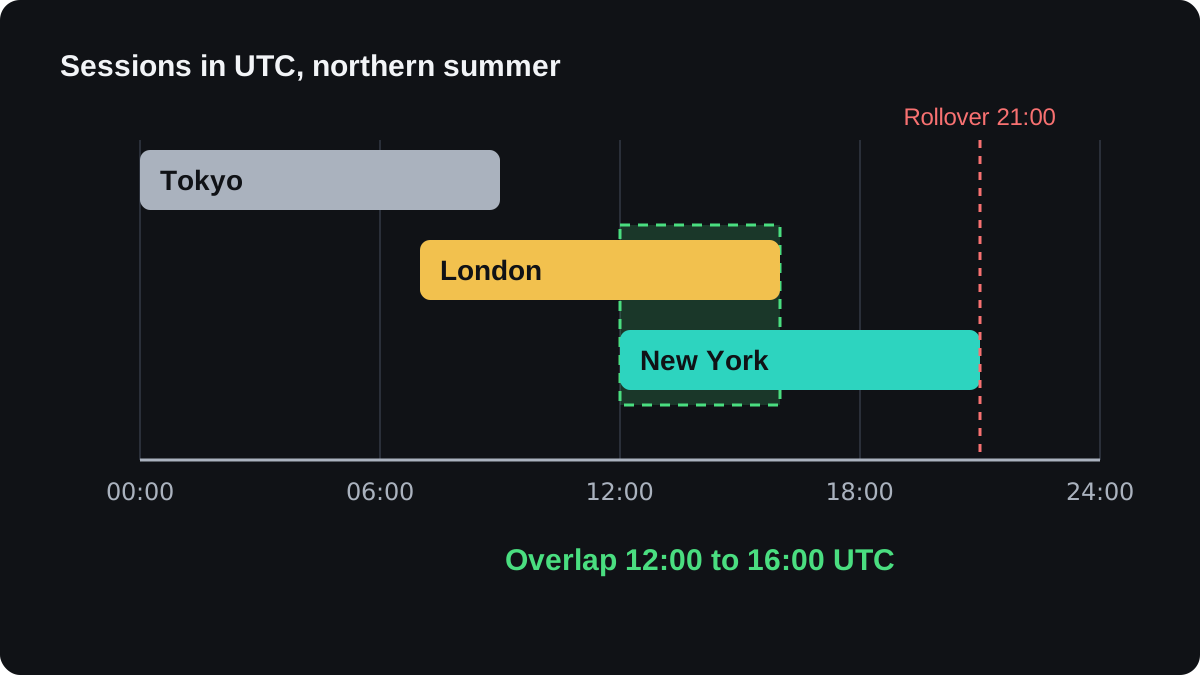
In the northern winter both cities put their clocks back one hour, so the overlap runs from 13:00 to 17:00 UTC. Japan does not change its clocks, so Tokyo's hours stay the same all year.
The United States and the United Kingdom change their clocks on different dates. For two or three weeks in March, and for about a week from late October, New York is on summer time while London is on winter time.
In those weeks the overlap stretches to about five hours, 12:00 to 17:00 UTC.
Brokers and websites draw these session edges slightly differently, so treat any session table as a guide to within about an hour.
Many major US releases, such as the monthly jobs report and consumer price data, come out at 08:30 New York time. That is 12:30 UTC in summer and 13:30 UTC in winter, inside the overlap.
At 16:00 London time a widely used benchmark rate, the London 4 p.m. fix, is set. Orders from funds and companies that deal at that rate can bring a burst of volume shortly before London winds down.
What happens in the other hours?
The Asian hours
From about 00:00 to 07:00 UTC, trading is led by centres such as Tokyo, Sydney, Singapore and Hong Kong. Euro and pound pairs often move in narrower ranges during these hours.
Pairs with the yen, the Australian dollar or the New Zealand dollar usually see more of their activity here, because local banks, companies and data releases are active then.
The Tokyo and London overlap
Tokyo and London share only a short window: about 07:00 to 09:00 UTC in the northern summer and 08:00 to 09:00 UTC in winter. The London open often brings a clear rise in activity on euro and pound pairs.
Late New York and the rollover
After London closes, New York trades on its own and activity usually fades through the afternoon. At 17:00 New York time one trading day ends and the next begins.
That moment is the rollover, when brokers charge or pay overnight swap on open positions. It falls at 21:00 UTC in the northern summer and 22:00 UTC in winter.
Liquidity is often at its thinnest around the rollover, and many brokers show much wider spreads for some minutes. For many pairs this is the most expensive time of day to open or close a trade.
How much can the hour change your cost?
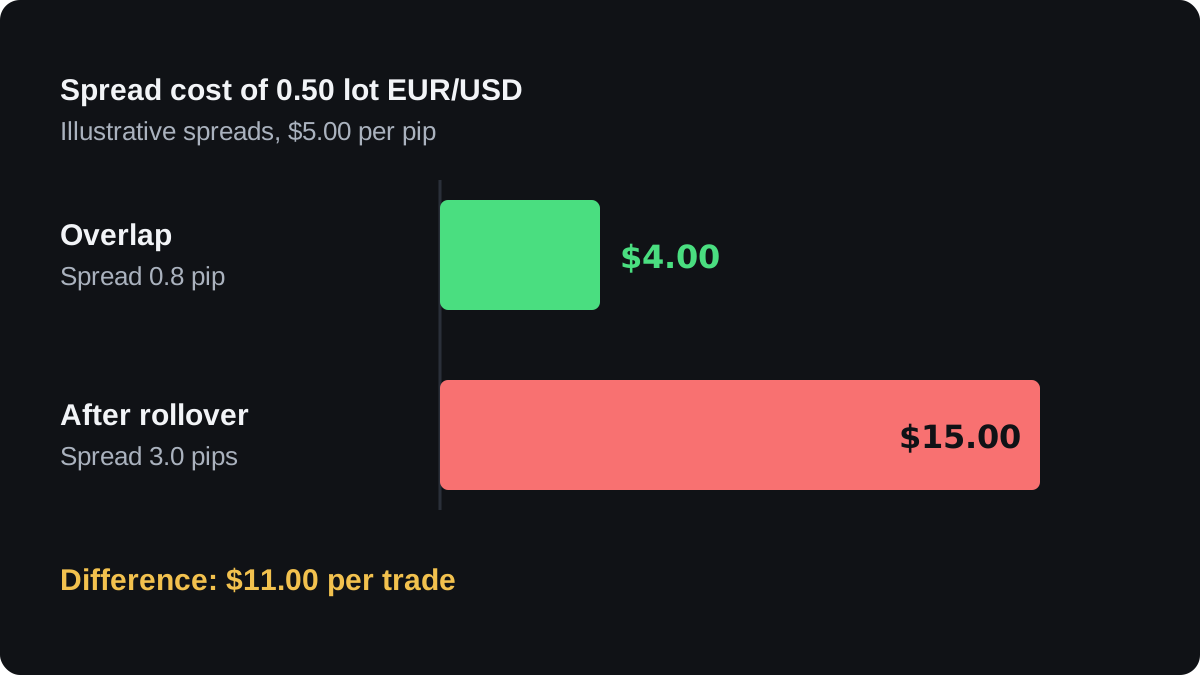
Take one trade of 0.50 lot of EUR/USD. One pip on 0.50 lot is 50,000 × 0.0001 = $5.00. The spreads below are round illustrative figures, chosen only to show the arithmetic.
- During the overlap the spread is 0.8 pip. The cost is 0.8 × $5.00 = $4.00.
- Just after the rollover the spread is 3.0 pips. The cost is 3.0 × $5.00 = $15.00.
- The same trade costs $15.00 minus $4.00 = $11.00 more at the quiet hour.
- Over 20 trades a month, that is 20 × $4.00 = $80.00 against 20 × $15.00 = $300.00, a gap of $220.00.
A wide spread can also close a trade you meant to keep. A stop loss on a short position is triggered by the ask price, while most charts show the bid.
So a sudden jump in the ask, with no move in the bid, can hit your stop although the chart line never touched it.
Your broker's real spreads will differ and change minute by minute. A simple check is to note the spread on the same pair at a busy hour and a quiet hour for a week, using a page such as live market rates.
Which hours suit which pairs?
As a rule of thumb, a pair tends to be most active when the home markets of both its currencies are open. That gives a rough map:
| Pair | Usually most active (UTC, northern summer) |
|---|---|
| EUR/USD, GBP/USD | 12:00 to 16:00, London and New York |
| EUR/GBP, EUR/CHF | 07:00 to 16:00, London hours |
| USD/JPY | 00:00 to 09:00 and 12:00 to 16:00 |
| AUD/JPY, AUD/NZD | 00:00 to 07:00, Asian hours |
| USD/CAD | 12:00 to 21:00, New York hours |
This map describes a habit of the market. Any pair can move sharply at any hour when unexpected news breaks.
How do you find your own trading window?
Suppose your clock runs at UTC+8 all year, with no daylight saving. Add 8 hours to each UTC time:
- Summer overlap: 12:00 to 16:00 UTC becomes 20:00 to midnight local time.
- Winter overlap: 13:00 to 17:00 UTC becomes 21:00 to 01:00 local time.
At UTC-3 all year you subtract 3 hours instead, which gives 09:00 to 13:00 in the northern summer and 10:00 to 14:00 in the northern winter. The market hours tool shows the sessions in your own time zone.
Busy hours make entering and leaving a trade cheaper. They do not make a strategy profitable, and the sharp moves after data releases fall in the same hours, so check the economic calendar first.
A method built for quiet hours, such as trading inside a narrow Asian range, depends heavily on the costs at those hours. Test any such idea with your own broker's spreads.
The best window is also one you can trade while alert. A tired session at 01:00 local time can cost more in mistakes than a slightly wider spread at a better hour.
Activity also changes across the week, from the Monday open to Friday afternoon, which is the subject of the best days to trade lesson.
Pertanyaan
What time is the London and New York overlap?
About 12:00 to 16:00 UTC when both cities are on summer time, and 13:00 to 17:00 UTC in the northern winter. For two or three weeks in March and about a week from late October it runs 12:00 to 17:00 UTC.
Is it bad to trade during the Asian session?
It depends on the pair. Yen, Australian and New Zealand dollar pairs are usually active then, while euro and pound pairs tend to move less, so check your broker's spreads at those hours.
Why do spreads widen at 5 p.m. New York time?
That is the daily rollover, when one trading day ends and the next begins. Fewer prices are quoted for a short time, so spreads at many brokers widen for some minutes.
Does the best time to trade depend on my time zone?
The busy hours are the same moment for everyone, so only your local clock time changes. Convert the UTC hours to your time zone and check again whenever daylight saving starts or ends.
Is the overlap the most profitable time to trade?
No hour guarantees profit. The overlap usually offers lower spreads and more movement, and more movement also means larger losses are possible when a trade goes against you.
Lanjut belajar
 Bab 3What are the forex trading sessions?The forex day runs in four overlapping sessions named after Sydney, Tokyo, London and New York, each following that city's working hours. Together they cover 24 hours from Monday morning in Asia to Friday evening in New York. The busiest stretch is usually the four hours when London and New York are both open.
 Bab 3The Tokyo session: hours and what moves.The Tokyo session is the Asian part of the forex day, roughly 00:00 to 09:00 UTC. Japan does not use daylight saving time, so those hours stay fixed all year. Yen pairs and the Australian and New Zealand dollars are most active, and ranges on European pairs are often smaller than in London.
 Bab 3The London session: hours and what moves.The London session is usually the busiest part of the forex day. By common convention it runs from 08:00 to 17:00 London time, which is 08:00 to 17:00 UTC in winter and 07:00 to 16:00 UTC in summer. Euro, pound and Swiss franc pairs tend to move most, and the overlap with New York usually lasts four hours.
 Bab 3The New York session: hours and what moves.The New York session runs from about 08:00 to 17:00 New York time, which is roughly 13:00 to 22:00 UTC in winter and 12:00 to 21:00 UTC in summer. Its first four hours overlap London, usually the busiest stretch of the day. Much of the major US data comes out at 08:30 New York time.
 Bab 3What are the best days of the week to trade forex?Forex opens around 17:00 New York time on Sunday and closes at the same time on Friday. Monday's first hours are often thin and can gap. Tuesday to Thursday are often busier, with many scheduled releases. Friday afternoons thin out before the close. No day is best for everyone, so check your own pairs.

