Margin call and stop out example: 100% and 50%.
In this example a $2,000 account buys 1 lot of EUR/USD at 1.10000 with $1,100 of used margin. The margin call at 100% arrives when equity falls to $1,100, 90 pips lower at 1.09100. The stop out at 50% closes the trade when equity reaches $550, at 1.08550, a loss of $1,450.
ខ្លឹមសារនេះមានតែជាភាសាអង់គ្លេសសិន។

The previous lesson followed a broker with a single trigger at 100%. Many brokers use two levels instead: a margin call that warns you, and a stop out that closes your trades.
Below, one account goes through both levels, and every number can be redone by hand.
What does the example account look like?
All figures here are illustrative and chosen so the arithmetic is easy to check. Your broker's leverage and trigger levels may be different.
- Account: $2,000 balance, held in US dollars
- Leverage: 1:100, so the margin is 1% of the trade's value
- Trade: buy 1 standard lot of EUR/USD at 1.10000
- Broker rules: margin call at 100% margin level, stop out at 50%
Four numbers come out of this setup:
- One lot is 100,000 euros. At 1.10000 its value is 100,000 × 1.10000 = $110,000.
- Used margin is $110,000 ÷ 100 = $1,100.
- A pip on 1 lot of EUR/USD is 0.0001 × 100,000 = $10.
- At entry, margin level is $2,000 ÷ $1,100 × 100 = 181.8%.
Spread, commission and swap are left out. Used margin is held at $1,100 throughout. A platform that recalculates it at the current price would move the trigger prices in this example by less than one pip.
How does margin level fall as EUR/USD drops?
Margin level is equity divided by used margin, times 100. Equity is your balance plus the floating profit or loss of open trades. The balance stays at $2,000 until the trade closes.
Every pip down costs $10 of equity. Used margin does not move, so margin level falls in a straight line with the price.
| EUR/USD | Floating P/L | Equity | Free margin | Margin level | Status |
|---|---|---|---|---|---|
| 1.10000 | $0 | $2,000 | $900 | 181.8% | Normal |
| 1.09500 | -$500 | $1,500 | $400 | 136.4% | Normal |
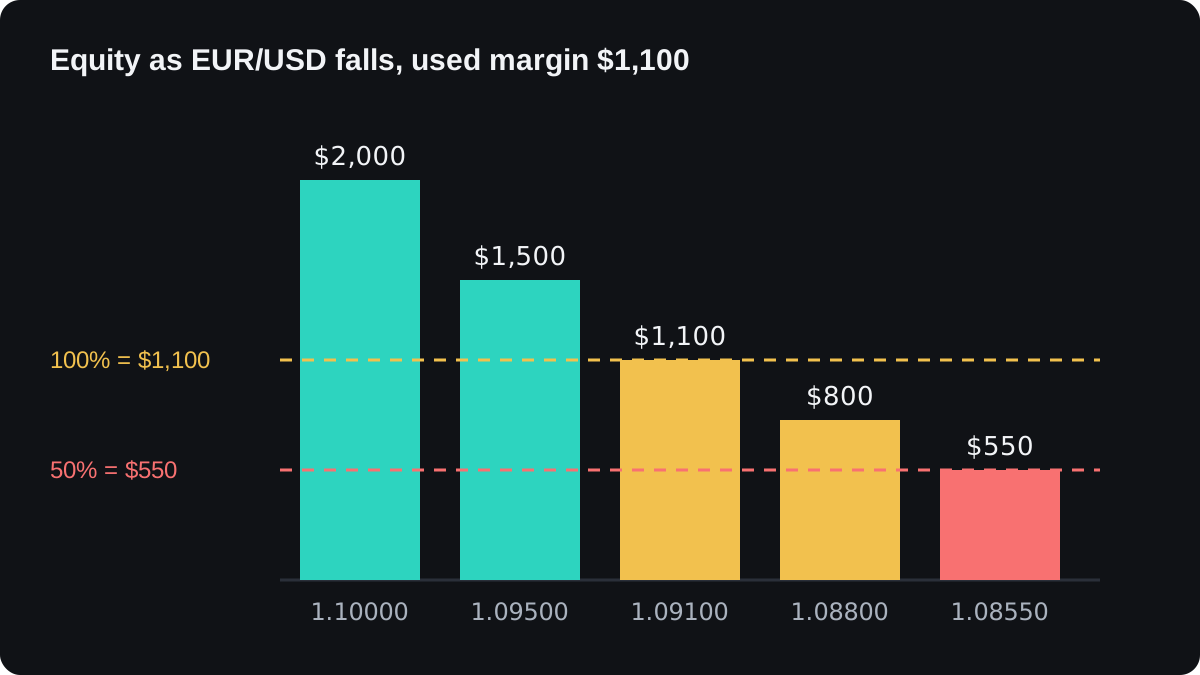
| 1.09100 | -$900 | $1,100 | $0 | 100.0% | Margin call |
| 1.08800 | -$1,200 | $800 | -$300 | 72.7% | No new trades |
| 1.08550 | -$1,450 | $550 | -$550 | 50.0% | Stop out |
Free margin is equity minus used margin. It reaches zero at the margin call and turns negative after it, which is why the last two rows show minus $300 and minus $550.
Drawn as bars, equity shrinks toward two fixed lines. The 100% line is equity of $1,100, equal to used margin. The 50% line is $550, half of it.
Where do the margin call and stop out prices sit?
You can find both prices before you open the trade. Work backwards from the equity each trigger needs.
The margin call at 100% fires when equity equals used margin, $1,100. The account can lose $2,000 minus $1,100 = $900 first. At $10 a pip that is 90 pips, so the price is 1.10000 minus 0.00900 = 1.09100.
The stop out at 50% fires when equity is half the used margin, $550. The loss allowed is $2,000 minus $550 = $1,450, which is 145 pips. The price is 1.10000 minus 0.01450 = 1.08550.
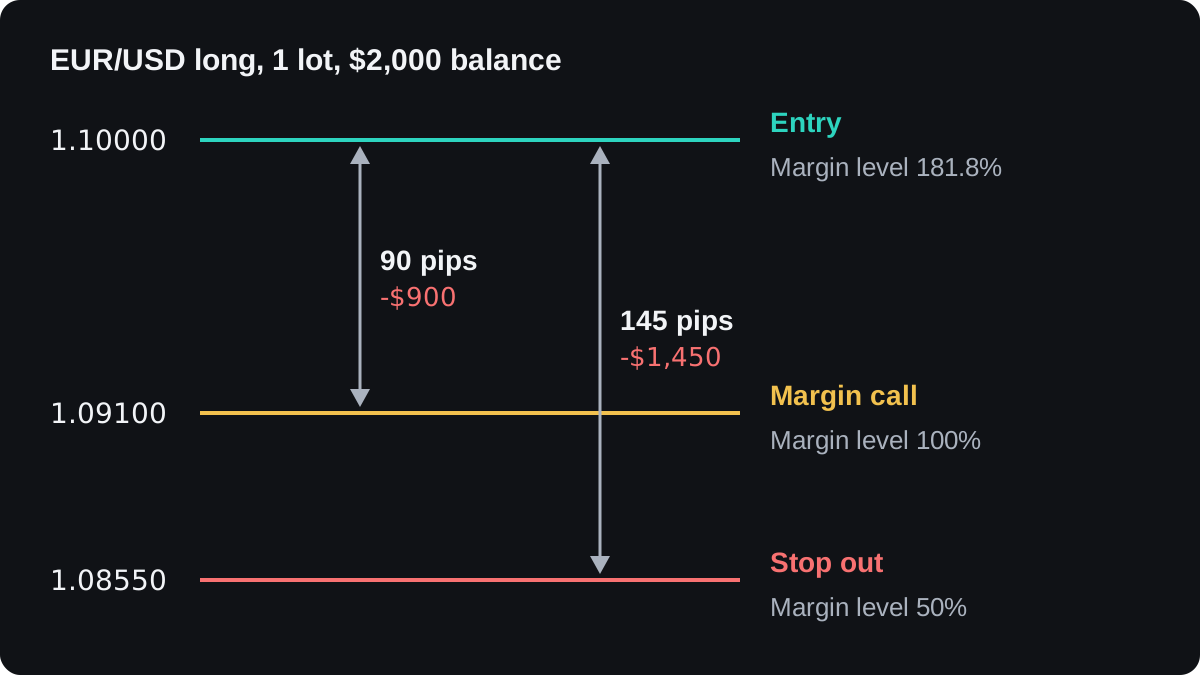
Between the warning and the forced close, this account has 145 minus 90 = 55 pips of room.
The same rule works for any level. Multiply the trigger level by used margin, subtract the result from your balance, then divide by the pip value to get the pips from entry.
The margin calculator gives used margin for other pairs and trade sizes. The same subtraction then gives their trigger prices.
What happens between 100% and 50%?
The margin call is a warning. On many platforms the margin level figure changes colour or a message appears, and some brokers also send an email. With these rules, nothing is closed at 100%.
Take the price at 1.08800. Equity is $800, margin level is 72.7% and free margin is minus $300. With free margin below zero, the platform refuses any new trade that needs margin.
You can still close trades or deposit money. If the price recovers above 1.09100, the margin level climbs back over 100% by itself.
At 1.08550 the stop out level is reached and the broker closes the trade at market. The $1,450 loss becomes realized, the balance drops to $550, used margin goes to zero and free margin becomes $550.
How can you give the trade more room?
Suppose the price sits at 1.08800, with margin level at 72.7%. Two common responses both push the stop out price lower, at different costs.
Deposit $500
- Balance rises to $2,500 and equity to $1,300.
- Margin level becomes $1,300 ÷ $1,100 × 100 = 118.2%, back above the margin call.
- The stop out still needs equity of $550, so the loss allowed is $2,500 minus $550 = $1,950.
- That is 195 pips from entry, a stop out price of 1.08050.
Close half the position
- Selling 0.5 lot at 1.08800 locks in 120 pips × $5 = $600 of loss. Balance becomes $1,400.
- The remaining 0.5 lot needs $550 of margin and shows a floating loss of $600, so equity is $800.
- Margin level is $800 ÷ $550 × 100 = 145.5%.
- Stop out now needs equity of $275. The loss allowed is $1,400 minus $275 = $1,125, which at $5 a pip is 225 pips from entry, a price of 1.07750.
Side by side, closing half gives the most room in pips. It also turns $600 of floating loss into a realized loss, while the deposit puts $500 more at risk on the same trade.
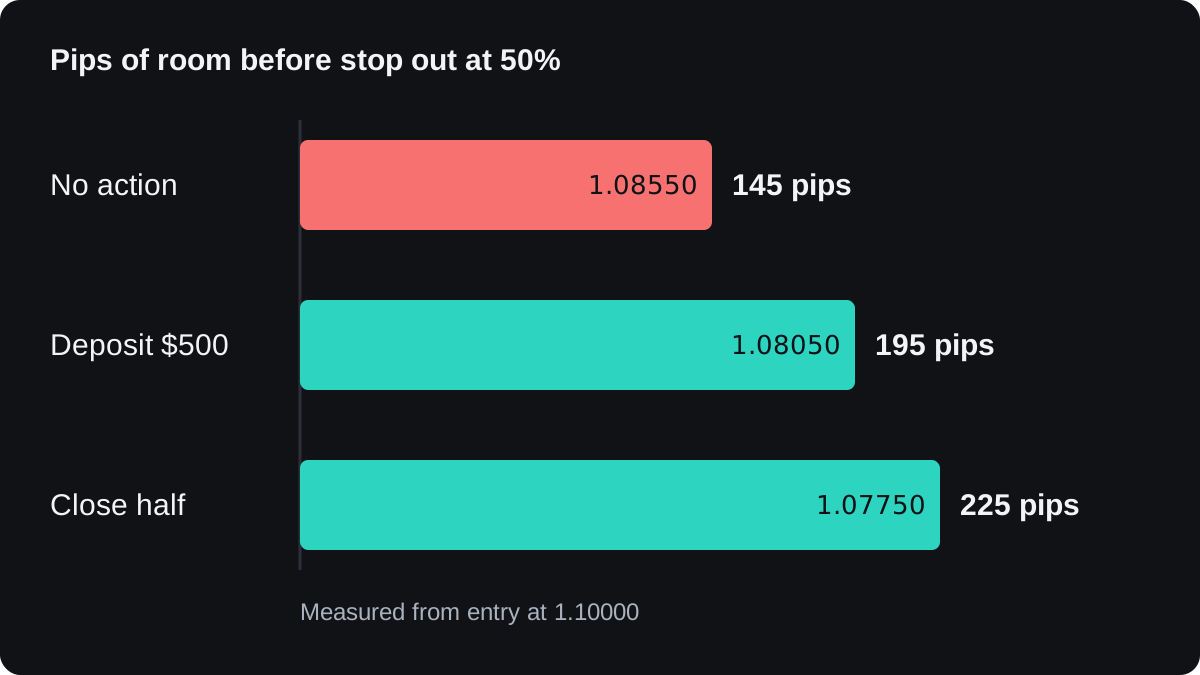
If EUR/USD keeps falling, both choices only move the point where the loss stops. The lesson on how to avoid a margin call covers sizing a trade so the account never gets this close.
Can a stop out happen below 50%?
Yes. The 50% figure triggers the close, and the broker then fills the order at the next price it can get. In a fast market or after a weekend, that price can be well past 1.08550.
Say EUR/USD closes on Friday at 1.08700. Equity is $700 and margin level is 63.6%, so nothing is closed. On Monday the market opens at 1.08300.
- The broker closes the trade at 1.08300, the first available price.
- The move from entry is 170 pips, so the loss is 170 × $10 = $1,700.
- The balance left is $300. At the fill, that equity was only 27.3% of the $1,100 used margin.
A fill worse than the expected price is a form of slippage. A large enough gap can push equity below zero. Whether the broker resets a negative balance to zero depends on the broker and where your account is held, so read its terms.
With several trades open, a stop out usually closes them one at a time and rechecks margin level after each close. Many brokers start with the trade showing the largest loss, and each broker's terms give the exact order.
The next lesson applies the same arithmetic to an account that starts with $100.
សំណួរ
What is the difference between a margin call and a stop out?
A margin call is a warning when margin level falls to a set point, 100% in this example. A stop out is the level where the broker starts closing your trades, 50% here.
Does my broker close my trades at the margin call?
With the rules in this example, no. At 100% you get a warning and cannot open new trades, and closing starts only at 50%. Some brokers use one level for both, as the previous lesson showed.
How do I work out my stop out price?
For a single open trade, multiply the stop out level by used margin to get the equity at stop out. Subtract that from your balance, divide by the pip value, and count that many pips against your trade from the entry price.
Can I lose more than my deposit with a 50% stop out?
It is possible if the price gaps far past the stop out level before the broker can close. Some brokers offer negative balance protection that resets the balance to zero, so check whether yours does.
បន្តរៀន
 ជំពូក 6What is margin trading?Margin trading means opening a position worth more than the money in your account. The broker sets aside part of your balance, the margin, as a deposit while the trade is open. Profit and loss are counted on the full position size, so small price moves change your balance much faster than the margin suggests.
 ជំពូក 6What is account balance in forex?Your account balance is the money in your trading account from deposits, withdrawals and closed trades, after booked costs such as commission and swap. It does not include open positions. While a trade is open the balance stays the same, and the floating profit or loss shows up in your equity instead.
 ជំពូក 6What is floating (unrealized) profit and loss?Floating profit and loss is the result your open trades would show if you closed them at the current price. It changes with every tick and moves your equity, while your balance stays the same. It becomes realized, and is added to or taken from your balance, only when the trade closes.
 ជំពូក 6Margin, កម្រិត Margin និង Stop out ក្នុង Forex ជាអ្វី?Margin គឺជាផ្នែកនៃប្រាក់របស់អ្នក ដែល Broker ចាក់សោទុកជាប្រាក់តម្កល់ ខណៈការជួញដូរប្រើ Leverage កំពុងបើក។ កម្រិត Margin គឺ Equity ចែកនឹង Margin ដែលបានប្រើ គុណនឹង 100%។ ពេលវាធ្លាក់ដល់កម្រិត Margin call របស់ Broker គណនីរបស់អ្នកនឹងត្រូវបានសម្គាល់ ហើយនៅកម្រិត Stop out Broker ចាប់ផ្តើមបិទ position របស់អ្នកដោយស្វ័យប្រវត្តិ។
 ជំពូក 6What is used margin?Used margin is the total amount your broker sets aside to keep all your open positions open. Each position's margin is its notional value divided by your leverage, and used margin adds them up. It is not a fee: the money returns to free margin when you close the trades.
 ជំពូក 6What is equity in a trading account?Equity is your account balance plus or minus the floating profit or loss of your open trades. It shows what the account would be worth if you closed everything at current prices. With no trades open, equity equals balance. Brokers use it to work out free margin, margin level and stop outs.
 ជំពូក 6What is free margin?Free margin is the money in your trading account that is not locked up as margin for open trades. It equals equity minus used margin. You need free margin to open new positions, and it falls as open trades lose and rises as they gain. At zero, your margin level is 100%.
 ជំពូក 6What is margin level?Margin level is your equity divided by your used margin, multiplied by 100 and shown as a percentage. It tells you how much cushion your open trades have. At 100%, equity equals used margin and free margin is zero. Brokers set their margin call and stop out levels on this number, and the levels differ between brokers.
 ជំពូក 6What is a margin call?A margin call is your broker's warning that your margin level, equity divided by used margin, has fallen to a set threshold such as 100%. You usually cannot open new trades from that point. The call closes nothing by itself. If losses continue, the broker's stop out level is where positions start to be closed for you.
 ជំពូក 6What is a stop out level?The stop out level is the margin level at which your broker starts closing your open positions automatically, often beginning with the largest loss. If your stop out level is 50%, closing begins when equity falls to half your used margin. It is meant to stop your account sinking further, though a price gap can still push it below zero.
 ជំពូក 6Margin call example: margin call at 100% with no separate stop out.When a broker sets the margin call and the stop out both at 100%, the warning and the forced close happen at the same moment. In this example, a $1,000 account buys 0.50 lot of EUR/USD with $550 of margin at 1:100, and the trade is closed after a 90 pip fall, a $450 loss.
 ជំពូក 6What happens if you trade forex with $100?With $100 and 1:100 leverage, 0.01 lot of EUR/USD at 1.10000 uses $11 of margin and can move about 890 pips against you before a 100% margin call. At 0.05 lot the margin call comes after 90 pips, and 0.10 lot cannot be opened at all. Trade size decides how much room you have.
 ជំពូក 6Why margin call and stop out levels differ between brokers.Margin call and stop out levels are set by each broker, often per account type, within any rules from the regulator that licenses the account. In this lesson's example, one trade is closed after 90 pips at one broker and after 178 pips at another, so look up your own levels before you trade.
 ជំពូក 6Leverage ក្នុង Forex ជាអ្វី?Leverage អនុញ្ញាតឲ្យអ្នកគ្រប់គ្រង position ដែលធំជាងប្រាក់តម្កល់របស់អ្នកច្រើនដង។ នៅ 1:100 រាល់ Margin $1 កាន់រូបិយប័ណ្ណ $100 ដូច្នេះ position $110,000 ត្រូវការ $1,100។ Leverage កំណត់ថា Margin ប៉ុន្មានត្រូវបានចាក់សោទុក មិនមែនកំណត់ថា pip មួយមានតម្លៃប៉ុន្មានទេ។ ហានិភ័យពិតរបស់អ្នក មកពីទំហំ position ដែលអ្នកជ្រើស។
 ជំពូក 6Margin cheat sheet.Balance is the cash from deposits, withdrawals and closed trades. Equity is balance plus the floating profit or loss on open trades. Used margin is the deposit your open trades hold, and free margin is equity minus used margin. Margin level is equity divided by used margin, times 100. A margin call warns; a stop out closes trades.
 ជំពូក 6How can you avoid a margin call?Margin level is your equity divided by your used margin, and a margin call comes when it falls to your broker's threshold. To stay clear, keep positions small compared with your equity, set stop losses that close losing trades long before that point, and leave plenty of free margin unused.

