Red flags of a fake or unsafe forex broker.
A fake or unsafe forex broker usually shows itself in a few ways: no licence or a cloned one, promises of guaranteed profit, pressure to deposit, payments to personal or unrelated accounts, bonus terms that lock your money, and withdrawals that stall or need a fee paid first. Check the regulator's register and test a small withdrawal.
이 내용은 현재 영어로만 제공됩니다.

A broker holds your deposit and reports your trades back to you. If the firm is fake or badly run, the balance on your screen can be a number it made up, and the money behind it may already be gone.
Many warning signs appear before you deposit. Others only appear the first time you ask for your money back.
Is the licence real, and does it belong to this firm?
The loudest red flag is a firm with no licence at all, or one that names a regulator but gives no licence number. The licence check lesson shows how to look a firm up on a regulator's public register.
A subtler trick is the clone firm: a fake website that copies the name, licence number and address of a real, licensed company. The register entry is genuine, but it belongs to someone else.
To catch a clone, compare the contact details in the register with the site you are on. The website domain, phone number and email address should match the ones the regulator lists.
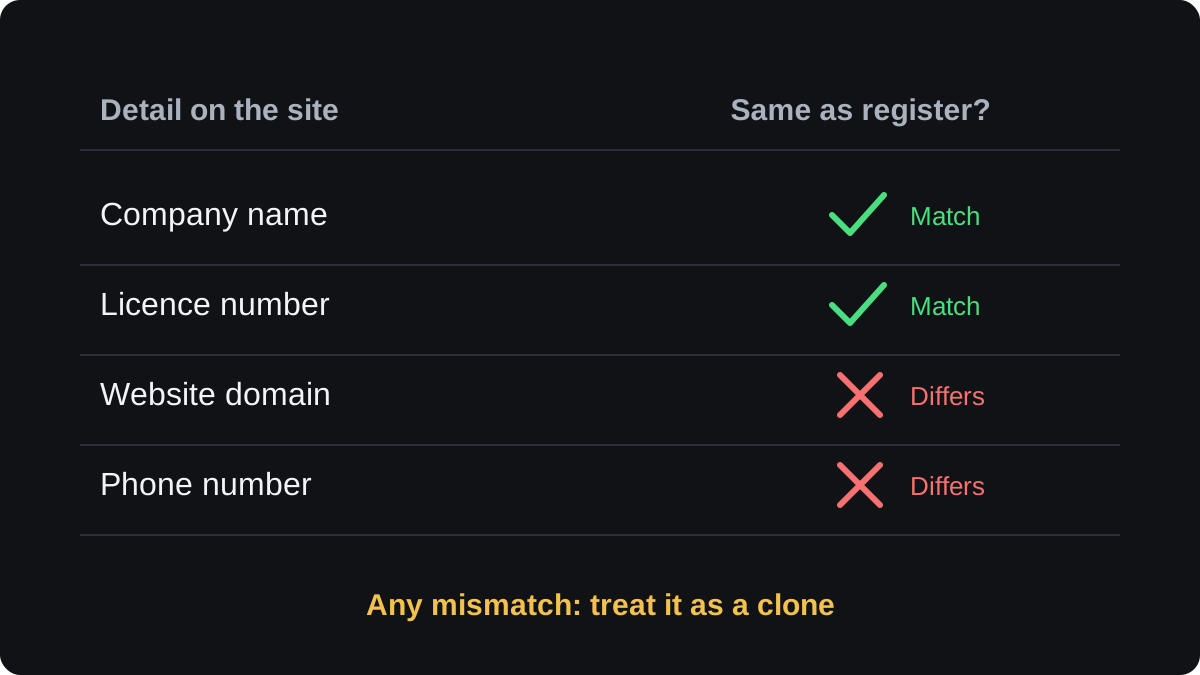
If any detail differs, contact the firm only through the details printed in the register. A clone can copy a logo and a licence number, but it cannot change what the regulator has on file.
Also look at where the licence comes from. Some places license firms with light checks on how client money is held, so read what that regulator actually supervises before you treat its licence as protection.
Many regulators also publish warning lists of firms they know to be unlicensed. Search the firm's name there as well as in the register.
Which promises and sales tactics should make you walk away?
A licensed broker cannot promise you a profit, because it does not control the market. An offer of guaranteed returns, a fixed monthly income or trading with no risk means the firm is selling a story.
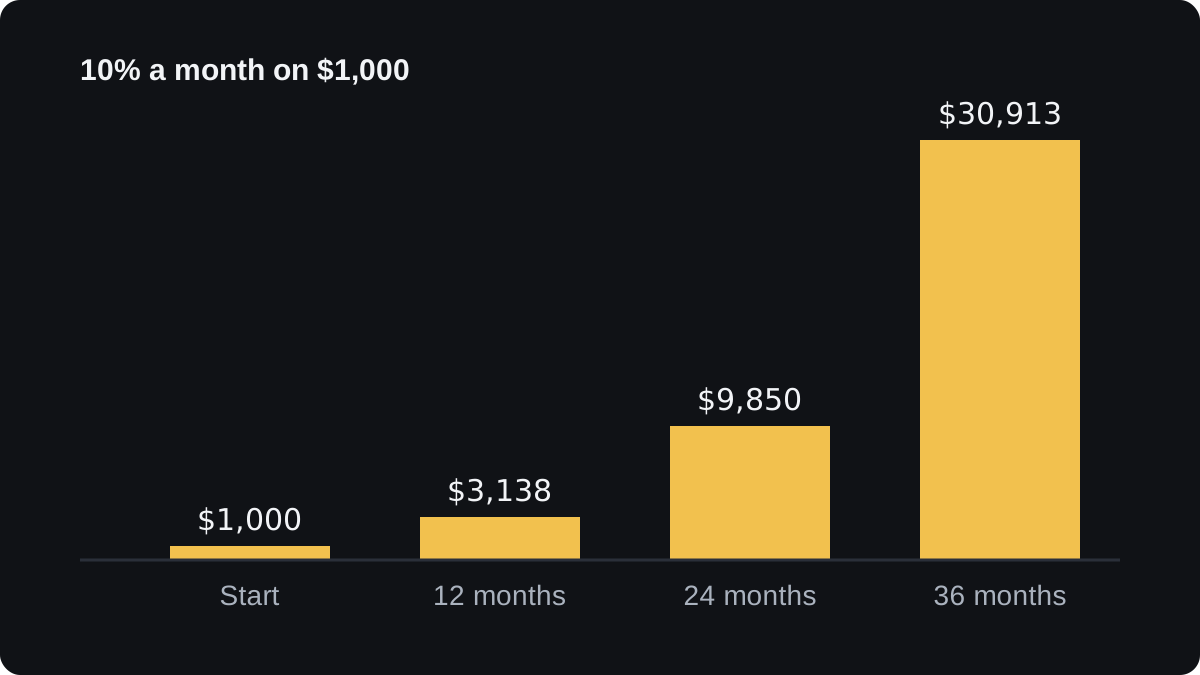
Take an offer of 10% a month, guaranteed, on a $1,000 deposit. The offer is illustrative, but the arithmetic is exact:
- After 12 months: $1,000 × 1.10^12 = $3,138.
- After 24 months: $1,000 × 1.10^24 = $9,850.
- After 36 months: $1,000 × 1.10^36 = $30,913.
If anyone could really earn that with certainty, they could borrow from a bank and keep the difference. They would have no reason to phone strangers for small deposits.
Real trading results vary from month to month and include losing months. A record with no losses proves nothing, since a screenshot is easy to edit and a demo account can show any result.
Be wary when the firm finds you first, through a cold call, a message on a social app or a new online friend who happens to know a great broker. The lesson on common forex scams covers the usual stories.
Pressure is the next sign. An account manager who urges you to deposit more before a big move, or to top up so a loss can be won back, is pushing a sale.
Refuse any request to install a remote access app on your phone or computer. These apps let another person control your device, including your banking app.
The same applies to anyone who asks for your trading password, your bank login or the codes your bank sends you. A genuine broker never needs them.
Where does your deposit actually go?
Read the payment details before you pay. A deposit sent to a personal bank account, to a company with an unrelated name, or only to a crypto wallet is hard to trace and very hard to reverse.
A licensed broker normally takes payments in its own name, or through a payment company that names it. In many licensing regimes it must also keep client money apart from its own, so ask how yours is held.
Check the platform too. If the broker uses its own app, compare its prices with a public feed such as live market rates. Prices far from the market suggest the trades on screen may not be real.
Download a trading app only from an official app store, and check that the publisher is the company you expect. Fake copies of well-known platforms exist.
When is a bonus a trap?
A trading bonus is credit added to your account, usually tied to a deposit. Some licensed brokers offer bonuses where local rules allow, so a bonus alone does not prove fraud.
The danger is in the terms. Watch for a bonus that locks your own deposit until you trade a large volume, or one you must accept to open the account at all.
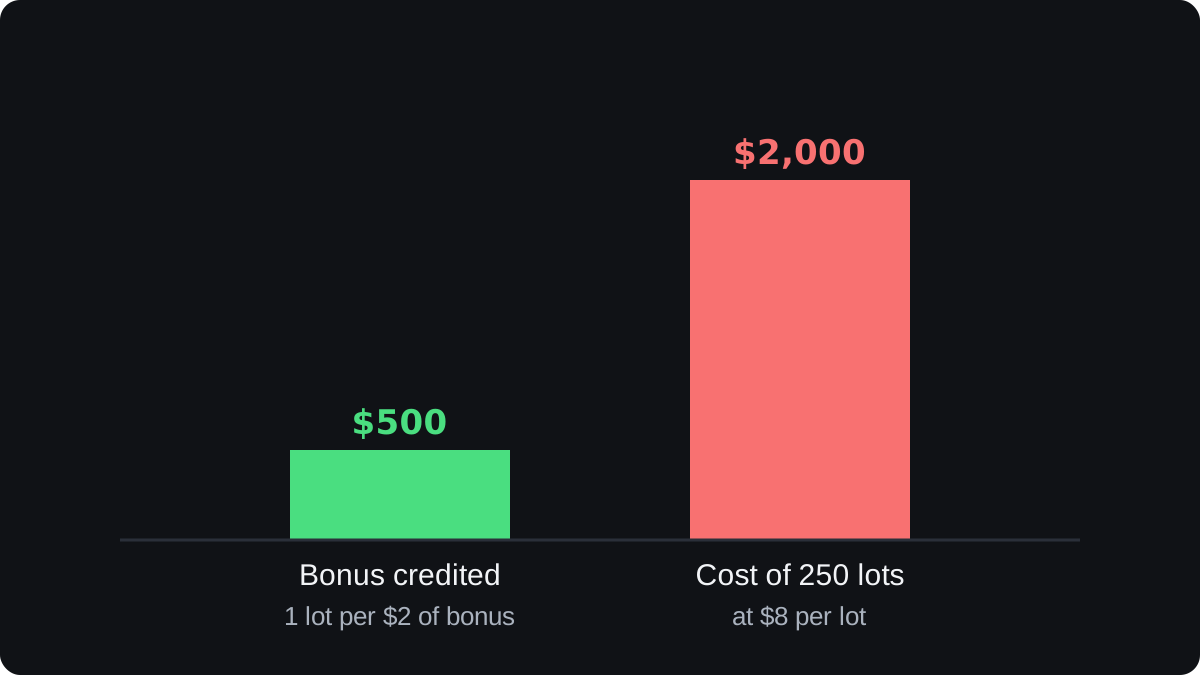
Say you deposit $500 and receive a $500 bonus. The terms say you can withdraw nothing, including your own $500, until you trade 1 standard lot for every $2 of bonus.
Assume an illustrative trading cost of $8 per lot, which is what a 0.8 pip spread costs on one lot of EUR/USD (0.8 × $10):
- Volume required: $500 ÷ $2 = 250 lots.
- Cost of that volume: 250 × $8 = $2,000.
- You pay $2,000 in spread to release a $500 bonus, whether the trades win or lose.
Read the client agreement for words such as turnover, volume requirement or forfeit. If the conditions are hard to find, or change after you deposit, treat that as a warning in its own right.
What does a withdrawal problem look like?
The real test of a broker is whether money comes back out. Trouble often grows slowly: a request stays pending, support asks for one more document, then the account is suddenly under review.
A genuine broker checks your identity, usually when you open the account, and may ask again for large or unusual payments. A firm that invents a new requirement each time you ask is stalling.
The clearest sign is a fee you must pay first. Say your screen shows $5,000 after a $1,000 deposit, and the firm demands a 20% tax, $1,000, before it releases anything.
A real broker that charges a fee takes it from the balance, so you would receive $5,000 minus the fee. A firm that wants $1,000 of new money first is telling you it will not pay from the $5,000 it claims to hold.
Paying once rarely ends it. Each payment tends to bring a new charge, such as an unlocking fee or an anti-money-laundering deposit.
Make a small withdrawal soon after your first deposit, before you add more. If money is already stuck, what to do if you have been scammed covers reporting the loss.
What can you check in a few minutes before you deposit?
These steps catch the obvious fakes:
- Find the legal company name in the website footer and look it up on the regulator's register.
- Compare the register's domain, phone and email with the site you are using.
- Search the company name on regulator warning lists.
- Read the client agreement for withdrawal terms and bonus conditions.
- Check that your payment goes to an account in the broker's own name.
- Plan a small test withdrawal before you deposit more.
Passing every check does not prove a broker is safe. The lesson on how to choose a forex broker covers costs and execution, and the next lesson explains who is on the other side of your trade.
자주 묻는 질문
How can I tell if a forex broker is fake?
Look the company up on the regulator's public register and check that its domain, phone and email match the site you are using. Then test a small withdrawal before you deposit more.
What is a clone broker?
A clone is a fake firm that copies the name and licence number of a real licensed company. The register entry is genuine, but the website, phone or email differ from the ones the regulator lists.
Is it normal to pay a fee before withdrawing?
A broker may charge a withdrawal fee, but it deducts it from your balance. A demand to send new money first, for tax or unlocking, is a classic sign of fraud.
Can someone get my money back from a fake broker for a fee?
Be very careful. People who promise recovery in exchange for an upfront fee often target victims of the first scam, so report the loss to your bank, the police and the regulator instead.
Is an offshore broker always a scam?
No. Some offshore licensed firms pay out normally, but the protection behind the licence can be thinner, so check what that regulator supervises and whether any compensation scheme applies.
이어서 배우기
 챕터 1How to choose a forex broker.To choose a forex broker, check four things before you deposit. Confirm the licence on the regulator's own register, work out the full cost of a trade from spread, commission and swap, test how orders are filled, and make a small withdrawal to see how payouts work. A broker that fails the licence check needs no further study.
 챕터 1What does a forex broker actually do?A forex broker opens your trading account, streams buy and sell prices, accepts your orders and fills them, either with outside liquidity providers or by taking the other side itself. It also holds your deposit, sets aside margin while trades are open, applies leverage, charges or pays swap and closes positions at stop out.
 챕터 1Is your forex broker regulated? How to check a licence.A regulated forex broker holds a licence from a government authority such as the UK's FCA or Australia's ASIC. To check it, find the legal company name and licence number on the broker's site, then search them on the regulator's own register and confirm the website and contact details match.
 챕터 1Who is on the other side of your forex trade?In retail forex, the other side of your trade is usually your broker. Spot forex has no central exchange, so deals are made over the counter, and your trade is most often a cash-settled CFD with the broker. The broker may keep that risk, hedge it with a liquidity provider, or match it against other clients.
 챕터 1How forex brokers make money.Forex brokers earn from the spread, the gap between the buy and sell price, often widened by a markup they keep. Many also charge commission per lot and add a margin to overnight swap. A broker that takes the other side of your trade can also profit when you lose.
 챕터 1A-book and B-book brokers explained.An A-book broker passes your trade to an outside liquidity provider and earns from a markup or commission, so your win or loss does not change its income. A B-book broker takes the other side itself, so it gains when you lose and pays when you win. Many brokers use both.
 챕터 1How A-book brokers earn, and what limits them.A pure A-book broker passes each client trade to a liquidity provider, so it earns nothing from your losses. Its income is a markup on the spread, a commission per lot, swap markups and fees. Income per lot is small after routing costs, so the broker needs high volume, and it can only offer the prices its providers quote.
 챕터 1STP and ECN execution explained.STP, straight-through processing, means your broker passes your order automatically to outside liquidity providers and usually earns by widening the spread. ECN, electronic communication network, means your order meets prices from many participants in a shared order book, usually with a raw spread plus a commission. Both are labels, so check how your broker actually routes orders.
 챕터 1Internalisation: how brokers net client orders.Internalisation is when a broker offsets client buy orders against client sell orders inside its own books. Opposite trades cancel, so only the leftover net position is left to hedge or keep. This cuts the broker's outside costs and risk, while each client's contract stays with the broker, who remains the counterparty.
 챕터 1Hybrid brokers and the C-book.A hybrid broker sends some client trades to liquidity providers (A-book) and keeps others in house, taking the other side itself (B-book). Routing usually depends on account results, trade size, style and total exposure. C-book has no fixed definition; it most often means splitting one trade, hedging part and keeping the rest.
 챕터 1Your broker's hedging policy and why it matters.A broker's hedging policy decides whether you can hold a buy and a sell on the same pair in one account, and how much margin that pair uses. Hedging accounts keep both positions open; netting accounts close or shrink the first one. Margin on a hedged pair can be full, one leg or zero.
 챕터 1Where your broker's prices come from.Your broker's prices start as quotes streamed by liquidity providers, mostly banks and non-bank trading firms. An aggregator keeps the highest bid and lowest ask from these streams, and the broker usually adds a markup before the price reaches your platform. Different providers, markups and timing mean two brokers can show different prices at the same moment.
 챕터 1How to judge a broker's order execution.Good order execution means your trades fill quickly, close to the price you asked for, with few requotes or rejections. To judge it, log the requested and filled price of every market order over dozens of trades. Slippage should run in both directions, with some fills better than requested, and news-time orders kept separate.

