외환 거래에서 레버리지란 무엇인가요?
레버리지를 쓰면 예치금보다 훨씬 큰 포지션을 운용할 수 있습니다. 1:100에서는 증거금 $1마다 $100어치 통화를 보유하므로, $110,000 포지션에 $1,100가 필요합니다. 레버리지가 정하는 것은 묶이는 증거금이지 핍 가치가 아닙니다. 실제 위험은 내가 고른 포지션 크기에서 나옵니다.

레버리지가 없다면 EUR/USD 표준 랏 1개를 거래하려면 계좌에 $100,000 넘게 있어야 합니다. 레버리지가 있으면 몇백 달러로 같은 거래를 열 수 있습니다. 그것이 레버리지의 매력이자 위험의 전부입니다.
레버리지는 어떻게 작동하나요?
레버리지는 1:100 같은 비율로 표시합니다. 증거금으로 낸 $1마다 $100어치 포지션을 운용한다는 뜻입니다. 거래가 열려 있는 동안 브로커는 그 증거금을 예치금으로 묶어 둡니다.
EUR/USD를 예시 가격 1.10000에 0.10랏 거래한다고 해 봅시다. 포지션 가치는 10,000 × 1.10000 = $11,000입니다. 1:100이면 이 거래를 여는 데 $11,000 ÷ 100 = $110의 증거금이 필요합니다.
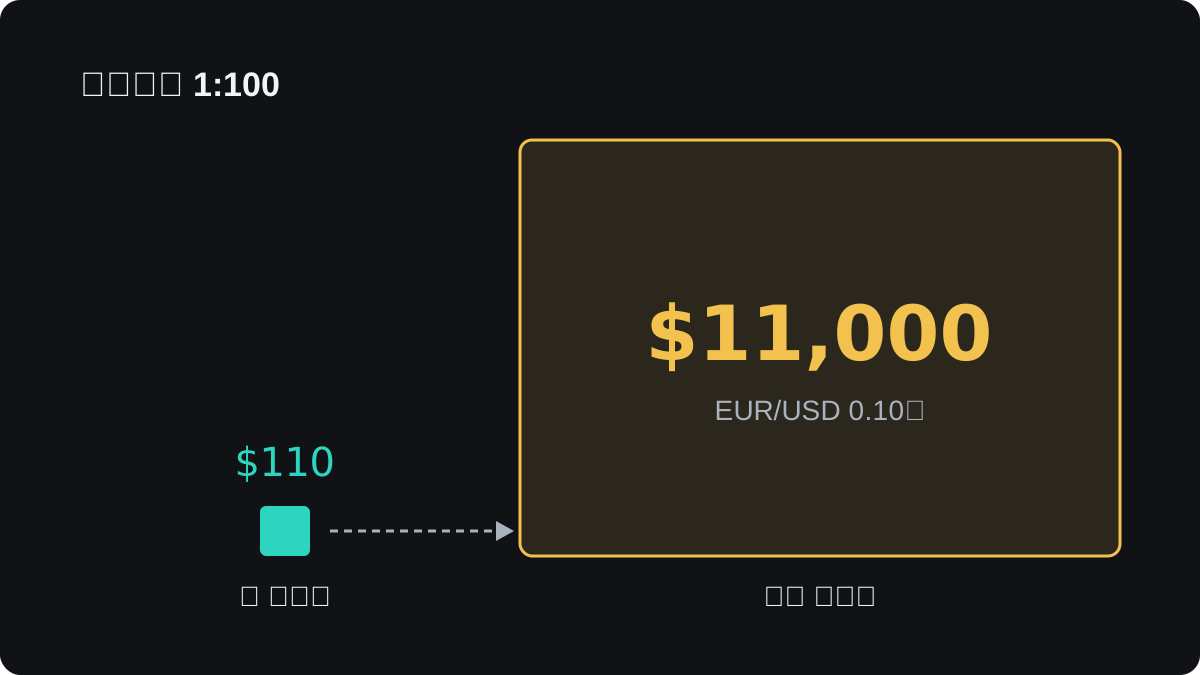
나머지 $10,900를 실제로 받는 일은 없습니다. 개인 외환 거래는 현금으로 정산되므로 손익만 계좌에 들어오거나 나갑니다.
레버리지, 증거금, 포지션 크기
세 숫자는 공식 하나로 묶여 있습니다.
증거금 = 포지션 가치 ÷ 레버리지
따라서 증거금률은 퍼센트로 나타내면 100 ÷ 레버리지입니다. 1:100이면 브로커는 포지션의 1%를, 1:500이면 0.2%를 요구합니다.
$110,000어치인 EUR/USD 1.10000 표준 랏 1개에 설정별로 필요한 증거금은 다음과 같습니다.
| 레버리지 | 증거금률 | 1.00랏 증거금 |
|---|---|---|
| 1:30 | 3.33% | $3,666.67 |
| 1:100 | 1% | $1,100 |
| 1:500 | 0.2% | $220 |
| 1:2000 | 0.05% | $55 |
계좌 설정이 늘 실제로 적용되는 레버리지는 아닙니다. 많은 브로커가 아주 큰 포지션, 일부 상품, 또는 주요 뉴스와 주말 전후 시간대에는 더 낮은 레버리지를 적용합니다.
레버리지 계산기로 어떤 통화쌍, 거래량, 계좌 통화든 이 숫자를 계산할 수 있습니다. 증거금이 무엇이고 부족해지면 어떻게 되는지는 증거금과 스톱아웃 강의에서 다룹니다.
레버리지는 핍 가치를 바꾸지 않습니다
초보자 대부분이 놓치는 부분입니다. EUR/USD 1랏은 레버리지가 1:30이든 1:2000이든 1핍에 $10씩 움직입니다. 레버리지가 바꾸는 것은 거래가 열려 있는 동안 묶이는 증거금뿐입니다.
손익은 랏 크기에서 나옵니다. 레버리지가 높으면 같은 돈으로 더 큰 랏을 열 수 있고, 위험은 바로 거기서 시작됩니다.
실질 레버리지: 정말 중요한 숫자
실질 레버리지는 열어 둔 포지션과 내가 가진 돈을 비교합니다.
실질 레버리지 = 전체 포지션 가치 ÷ 계좌 순자산
$1,000를 가지고 EUR/USD를 1.10000에 0.50랏 매수했다고 해 봅시다. 포지션 가치는 $55,000이므로, 계좌 설정이 무엇이든 실질 레버리지는 55,000 ÷ 1,000 = 55:1입니다.
55:1에서는 가격이 불리하게 1% 움직이면 계좌의 55%가 사라집니다. 1.10000에서 1% 움직이면 110핍이고, 110핍 × 핍당 $5 = $550입니다.
이런 움직임은 드물지 않습니다. 2026년 10월 29일 16:35 UTC까지 EUR/USD는 그날 이미 1.11152에서 1.11710 사이에서 거래되었습니다. 약 0.5%의 변동 폭입니다.
아래 차트는 같은 $1,000 계좌가 네 가지 포지션 크기에서 똑같이 50핍 불리한 움직임을 맞았을 때를 보여 줍니다.
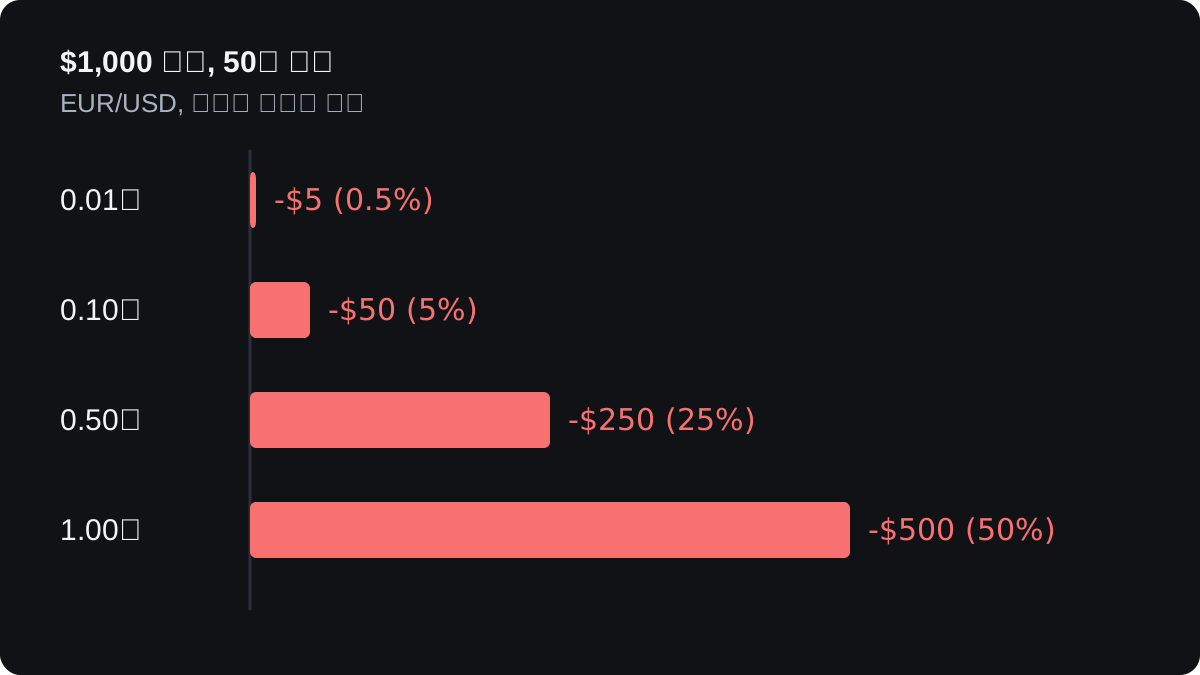
마지막 막대를 보세요. 1:100에서 1.00랏은 $1,100의 증거금이 필요해서 계좌 잔고보다 많습니다. 훨씬 높은 설정이어야만 그 거래를 열 수 있습니다.
레버리지는 왜 위험한가요?
레버리지는 이익을 키우는 것과 정확히 같은 비율로 손실도 키웁니다. 계좌에 비해 너무 큰 포지션은 평범한 움직임 한 번에 계좌의 큰 몫을 잃을 수 있습니다.
빠른 시장에서는 손절도 설정한 가격보다 불리한 가격에 체결될 수 있는데, 이를 슬리피지라고 합니다. 포지션이 클수록 슬리피지가 1핍 늘 때마다 드는 비용도 커집니다.
이런 이유로 일부 규제 당국은 개인 고객의 레버리지에 상한을 둡니다. 예를 들어 유럽연합에서는 주요 통화쌍의 개인 레버리지가 1:30으로, 미국에서는 1:50으로 제한됩니다.
이 지역 밖의 많은 브로커는 훨씬 높은 설정을 제공합니다. 마이너스 잔고 보호도 함께 확인하세요. 이 보호가 적용되면 손실이 계좌에 있는 돈을 넘을 수 없습니다.
레버리지 설정을 고르는 법
레버리지는 목표가 아니라 상한으로 여기세요. 먼저 리스크에 맞춰 거래 규모를 정한 다음, 그 거래에 필요한 증거금을 묶고도 여유 증거금이 넉넉히 남는지 확인하세요.
숫자로 보면 이렇습니다. $1,000 계좌에서 1%, 즉 $10를 걸고 EUR/USD에 25핍 손절을 둔다면 거래 규모는 $10 ÷ (25 × $10) = 0.04랏입니다.
1.10000에서 이 거래는 1:100이면 $44, 1:500이면 $8.80의 증거금을 묶습니다. 두 경우 모두 손절에 걸리면 정확히 $10를 잃습니다. 레버리지가 바꾼 것은 증거금이지 리스크가 아닙니다.
레버리지가 높으면 같은 거래에 묶이는 증거금이 줄어서, 연속 손실을 버틸 여유가 커집니다. 문제는 그 여유를 더 큰 포지션을 여는 데 쓸 때부터 시작됩니다.
실용적인 습관을 하나 들자면, 실질 레버리지를 낮게 유지하고 무엇이든 열기 전에 스톱아웃 수준을 알아 두세요. 외환 증거금 계산기로 주문 전에 그 거래가 묶을 증거금을 확인할 수 있습니다.
자주 묻는 질문
1:500 레버리지는 무슨 뜻인가요?
증거금 $1마다 $500어치 포지션을 운용한다는 뜻입니다. $110,000어치인 EUR/USD 1.10000 표준 랏 1개에는 $220의 증거금이 필요합니다.
레버리지가 높을수록 더 위험한가요?
그 자체로는 아닙니다. 핍 가치는 레버리지가 아니라 랏 크기로 정해지기 때문입니다. 남는 여유 때문에 계좌가 감당할 수 없는 큰 포지션을 열고 싶어질 때 위험해집니다.
초보자는 레버리지를 얼마로 써야 하나요?
정답인 설정이 하나 있는 것은 아닙니다. 나를 지켜 주는 것은 낮은 실질 레버리지, 즉 순자산에 비해 작은 포지션과 모든 거래에 거는 손절입니다.
입금한 돈보다 더 많이 잃을 수 있나요?
브로커와 거주 지역에 따라 다릅니다. 마이너스 잔고 보호가 있으면 계좌가 0 아래로 내려가지 않지만, 보호가 없으면 가격이 크게 갭을 만들 때 갚아야 할 마이너스 잔고가 생길 수 있습니다.
이어서 배우기
 챕터 6What is margin trading?Margin trading means opening a position worth more than the money in your account. The broker sets aside part of your balance, the margin, as a deposit while the trade is open. Profit and loss are counted on the full position size, so small price moves change your balance much faster than the margin suggests.
 챕터 6What is account balance in forex?Your account balance is the money in your trading account from deposits, withdrawals and closed trades, after booked costs such as commission and swap. It does not include open positions. While a trade is open the balance stays the same, and the floating profit or loss shows up in your equity instead.
 챕터 6What is floating (unrealized) profit and loss?Floating profit and loss is the result your open trades would show if you closed them at the current price. It changes with every tick and moves your equity, while your balance stays the same. It becomes realized, and is added to or taken from your balance, only when the trade closes.
 챕터 6외환 거래에서 증거금, 증거금 수준, 스톱아웃이란 무엇인가요?증거금은 레버리지 거래가 열려 있는 동안 브로커가 예치금으로 묶어 두는 돈입니다. 증거금 수준은 순자산을 사용 증거금으로 나눈 뒤 100%를 곱한 값입니다. 이 값이 브로커의 마진콜 수준까지 떨어지면 계좌에 경고가 표시되고, 스톱아웃 수준에 이르면 브로커가 포지션을 자동으로 청산하기 시작합니다.
 챕터 6What is used margin?Used margin is the total amount your broker sets aside to keep all your open positions open. Each position's margin is its notional value divided by your leverage, and used margin adds them up. It is not a fee: the money returns to free margin when you close the trades.
 챕터 6What is equity in a trading account?Equity is your account balance plus or minus the floating profit or loss of your open trades. It shows what the account would be worth if you closed everything at current prices. With no trades open, equity equals balance. Brokers use it to work out free margin, margin level and stop outs.
 챕터 6What is free margin?Free margin is the money in your trading account that is not locked up as margin for open trades. It equals equity minus used margin. You need free margin to open new positions, and it falls as open trades lose and rises as they gain. At zero, your margin level is 100%.
 챕터 6What is margin level?Margin level is your equity divided by your used margin, multiplied by 100 and shown as a percentage. It tells you how much cushion your open trades have. At 100%, equity equals used margin and free margin is zero. Brokers set their margin call and stop out levels on this number, and the levels differ between brokers.
 챕터 6What is a margin call?A margin call is your broker's warning that your margin level, equity divided by used margin, has fallen to a set threshold such as 100%. You usually cannot open new trades from that point. The call closes nothing by itself. If losses continue, the broker's stop out level is where positions start to be closed for you.
 챕터 6What is a stop out level?The stop out level is the margin level at which your broker starts closing your open positions automatically, often beginning with the largest loss. If your stop out level is 50%, closing begins when equity falls to half your used margin. It is meant to stop your account sinking further, though a price gap can still push it below zero.
 챕터 6Margin call example: margin call at 100% with no separate stop out.When a broker sets the margin call and the stop out both at 100%, the warning and the forced close happen at the same moment. In this example, a $1,000 account buys 0.50 lot of EUR/USD with $550 of margin at 1:100, and the trade is closed after a 90 pip fall, a $450 loss.
 챕터 6Margin call and stop out example: 100% and 50%.In this example a $2,000 account buys 1 lot of EUR/USD at 1.10000 with $1,100 of used margin. The margin call at 100% arrives when equity falls to $1,100, 90 pips lower at 1.09100. The stop out at 50% closes the trade when equity reaches $550, at 1.08550, a loss of $1,450.
 챕터 6What happens if you trade forex with $100?With $100 and 1:100 leverage, 0.01 lot of EUR/USD at 1.10000 uses $11 of margin and can move about 890 pips against you before a 100% margin call. At 0.05 lot the margin call comes after 90 pips, and 0.10 lot cannot be opened at all. Trade size decides how much room you have.
 챕터 6Why margin call and stop out levels differ between brokers.Margin call and stop out levels are set by each broker, often per account type, within any rules from the regulator that licenses the account. In this lesson's example, one trade is closed after 90 pips at one broker and after 178 pips at another, so look up your own levels before you trade.
 챕터 6Margin cheat sheet.Balance is the cash from deposits, withdrawals and closed trades. Equity is balance plus the floating profit or loss on open trades. Used margin is the deposit your open trades hold, and free margin is equity minus used margin. Margin level is equity divided by used margin, times 100. A margin call warns; a stop out closes trades.
 챕터 6How can you avoid a margin call?Margin level is your equity divided by your used margin, and a margin call comes when it falls to your broker's threshold. To stay clear, keep positions small compared with your equity, set stop losses that close losing trades long before that point, and leave plenty of free margin unused.

