Why margin call and stop out levels differ between brokers.
Margin call and stop out levels are set by each broker, often per account type, within any rules from the regulator that licenses the account. In this lesson's example, one trade is closed after 90 pips at one broker and after 178 pips at another, so look up your own levels before you trade.
이 내용은 현재 영어로만 제공됩니다.

Two traders open the same position with the same balance. One is closed out after the price moves 90 pips against them, the other after 178 pips. The only difference is the broker's settings.
Every broker chooses its own margin call and stop out levels, within whatever rules apply where the account is licensed. Many brokers also set different levels for each account type.
What do margin call and stop out levels measure?
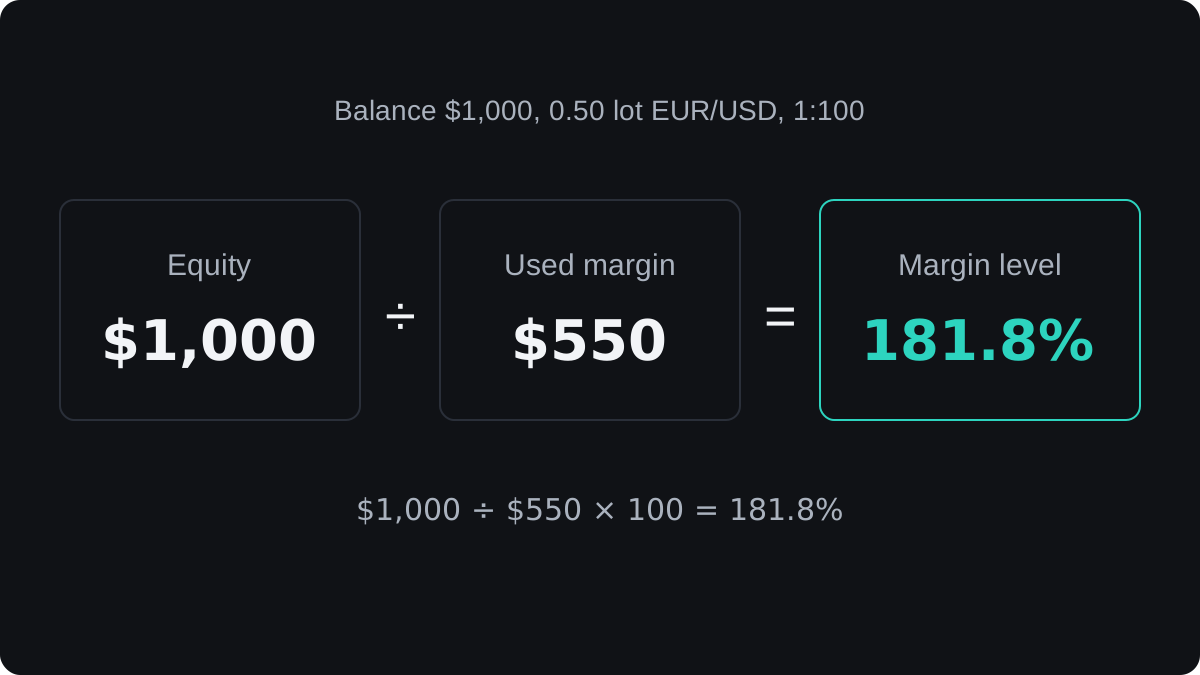
Both levels are read off your margin level: your equity divided by your used margin, times 100. Equity is your balance plus or minus the profit or loss on open trades.
The margin call level is a warning line. When your margin level falls to it, the platform alerts you. Nothing is closed yet, though some brokers also stop you opening new trades at this point.
The stop out level is the line where the broker starts closing your positions for you. It sits at or below the margin call level. The lessons on the margin call and the stop out cover each one in detail.
Take a $1,000 balance and a buy of 0.50 lot of EUR/USD at 1.10000 with 1:100 leverage. All prices and broker settings in this lesson are illustrative.
The position's face value is 50,000 euros × 1.10000 = $55,000. At 1:100 the used margin is $55,000 ÷ 100 = $550, so the margin level is $1,000 ÷ $550 × 100 = 181.8%.
Why do brokers set different levels?
A stop out closes a losing account before its equity runs out. Where the broker draws that line depends on how much risk it is willing to carry and which rules it works under.
Several things push the numbers apart:
- Regulation. Some regulators set a level at which retail positions must be closed, so a broker licensed there cannot go lower for those clients. These rules differ by country and can change.
- Negative balance risk. If prices jump past your stop out, equity can fall below zero. A broker that offers negative balance protection absorbs that loss, which gives it a reason to close accounts earlier.
- Account type. One broker may set a higher stop out on one account and a lower one on another, each aimed at a different kind of trader.
- Client category. Accounts classed as professional are often handled under different rules from retail accounts, which can change the levels on offer.
- Platform setup. MetaTrader lets a broker set these levels as a percentage or as an amount of money, so read which one your terms use.
The margin requirement itself can also change. Some brokers raise the margin needed before weekends or major news. That raises your used margin and lowers your margin level without any price move, so you reach the same lines sooner.
What does the difference mean for one trade?
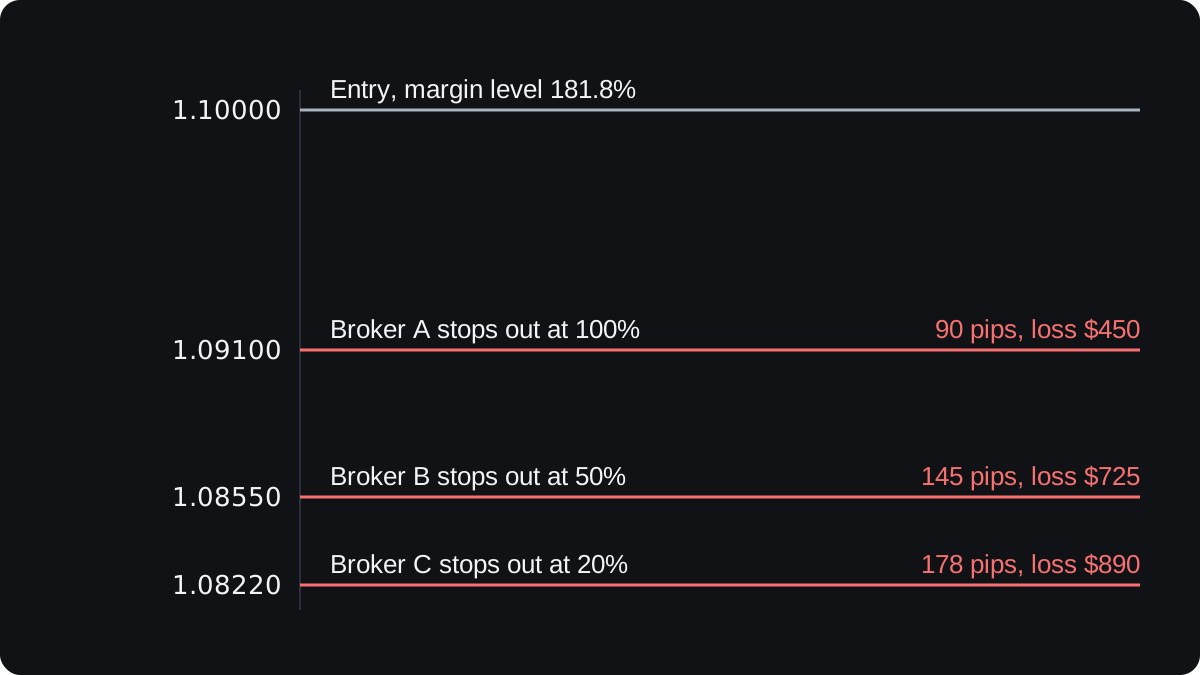
Keep the trade above and change only the broker. The three sets of levels below are made up for this example and do not describe any real firm.
On 0.50 lot of EUR/USD, a pip is worth 50,000 × 0.0001 = $5. Here is the working for Broker B, with a stop out of 50%:
- Equity at stop out = 50% × $550 = $275.
- Loss allowed = $1,000 minus $275 = $725.
- Distance = $725 ÷ $5 = 145 pips.
- Stop out price = 1.10000 minus 0.01450 = 1.08550.
The same four steps give the other two columns:
| Setting | Broker A | Broker B | Broker C |
|---|---|---|---|
| Margin call level | 100% | 100% | 80% |
| Stop out level | 100% | 50% | 20% |
| Equity at stop out | $550 | $275 | $110 |
| Loss at stop out | $450 | $725 | $890 |
| Distance | 90 pips | 145 pips | 178 pips |
| Stop out price | 1.09100 | 1.08550 | 1.08220 |
The warnings arrive at different times too. Brokers A and B send the margin call at 1.09100. Broker C waits until equity is 80% of $550, which is $440, a loss of $560 or 112 pips, at 1.08880.
Used margin is held at $550 here to keep the sums clean. On many platforms it moves slightly with the EUR/USD price, which shifts these points by less than a pip.
Is a lower stop out level better?
A lower stop out gives a losing trade more room. It also lets you lose more of your deposit before anything is closed: at Broker C, the account keeps only $110 of its $1,000.
The stop out level is a trigger. The closing price is whatever the market offers when it fires, and after a gap that can be well past the line.
Say you hold the Broker B trade over a weekend. EUR/USD closes Friday at 1.08700, a loss of 130 pips × $5 = $650. Equity is $350, and the margin level is $350 ÷ $550 × 100 = 63.6%, still above 50%.
On Monday the market opens at 1.08300. The loss is now 170 pips × $5 = $850, equity is $150 and the margin level is $150 ÷ $550 × 100 = 27.3%.
The broker closes at about that price. The loss is $850, which is $125 more than the $725 the 50% line implied.
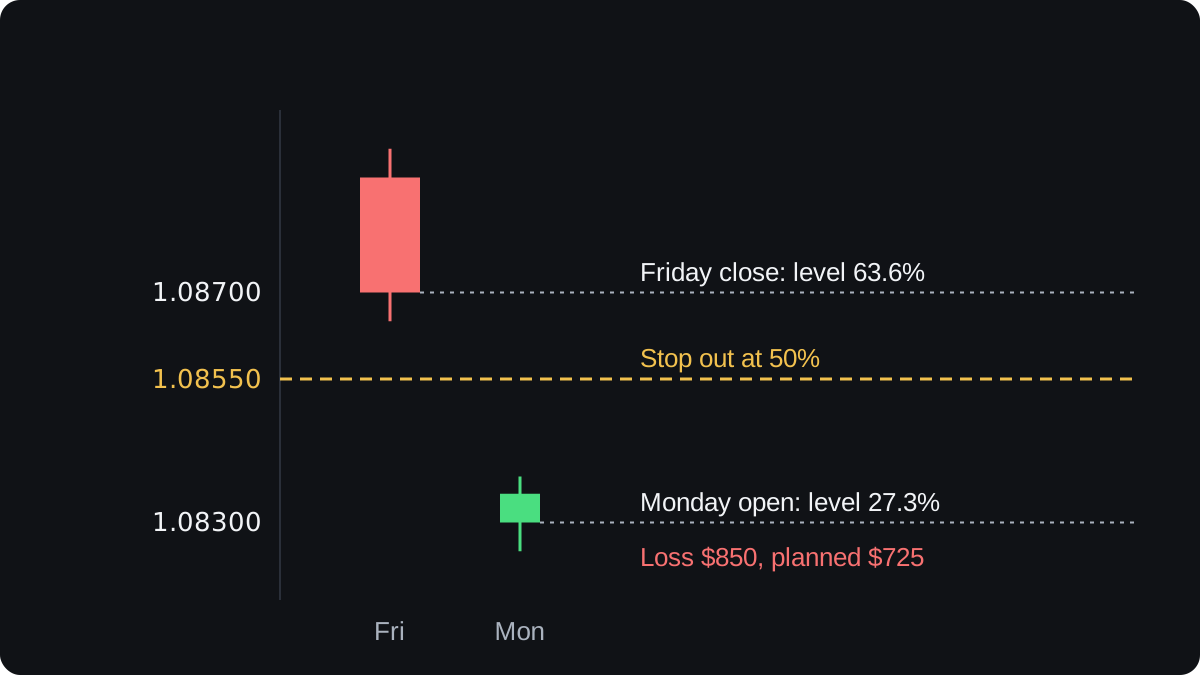
A large enough gap can push equity below zero. Whether you would owe that amount depends on your broker's negative balance policy, which is worth reading before you hold trades through weekends or news.
With several positions open, a stop out often closes them one at a time, commonly starting with the biggest loss, until the margin level is back above the line. Your broker's terms say which order it uses.
Treat the stop out as a last resort. A stop loss you set yourself fixes your exit in advance, and a margin buffer keeps the stop out far away.
How do you find your broker's levels?
Start with the broker's account types page, which usually lists margin call and stop out for each account. The client agreement or terms of business is the binding source if the two disagree.
If you cannot find them, ask support in writing, name your exact account type and keep the reply.
Check again whenever something changes, such as a new account type, a different leverage setting or an account opened under another company in the same broker group. A group can hold several licences, and the levels can differ between them.
Your platform shows your live margin level, in MetaTrader on the Trade tab of the bottom panel. Compare it with your broker's two numbers while trades are open.
Before a trade, you can work out your own stop out price as in the table above. The margin calculator gives the used margin for any pair and size. Leverage changes that used margin, and the leverage lesson covers how.
자주 묻는 질문
What is a normal stop out level?
There is no single standard. Levels vary by broker, account type and the rules where the account is held, so read the terms for your own account.
Can my broker change its margin call or stop out level?
Usually yes, under the terms of the client agreement, which normally explains how you will be told. Check that section and read any notices your broker sends.
Why was my trade closed at a worse price than the stop out level?
The price moved fast or gapped past the line. The stop out is a trigger, and the broker closes at the next price available, which can be well beyond it.
Does higher leverage change the stop out level?
The level itself usually stays the same. Higher leverage lowers the used margin for the same trade, which raises your margin level, but it also makes it easy to open a bigger position.
이어서 배우기
 챕터 6What is margin trading?Margin trading means opening a position worth more than the money in your account. The broker sets aside part of your balance, the margin, as a deposit while the trade is open. Profit and loss are counted on the full position size, so small price moves change your balance much faster than the margin suggests.
 챕터 6What is account balance in forex?Your account balance is the money in your trading account from deposits, withdrawals and closed trades, after booked costs such as commission and swap. It does not include open positions. While a trade is open the balance stays the same, and the floating profit or loss shows up in your equity instead.
 챕터 6What is floating (unrealized) profit and loss?Floating profit and loss is the result your open trades would show if you closed them at the current price. It changes with every tick and moves your equity, while your balance stays the same. It becomes realized, and is added to or taken from your balance, only when the trade closes.
 챕터 6외환 거래에서 증거금, 증거금 수준, 스톱아웃이란 무엇인가요?증거금은 레버리지 거래가 열려 있는 동안 브로커가 예치금으로 묶어 두는 돈입니다. 증거금 수준은 순자산을 사용 증거금으로 나눈 뒤 100%를 곱한 값입니다. 이 값이 브로커의 마진콜 수준까지 떨어지면 계좌에 경고가 표시되고, 스톱아웃 수준에 이르면 브로커가 포지션을 자동으로 청산하기 시작합니다.
 챕터 6What is used margin?Used margin is the total amount your broker sets aside to keep all your open positions open. Each position's margin is its notional value divided by your leverage, and used margin adds them up. It is not a fee: the money returns to free margin when you close the trades.
 챕터 6What is equity in a trading account?Equity is your account balance plus or minus the floating profit or loss of your open trades. It shows what the account would be worth if you closed everything at current prices. With no trades open, equity equals balance. Brokers use it to work out free margin, margin level and stop outs.
 챕터 6What is free margin?Free margin is the money in your trading account that is not locked up as margin for open trades. It equals equity minus used margin. You need free margin to open new positions, and it falls as open trades lose and rises as they gain. At zero, your margin level is 100%.
 챕터 6What is margin level?Margin level is your equity divided by your used margin, multiplied by 100 and shown as a percentage. It tells you how much cushion your open trades have. At 100%, equity equals used margin and free margin is zero. Brokers set their margin call and stop out levels on this number, and the levels differ between brokers.
 챕터 6What is a margin call?A margin call is your broker's warning that your margin level, equity divided by used margin, has fallen to a set threshold such as 100%. You usually cannot open new trades from that point. The call closes nothing by itself. If losses continue, the broker's stop out level is where positions start to be closed for you.
 챕터 6What is a stop out level?The stop out level is the margin level at which your broker starts closing your open positions automatically, often beginning with the largest loss. If your stop out level is 50%, closing begins when equity falls to half your used margin. It is meant to stop your account sinking further, though a price gap can still push it below zero.
 챕터 6Margin call example: margin call at 100% with no separate stop out.When a broker sets the margin call and the stop out both at 100%, the warning and the forced close happen at the same moment. In this example, a $1,000 account buys 0.50 lot of EUR/USD with $550 of margin at 1:100, and the trade is closed after a 90 pip fall, a $450 loss.
 챕터 6Margin call and stop out example: 100% and 50%.In this example a $2,000 account buys 1 lot of EUR/USD at 1.10000 with $1,100 of used margin. The margin call at 100% arrives when equity falls to $1,100, 90 pips lower at 1.09100. The stop out at 50% closes the trade when equity reaches $550, at 1.08550, a loss of $1,450.
 챕터 6What happens if you trade forex with $100?With $100 and 1:100 leverage, 0.01 lot of EUR/USD at 1.10000 uses $11 of margin and can move about 890 pips against you before a 100% margin call. At 0.05 lot the margin call comes after 90 pips, and 0.10 lot cannot be opened at all. Trade size decides how much room you have.
 챕터 6외환 거래에서 레버리지란 무엇인가요?레버리지를 쓰면 예치금보다 훨씬 큰 포지션을 운용할 수 있습니다. 1:100에서는 증거금 $1마다 $100어치 통화를 보유하므로, $110,000 포지션에 $1,100가 필요합니다. 레버리지가 정하는 것은 묶이는 증거금이지 핍 가치가 아닙니다. 실제 위험은 내가 고른 포지션 크기에서 나옵니다.
 챕터 6Margin cheat sheet.Balance is the cash from deposits, withdrawals and closed trades. Equity is balance plus the floating profit or loss on open trades. Used margin is the deposit your open trades hold, and free margin is equity minus used margin. Margin level is equity divided by used margin, times 100. A margin call warns; a stop out closes trades.
 챕터 6How can you avoid a margin call?Margin level is your equity divided by your used margin, and a margin call comes when it falls to your broker's threshold. To stay clear, keep positions small compared with your equity, set stop losses that close losing trades long before that point, and leave plenty of free margin unused.

