Trading psychology basics.
Trading psychology is how emotions and mental shortcuts change your decisions with money at risk. Fear makes you close winners early, hope makes you move stops on losers, and a loss can push you into larger revenge trades. Deciding stop, target and size before entry, and keeping risk small, limits the damage.
이 내용은 현재 영어로만 제공됩니다.

A beginner can usually write a sensible rule in a calm moment, such as risking 1% per trade and never moving the stop. Following that rule is harder when a live position is moving against you.
Trading psychology is the study of how emotions and mental shortcuts change your decisions while money is at risk. Most broken rules break in the minutes after you click buy or sell, while the result is still open.
What do fear and greed do to an open trade?
Fear usually shows up after you enter. A trade goes 10 pips into profit, you worry it will turn, and you close it long before your target.
Fear also works on losing trades. The price moves toward your stop, and instead of accepting a small loss, you freeze or push the stop further away.
Greed pulls the other way. After a good win you raise the lot size beyond your plan, or you hold past your target hoping the move keeps going.
Both feelings are normal reactions to money at risk. They become a problem when they overrule a decision your plan made before the trade.
The mental shortcuts behind broken rules
Psychologists call these shortcuts cognitive biases: patterns of thinking that save effort in daily life and can mislead you in markets. Four of them come up often in trading.
Loss aversion
A loss tends to hurt more than a gain of the same size feels good. Behavioural economists call this loss aversion. In trading it makes closing a losing position painful, so you look for reasons to keep it open.
Selling winners early and holding losers
Research on investors describes the disposition effect, a tendency to sell assets that have risen too soon and keep assets that have fallen too long.
A trader banks a small profit to feel safe, then moves the stop loss on a loser so the loss does not have to become real.
Confirmation bias
Once you hold a position, you notice news and chart signals that agree with it and skim past those that do not. This is confirmation bias.
A trader who is long EUR/USD reads every bullish comment as proof and treats a broken support level as noise.
Overconfidence after a streak
Five wins in a row can feel like skill. Five trades are far too few to tell skill from luck, yet the streak often leads to a larger trade at the moment you feel least careful.
How fear and hope turn a plan around
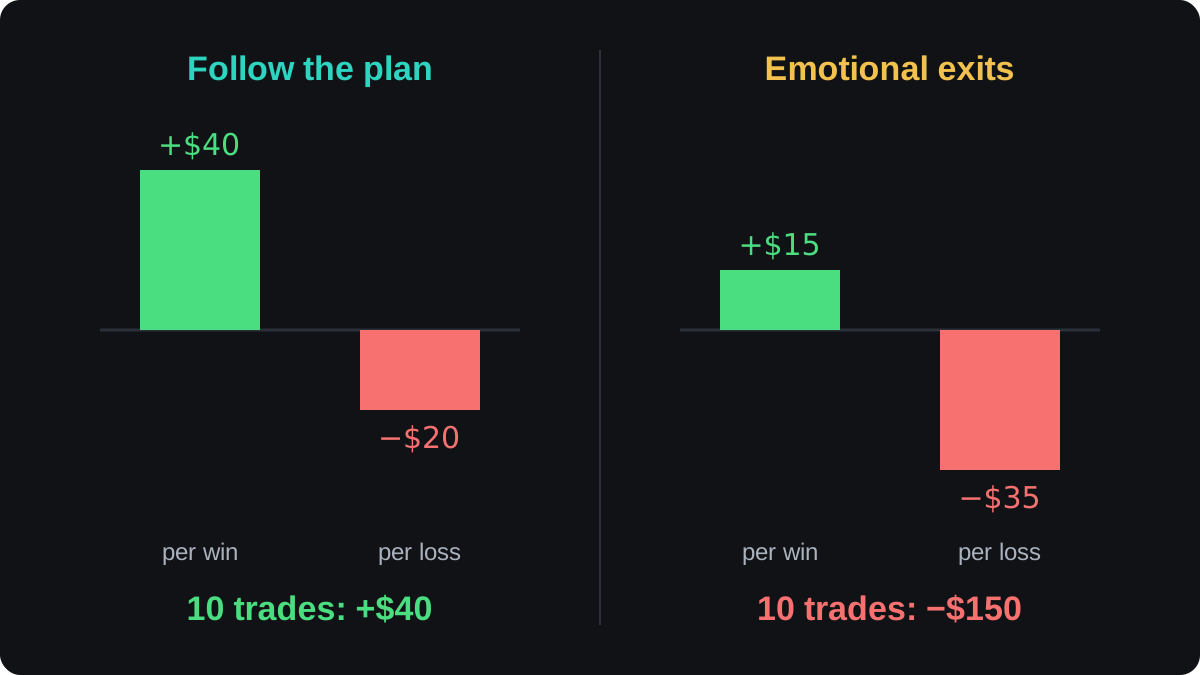
Small changes to your exits matter more than they look. Take a plan with round illustrative numbers: 0.10 lot of EUR/USD, where one pip is worth $1, with a 20 pip stop and a 40 pip target.
Assume 10 trades, 4 winners and 6 losers. The win rate is chosen only for the example and says nothing about any real strategy.
Following the plan:
- Each win is 40 pips × $1 = $40, so 4 wins make $160.
- Each loss is 20 pips × $1 = $20, so 6 losses cost $120.
- The result is $160 − $120 = +$40.
Now the same trader lets emotion manage the exits. Fear closes each winner at 15 pips. Hope moves each stop further away, and the losers end at 35 pips on average.
- Each win is 15 pips × $1 = $15, so 4 wins make $60.
- Each loss is 35 pips × $1 = $35, so 6 losses cost $210.
- The result is $60 − $210 = −$150.
The entries are identical in both runs, and only the exits moved. Reward to risk per trade fell from 40:20, or 2 to 1, to 15:35, about 0.43 to 1, and a plan that made $40 now loses $150.
Real trades would not keep the win count fixed. Closing winners early would turn some trades that later hit the stop into small wins, and wider stops would let some losers recover.
The example holds the count at 4 wins to isolate the effect of exit size. The risk-reward ratio lesson shows how win rate and reward to risk combine.
Revenge trading: when a loss sets the next size
Revenge trading is opening a trade to win back a loss quickly, usually larger than planned and without a proper setup. It often feeds the habit described in the lesson on overtrading.
Take a $2,000 account with a rule to risk 1% per trade. Each loss is capped at 1% × $2,000 = $20.
A trader loses $20, doubles the risk to $40 to recover it, loses again, and doubles to $80. Three losses now total $20 + $40 + $80 = $140, which is 140 ÷ 2,000 = 7% of the account.
Under the plan, the same three losses would cost 3 × $20 = $60, or 3%.
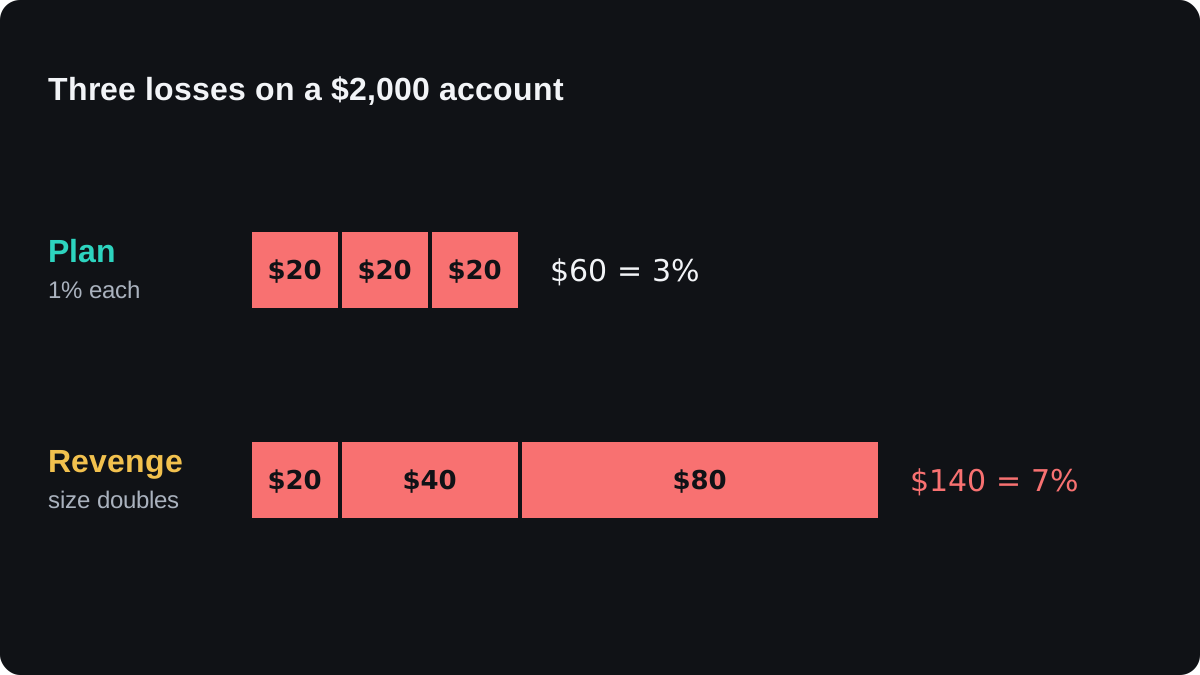
The larger loss is also harder to recover. Winning back $140 from the $1,860 left takes a gain of 140 ÷ 1,860, about 7.5%. Winning back $60 from $1,940 takes about 3.1%.
The drawdown and recovery lesson explains why the gain you need grows faster than the loss.
Habits that limit the damage
No routine makes you immune to fear or greed. The habits below are common practice with no guarantee attached, and they work by moving decisions to a calm moment before the trade.
- Decide the stop, target and lot size before you enter, and write them down. A written trading plan keeps the rule in front of you when you are tempted to change it.
- Keep risk per trade small and fixed, so a single loss does not hurt enough to trigger revenge. The risk per trade lesson explains how to set it.
- Set a daily limit, such as a number of losses or an amount lost, after which you close the platform until the next day.
- Make it a rule never to move a stop further from your entry. Moving it closer to protect a profit is a separate choice that also belongs in the plan.
- Keep a trading journal that records why you entered and how you felt, then check what broken rules cost you.
A demo account is useful for learning the platform and testing rules. It does little to train your reaction to a real loss, because nothing is at stake.
Starting live with the smallest lot size your broker allows keeps the money real and the damage small while you learn how you react.
자주 묻는 질문
Can you remove emotions from trading?
No. You can reduce how much they change your decisions by fixing the stop, target and size before you enter and keeping risk per trade small.
What is revenge trading?
It is opening a trade to win back a loss quickly, usually larger than planned and without a real setup. Doubling size after each loss can turn three planned losses of 1% into a 7% drawdown.
Why do I close winning trades too early?
Fear of watching a profit disappear makes a small sure gain feel better than a larger uncertain one. If you also let losers run, your average loss grows larger than your average win.
Does automated trading solve psychology problems?
It removes some decisions during the trade. You still choose when to switch it off, change its settings or raise its size, and those choices face the same pressures.
Is psychology more important than strategy?
Both matter. Discipline cannot rescue a strategy with no edge, and a sound plan can still lose money if you break its rules under pressure.
이어서 배우기
 챕터 3The most common beginner mistakes.The most expensive beginner mistakes are trading too large for the account, trading without a stop loss, and raising size after a loss to win it back. Overtrading and letting losers outrun winners add slower damage. Each can be measured in money, and a fixed risk per trade and a trade journal limit them.
 챕터 3Overtrading and how to stop it.Overtrading means taking more trades, or bigger positions, than your trading plan allows. It raises costs, deepens losing runs and often follows a loss, boredom or a winning streak. Written limits help rein it in: a fixed risk per trade, a daily trade cap, a daily loss limit and a rule to trade only planned setups.

