The most common beginner mistakes.
The most expensive beginner mistakes are trading too large for the account, trading without a stop loss, and raising size after a loss to win it back. Overtrading and letting losers outrun winners add slower damage. Each can be measured in money, and a fixed risk per trade and a trade journal limit them.
이 내용은 현재 영어로만 제공됩니다.

The costliest beginner mistakes usually come from position size, from exits, and from what you do straight after a loss. Each one can be measured in money with simple arithmetic.
Every example uses a $1,000 account and EUR/USD, where one pip on one standard lot is worth $10. The prices, sizes and leverage are illustrative.
Why does trading too large empty an account so fast?
Leverage lets you open a position far larger than your deposit. Say your broker offers 1:500. One standard lot of EUR/USD at 1.10000 is worth $110,000, so the margin is 110,000 ÷ 500 = $220.
That $220 is only the deposit the broker holds while the trade is open. Your risk is what you lose if price moves against you, and on one lot that is $10 for every pip.
Compare two traders with the same $1,000 and the same 50 pip stop:
- Trader A buys 1.00 lot. Each pip is worth $10, so the stop risks 50 × $10 = $500, half the account.
- Trader B buys 0.02 lot. Each pip is worth $0.20, so the stop risks 50 × $0.20 = $10, or 1% of the account.
- Both are wrong on this trade. A has $500 left, and B has $990.
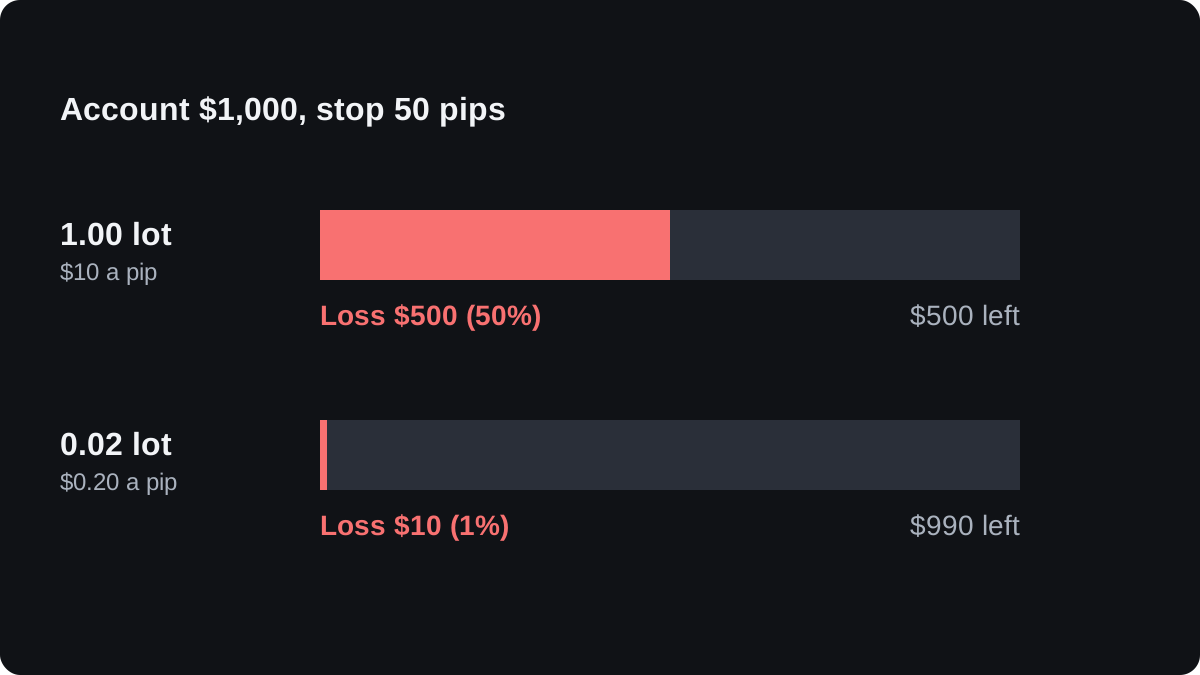
Trader A cannot afford a second loss of the same size. Trader B could lose 10 trades in a row at $10 each and still hold $900.
A small fixed share of the account per trade, often quoted as 1 to 2%, is a common convention. No single study sets that number, and the risk per trade lesson covers how to choose yours.
To size a trade, work backwards from the stop: lots = risk in dollars ÷ (stop in pips × pip value per lot). For Trader B, $10 ÷ (50 × $10) = 0.02 lot. The lot size calculator does this sum for any pair.
Large losses are also slow to repair. After a 50% loss, $1,000 becomes $500, and $500 has to double to return to $1,000. That is a 100% gain.
The gain needed is the loss ÷ (100% minus the loss). A 10% loss needs 11.1%, a 25% loss needs 33.3% and a 75% loss needs 300%.
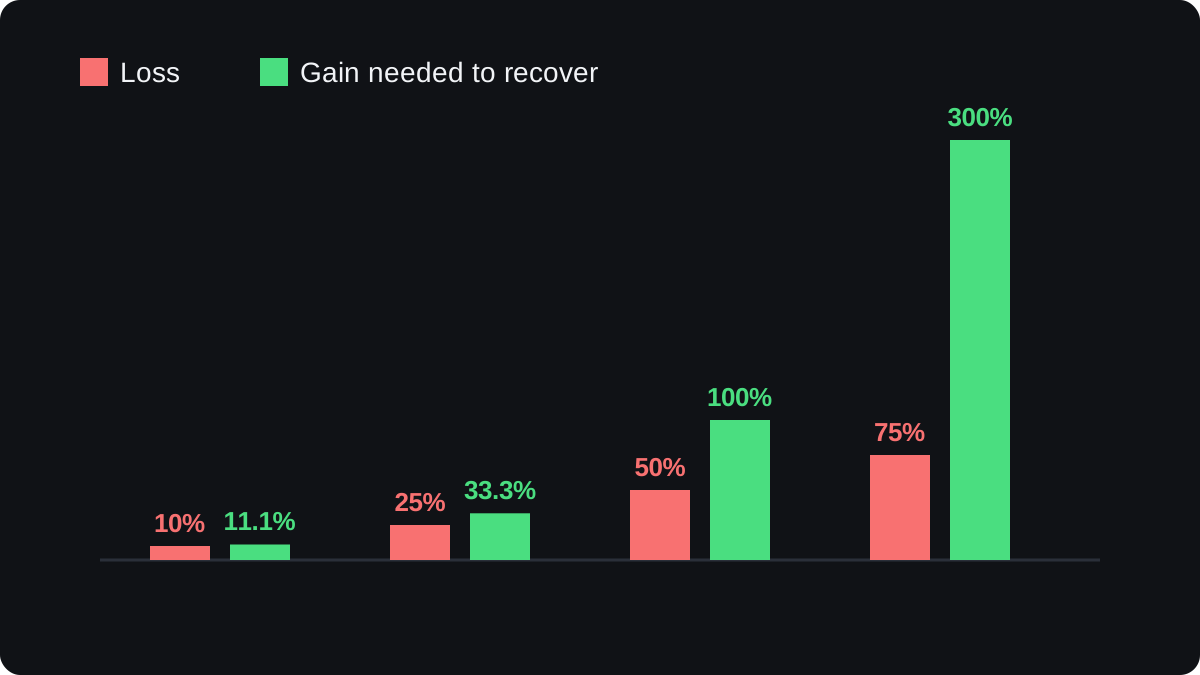
The drawdown and recovery lesson works through more cases, including what a run of small losses does to the balance.
What happens when you trade without a stop loss?
A stop loss is an order that closes your trade at a price you set in advance, so a wrong idea costs an amount you chose before entering. The stop loss lesson covers the reasons in full.
Without one, the only limit is your broker's stop out, the margin level at which it starts closing positions for you. By the time that triggers, most of the account can already be gone.
Say Trader B plans a 50 pip stop but never places the order. Price falls 50 pips, and B waits for a bounce. At 150 pips the loss is 150 × $0.20 = $30, three times the plan.
On Trader A's 1.00 lot, 150 pips would be $1,500, more than the account holds. The broker's stop out would close the trade well before that point.
Moving a stop further away as price comes near it has the same effect. It feels like giving the trade room, yet the planned limit is gone.
A stop does not promise an exact price either. In a fast market or across a weekend gap it can fill beyond its level, which is called slippage, so the real loss can be larger than planned.
How does revenge trading turn $10 into $150?
Revenge trading is jumping back in straight after a loss, usually with a bigger size, to win the money back quickly. The wish to get even chooses the trade before the chart has a say.
Picture a trader with a 20 pip stop on every trade who doubles the size after each loss:
- Trade 1, 0.05 lot: 20 × $0.50 = $10 lost.
- Trade 2, 0.10 lot: 20 × $1 = $20 lost.
- Trade 3, 0.20 lot: 20 × $2 = $40 lost.
- Trade 4, 0.40 lot: 20 × $4 = $80 lost.
The four losses total $10 + $20 + $40 + $80 = $150, which is 15% of the account. The last trade alone risked 8% of the starting balance, eight times the first.
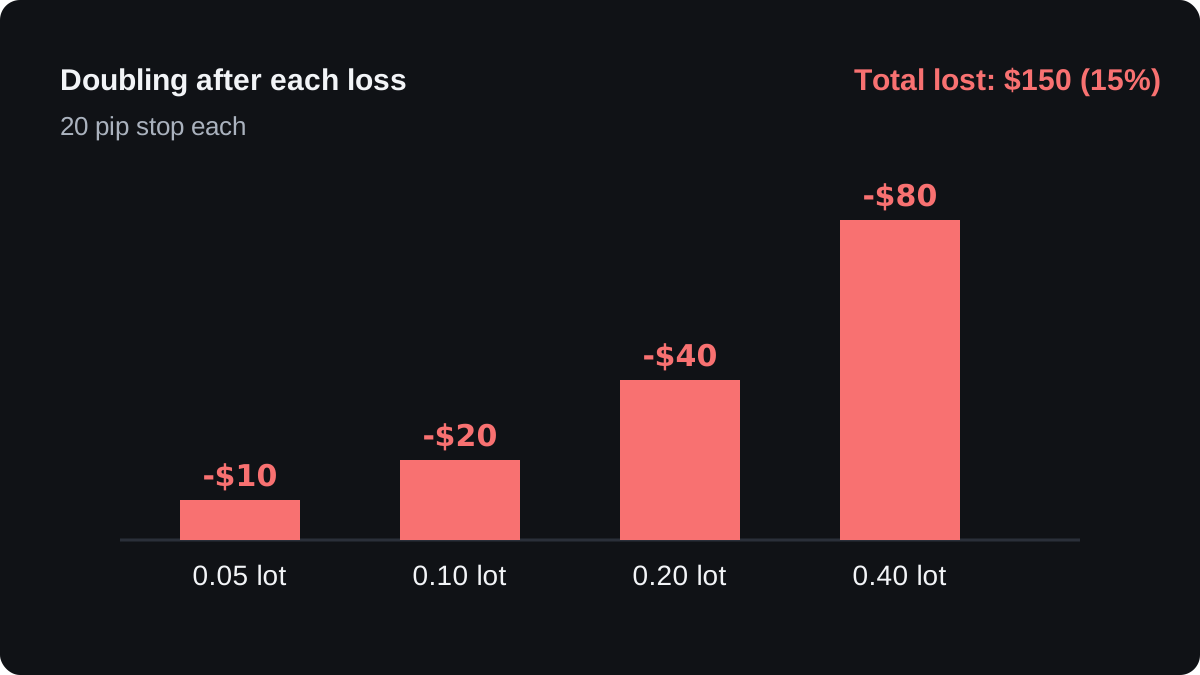
Doubling after every loss is the old martingale idea. If a fifth trade at 0.80 lot wins 20 pips, it makes 20 × $8 = $160 and covers the $150.
If that fifth trade loses instead, the total loss reaches $310 and the next trade needs 1.60 lot. The size keeps doubling until the balance or the free margin runs out.
Losing streaks happen even with a sound method. Over 100 trades at a 50% win rate, a run of five or more losses in a row is more likely than not.
A simple guard is a daily limit set before you start: after a fixed number of losses, or a fixed loss in money, you stop for the day.
Which other habits quietly cost beginners money?
Trading too often
Every trade pays the spread, and many accounts also pay commission and swap. With an illustrative 1 pip spread on 0.10 lot of EUR/USD, each round trip costs $1 before price moves at all.
Twenty such trades a day is $20, or 2% of a $1,000 account every day. How much one trade costs shows how to add up every charge, and the next lesson, on overtrading, looks at why it happens.
Small wins and large losses
Many beginners close winners quickly and hold losers in the hope they come back, which leaves the average loss larger than the average win.
If your average win is 10 pips and your average loss is 30 pips, you need to win 30 ÷ (10 + 30) = 75% of your trades just to break even, before costs.
Trading real money with no tested rules
Going live without written rules for entry, exit and size leaves each decision to your mood that day. A demo account lets you test those rules first, although demo fills can differ from live ones.
How do you find these mistakes in your own trades?
These habits are easy to spot in someone else's example and hard to see in your own. A record of every trade makes them visible.
For each trade, note the size, the planned stop, the actual exit and the reason you entered. After 20 to 30 trades, patterns appear, such as sizes creeping up after losses or stops moved before they were hit.
The trading journal lesson sets out what to record. A written rule, such as a fixed percentage per trade and a stop on every order, gives the journal something to check against.
These rules do not make a losing strategy profitable, and slippage can still push a loss past its stop. They keep each planned loss to a size the account can absorb.
자주 묻는 질문
What is the biggest mistake beginner traders make?
Trading too large for the account empties it fastest. On $1,000, one lot of EUR/USD with a 50 pip stop risks $500 on a single trade.
Is it OK to trade without a stop loss?
You can, but then a loss has no planned limit apart from the broker's stop out. A stop tells you the worst case before you enter, though it can slip in fast markets.
How do I stop revenge trading?
Set a daily loss limit or a maximum number of losing trades before the session starts, and stop when you reach it. Keeping the same size after a loss removes the pull to double up.
How much should a beginner risk per trade?
A small fixed share of the account, often quoted as 1 to 2%, is a common starting convention. On a $1,000 account, 1% is $10 per trade.
이어서 배우기
 챕터 3Overtrading and how to stop it.Overtrading means taking more trades, or bigger positions, than your trading plan allows. It raises costs, deepens losing runs and often follows a loss, boredom or a winning streak. Written limits help rein it in: a fixed risk per trade, a daily trade cap, a daily loss limit and a rule to trade only planned setups.
 챕터 3Trading psychology basics.Trading psychology is how emotions and mental shortcuts change your decisions with money at risk. Fear makes you close winners early, hope makes you move stops on losers, and a loss can push you into larger revenge trades. Deciding stop, target and size before entry, and keeping risk small, limits the damage.

