Ways to trade forex: spot, forwards, swaps, futures, options and CFDs.
Currencies change hands as spot deals, outright forwards, FX swaps, currency swaps, options and futures. Spot settles within two business days, a forward fixes a rate for a later date, and an FX swap pairs an exchange now with its reverse later. Retail traders usually trade CFDs or rolling spot, cash-settled contracts with a broker.
이 내용은 현재 영어로만 제공됩니다.
The carmaker from the first lesson, a pension fund and a retail trader all deal in currencies, but their needs differ, so they rarely use the same instrument.
What are spot, forwards and FX swaps?
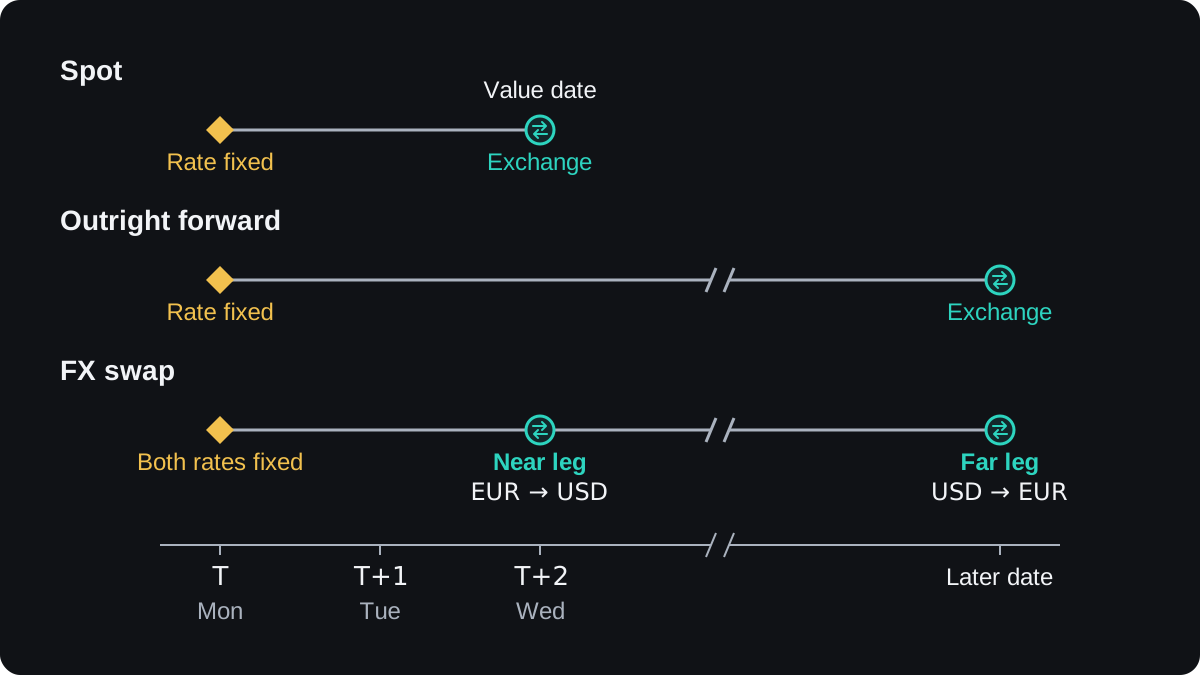
Spot is the plain exchange at today's rate. The currencies change hands on the value date, normally two business days after the trade date, written T+2. A deal struck on a Monday usually settles on Wednesday.
Deals settled the same day or the next business day also count as spot. Spot suits anyone who needs currency now, such as a pension fund paying for US bonds.
In April 2025, forex turnover (the total value of new deals) averaged $9.5 trillion a day, and spot made up $2.95 trillion of it (31%).
An outright forward is a rate agreed now for one exchange on a later date, dealt privately on terms the two sides choose. Companies use it to hedge, which means offsetting a risk they already carry.
The carmaker can fix a rate today for euros due in six months. If the euro weakens in the meantime, its income in won is already locked in. Outright forwards were $1.75 trillion a day (18%).
An FX swap is an exchange now plus the reverse exchange later, both rates set at the start. The first exchange is the near leg and the reverse is the far leg.
Banks and funds use FX swaps to borrow one currency against another. In the 2025 survey they were the largest instrument, at $4.02 trillion a day (42%).
The overnight swap on a retail account is a separate thing: a charge or credit for holding a position past the daily rollover. The swap fees lesson covers it.
What are currency swaps, futures and options?
A currency swap exchanges interest payments in two currencies over its life, with the principal exchanged at maturity. It was the smallest group in the BIS survey, at $0.16 trillion a day (2%).
A currency future works like a forward, but its terms are standardised and it trades on an exchange. The $9.5 trillion counts only deals struck directly between two parties, so futures are outside it.
An FX option gives its holder the right, without the obligation, to exchange at a set rate. A hedger can guard against a bad rate yet benefit if the market moves its way. Options were $0.63 trillion a day (7%).
Exchange or over the counter?
On a stock exchange, every order for a listed share meets in one order book. The book shows one best bid, the highest price a buyer offers, and one best ask, the lowest price a seller accepts.
Forex is mostly traded over the counter (OTC): each deal is struck directly between two parties, usually with a dealer, a firm that quotes both a buying and a selling price. Over the counter does not mean unregulated.
Each dealer sets its own bid and ask from the orders it sees and the risk it carries.
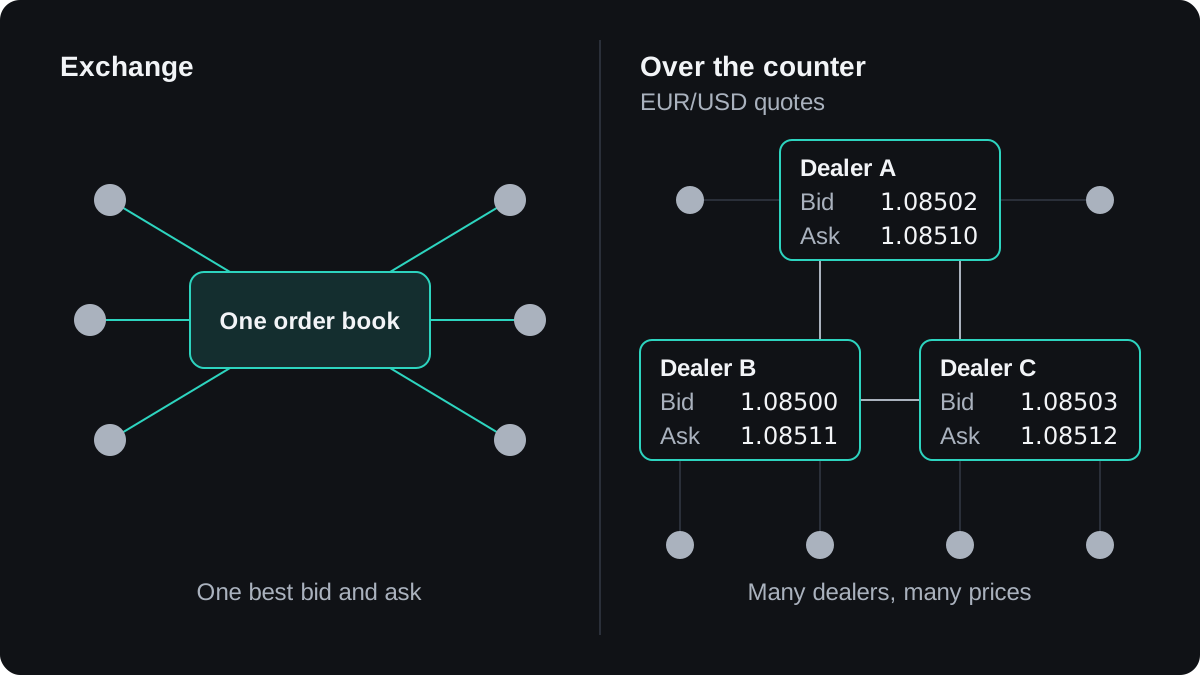
So EUR/USD trades at many slightly different prices at once. In the picture, Dealer A quotes 1.08502 / 1.08510, Dealer B 1.08500 / 1.08511 and Dealer C 1.08503 / 1.08512.
Your broker builds its quote from the prices it receives and sets a spread, the gap between bid and ask, for each account type.
Who is in the market, and where do you sit?
BIS splits turnover by who the dealer traded with: other dealers 47%, other financial institutions 49% and non-financial companies, such as exporters, about 5%.
A liquidity provider is a bank or non-bank firm that streams tradable prices to brokers and platforms. The table lists the market's main participants.
| Participant | Why they trade | How they reach the market |
|---|---|---|
| Dealer banks | Make prices, manage their own positions | With each other, directly or on venues |
| Non-bank liquidity providers | Quote prices and earn the spread | Stream prices to brokers and venues |
| Central banks | Manage reserves, steady their currency | Through dealer banks |
| Funds and asset managers | Invest abroad, hedge, take views | Through dealer banks and prime brokers |
| Companies | Pay for trade, hedge future income | Through their own bank |
| Retail traders | Profit from price changes | Through a retail broker, as CFDs or rolling spot |
Dealers trade with each other at the top, in the interbank market. Below them, prime brokers and ECNs connect funds and brokers to those prices.
A prime broker is a large bank that lets a client deal with many dealers in the bank's name. An ECN is an electronic venue where the quotes of many participants meet.
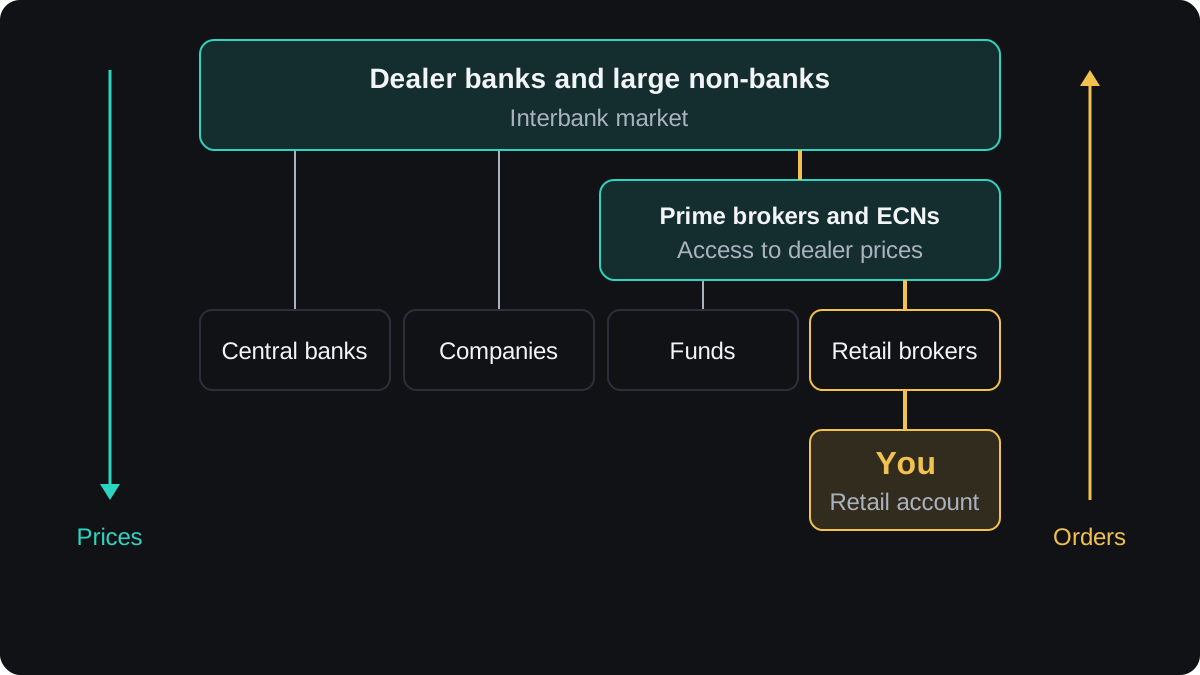
You sit at the bottom. Your orders go to your broker, and your broker gets its prices from the layers above.
What does a retail account trade?
A retail forex position is usually a contract for difference (CFD) with your broker. It pays or charges you the price change in cash, whether you bought or sold.
Some brokers describe the product as rolling spot: a spot position carried to the next value date every evening, so it never settles.
The European Securities and Markets Authority (ESMA) treats rolling spot forex as a type of CFD. Under either name no currency is delivered, and profit or loss settles in your account currency.
Your broker either takes the other side of your trade itself or passes the risk on to its liquidity providers.
CFDs are usually traded with leverage: you set aside only part of the position's value as margin, money held to keep the position open. Under EU rules, the margin on one trade works out like this:
- At 1.08510, 0.10 lot of EUR/USD is 10,000 euros, worth $10,851.
- The EU caps leverage for retail clients at 30:1 on major pairs.
- Margin is $10,851 ÷ 30 = $361.70, about $362.
The trade still gains or loses $1 a pip; leverage changes only the margin.
When ESMA studied retail CFD accounts in 2018, it found that 74% to 89% of them lost money.
The margin and stop out lesson covers what happens when margin runs short. Spreads on the same product differ by broker and account, and the spread comparison shows measured EUR/USD spreads at Exness and XM.
자주 묻는 질문
Who controls the forex market?
No single body. Prices come from dealers trading with each other and with their clients. US authorities, acting through the New York Fed, intervene only to counter disorderly markets, and have rarely done so since the mid-1990s.
What is the difference between spot and forward forex?
Spot is an exchange at today's rate, settled within two business days. A forward fixes a rate now for an exchange on a later date.
Is forex traded on an exchange?
Mostly not. Spot, forwards and FX swaps are dealt over the counter, directly between two parties, while currency futures trade on exchanges.
Is a forex CFD the same as owning currency?
No. A CFD pays or charges the price change in cash, and no currency is delivered. EU regulators treat rolling spot forex as a type of CFD too.
What leverage can EU retail traders use on forex?
Up to 30:1 on major pairs. A 0.10 lot EUR/USD position worth $10,851 then needs about $362 of margin.
이어서 배우기
 챕터 1What is forex trading?Forex trading is exchanging one currency for another, either because a business needs the currency or to profit from a change in the exchange rate. Prices are quoted in pairs such as EUR/USD, with a bid to sell at and an ask to buy at. Forex turnover averaged $9.5 trillion a day in April 2025.
 챕터 1What is traded in the forex market?The forex market trades currencies, always two at a time: every deal buys one and pays with another. Eight are known as the majors, and the US dollar was on one side of 89% of turnover in April 2025. A retail trader receives no currency and instead holds a cash-settled contract with a broker.
 챕터 1How does buying and selling a currency pair work?Buying a currency pair buys the first currency and sells the second, so you gain if the price rises. Selling does the opposite and gains if it falls. A buy opens at the ask and closes at the bid, and a sell does the reverse. Profit and loss land in the quote currency.
 챕터 1How big is the forex market, and what is liquidity?Forex turnover averaged $9.5 trillion a day in April 2025, in the final results of the BIS Triennial Survey. The figure adds up the face value of new deals. Liquidity is how easily you can trade without moving the price. In AutoFXRebate's measurements, EUR/USD spreads held steady through the sessions and widened sharply at the daily rollover.

