Risk management for crypto traders.
Crypto risk management is a set of limits fixed before you trade: how much one trade can lose, how much all open trades can lose together, how much leverage you use and where you keep your coins. It matters more in crypto because prices move fast and some losses, such as an exchange failure, never show on a chart.
เนื้อหานี้ยังมีเฉพาะภาษาอังกฤษ
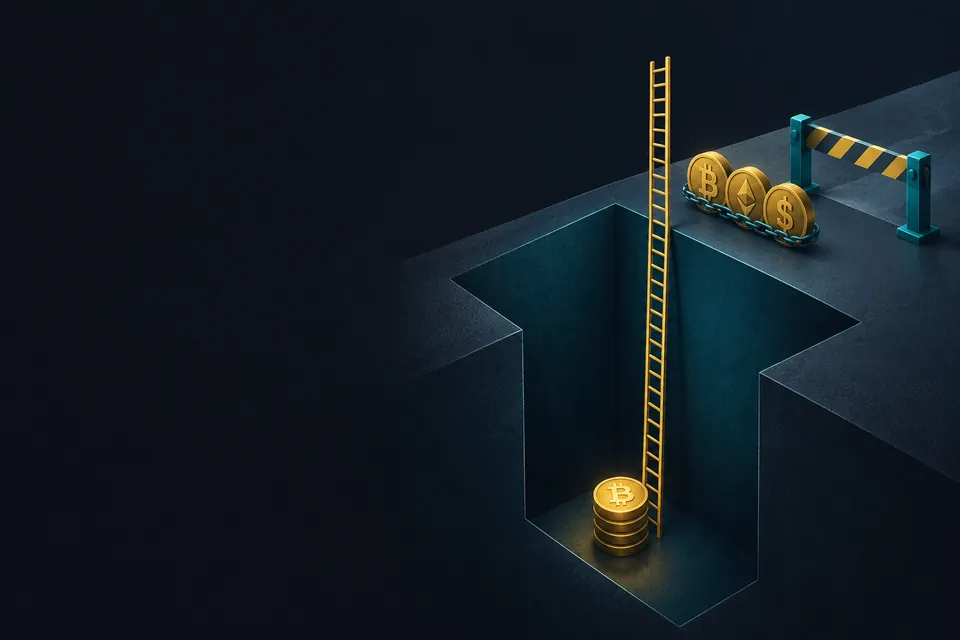
A trader who loses half an account needs to double what is left just to get back to the start. In crypto, where a coin can halve in a few weeks, that hole is easy to fall into.
Risk management is the set of limits you decide before you trade, so that no single loss or bad month can end your trading. The forex lesson on risk management covers the general idea.
This lesson adds what changes when you trade coins.
What does risk management cover in crypto?
Four limits do most of the work. The first three apply in any market, and the fourth matters more in crypto than almost anywhere else.
- The loss you accept on one trade.
- The loss you accept on all open trades together.
- The leverage you use, if any.
- Where your money and coins are held.
Write the limits down before you need them. Here is an illustrative set for a $10,000 account, to show the form a plan can take. Choose your own numbers.
- At most 1% at risk per trade, which is $100.
- At most 3% at risk across all open trades, which is $300.
- No new trades for the rest of the week after losing 5%, which is $500.
- Only the money you trade with kept on an exchange.
How much should one trade risk?
The loss on one trade comes from two numbers you control: position size and stop distance. The lesson on sizing a crypto position turns a risk limit into a coin amount.
Every method has losing streaks, so that loss needs to stay small. Ten losses in a row at 1% of the balance each take $10,000 to $9,043.82, a fall of about 9.6%.
At 5% each, the same streak leaves $5,987.37, a fall of about 40.1%. The forex lesson on risk per trade works through those sums at more risk levels.
Why do deep losses take so long to repair?
After a loss you have less money working for you, so the next gain has to be bigger. The gain you need to get back to the start is loss ÷ (1 minus loss), and it grows fast:
- Lose 10%, and you need 11.1% to recover.
- Lose 25%, and you need 33.3%.
- Lose 50%, and you need 100%.
- Lose 80%, and you need 400%.
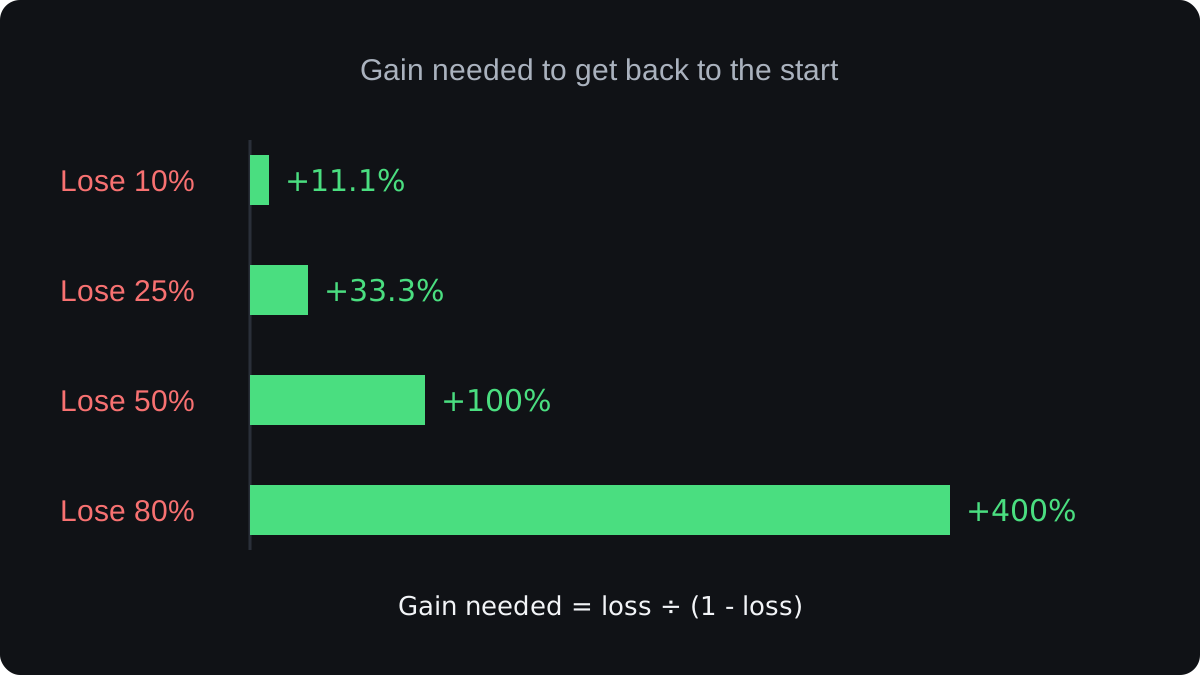
Crypto makes the last row realistic. Put all $10,000 into one coin that falls 80% and you hold $2,000. It has to grow to five times its size, a 400% gain, to reach $10,000 again.
The forex lesson on drawdown and recovery shows how long a climb like that can take.
Why can several coin trades be one bet?
Coins often rise and fall together, and the link tends to tighten in a sharp sell-off, when traders sell whatever they hold. Three trades in three different coins can then behave like one large trade.
Say you open three trades, each risking 1% of $10,000, which is $100. On a calm day they move separately.
On a day the whole market drops, all three stops trigger at once. You lose $300, or 3%, and more if the stops slip.
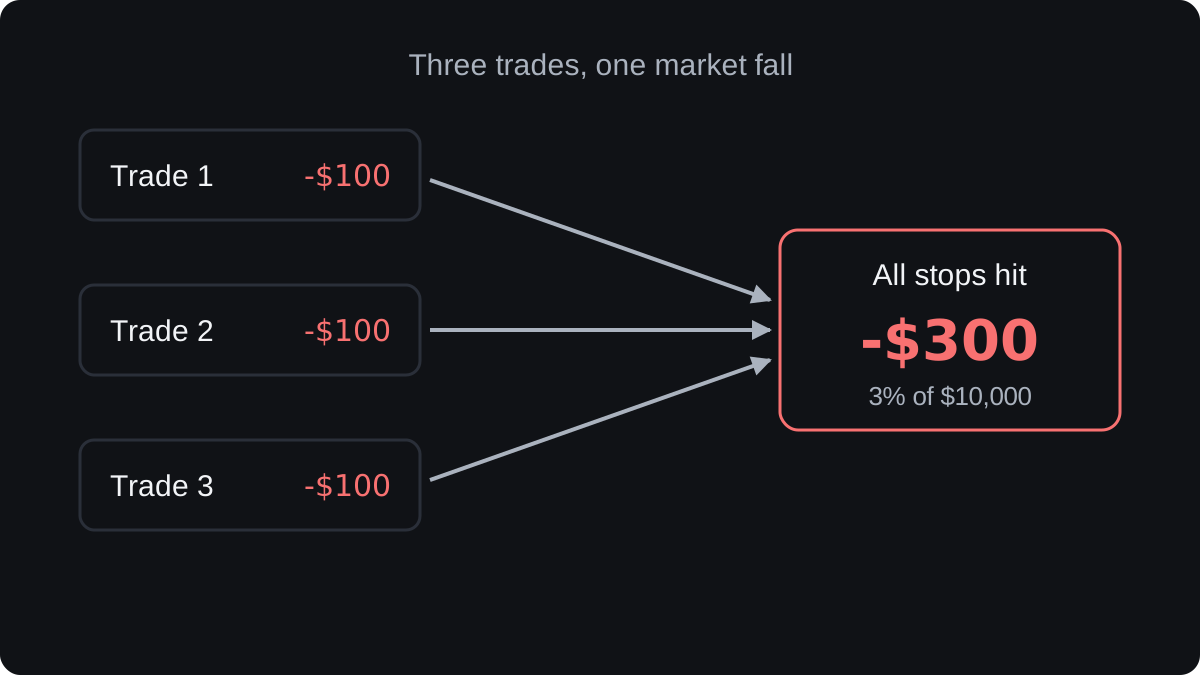
That is why a limit on total open risk matters as much as the limit per trade. The forex lesson on correlation and portfolio risk explains how to count exposure that overlaps.
How does leverage change the picture?
On a crypto CFD you put up margin and the broker lets you hold a larger position. With $1,000 of margin at 5:1, you control $5,000 of a coin.
A 20% fall in price then loses 20% of $5,000, which is $1,000, the whole margin. In general, the fall that wipes out the margin is 1 ÷ leverage: 50% at 2:1, 20% at 5:1 and 10% at 10:1.
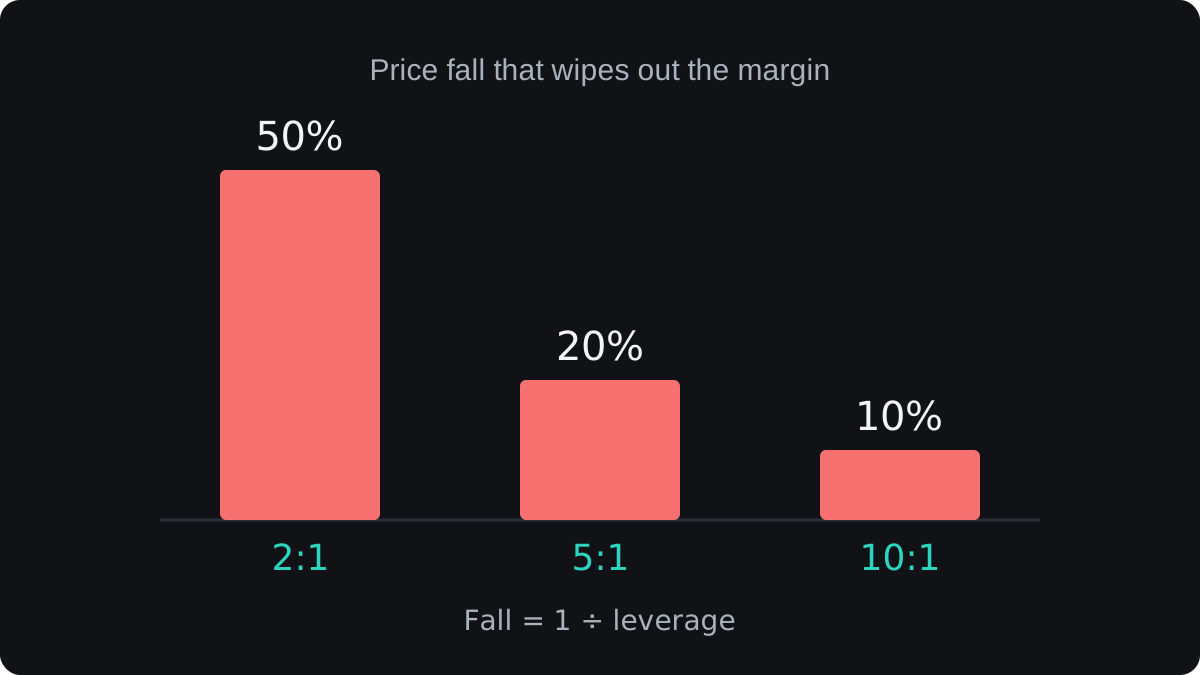
With little else in the account, the broker's stop out can close the trade before that point, depending on the level the broker sets. Spare money in the account delays the stop out, so the loss can pass the margin.
Crypto prices have fallen more than 20% in a single day before, so 5:1 leaves little space for error.
The lesson on leverage on crypto CFDs shows how margin and stop out work on these contracts.
What risks can a stop loss not cover?
A stop protects you against price moves on one trade. Several crypto losses come from somewhere else, and each needs a rule of its own.
An exchange can fail or freeze withdrawals, and coins held there can be lost or stuck whatever your stop says. Keeping only trading funds on an exchange limits that loss.
A wallet you control takes the exchange out of the picture and brings its own risk: lose the keys and the coins are gone. The lesson on types of crypto wallet compares the two set-ups.
Scams aim at traders directly, through fake trading platforms and people posing as support staff. The lesson on common crypto scams shows how they work.
Stablecoins can lose their peg too. If you park profits in one, you carry the risk of the company or system that keeps it at one dollar.
คำถามที่พบบ่อย
What is the 1% rule in crypto trading?
It caps the loss on any one trade at 1% of your account, set through the stop distance and the position size. On $10,000 that is $100 per trade, whatever the coin's price.
Is a stop loss enough to manage crypto risk?
No. A stop limits the price loss on one trade, and in a fast market it can slip or, as a stop-limit, not fill. It does nothing about trades that fall together, or coins lost when an exchange fails.
How much leverage is safe for crypto?
No level is safe in itself. The fall that empties your margin is 1 ÷ leverage, which is 20% at 5:1. The broker's stop out can come earlier, or later if the account holds spare money.
Should I keep my coins on an exchange?
Coins on an exchange are only as safe as the exchange. Keeping only trading funds there limits what a failure can cost, while a wallet you control brings the risk of lost keys.
เรียนต่อ
 บทที่ 3How volatile is crypto?Crypto is one of the most volatile markets you can trade. Even the largest coins can move several percent in a day, smaller coins usually move more, and Bitcoin has fallen more than 70% from a peak more than once. You measure volatility as the usual size of moves in percent, which lets you compare any two coins.
 บทที่ 3How to size a crypto position.To size a crypto position, divide the money you accept losing by the distance from your entry to your stop. With $100 at risk, an entry at 50,000 and a stop at 47,500, you buy 100 ÷ 2,500 = 0.04 coin, a position worth $2,000. Round down to the exchange's order step and allow for fees.

