How to size a crypto position.
To size a crypto position, divide the money you accept losing by the distance from your entry to your stop. With $100 at risk, an entry at 50,000 and a stop at 47,500, you buy 100 ÷ 2,500 = 0.04 coin, a position worth $2,000. Round down to the exchange's order step and allow for fees.

Two traders each put $2,000 into crypto. One buys a large coin and sets a stop 5% below the entry. The other buys a small coin with a stop 15% below.
If both stops are hit, the first loses $100 and the second loses $300. They spent the same amount and took very different risks.
Position sizing is choosing how much to buy so that hitting your stop costs a set amount of money. You decide the loss first, and the position value follows from it.
What do you need before you size a trade?
You need three numbers: your account balance, the share of it you accept losing on this trade, and the price where your stop loss sits.
A common rule caps the loss on one trade at 1% to 2% of the account, and the forex lesson on risk per trade explains why. This lesson uses 1% of a $10,000 account, which is $100.
The stop comes from the chart, before the size. It belongs where the trade idea is proven wrong, outside the coin's normal swings. The forex lesson on ways to place a stop loss covers the methods.
Crypto has no standard pip, so you measure the stop distance in price or in percent. A stop at 47,500 under an entry at 50,000 is 2,500 away, which is 5%.
How do you turn risk into a coin amount?
The formula is: coins to buy = money at risk ÷ stop distance. Here it is step by step, with illustrative prices:
- Your account holds $10,000 and you risk 1%, so $100.
- You buy at 50,000 and place the stop at 47,500, a distance of 2,500.
- Coins to buy: 100 ÷ 2,500 = 0.04 coin.
- Position value: 0.04 × 50,000 = $2,000.
- Check: if the stop is hit, you lose 0.04 × 2,500 = $100.
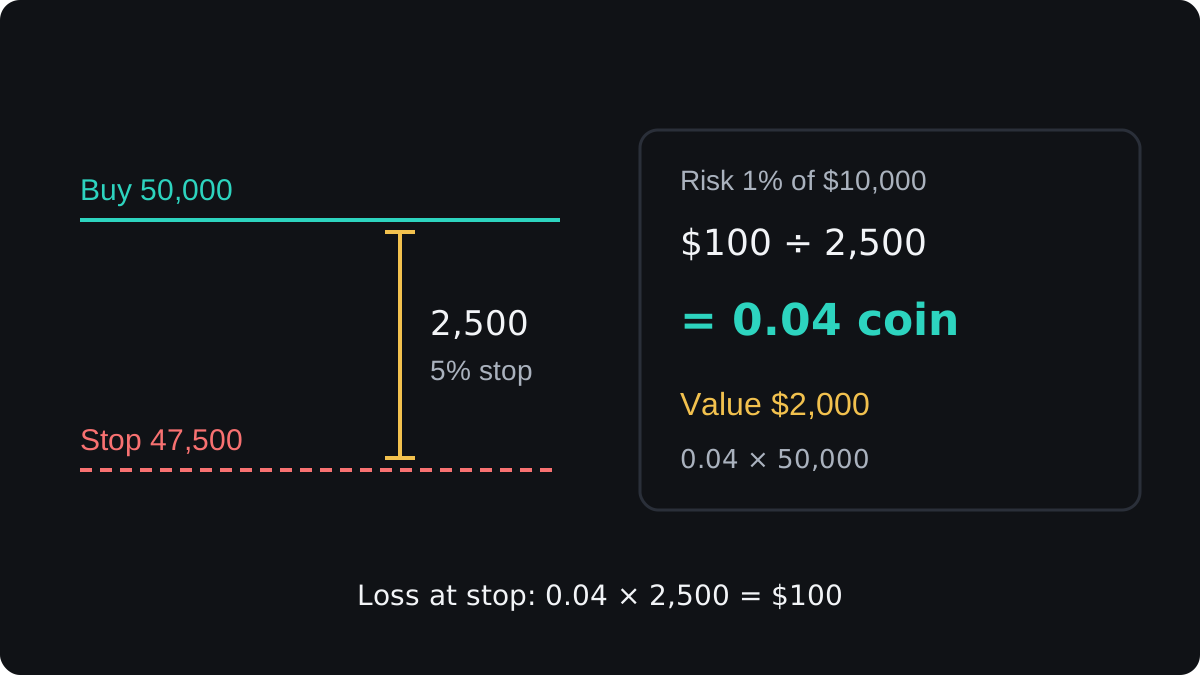
You spend $2,000 and risk $100. Those are two different numbers, and the distance to the stop is what connects them.
A shortcut in percent gives the position value directly: position value = money at risk ÷ stop distance in percent. Here, $100 ÷ 5% = $2,000.
Exchanges set a minimum order and a size step, such as an illustrative 0.001 coin. Always round down, so the loss stays at or under your plan. The forex lesson on position size shows the same rounding with lots.
Why does a wider stop mean a smaller position?
Volatile coins need wider stops, and the formula shrinks the position to match. Take a small coin at 2.00 with a stop at 1.70, a 15% distance, and the same $100 of risk:
- Stop distance: 2.00 minus 1.70 = 0.30.
- Coins to buy: 100 ÷ 0.30 = 333.33, rounded down to 333.
- Position value: 333 × 2.00 = $666.
- Loss at the stop: 333 × 0.30 = $99.90.
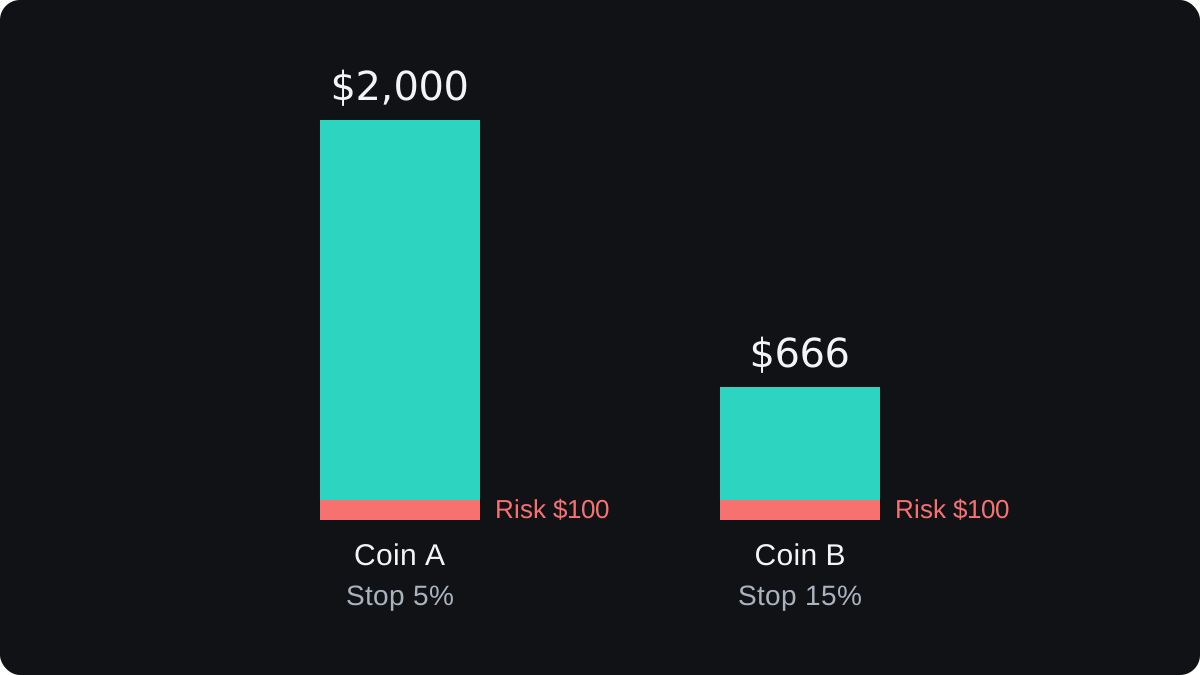
The two trades risk the same money, and the more volatile coin gets a third of the position.
The lesson on how volatile crypto is shows how to measure the swings a stop has to clear.
Tight stops push the other way. A stop 0.5% away gives $100 ÷ 0.5% = $20,000, twice the whole account.
On a spot exchange you cannot buy that without borrowing. Ask, too, whether a stop that close can survive the coin's ordinary swings.
How do fees and slippage change the size?
Fees come out of every trade. Say the exchange charges 0.1% on each side, an illustrative rate. Buying 0.04 coin at 50,000 then costs 0.1% of $2,000, which is $2.00.
Selling at the stop is a sale of 0.04 × 47,500 = $1,900, so its fee is $1.90. The full loss at the stop becomes $100 + $2.00 + $1.90 = $103.90.
To hold the total near $100, add the fees per coin to the stop distance:
- Fees per coin: 0.1% of 50,000 plus 0.1% of 47,500 = 50 + 47.50 = 97.50.
- Cost per coin if the stop is hit: 2,500 + 97.50 = 2,597.50.
- Coins to buy: 100 ÷ 2,597.50 = 0.0385, rounded down to 0.038.
- Loss at the stop: 0.038 × 2,500 = $95.00, plus $1.90 and $1.81 in fees, so $98.71.
The maker and taker fees lesson explains why the rate can differ between buying and selling.
Slippage is harder to plan, and how it hurts depends on the kind of stop.
A stop-market order becomes a market order once price reaches your level. It then fills at the next prices available, which in a fast fall can be well below the stop.
If a stop-market order at 47,500 fills at 46,500, the loss on 0.04 coin is 0.04 × 3,500 = $140 instead of $100.
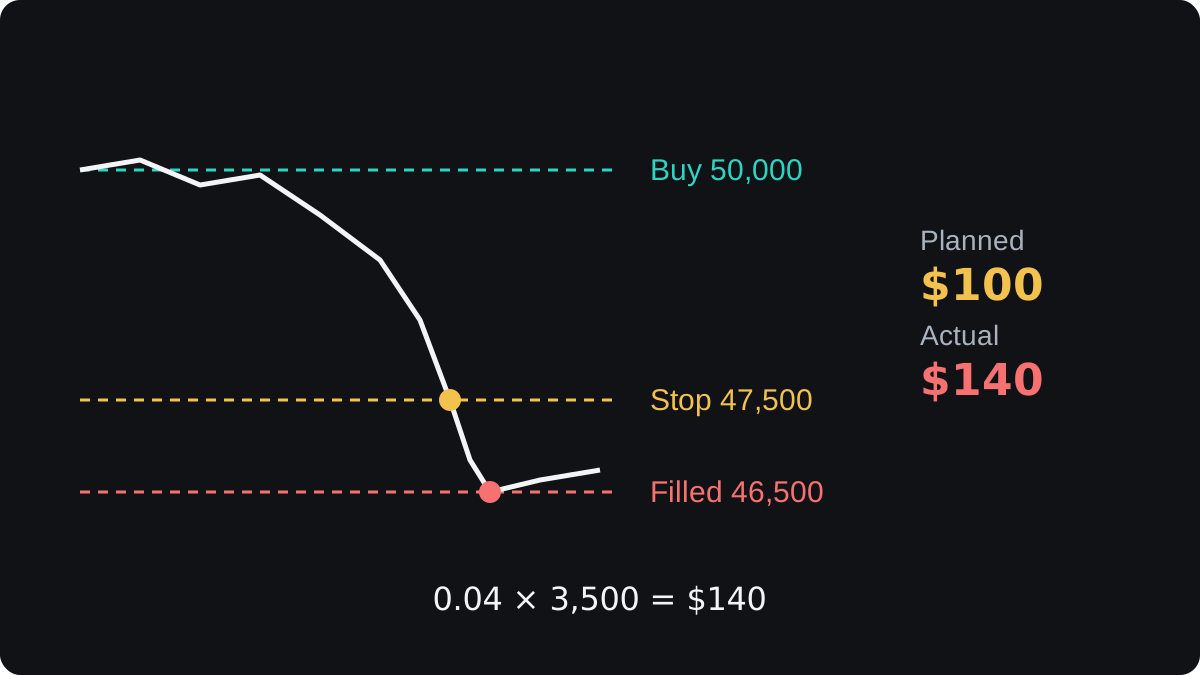
A stop-limit order becomes a limit order instead, with a lowest price you accept. It never sells below that limit. If price drops straight past it, the order sits unfilled and you still hold the coin as it falls.
Neither kind makes a fast market safe. Some traders leave room by sizing on a slightly lower risk, such as 0.8% when their limit is 1%, so a bad fill still lands close to plan.
How does sizing work on a crypto CFD?
A crypto CFD is a contract with a broker on a coin's price, and you trade it in lots. Size it in coins exactly as above, then convert to lots.
Each broker sets its own contract size, so open the contract specification and find how many coins one lot stands for. Then lots = coins ÷ coins per lot.
If a specification listed 1 coin per lot, 0.04 coin would be 0.04 lot. At 0.1 coin per lot, it would be 0.04 ÷ 0.1 = 0.4 lot. Check the minimum lot and step, and round down.
On a CFD the spread is part of the cost, like the exchange fee above. For a buy, measure the stop distance from the ask, the price you actually pay.
Leverage changes only the margin you put up. At an illustrative 2:1, the $2,000 position ties up $1,000 of margin and still loses $100 at the stop, because the loss depends on size and distance.
The lesson on leverage on crypto CFDs covers margin and stop out.
Holding a CFD overnight can add a swap fee for each night you keep it. For a trade you plan to hold for weeks, count it in the cost, the same way as the exchange fees above.
Questions
How much of my account should go into one crypto trade?
Work from the loss at your stop and let the position value follow. With 1% risk, a 5% stop gives a position worth 20% of the account, and a 10% stop gives 10%.
Should I size crypto trades in coins or in dollars?
Plan the risk in your account currency, then convert it into coins with the stop distance. The order itself goes in coins on an exchange, or in lots on a CFD.
Does leverage let me risk more on a trade?
Leverage lets you open a bigger position with the same margin. The risk is still size times stop distance, so a bigger position at the same stop risks more money.
What if the formula gives less than the minimum order?
Then the trade does not fit your risk limit at that stop. Skip it or wait for a setup with a closer stop, instead of buying the minimum and risking more than planned.
Keep learning
 Chapter 3How volatile is crypto?Crypto is one of the most volatile markets you can trade. Even the largest coins can move several percent in a day, smaller coins usually move more, and Bitcoin has fallen more than 70% from a peak more than once. You measure volatility as the usual size of moves in percent, which lets you compare any two coins.
 Chapter 3Risk management for crypto traders.Crypto risk management is a set of limits fixed before you trade: how much one trade can lose, how much all open trades can lose together, how much leverage you use and where you keep your coins. It matters more in crypto because prices move fast and some losses, such as an exchange failure, never show on a chart.

