Crypto trading principles that hold up.
The crypto trading principles that hold up rest on arithmetic and behaviour, so they apply to any coin. Risk a small fixed share of the account on each trade, let the stop decide the size, expect fills worse than your stop, size the trade before leverage, count every fee, and keep your money safe outside the trade.
เนื้อหานี้ยังมีเฉพาะภาษาอังกฤษ

Coins rise and fade, and so do the popular ways of trading them. The principles below last longer because they rest on arithmetic and on how people act under pressure.
None of them makes a trade win. They limit how much damage the losing trades can do, so you still have money to trade with after a losing run. All numbers here are round figures for illustration.
Risk a small, fixed share on each trade
Picture two traders who each start with $5,000 and then lose ten trades in a row. One risks 1% of the current balance on each trade. The other risks 10%.
- At 1%: $5,000 × 0.99 to the power of 10 = $4,521.91, a fall of about 9.6%.
- At 10%: $5,000 × 0.90 to the power of 10 = $1,743.39, a fall of about 65%.
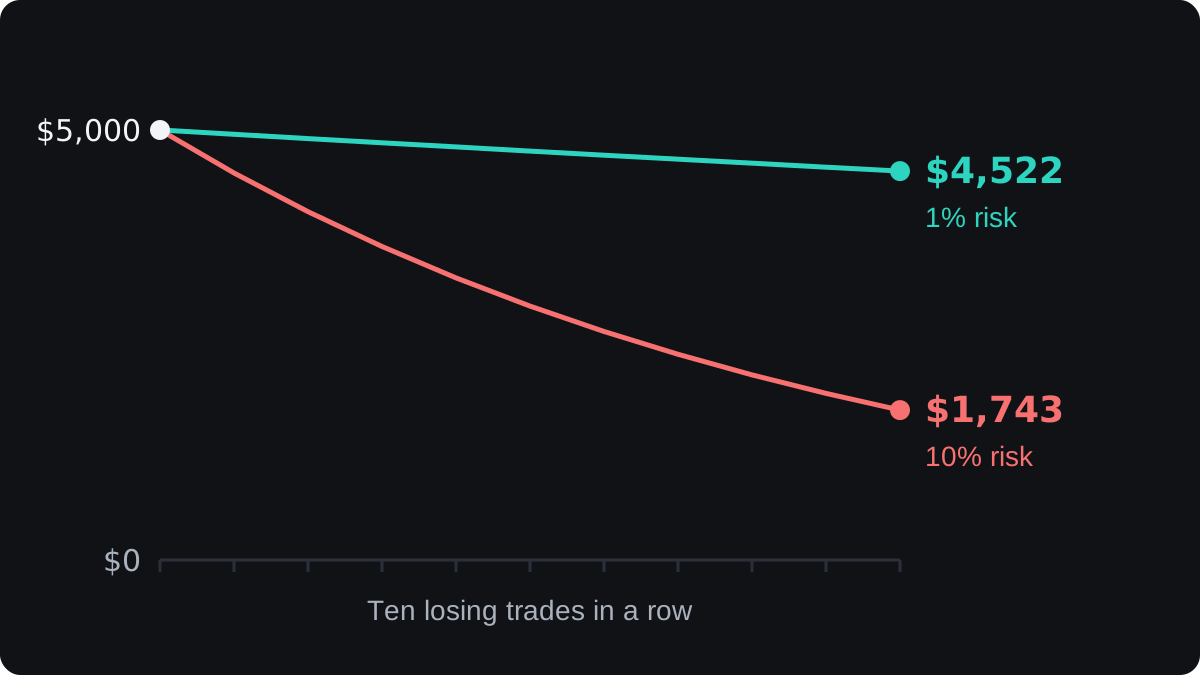
To get back to $5,000, the first trader needs a gain of about 10.6%. The second needs about 187%, nearly tripling what is left.
Losing streaks happen to sound strategies too. A small fixed risk lets you live through them with enough money to keep trading. The lesson on risk per trade works through other percentages.
Let the stop decide the position size
Crypto prices swing more than most currency pairs. A stop that sits outside the normal noise is often several percent from the entry, and that distance, together with your risk limit, sets the size.
Keep the risk at $50, which is 1% of $5,000:
- Stop 2% below the entry: position = $50 ÷ 0.02 = $2,500.
- Stop 8% below the entry: position = $50 ÷ 0.08 = $625.
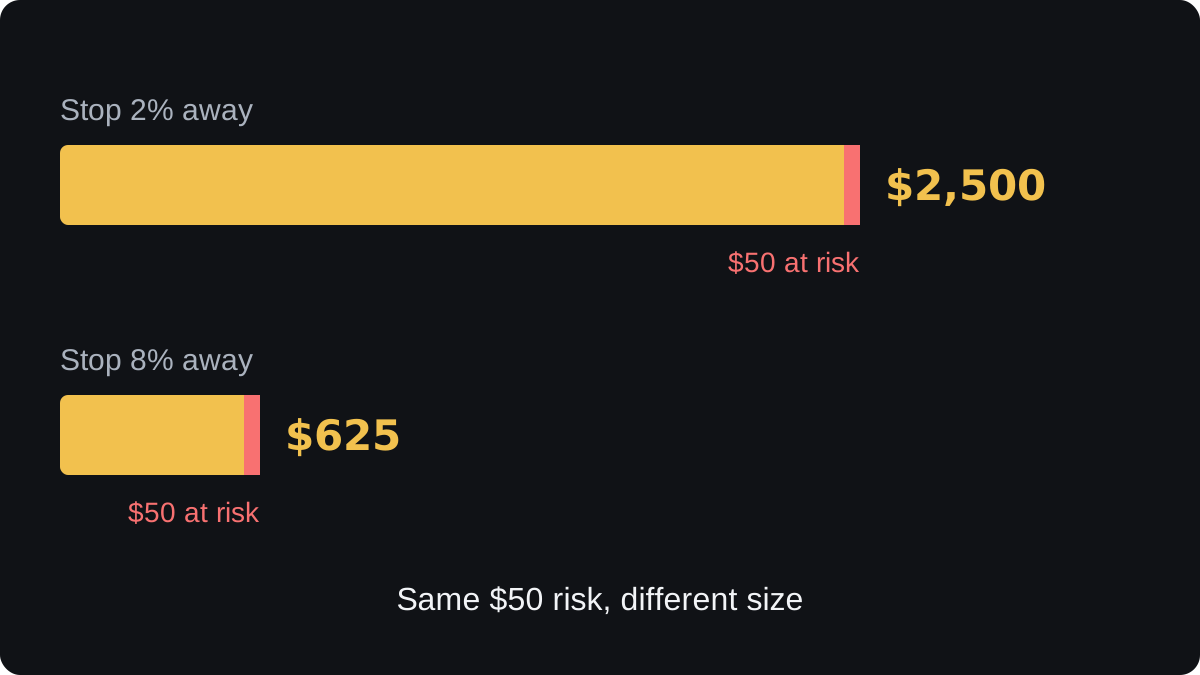
Both trades lose the same $50 at the stop. You fit the size to the stop. Pulling the stop closer just to buy more puts it where ordinary swings will hit it.
The lesson on position sizing for crypto works through more examples.
Expect fills worse than your stop
A stop loss tells the platform to exit once price reaches a level. In a fast fall, the next available price may be well past that level, and the order fills there. That difference is slippage.
Crypto exchanges trade around the clock, and order books can be thin at quiet hours. Sharp moves also happen when many stops and forced closes of leveraged positions fire at once.
Say you hold 10 coins bought at $100, with a stop at $95 for a planned loss of $50. In a sudden drop the stop fills at $93.
The loss is 10 × $7 = $70, which is 1.4% of $5,000 instead of 1%.
Crypto CFDs can also gap if your broker pauses its crypto prices at weekends, as the lesson on trading crypto at weekends explains. Size each trade so that a bad fill still leaves a loss you can accept.
Size the trade first, then look at leverage
On a crypto CFD, leverage lets you open a position larger than the margin you put down. At 1:10, a $10,000 position needs $1,000 of margin.
Leverage does not change what a price move is worth. A 10% fall on a $10,000 position loses $1,000 at any leverage. At 1:10, that one move equals the whole margin.
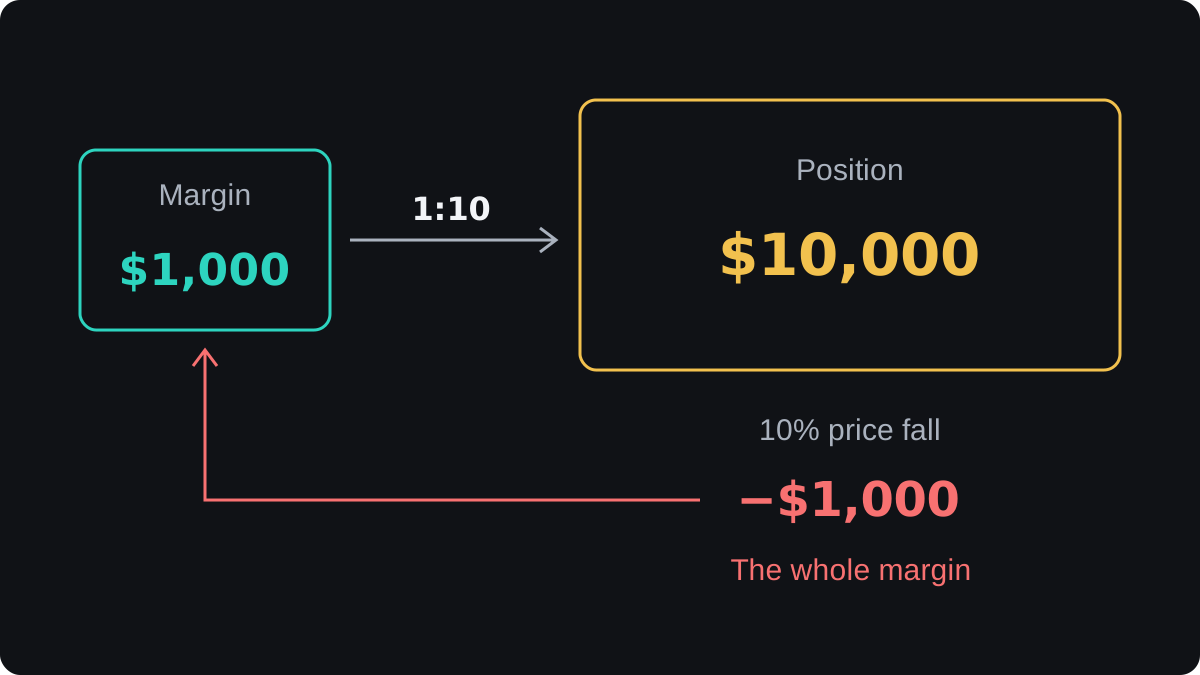
So work out the size from your risk limit first. Leverage then decides only how much margin is locked, and the rest of the account stays free as a buffer.
Brokers and regulators usually allow less leverage on crypto than on major currency pairs, and the limits differ by country. The lesson on leverage on crypto CFDs covers margin calls and stop outs.
Count costs, and trade less often
Every round trip pays fees and the spread. Each one looks small, and they add up fast when you trade often. Say each round trip costs 0.2% of the position, and you trade a $5,000 position 20 times a month:
- Cost per trade: 0.2% of $5,000 = $10.
- Cost per month: 20 × $10 = $200.
- Share of the account: $200 ÷ $5,000 = 4% a month.
That 4% is gone before any trade is right or wrong. The lesson on overtrading shows how extra trades add up, and maker and taker fees explains how exchanges charge.
Protect the money outside the trade
Some crypto losses have nothing to do with the chart. Exchanges have failed and frozen withdrawals, and accounts get emptied after a stolen password.
Keep only the money you trade on a platform, and turn on 2FA. Never type a seed phrase or password into a site you reached from a message.
Treat any promise of a guaranteed return as a warning sign. The lesson on common crypto scams shows the usual patterns.
คำถามที่พบบ่อย
What is the 1% rule in crypto trading?
It is a common rule of thumb: lose at most 1% of the account if the stop loss is hit. No single figure suits everyone, and the position itself can be worth far more than 1% of the account.
Are crypto trading principles different from forex?
The arithmetic is the same. Crypto adds wider price swings and trading at all hours, so stops tend to sit further away and positions come out smaller. Coins left on an exchange also carry the risk of that exchange failing.
Should I use leverage when trading crypto?
Leverage only changes the margin you set aside, so the question that matters is position size. If you use it, size from your risk limit first and keep spare margin, because a fast move can close the position.
Why did my stop loss lose more than I planned?
A triggered stop becomes an order to exit at the next available price. In a fast market or after a gap, that price can be well past your stop, so allow for it when you size the trade.
เรียนต่อ
 บทที่ 2How to start trading crypto.To start trading crypto, first decide whether you want to own coins on an exchange or trade the price through a broker's CFDs. Then secure the account with 2FA, learn what each trade costs, practise on a demo or with tiny sizes, and set a fixed risk per trade before you choose a coin.
 บทที่ 2How to build a crypto trading strategy.To build a crypto trading strategy, choose one market, instrument and timeframe, then pick one idea you can explain, such as following trends. Write exact rules for the filter, entry, stop, target and size, so every number comes from the rules. Test them on past prices with fees included, then forward test before risking real money.
 บทที่ 2A crypto trade from plan to exit.This example follows one bitcoin trade with round illustrative numbers. A $10,000 account risks 1%, so $100. Entry is $60,000, the stop $57,500 and the target $65,000, which gives a size of 0.04 BTC. The target is hit, and after $5 of fees the result is $195, or 1.95 times the amount risked.
 บทที่ 2How to keep a crypto trading journal.Keep a crypto trading journal by writing the plan before each trade: venue, pair, setup, entry, stop, target, size in coins and risk in money. After the exit, record each fee as charged, the net result and R, and whether you followed the plan. Log deposits, withdrawals and wallet moves in a separate transfer log.

