What is a blockchain?
A blockchain is a record of transactions stored in batches called blocks. Each block carries a fingerprint, called a hash, of the block before it, and thousands of computers keep identical copies. Changing an old entry would break every link that follows it, which makes the record very hard to rewrite.
เนื้อหานี้ยังมีเฉพาะภาษาอังกฤษ

Say you send 0.1 bitcoin to a friend. No bank approves it, and no company keeps the record.
About ten minutes later, the payment sits inside a block on a list that thousands of computers keep in identical copies. That shared list is called a blockchain.
What a blockchain looks like
A blockchain is a list of records grouped into batches called blocks. New blocks are only ever added to the end, in order.
Bitcoin was the first working blockchain. Its network started in January 2009, and every bitcoin payment since then is still in the same chain. The coin itself is covered in what is Bitcoin.
Each block has two parts. The body holds the transactions. The header is a short summary: it holds the time, a fingerprint of this block's transactions and a fingerprint of the block that came before.
How the blocks are chained together
Each fingerprint is a hash. A hash function turns any data, even a whole block, into a short string of fixed length. Change one character of the input and the output changes completely.
Bitcoin uses a function called SHA-256. Its output is always 256 bits, written as 64 hexadecimal characters (0 to 9 and a to f). The hashing lesson shows how that works.
Every block header stores the hash of the block before it. Block 102 points to block 101, block 101 points to block 100, and so on back to the very first block. Those links are the chain in the name.
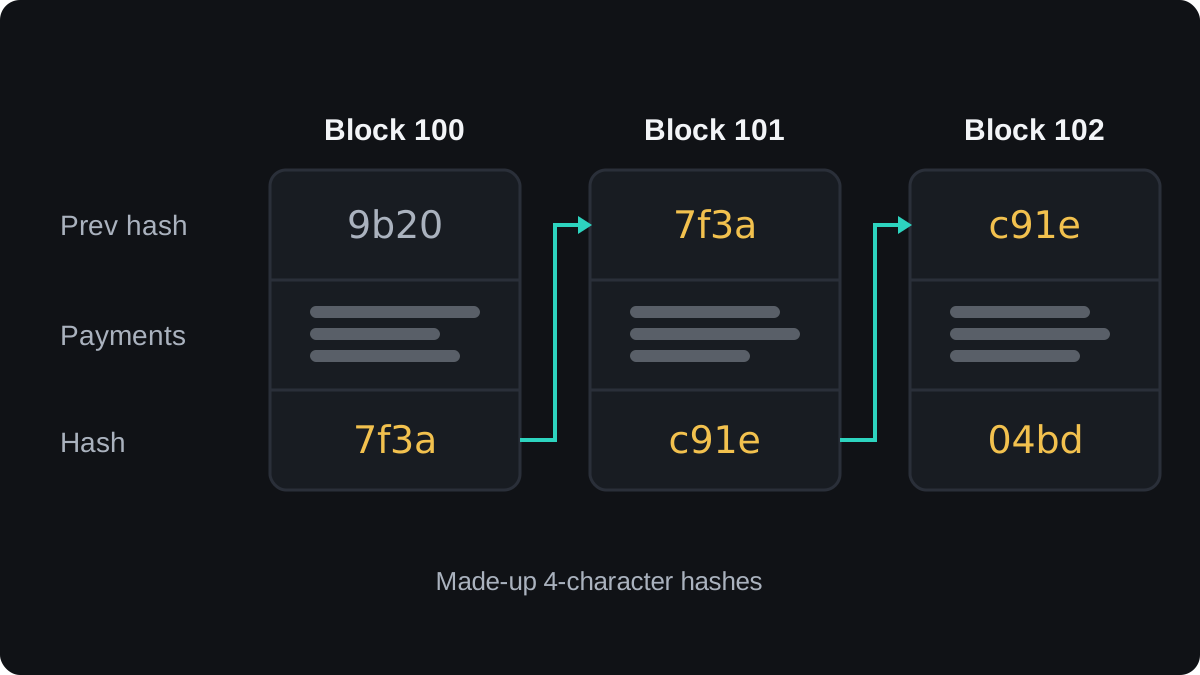
The hashes in the picture are made-up four-character stand-ins. A real Bitcoin block hash is 64 characters long.
Why changing an old block breaks the chain
Suppose someone edits block 101 so that a payment of 0.1 BTC reads 1.0 BTC. The transactions changed, so their fingerprint in the header changes, and so does the hash of block 101: from c91e to 5e88 in this example.
Block 102 still stores the old hash, c91e. The two no longer match. Every computer that checks the chain sees the break at once and rejects the edited copy.
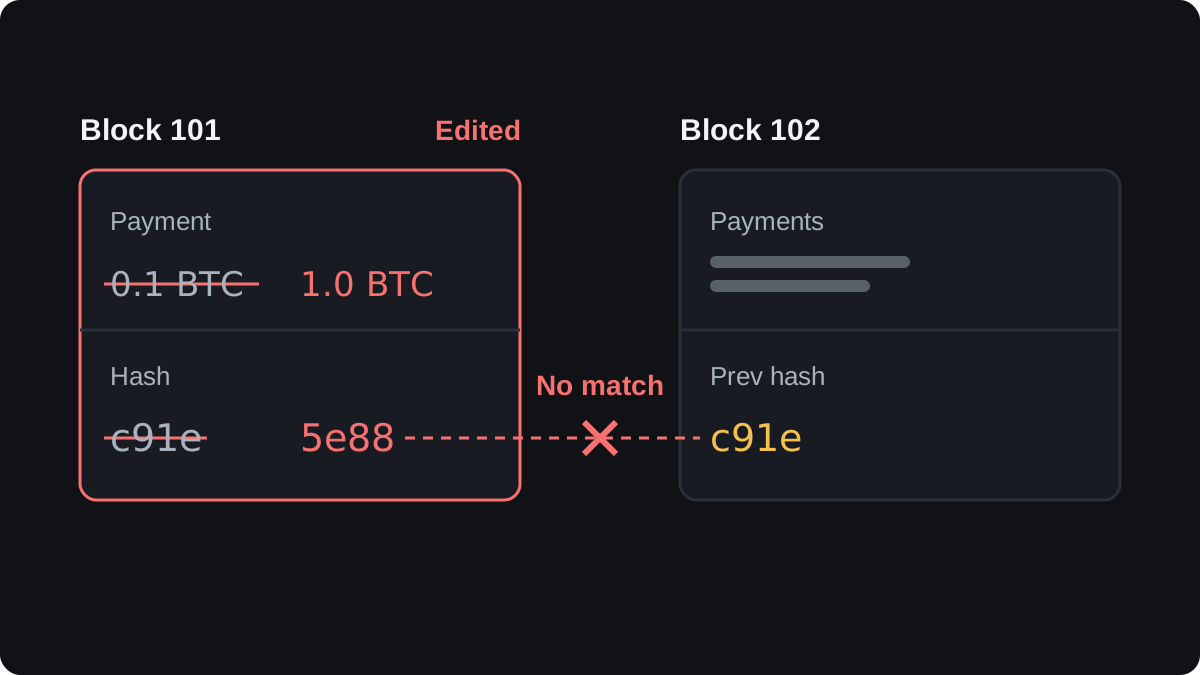
To hide the edit, a forger would have to rebuild block 102, then 103, and every block after it.
On Bitcoin each rebuilt block takes a huge amount of computing work. Meanwhile, the rest of the network keeps adding new blocks on top of the honest chain.
This is why people call a blockchain immutable, meaning unchangeable. History can be rewritten in theory. In practice the cost grows with every block stacked on top, and on a large chain it becomes enormous.
Who adds the next block
Thousands of computers hold a copy, which makes a blockchain one kind of distributed ledger. Those computers need a shared rule for deciding who writes the next block. That rule is the consensus mechanism.
Bitcoin uses proof of work. Computers called miners compete to solve a costly puzzle, and the winner adds the next block.
Ethereum moved to proof of stake in 2022. Validators lock up coins as a deposit, and the network picks one of them at random to propose each new block. Proof of work vs proof of stake compares the two.
Whoever proposes a block, the other computers check it before adding it to their copy. A block that spends the same coins twice or carries a forged signature is thrown away.
These checking computers are called nodes. The node lesson explains what they store and why people run one.
Confirmations: how deep is your payment?
Every block added after the one holding your payment counts as one more confirmation. A payment in the newest block has one confirmation. Five blocks later, it has six.
Here is a worked example with round numbers, for illustration:
- You send a payment. Bitcoin aims for one block every 10 minutes on average.
- Your payment lands in block 100. It now has 1 confirmation.
- Blocks 101 to 105 follow. It now has 6 confirmations.
- Six blocks at about 10 minutes each take 6 × 10 = 60 minutes from the moment you send.
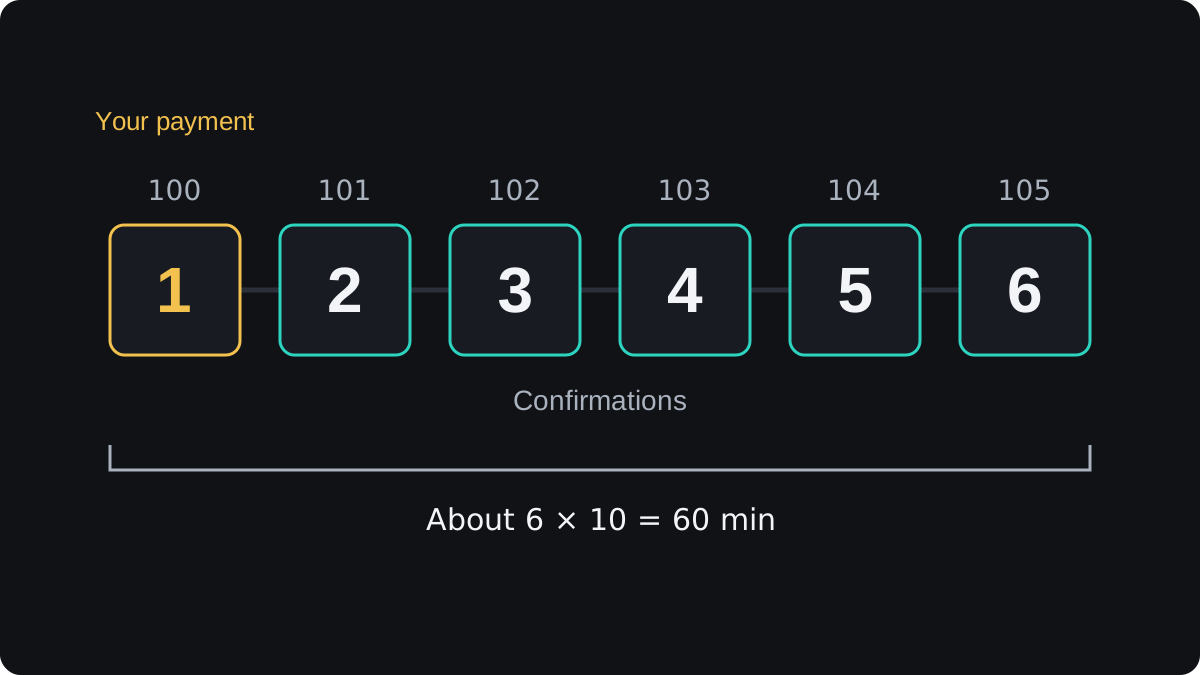
Block times vary a lot. One block can arrive after a minute and the next after forty, so 60 minutes is a typical wait and the real one can be shorter or longer.
Now and then two miners find a block at almost the same moment, and the network keeps only one. Payments that were only in the dropped block go back to waiting, so one confirmation is not final.
Exchanges and merchants choose how many confirmations to wait for before they credit a deposit. Each extra block makes a rewrite more expensive. The send and receive lesson shows where you see this count.
What a blockchain cannot do
A blockchain records whatever its rules allow. It cannot tell whether a payment was a good idea. If you send coins to a scammer, that payment is perfectly valid and stays in the record for good.
There is no help desk either. Nobody can reverse a payment for you, and if you lose the private key that controls your coins, nobody can move them again.
Public chains are open to read. Addresses do not show names, yet anyone can follow every transfer between them.
Keeping thousands of copies in step is also slow and costly next to one company's database. What makes a blockchain different from a database looks at when that trade is worth making.
คำถามที่พบบ่อย
Is a blockchain the same as Bitcoin?
No. Bitcoin is a currency that runs on its own blockchain. Ethereum and many other networks keep separate blockchains with their own rules.
Can a blockchain be hacked?
Rewriting the history of a large public chain is extremely expensive, so most losses happen elsewhere: stolen keys, hacked exchanges and buggy apps. Small chains with little computing power or stake behind them have had recent blocks rewritten.
Where is a blockchain stored?
On every full node that runs the network's software. There is no central server. Each node keeps its own copy and checks every new block itself.
Can data on a blockchain be deleted?
Not in practice. Old blocks stay in every copy, which is why personal data should never be written to a public chain.
เรียนต่อ
 บทที่ 1What is a distributed ledger?A distributed ledger is a record of who owns what that many independent computers keep in full, with no master copy. Each new entry is checked by the participants and added to every copy in the same agreed order. A blockchain is the best known kind of distributed ledger, and other designs exist too.
 บทที่ 1What makes a blockchain different from a database?An ordinary database is run by one owner, who can add, change and delete records in milliseconds. A blockchain is shared by many computers with no owner, and its records can only be added to. That makes it slower and more expensive, and worth using only when several parties need a record that none of them controls alone.

