What makes a blockchain different from a database?
An ordinary database is run by one owner, who can add, change and delete records in milliseconds. A blockchain is shared by many computers with no owner, and its records can only be added to. That makes it slower and more expensive, and worth using only when several parties need a record that none of them controls alone.
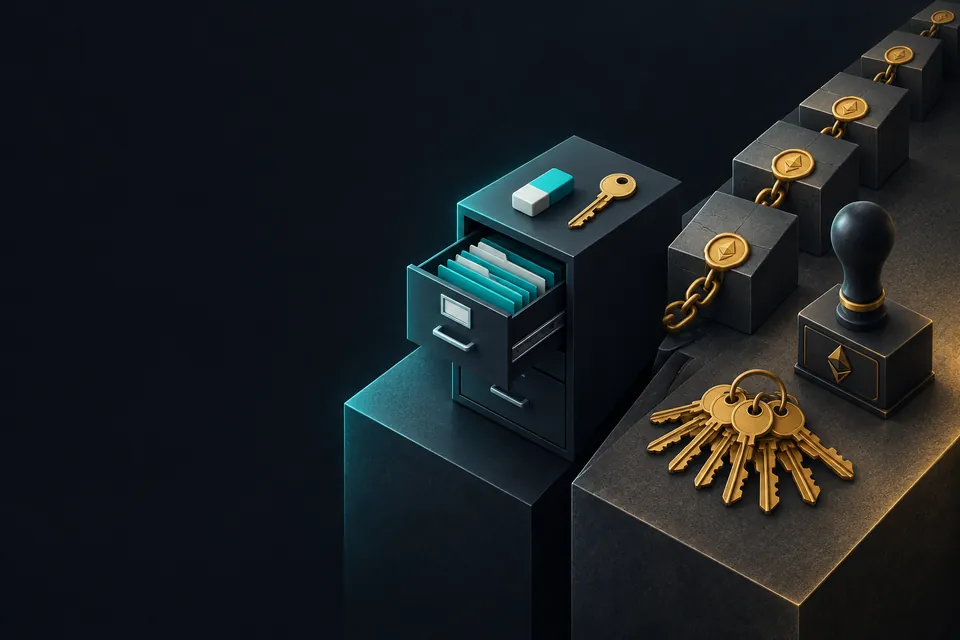
Change the email address on your shopping account and the shop updates one row in its database. The old address is gone, and only the shop could have changed it.
On a public blockchain, nobody can go back and edit a past entry, not even the people who wrote the software. You can only add a new entry after it, and most other differences follow from that one rule.
What a database does
A database is software that stores records so that programs can create, read, update and delete them. Developers call those four actions CRUD. Banks, airlines, games and online shops all run on databases.
One organisation runs it. It decides who may read or change what, and it can fix a wrong entry in seconds. You trust that organisation to keep the records honest, and auditors and the law back that trust.
A blockchain is also a store of records, but it allows only two of those actions: adding new entries and reading old ones. Nobody can update or delete.
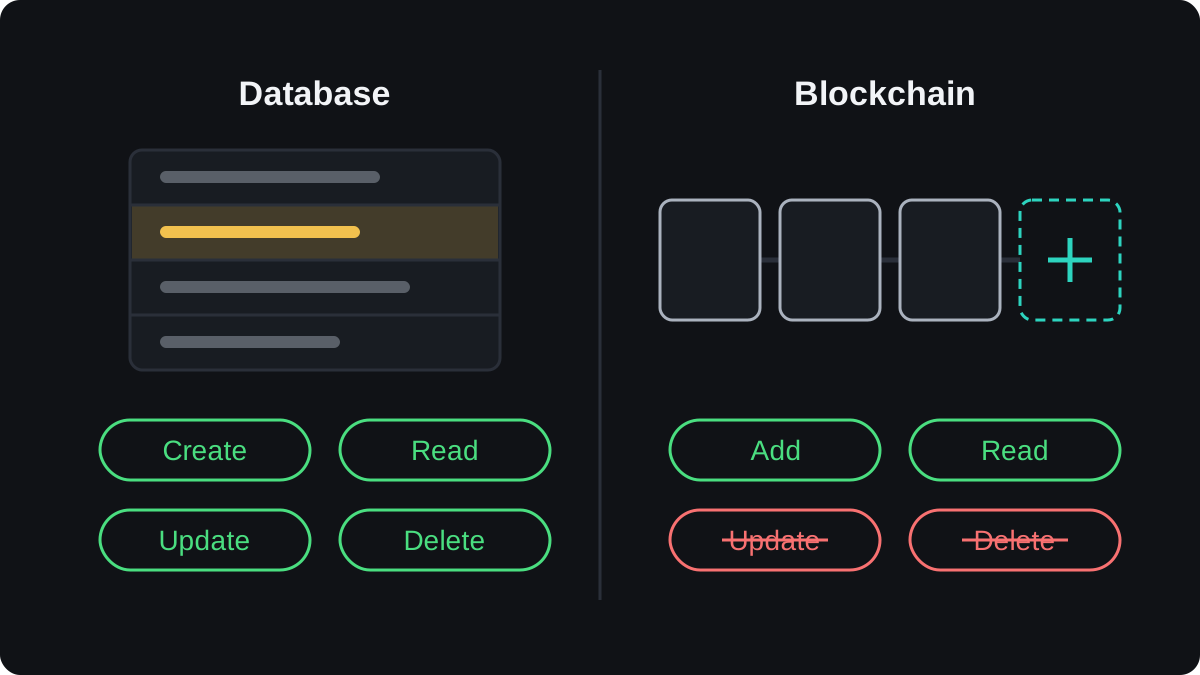
The main differences side by side
| Database | Public blockchain | |
|---|---|---|
| Who runs it | One organisation | Thousands of independent nodes |
| Old records | Can be changed or deleted | Can only be added to |
| Who you trust | The operator | The rules, checked by every node |
| Speed of a write | Milliseconds | Seconds to minutes |
| Cost of a write | Close to nothing | A fee for each transaction |
| Who can read it | Whoever the operator allows | Anyone |
A public blockchain is slower, costs more per write and shows everything to everyone. In return, no single party can change the record or switch it off.
A distributed ledger of this kind only makes sense when that is worth the price.
Why a blockchain is slower: a worked example
A database on one server writes a change once. A blockchain has every node check and store the same change, and it spaces out its blocks so that nodes around the world can agree on each one.
Here is the effect with round numbers, for illustration:
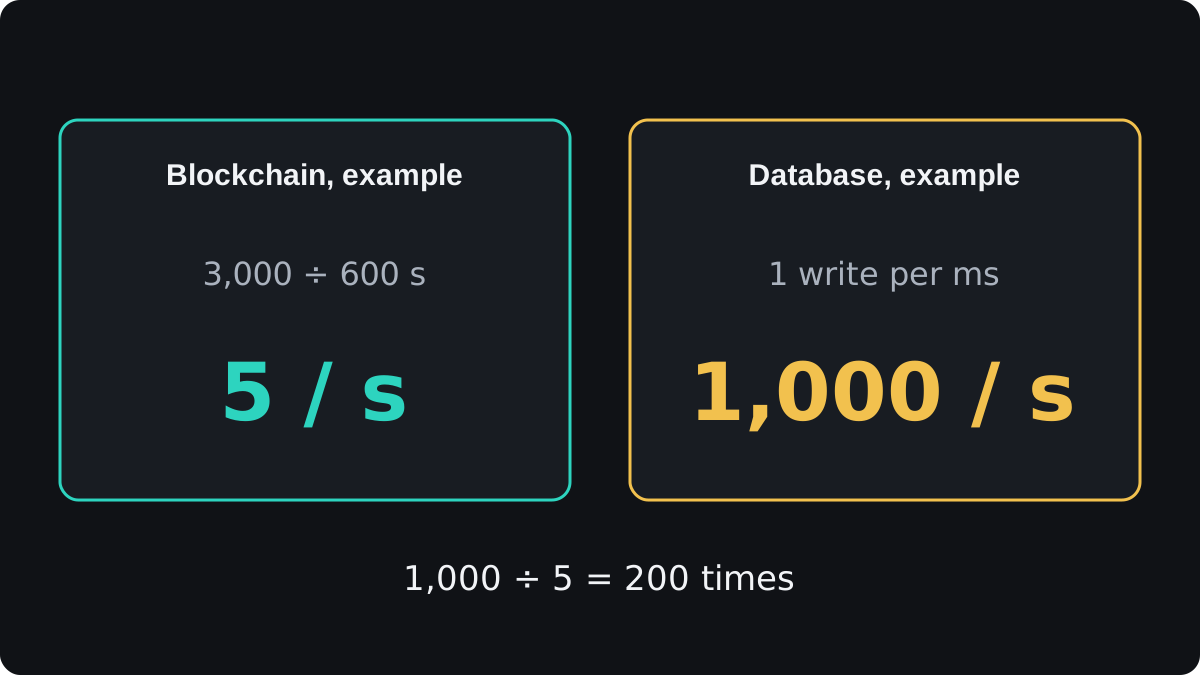
- Say a chain adds a block every 10 minutes, which is 600 seconds.
- Say each block holds 3,000 transactions.
- The chain handles 3,000 ÷ 600 = 5 transactions per second.
- Now say a database takes 1 millisecond per write. One connection alone handles 1,000 writes per second.
- That is 1,000 ÷ 5 = 200 times the chain's rate, before the database adds a second server.
Newer chains use shorter block times and bigger blocks, and extra layers on top can bundle many transfers into one. They narrow the gap, but every one of them pays the cost of many computers agreeing.
Fees follow from the limited space. When more people want into the next block than it can hold, they bid for room and fees rise. A database has no such auction.
Mistakes are permanent
Say you send 0.5 ETH to a wrong address. Make the same slip with a bank transfer and the bank can sometimes reverse it, because it runs the database.
On a blockchain, only whoever controls the receiving address can send the coins back. You may never find out who that is.
The same goes for software. Programs that run on a blockchain, called smart contracts, can be hard or impossible to fix once they are live. A bug can stay in place while people keep using the contract.
That is why you check the address and the network twice before you send. The send and receive lesson shows how.
When a blockchain is worth it
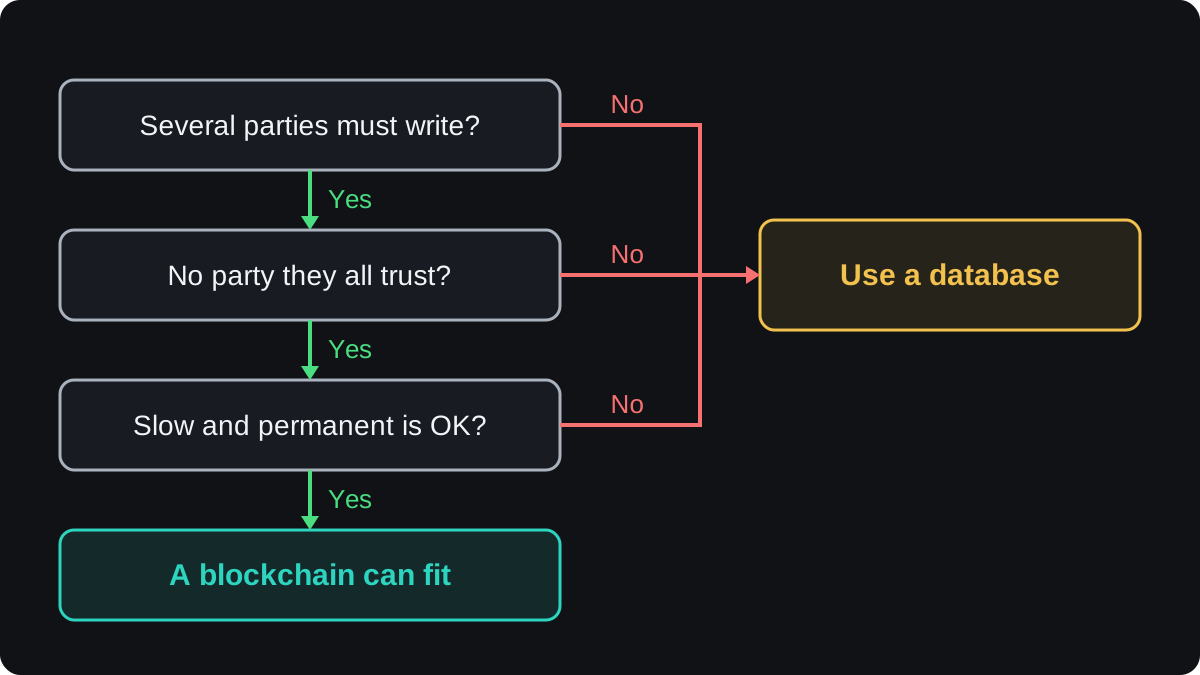
A blockchain earns its cost in a narrow set of cases. Ask three questions in order.
- Do several parties need to write to the same record?
- Is there no single party that all of them trust to run it?
- Can they live with a record that is slow, public and permanent?
If any answer is no, an ordinary database does the job faster and at lower cost. Money that no government or company issues is the case blockchains were built for, which is why crypto runs on them.
Crypto still runs on ordinary databases
When you trade on a centralized exchange, your trades are rows in the exchange's own database. The blockchain only sees your deposit coming in and your withdrawal going out.
That is why trades on an exchange are instant and pay no network fee. It also means you are trusting the exchange, much as you would trust a bank, until you withdraw.
A crypto CFD goes further. It is a contract with a broker, recorded in the broker's systems, and no coin moves on any blockchain at all.
Questions
Is a blockchain a type of database?
In a broad sense, yes: it stores records that programs can read. It differs from an ordinary database because many parties share it, it has no administrator and it only allows new records to be added.
Why not just use a database for crypto?
Then whoever runs the database controls everyone's balances, as a bank does. Bitcoin was built to remove that operator, and a blockchain is how it does so.
Are blockchains faster than databases?
No. A blockchain is slower because many computers must check and agree on every change. What it offers instead is a record that no single party controls.
Can a company run its own private blockchain?
Yes, and some do. If the company controls every node, though, it can still change the record, so an ordinary database with good audit logs often does the same job for less.
Keep learning
 Chapter 1What is a blockchain?A blockchain is a record of transactions stored in batches called blocks. Each block carries a fingerprint, called a hash, of the block before it, and thousands of computers keep identical copies. Changing an old entry would break every link that follows it, which makes the record very hard to rewrite.
 Chapter 1What is a distributed ledger?A distributed ledger is a record of who owns what that many independent computers keep in full, with no master copy. Each new entry is checked by the participants and added to every copy in the same agreed order. A blockchain is the best known kind of distributed ledger, and other designs exist too.

