What is ether, and why does it have value?
Ether (ETH) is the native currency of the Ethereum network. Every transaction pays its fee in ether, and validators lock it up as a deposit to secure the network. Its value comes from that demand meeting a supply with no fixed cap, which grows through new issuance and shrinks when fees are burned. Nothing guarantees its price.
Nội dung này hiện chỉ có bản tiếng Anh.
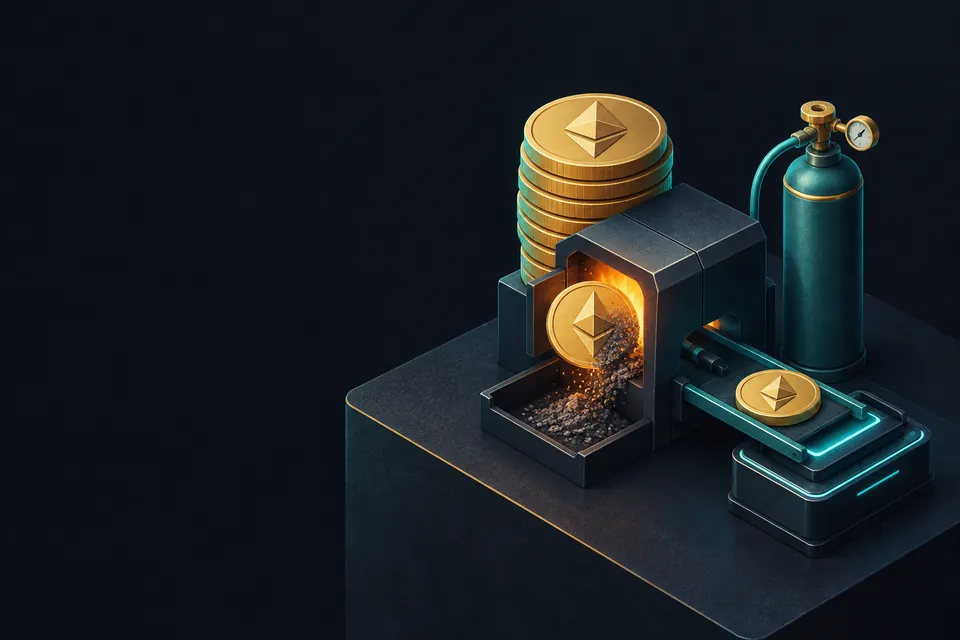
To do anything on Ethereum, from sending a token to calling a contract, you need a little ether in your wallet. A wallet holding thousands of dollars in other tokens usually cannot move them without ether for the fee.
That rule creates the first source of demand for ether. Staking, lending and a supply that changes every day add to the picture.
Ether, ETH and Ethereum
Ether is the native currency of Ethereum, and its ticker is ETH. Ethereum is the network, and ether is the money used inside it.
Ether splits into very small units. The smallest is the wei, and one ether equals a 1 followed by 18 zeros in wei. Fees are usually quoted in gwei, one billionth of an ether.
| Unit | Value in ether |
|---|---|
| wei | 0.000000000000000001 |
| gwei | 0.000000001 |
| ether | 1 |
What ether is used for
Every action on Ethereum costs gas, and the network collects gas fees only in ether. Anyone who uses the network has to hold some, so real use creates steady demand.
Validators lock up ether as a deposit to propose and check blocks, and earn new ether in return. This is staking, and staked ether is off the market while it stays locked.
Lending apps in DeFi accept ether as collateral, so people deposit it to borrow other tokens. Many NFTs and tokens on Ethereum are also priced in ether rather than in dollars.
How a fee is split, and why some ether is burned
Since an upgrade in 2021, each fee on Ethereum has two parts. The base fee is set by the network according to demand and is burned, which means destroyed for good. The priority fee, or tip, goes to the validator.
Here is a plain transfer with illustrative fees: 21,000 gas, a base fee of 18 gwei and a tip of 2 gwei.
- Burned: 21,000 × 18 = 378,000 gwei, which is 0.000378 ETH.
- Paid to the validator: 21,000 × 2 = 42,000 gwei, which is 0.000042 ETH.
- Total you pay: 420,000 gwei, which is 0.00042 ETH.
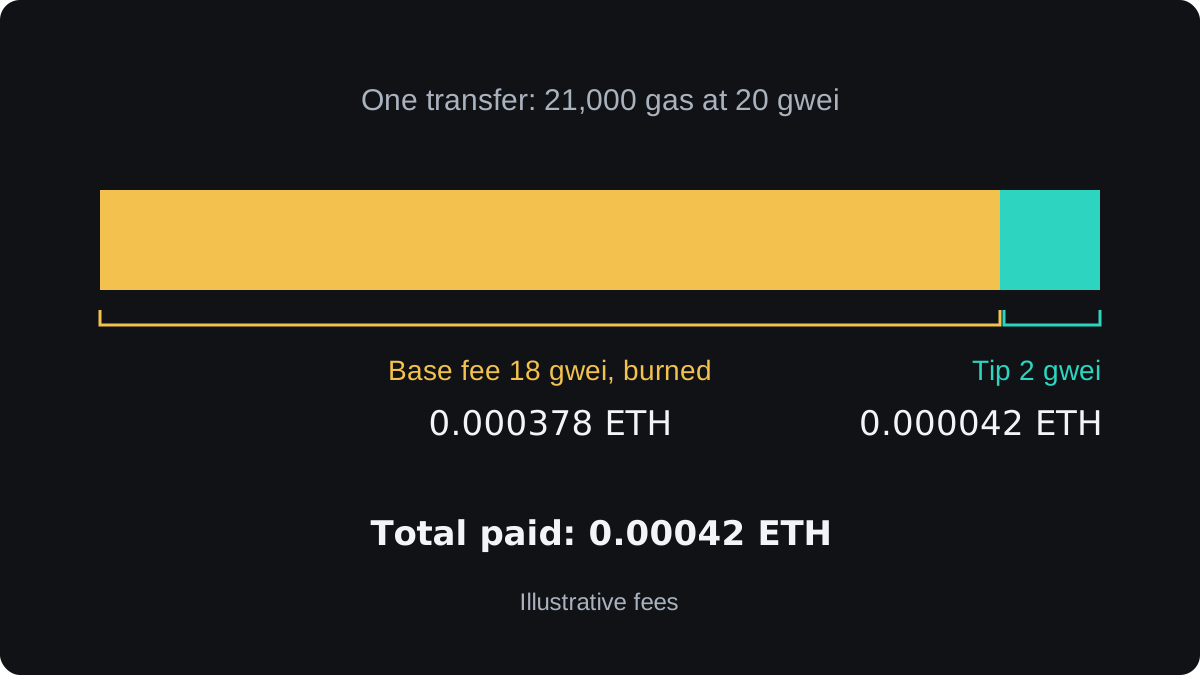
One burn is tiny. Across a busy network it adds up, because the base fee rises with demand and every transaction burns its share.
Supply: new issuance against burning
Ether has no maximum supply, unlike bitcoin with its 21 million cap. About 72 million ether existed at launch in 2015, and new ether has been created ever since as rewards for securing the network.
Since the Merge in 2022, all new ether goes to validators. How much depends mainly on how much ether is staked, and it is far less than miners used to receive.
Whether total supply grows on a given day comes down to issuance minus burn. Two illustrative days, with 2,000 ETH issued on each:
- Quiet day: 500 ETH burned. Supply grows by 2,000 minus 500 = 1,500 ETH.
- Busy day: 3,000 ETH burned. Supply shrinks by 3,000 minus 2,000 = 1,000 ETH.
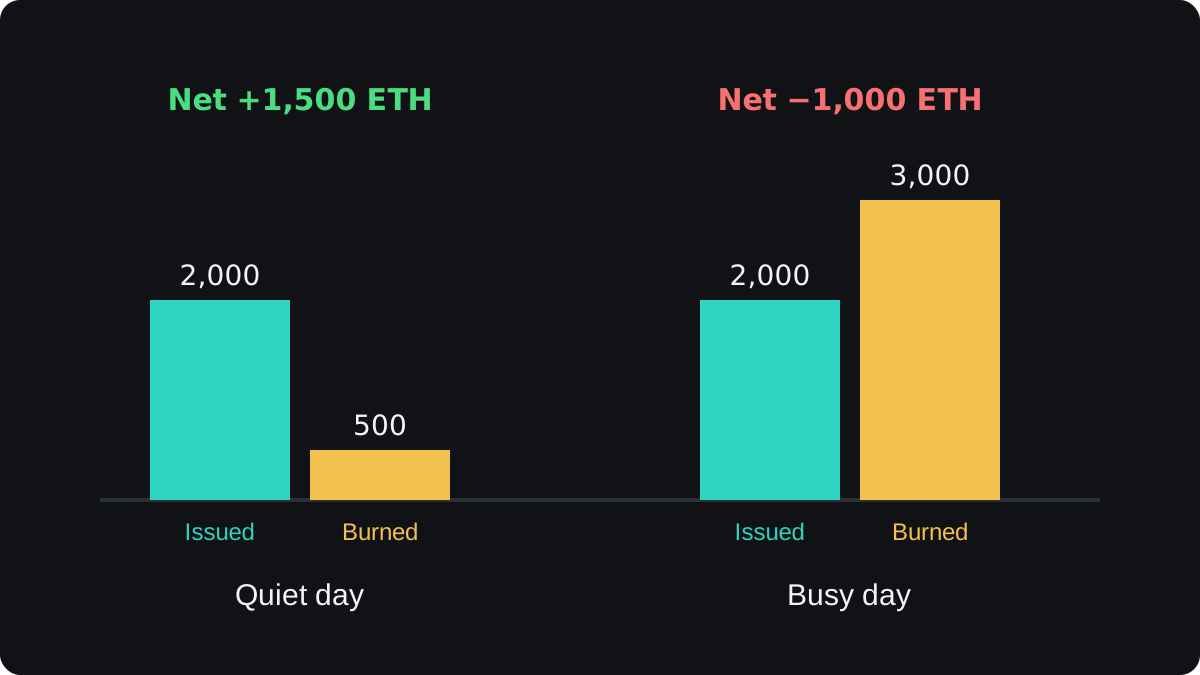
The burn depends on demand for space on Ethereum's main chain. Much activity has moved to layer 2 networks, which pay the main chain far less in fees. When the burn falls below issuance, supply grows.
Why ether has value, and the limits of that case
Ether's price is set by buyers and sellers, like any traded asset. Its supporters point to demand that comes from use: to do anything on Ethereum, you need ether.
Staking and collateral also take part of the supply off the market. Some holders treat staking rewards like a yield, and others hold ether as a bet that more of finance will move onto blockchains.
None of this sets a floor under the price. Use of the network can fall, rival blockchains can win users, and much of the price at any moment is a guess about the future.
Ether pays no profits the way a company does, so there is no agreed way to value it. The price has fallen by more than half several times in its history, and what moves the price of ether covers why.
Owning ether or trading its price
You can buy ether on a crypto exchange and keep it there or move it to your own wallet. Owning it lets you pay gas, stake it or use it in apps.
You can also trade its price through a crypto CFD with a broker. A CFD is a contract with the broker, so you own no ether and have no wallet, and you pay a spread and often an overnight fee.
CFDs usually allow leverage, which makes both gains and losses larger than the money you put down.
Câu hỏi thường gặp
Is ether the same as Ethereum?
Ethereum is the network and ether (ETH) is its currency. People often use the two names loosely, so "buying Ethereum" usually means buying ether.
Does ether have a maximum supply?
No. Supply rises with new issuance to validators and falls when fees are burned, so the net change depends on how busy the network is.
What is gwei?
Gwei is a small unit of ether, one billionth of 1 ETH. Gas prices are quoted in gwei because fees in whole ether would need many decimal places.
Can you earn ether by holding it?
Holding alone earns nothing. Staking, directly or through a service, earns rewards in ether, with risks such as penalties, waiting periods to withdraw and the service failing.
Học tiếp
 Chương 3What is Ethereum?Ethereum is a public blockchain that records balances and also runs programs called smart contracts. Anyone can use it or build on it without asking permission. Its own currency, ether (ETH), pays the fee for every action. Since 2022 the network has been secured by proof of stake instead of mining.
 Chương 3What is a smart contract?A smart contract is a program stored on a blockchain such as Ethereum. It holds funds and follows fixed rules: when someone calls it and the conditions are met, it acts automatically, with no company in the middle. It cannot see outside data on its own, and a bug can lose money for good.
 Chương 3What is a dApp?A dApp, short for decentralized application, is an app whose core rules run as smart contracts on a blockchain instead of on a company's servers. You use it through a website and a crypto wallet that signs each action. No company holds your funds, so contract bugs, fake sites and fees are yours to manage.
 Chương 3What moves the price of ether?Ether's price moves when the balance between buyers and sellers shifts. Most days the biggest driver is the crypto market as a whole, led by bitcoin, which in turn reacts to interest rates and risk appetite. Ether's own supply, use of the network, fund flows and forced selling by leveraged traders add moves on top.

