How does a forex trade make or lose money?
A forex trade makes money when the pair moves in your direction by more than the trade costs, and loses when it moves against you. A buy gains as the price rises and a sell gains as it falls. Profit is the price change times trade size, less commission and swap.
Nội dung này hiện chỉ có bản tiếng Anh.

You open a trade at one price and close it at another. The gap between the two, multiplied by the size of the trade, is your result before costs.
Costs come out of that, and what is left lands in your balance. All prices in this lesson are round illustrative numbers, not live quotes.
What decides whether a trade makes money?
Direction comes first. If you buy a pair, called going long, you gain when its price rises. If you sell it, called going short, you gain when the price falls.
Distance is counted in pips: 0.0001 on most pairs and 0.01 on pairs quoted in Japanese yen. Size is counted in lots, and one standard lot is 100,000 units of the base currency.
Your gross result is the price change times the number of units traded, before any costs. For a long trade the price change is the closing price minus the opening price.
For a short trade it runs the other way, opening price minus closing price, because you sold first and bought back later. A negative answer is a loss.
The result comes out in the quote currency, the second currency in the pair. If your account is held in a different currency, the broker converts it at the current rate.
How does a long trade make or lose money?
Say EUR/USD shows a bid of 1.10000 and an ask of 1.10010, a spread of 1.0 pip. You expect the euro to rise, so you buy 0.10 lot, which is 10,000 euros.
You buy at the ask and will later sell at the bid, as the bid and ask lesson explains. So the ask is your entry, and the bid is the price to watch.
- Work out the pip value: 10,000 × 0.0001 = $1.00 per pip.
- Open at the ask, 1.10010.
- Later the bid reaches 1.10410, and you sell to close: 1.10410 − 1.10010 = 0.00400, which is 40 pips.
- Gross result: 40 × $1.00 = +$40.00.
- Had the bid fallen to 1.09710 instead: 1.09710 − 1.10010 = −0.00300, which is −30 pips.
- Gross result: −30 × $1.00 = −$30.00.
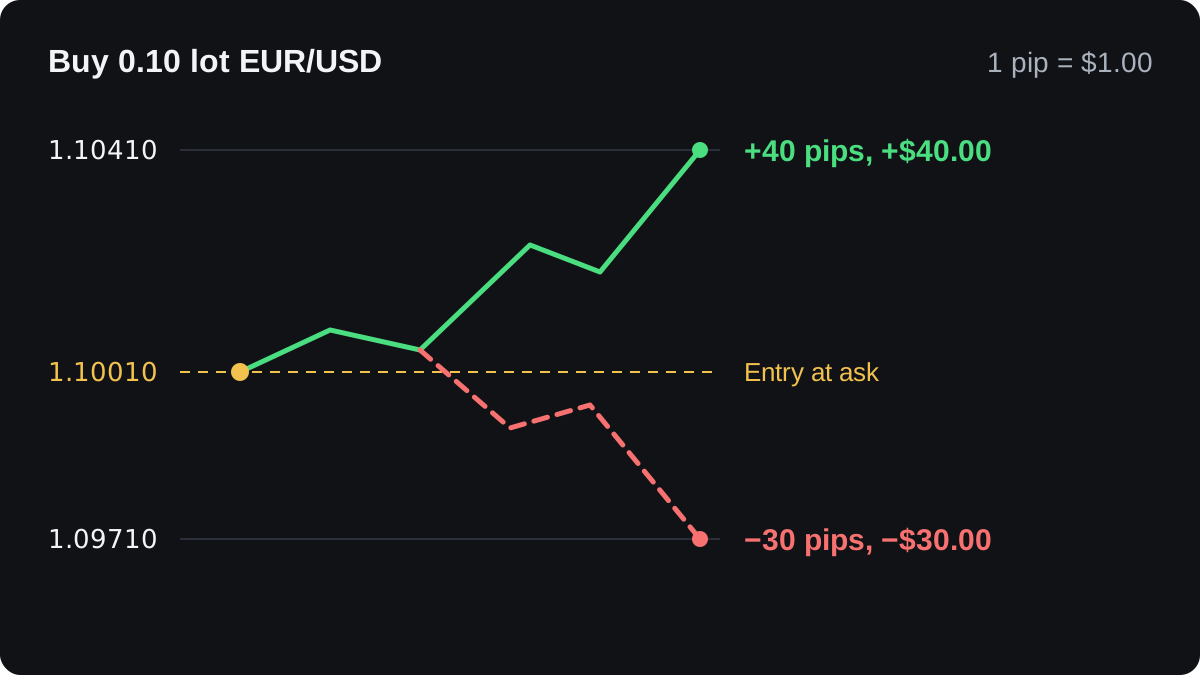
Nothing in the setup changed between the two cases. The entry, the trade size and the pip value were identical, and the move after entry decided the sign of the result.
How does a short trade make or lose money?
A short trade uses the same sum in reverse. Say USD/JPY shows a bid of 150.00 and an ask of 150.01, and you expect the dollar to fall against the yen.
- You sell 0.10 lot, which is 10,000 US dollars, at the bid of 150.00.
- Work out the pip value: 10,000 × 0.01 = ¥100 per pip.
- Later the ask falls to 149.50, and you buy to close: 150.00 − 149.50 = 0.50, which is 50 pips.
- Gross result: 50 × ¥100 = +¥5,000.
- In a US dollar account, the broker converts at the current rate: ¥5,000 ÷ 149.50 = $33.44.
Had the ask risen to 150.30 instead, the sum would be 150.00 − 150.30 = −0.30, a loss of 30 pips or ¥3,000. At 150.30 that is ¥3,000 ÷ 150.30 = $19.96.
The yen amounts are exact. The dollar amounts depend on the exchange rate at the moment the broker converts them.
What do trading costs take from the result?
The spread costs you through the prices themselves. It is already inside the 40 pips above, because you entered at the higher ask and left at the lower bid.
A commission is a fee per lot that some account types charge on top of the spread. Assume an illustrative $6 per lot for the round trip, open plus close. On 0.10 lot that is $0.60.
Swap is interest charged or paid when you hold a position overnight. It can be a charge or a credit, and it changes over time. Assume an illustrative charge of $0.40 per night for 2 nights, which is $0.80.
On the winning long trade, $40.00 − $0.60 − $0.80 = $38.60 reaches your balance.
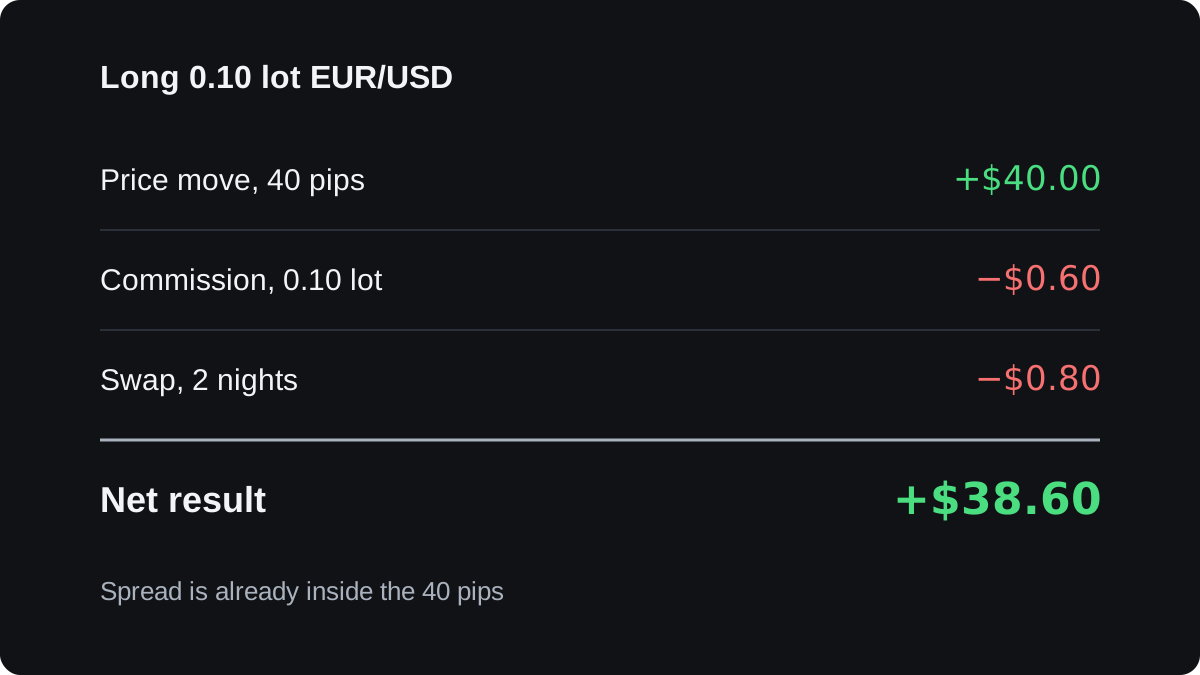
The same costs apply to the losing case, so they make a win smaller and a loss bigger:
| Line item | Winning case | Losing case |
|---|---|---|
| Gross result | +$40.00 | −$30.00 |
| Commission | −$0.60 | −$0.60 |
| Swap, 2 nights | −$0.80 | −$0.80 |
| Net result | +$38.60 | −$31.40 |
A rebate paid per lot through an introducing broker, such as the one described on the Exness rebate page, lowers your net cost on every trade.
How far must price move before you break even?
Right after you buy, the bid is still 1.10000, 1.0 pip below your entry. If you closed at once, you would lose the spread: 1.0 pip, or $1.00.
Commission widens the gap. $0.60 on a pip value of $1.00 is 0.6 pip, so the bid must climb 1.6 pips from where it stood when you bought, to 1.10000 + 0.00016 = 1.10016.
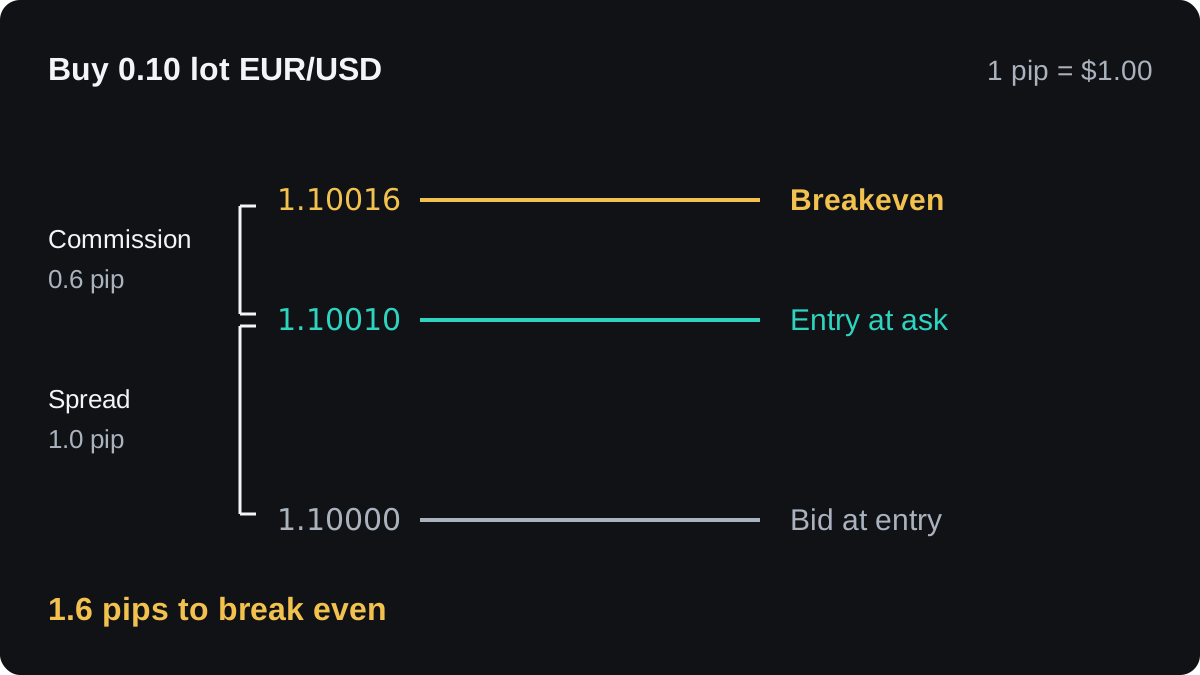
Each night of swap at $0.40 raises that level by another 0.4 pip. Holding for 2 nights would move breakeven to 1.10024.
Costs weigh most on small targets, because they stay the same while the target shrinks. On a 5 pip gain of $5.00, the $0.60 commission takes 12%. On a 40 pip gain it takes 1.5%.
How do floating profit and leverage change the picture?
While a trade is open, its result is a floating profit or loss: the platform recalculates it at every price change. It becomes a fixed amount in your balance only when you close.
Leverage sets how much margin you need, the deposit the broker holds while the trade is open. On 0.10 lot of EUR/USD at 1.10010, the position is worth 10,000 × 1.10010 = $11,001.
At an illustrative leverage of 1:100, the margin is 11,001 ÷ 100 = $110.01. Pip value stays $1.00 on this trade at any leverage.
In a $500 account, the $31.40 net loss on 0.10 lot is 6.3% of the balance. Higher leverage lets the same account open a bigger trade, and the same 30 pip fall on 1.00 lot would cost $300 before costs, which is 60% of $500.
Every example here filled at the quoted price. In fast markets an order can fill at a worse price, called slippage, and a stop loss can close a trade beyond its level when the price jumps over it.
The profit and loss calculator repeats these sums for any pair and size, though it cannot tell you which way the price will move next.
Câu hỏi thường gặp
How is profit calculated in forex?
Multiply the price change by the number of units traded, then subtract commission and swap. For a buy the price change is close minus open, and for a sell it is open minus close.
Why does my trade show a loss as soon as I open it?
You buy at the ask and can only close at the bid, which is lower. A new trade starts with a loss equal to the spread, plus any commission your account charges.
Does leverage increase my profit per pip?
No. Pip value depends on the pair and the trade size, not on leverage. Leverage lets you open a larger trade with less margin, and a larger trade gains and loses more per pip.
Is my profit paid in my account currency?
The result is first worked out in the quote currency of the pair. If that differs from your account currency, the broker converts it at the current rate.
Học tiếp
 Chương 2When do you buy or sell a currency pair?You buy a currency pair when you expect the first currency, the base, to strengthen against the second, and you sell when you expect it to weaken. If your view is about one currency, find which side of the pair it sits on: a weaker quote currency pushes the pair up, so you buy.
 Chương 2Pip trong forex là gì?Pip là bước giá chuẩn trader dùng để đo biến động giá. Với đa số cặp tiền, pip là 0.0001, tức chữ số thập phân thứ tư, còn với các cặp yết giá bằng yên Nhật, pip là 0.01. Pipette bằng một phần mười pip. Với một lot chuẩn EUR/USD, mỗi pip trị giá $10.
 Chương 2Lot trong forex là gì?Lot là đơn vị dùng để đặt khối lượng một lệnh forex. Một lot chuẩn là 100,000 đơn vị đồng tiền cơ sở, lot mini là 10,000 và lot micro là 1,000. Với EUR/USD, mỗi pip tương ứng trị giá $10, $1 và $0.10. Các sản phẩm khác, như vàng, dùng kích thước hợp đồng riêng.
 Chương 2Spread trong forex là gì?Spread là khoảng chênh giữa giá bid bạn bán ra và giá ask bạn mua vào. Bạn trả nó ở mọi lệnh, ngay lúc mở lệnh. Với EUR/USD, spread thường chỉ một hai pip hoặc thấp hơn, và giãn rộng quanh giờ chuyển ngày, lúc mở cửa đầu tuần và khi có tin lớn.
 Chương 2Giá bid và giá ask trong forex là gì?Mỗi báo giá forex có hai mức giá. Bid là giá bạn bán được, còn ask là giá cao hơn mà bạn mua được. Khoảng chênh giữa hai giá là spread. Bạn mua ở giá ask và đóng lệnh ở giá bid, nên lệnh nào vừa mở cũng âm một khoảng đúng bằng spread.
 Chương 2Forex terms you will hear every day.The everyday words of forex describe what a trade is doing and what it costs. Long means you bought, short means you sold. A pip is the standard price step, a lot is the trade size, the spread is the gap between bid and ask, and margin is the deposit your broker holds while a trade is open.
 Chương 2What types of orders can you place in forex?A market order buys or sells straight away at the current price. A pending order waits for a price you choose: a limit order waits for a better price, and a stop order joins a move once price breaks a level. Stop loss and take profit orders close an open trade at prices you set in advance.
 Chương 2Forex order types cheat sheet.A market order fills now at the current price. A limit order waits for a better price: a buy limit below the market, a sell limit above it. A stop order waits for a worse price: a buy stop above, a sell stop below. Buy orders trigger on the ask, sell orders on the bid.
 Chương 2What is a forex demo account, and how should you use it?A forex demo account is a practice account funded with virtual money. You trade on the broker's platform with live or near-live prices, so you can learn orders, stops and margin without risking your own cash. Set it up with the balance and leverage you would really use, and expect live fills and feelings to differ.
 Chương 2Can you get rich trading forex?A few people make large sums trading forex, but the loss figures that EU and UK brokers must publish show that most retail CFD accounts at those brokers lose money. Getting rich would need a large starting balance and years of steady returns. Small accounts chasing big targets usually take risks large enough to wipe them out.
 Chương 2Tóm tắt forex cơ bản: cặp tiền, pip, lot, đòn bẩy và margin.Bảng tóm tắt này gói chương forex cơ bản vào một trang. Mỗi khái niệm có một đoạn tóm tắt ngắn, công thức và link tới bài đầy đủ. Các bảng tra nhanh giúp bạn kiểm tra kích thước pip, giá trị pip, kích thước hợp đồng và margin trước khi đặt lệnh, và một lệnh mẫu nối tất cả lại với nhau.

