Directional news trading.
Directional news trading means taking a side, long or short, on what an economic release will do to a currency pair. You can trade before the number and guess the surprise, or after it and trade the move. Both face wide spreads, slippage and sudden reversals, so position size matters more than usual.
本頁目前僅提供英文版。

A major economic release can push a currency pair dozens of pips within minutes. A directional news trader tries to be on the right side of that move: long if they expect the pair to rise, short if they expect it to fall.
The previous lesson covered how markets react to news. This one is about choosing a side, either before the figure comes out or after you have seen it.
What makes a news trade directional?
A directional trade is a bet on which way price will go. You buy or you sell, and your result depends on getting the direction right.
Around news, that view comes from comparing the release with what the market expected. The forecast, often called the consensus, sits on an economic calendar next to the previous figure.
Price usually reacts to the gap between forecast and actual, which traders call the surprise. A figure that matches the forecast often moves little, because prices already reflected it. The lesson on expectations versus actual explains why.
You can take your side at three moments. Each one changes what you know and what can go wrong.
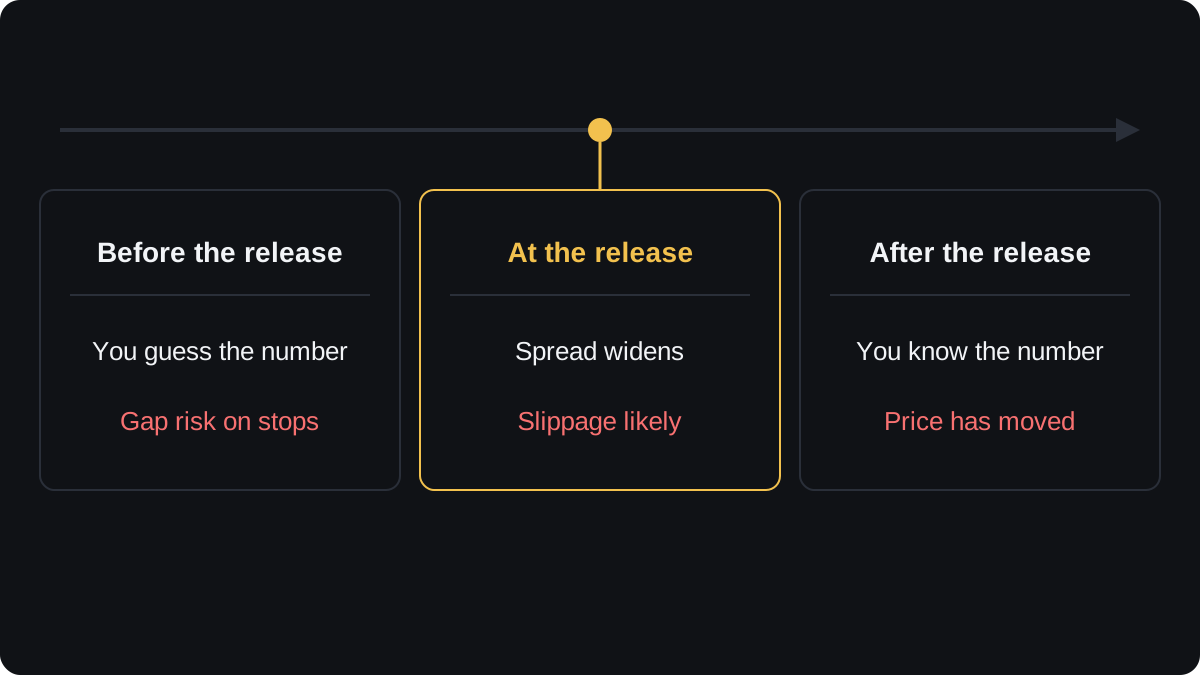
Before the release you are guessing the figure. At the release the spread widens and fills are uncertain. After it you know the figure, but part of the move has already happened.
Trading before the release: guessing the surprise
Say you expect a US jobs report to beat its forecast, so you buy the dollar an hour early. If you are right, you are in before the jump, at a better price than anyone who reacts afterwards.
If you are wrong, the move runs against you at once. A position you opened calmly can lose its full planned risk in seconds.
The harder problem is the forecast itself. The consensus already pools the estimates of many economists, so to profit you need a better guess than that crowd. A reliable way to get one is hard to find.
Price can also move ahead of the release. If the dollar has climbed all week on hopes of a strong report, a figure that only meets those hopes can send it lower as early buyers take profit.
Holding through the release also brings gap risk: price can jump past your stop without trading at it. Suppose you are long EUR/USD at 1.10000 with a stop loss at 1.09800, a planned loss of 20 pips.
If the price jumps from 1.10000 straight to 1.09600, there was never a trade at 1.09800. Your stop turns into a market order and fills near 1.09600, a loss of about 40 pips.
Some brokers offer guaranteed stops, usually for a fee. An ordinary stop loss gives no such promise.
Trading after the release: reading the surprise
Waiting for the figure removes the guess. You read the actual number, compare it with the forecast and trade the way the surprise points.
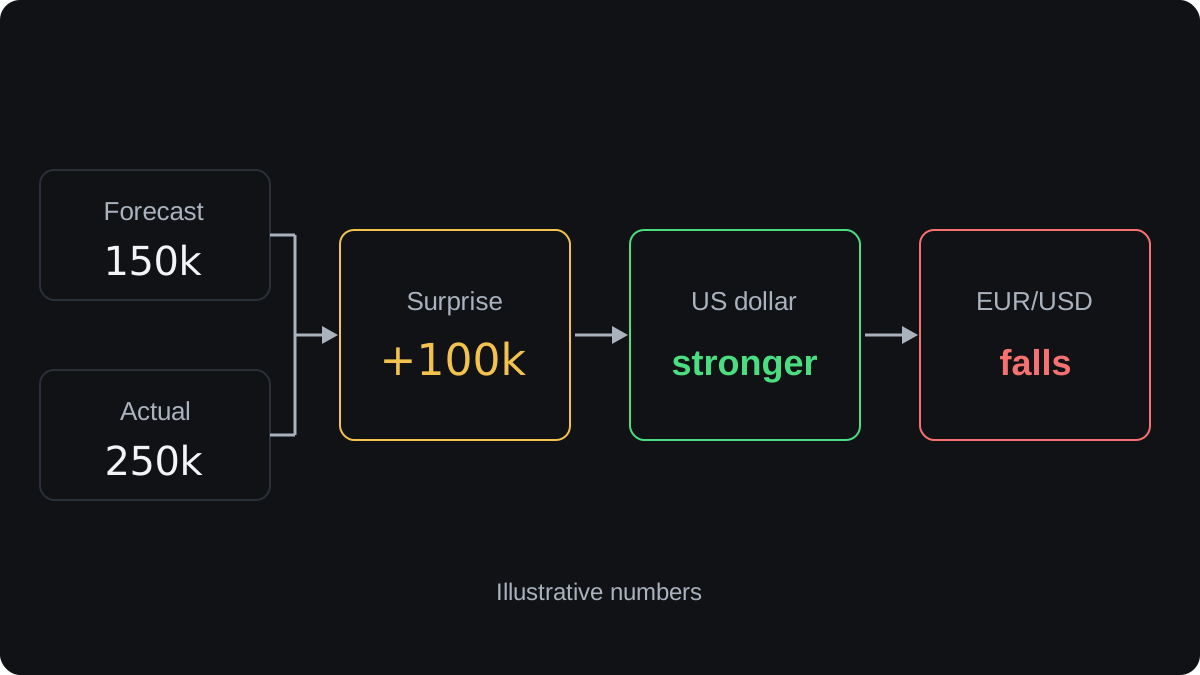
Take the US jobs report again. The forecast is 150,000 jobs added in the month and the actual figure is 250,000, a surprise of +100,000. These numbers are illustrative.
A stronger job market can raise expectations of higher US interest rates, which tends to lift the dollar. EUR/USD prices one euro in dollars, so a stronger dollar pushes it down. The directional trade is a sell.
The cost of waiting is speed. Automated systems trade the first seconds after a release, so a manual order sent straight away often fills worse than the price on screen. That difference is slippage.
A slower approach is to wait 15 to 30 minutes and act only if the move holds, or to wait for a pullback before entering. You give up part of the move for calmer prices.
Neither timing has solid evidence that it beats the other. Both are examples of a method, and either can lose.
A worked example: selling EUR/USD after a jobs surprise
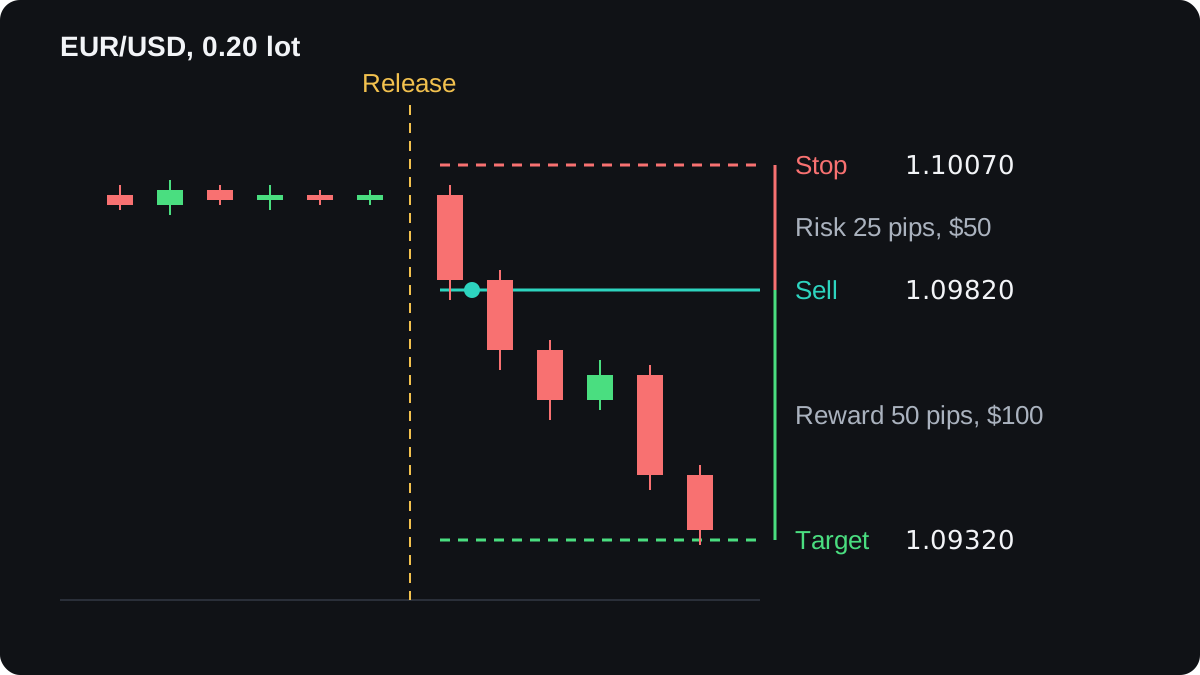
Here is the sell from the last section, step by step, with round illustrative prices. Your account holds $5,000 and you plan to risk 1% of it, which is $50.
- Before the release, EUR/USD trades near 1.10000.
- The jobs figure arrives at 250,000 against a forecast of 150,000, and the pair drops.
- You click sell when the bid shows 1.09850. The fill comes back at 1.09820, which is 3 pips of slippage.
- You place the stop at 1.10070, just above the pre-release price. From 1.09820 that is 25 pips.
- You size the trade so that 25 pips costs $50. One pip on one standard lot of EUR/USD is worth $10, so 50 ÷ (25 × 10) = 0.20 lot, or $2 per pip.
- You set the target 50 pips below the entry: 1.09820 minus 0.00500 = 1.09320.
- If the target fills, the profit is 50 × $2 = $100. If the stop fills exactly, the loss is 25 × $2 = $50.
That plan assumes the stop fills at its own price. Suppose the pair snaps back when traders focus on a weak detail in the report, and your stop fills at 1.10100 instead.
The loss is then 1.10100 minus 1.09820 = 0.00280, which is 28 pips, or 28 × $2 = $56.
A sell also closes with a buy, so its stop triggers on the ask. When the spread widens around a release, the ask can reach 1.10070 while the bid on your chart is still below it.
One response is a smaller size than usual around news, or a wider stop with the same money at risk. The position size lesson gives the formula for any pair.
Where directional news trades go wrong
A release is rarely one number. A jobs report includes the headline count, the unemployment rate, wage growth and revisions to earlier months, and these can point in different directions.
When they disagree, price can rise and fall within the same few minutes as traders weigh each part. A trade that was right for the first 30 seconds can be stopped out by the second minute.
The market may also care about a different figure from the one you watched. In some months inflation data matters more than jobs data, and a large jobs surprise produces only a modest move.
Costs rise exactly when you trade. Wider spreads and slippage come out of every news trade, on the way in and on the way out, and a small surprise may not move price far enough to cover them.
Releases can also collide. If two countries publish data in the same hour, the pair can react to the other currency's news instead of the one you traded.
If picking a direction feels like a coin toss, the next lesson covers non-directional news trading, which tries to profit from the size of a move whichever way it goes.
常見問題
Is it better to trade before or after the news?
Neither is better in every case. Trading before gives a better price if you are right but carries gap risk, while trading after removes the guess at the cost of a later and often worse entry.
Why did the price fall when the data beat the forecast?
The market may have expected even more than the forecast, focused on a weaker part of the release, or moved up before the figure came out.
Price reacts to what the whole release means for interest rates, and the headline is only one part of that.
Does a stop loss protect me during news?
Only partly. An ordinary stop becomes a market order once price reaches it, so in a fast market it can fill well beyond its level.
How long does a news move last?
There is no fixed rule. Some moves fade within minutes and others set the direction for days, depending on whether the release changes what the market expects from the central bank.
Can I practise news trading on a demo account?
Yes, and it is a safe way to learn the mechanics. Demo fills during news can be smoother than live fills, so expect more slippage and wider spreads with real money.
繼續學習
 第 7 章How markets react to news.When a major economic figure is released, price can jump many pips in seconds. Liquidity providers quote less and wider, so the spread widens, and orders can fill at a worse price than requested, which is slippage. A stop loss closes the trade but cannot guarantee its price when the market gaps.
 第 7 章Non-directional news trading.Non-directional news trading places a buy stop above the price and a sell stop below it just before a release, so whichever way the market breaks, one order catches the move. The catch is execution: around the release spreads widen and fills slip, and a whipsaw can trigger both orders, so costs can erase the expected gain.

