How prop firm challenges work.
A prop firm challenge is a paid test on a firm's account. You must reach a profit target, such as 10%, without breaking a daily loss limit or a maximum loss limit, and follow rules on trading days and news. Pass and you trade a funded account for a share of profits. Fail and the fee is usually gone.
本頁目前僅提供英文版。

Imagine a firm hands you a $100,000 account as a test. Make $10,000 without losing $5,000 in one day or $10,000 overall, and you get a funded account and a share of its profit.
That test is a prop firm challenge. The previous lesson explained what prop firms are. This one covers the rules of the test, with round illustrative numbers.
Every firm sets its own figures, so read the rules page of any firm before you pay.
What does a prop firm challenge ask you to do?
A challenge is a paid evaluation. You pay a fee, get an account of a stated size and trade it under fixed rules. Reach the target without breaking a rule and you pass.
Many firms use two phases. The first has a larger target and the second a smaller one, and the loss limits apply in both. Some firms offer a one-phase version, often with tighter limits.
After you pass, you receive a funded account. Profits there are shared under a profit split, the percentage of profit you keep. Loss limits still apply, so you can lose the funded account too.
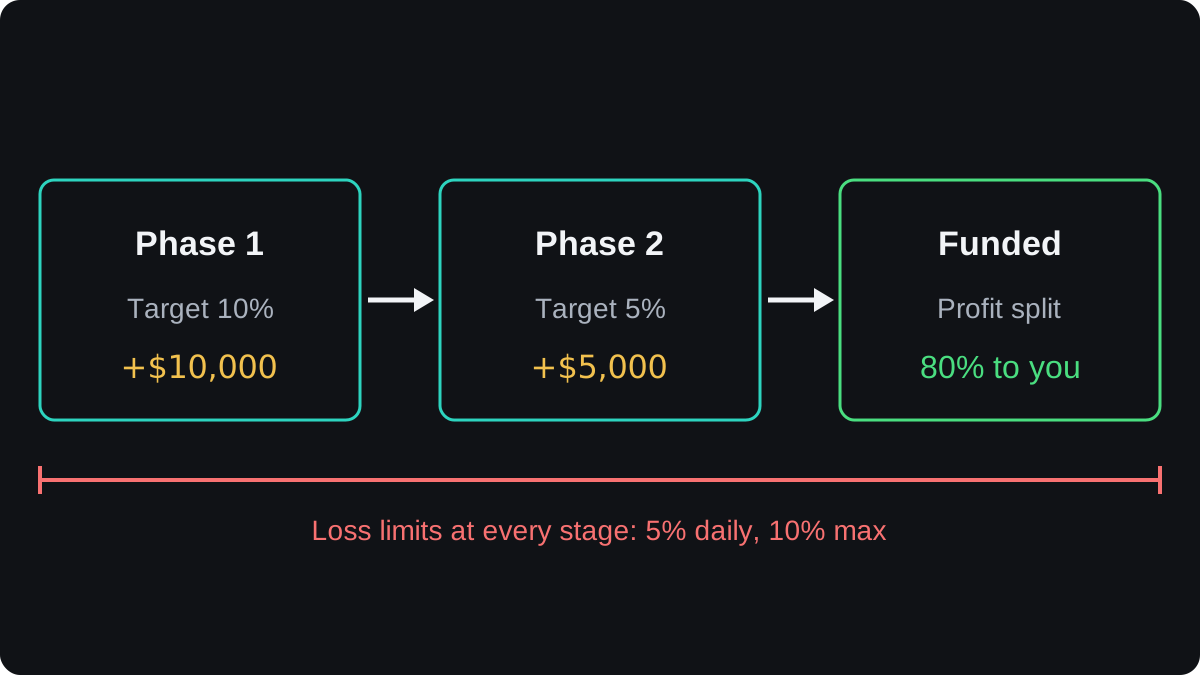
At many firms the challenge account, and often the funded account as well, runs on simulated money. The firm pays your share from its own funds, so ask each firm where its payouts come from.
How does the profit target work?
The profit target is the gain you must reach, stated as a percentage of the starting balance. With illustrative numbers:
- Account size: $100,000.
- Phase 1 target of 10%: 0.10 × $100,000 = $10,000, so the balance must reach $110,000.
- Phase 2 target of 5%: 0.05 × $100,000 = $5,000, so a fresh $100,000 account must reach $105,000.
Check whether a firm counts the target on balance, which includes closed trades only, or on equity, which includes the floating profit and loss of open trades.
Reaching the target quickly may not end the phase. Many challenges also set a minimum number of trading days, for example 4, so you may need to trade on extra days.
How do daily and maximum loss limits work?
Two loss limits usually run at the same time. The daily loss limit caps how much you can lose in one trading day. The maximum loss limit caps how far the account can fall overall.
Using illustrative figures of 5% daily and 10% overall on $100,000:
- Daily limit: 0.05 × $100,000 = $5,000.
- Maximum loss: 0.10 × $100,000 = $10,000, so the account must never fall to $90,000.
- Say a new day starts with a balance of $102,000. That day's floor is $102,000 minus $5,000 = $97,000.
- If equity dips to $97,400 and recovers, you are still in. If it touches $97,000, the challenge fails.
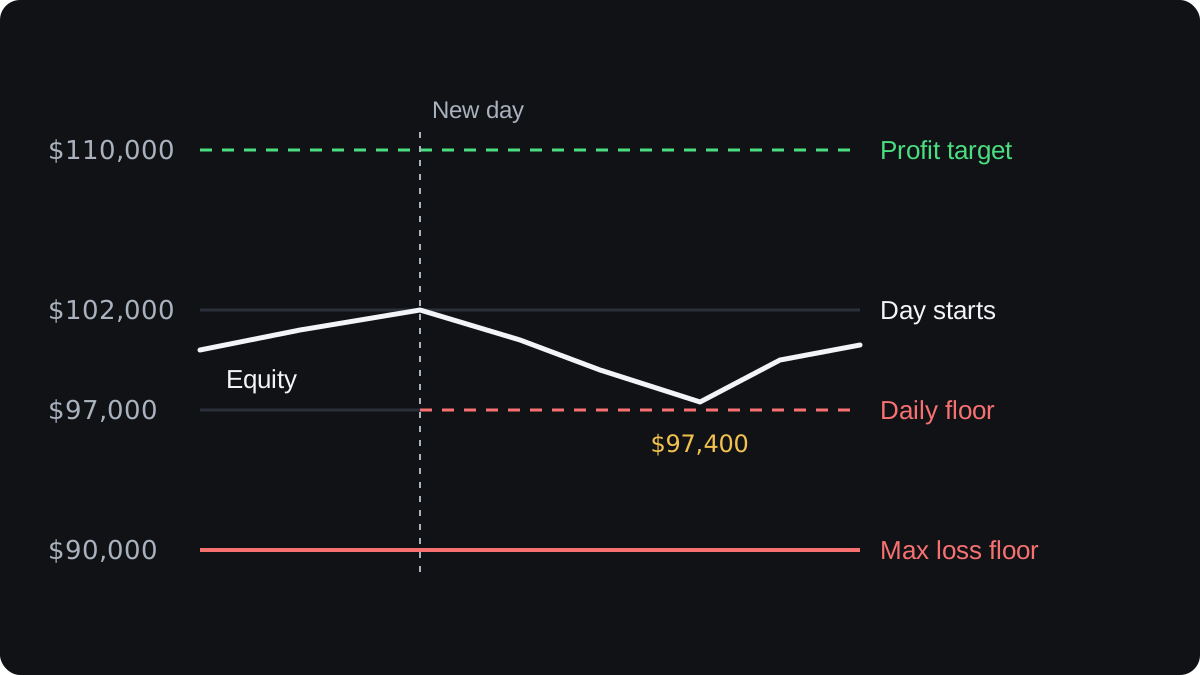
The limits count your equity, so a trade can fail the challenge while it is still open. A floating loss of $5,000 breaks the daily rule even if the price later comes back.
Firms differ on where the day starts. Some measure from the balance at the daily reset time, some from equity, and some from whichever is higher. The same trade can pass at one firm and fail at another.
Static and trailing limits
A static maximum loss stays at one level, here $90,000, for the whole challenge. A trailing drawdown is a floor that moves up as your account makes new highs and never moves down.
Take the same 10% limit as a trailing rule. Equity climbs from $100,000 to $104,000, so the floor rises from $90,000 to $94,000.
If equity then falls to $96,000, you are $2,000 from failing. A static rule would leave $96,000 minus $90,000 = $6,000 of room.
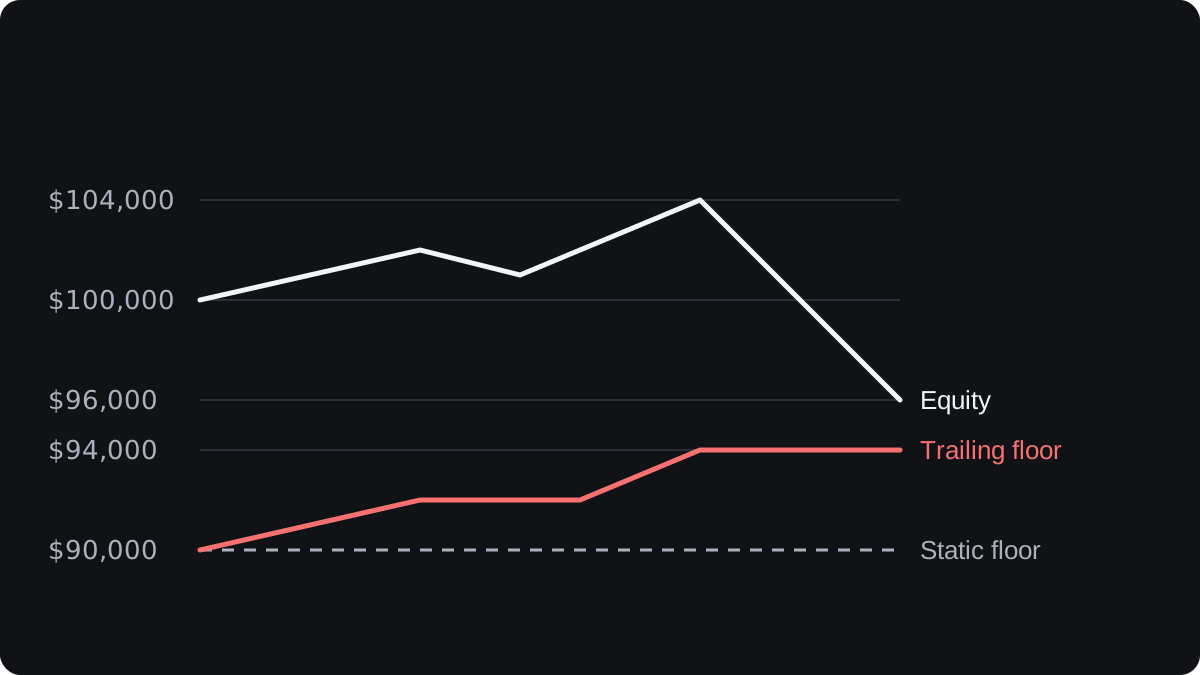
Some firms stop the trail once the floor reaches the starting balance, and some trail on closed balance only. The drawdown and recovery lesson shows why a fall needs a larger percentage gain to recover.
What other rules come with a challenge?
Rule pages often add some of the following. Each firm picks its own mix.
- A time limit, such as 30 days per phase, though some firms have none.
- A minimum number of trading days.
- Limits on trading around major news releases.
- A ban on holding trades over the weekend.
- Caps on lot size or on the number of open trades.
- A consistency rule, which stops one very large day from making up most of your profit.
A consistency rule might say no single day can exceed 40% of total profit. On a $10,000 profit, that means no day above 0.40 × $10,000 = $4,000. The consistency calculator checks your own figures.
Breaking any of these rules can fail the account even while you are in profit. Read the full terms as well as the headline target.
What does a challenge cost, and what do you get back?
You pay a fee up front, and larger accounts cost more. If you break a rule, the account closes and the fee is usually gone.
Some firms sell a reset, a fresh attempt for another fee. Some refund the original fee with your first payout.
An illustrative path, with a $500 fee and an 80% profit split:
- You fail twice and pass on the third attempt: 3 × $500 = $1,500 in fees.
- The funded account makes $4,000 of profit and you request a payout.
- Your share is 0.80 × $4,000 = $3,200. The firm keeps $800.
- Net result: $3,200 minus $1,500 = $1,700.
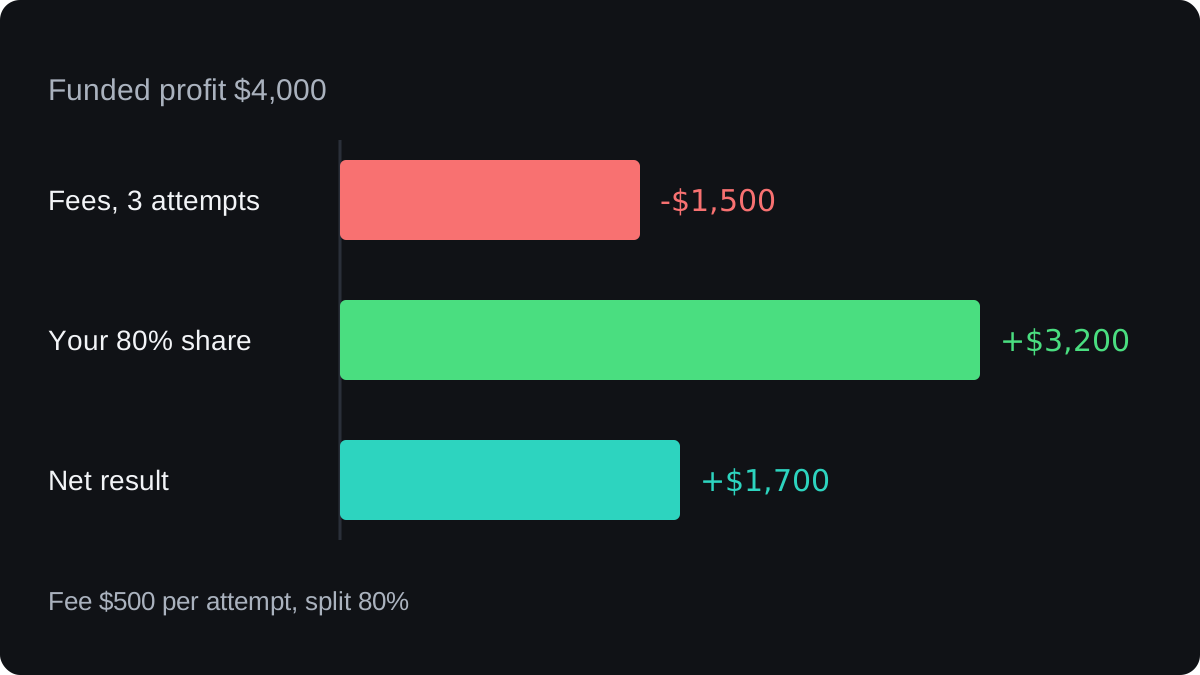
Turn the sum around to see the hurdle. At an 80% split, one $500 fee needs $500 ÷ 0.80 = $625 of funded profit just to break even. Each failed attempt adds another $625.
The fee is income for the firm whether you pass or fail. If a firm quotes a pass rate, ask how it was measured, because you usually cannot check it. The rules and risks lesson covers what can go wrong.
How do you size trades inside the limits?
The limits are in dollars, so plan your risk in dollars too. Decide the risk per trade first, then work out the lot size.
A worked example on the $100,000 account, trading EUR/USD in a USD account:
- Risk 1% per trade: 0.01 × $100,000 = $1,000.
- Stop loss 25 pips away. One pip on one standard lot of EUR/USD is $10, so 25 pips cost $250 per lot.
- Position size: $1,000 ÷ $250 = 4 lots.
- Five losing trades in one day: 5 × $1,000 = $5,000, the whole daily limit.
Touching the floor fails the challenge, so in this setup the fifth full loss in one day ends it. Spread, commission and any slippage make each loss a little larger than $1,000, so the real room is smaller still.
Over several days, ten such losses would use the whole $10,000 maximum.
Halving the risk to 0.5% doubles the number of losses you can absorb, but the target takes longer to reach.
A time limit adds pressure to raise size, which is one reason to compare firms with and without one. The position size lesson covers other pairs.
常見問題
Can you lose more than the challenge fee?
In a typical challenge, no. Trading losses come out of the firm's account, and your cost is the fee plus any resets, but the contract decides this, so read it.
Is the daily loss limit based on balance or equity?
It depends on the firm. Some use the balance at the daily reset, some use equity and some use the higher of the two.
What happens if you break a rule?
The challenge usually ends at once and the fee is not refunded. Some firms offer a reset for a new fee.
Does passing a challenge prove you are a good trader?
Passing shows you met the rules over a few weeks. That is a small sample of trades, so a lucky run can pass and a sound method can fail.
How long does a challenge take?
Some firms give each phase a fixed number of days and others set no limit. Many also require a minimum number of trading days.
繼續學習
 第 1 章What is a prop trading firm?A prop trading firm trades its own money. Online prop firms sell an evaluation, called a challenge: you pay a fee, trade under a profit target and loss limits, and if you pass you trade a firm account and keep a share of the profit. Many funded accounts are simulated, so read the terms.
 第 1 章Prop firm rules and risks.Prop firm accounts usually end on a rule breach, typically a daily loss limit or a maximum drawdown, and floating losses often count. Trailing drawdown rules move the floor up as you profit. The firm itself also carries risk: funded accounts are often simulated, payouts can be refused and rules can change.

