What is a prop trading firm?
A prop trading firm trades its own money. Online prop firms sell an evaluation, called a challenge: you pay a fee, trade under a profit target and loss limits, and if you pass you trade a firm account and keep a share of the profit. Many funded accounts are simulated, so read the terms.

You have $500 to spare, and a firm offers you a $100,000 account to trade. That is the pitch behind online prop firms.
You pay a fee and take a test of their risk rules. If you pass, you trade their account and keep part of the profit.
Some traders are paid this way. The business behind it also has a conflict of interest that is worth understanding before you pay anything. The numbers in this lesson are illustrative, chosen so you can follow the mechanics.
What does a prop trading firm do?
"Prop" is short for proprietary. A prop trading firm trades the firm's own money for the firm's own profit. It holds no client deposits and does not open trading accounts for the public the way a broker does.
The older kind of prop firm hires traders, often trains them, and gives each one a slice of capital with strict limits. The trader earns a share of the profit, and the firm usually carries the losses.
A newer kind works online and is open to anyone. You buy an evaluation, and if you meet its rules you get access to a firm account. This is the version you see in ads, so it is the focus of this module.
How does an online prop firm work?
The path is much the same from firm to firm, although each one uses its own names for the stages.
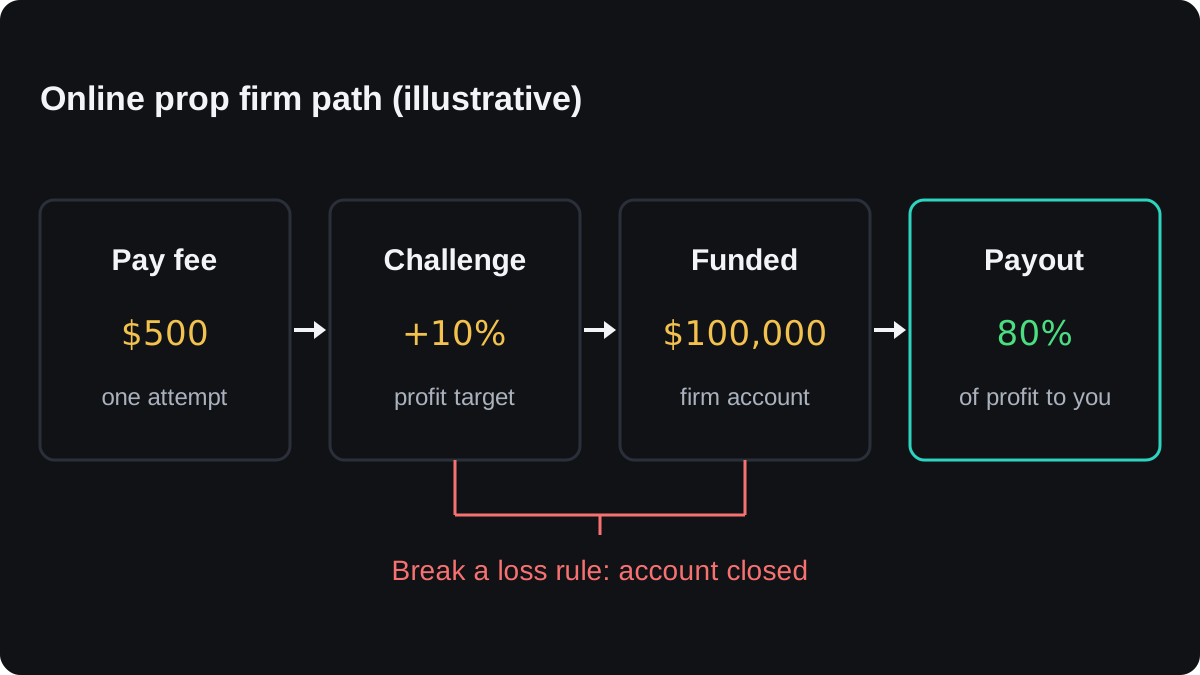
- You buy a challenge, an evaluation account with set rules, for a one-off fee. Larger accounts cost more.
- You trade it until you reach a profit target without breaking any loss limit. Some firms use two stages.
- If you pass, you get a funded account, where the firm pays you for profits under the same kind of rules.
- You keep a percentage of what you make, called the profit split, paid on a schedule the firm sets.
Break a loss rule at any stage and the account is closed. The fee is gone, and to try again you buy a new challenge.
What rules do you trade under?
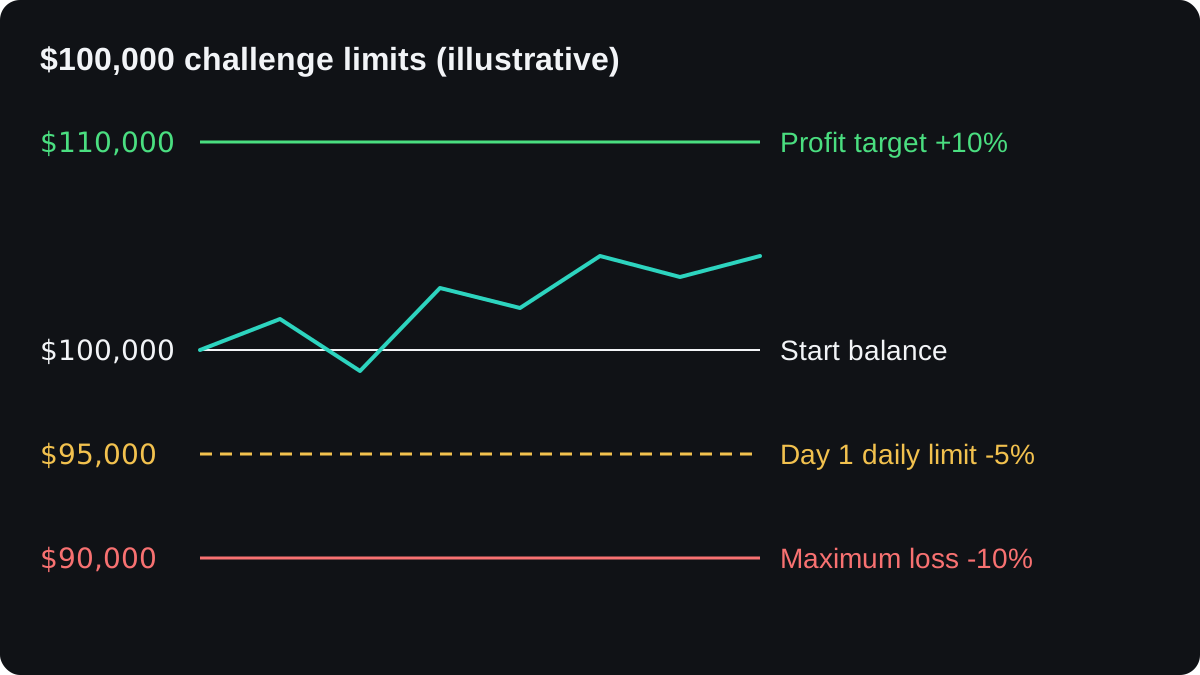
Take an illustrative $100,000 challenge. The profit target is 10%, so you pass when the balance reaches $110,000.
Two loss limits guard the downside. The daily loss limit is 5%, or $5,000 in one day. The maximum loss is 10%, so the account fails if it falls to $90,000.
Both limits measure drawdown, the fall in an account from its starting point or its peak. Firms also differ on whether each day's limit counts from that day's opening balance or equity.
Some firms fix the floor at $90,000. Others use a trailing limit that rises as the account grows, which leaves less room once you are in profit. The challenge lesson covers both.
The limits decide how big each trade can be. Say you plan to risk 1% of the starting account per trade, which is $1,000, with a 20 pip stop on EUR/USD.
- One pip on one standard lot of EUR/USD is worth $10.
- A 20 pip stop on one lot risks 20 × $10 = $200.
- To risk $1,000, you trade $1,000 ÷ $200 = 5 lots.
At that size, five losing trades in one day use up the whole $5,000 daily limit, before spread or commission. Ten losses in a row over several days reach the $90,000 floor.
The position size lesson shows the method for any pair.
Many firms add other conditions, such as a minimum number of trading days or limits on trading around major news. These differ from firm to firm and sit in the terms, so read them line by line.
How does the profit split work?
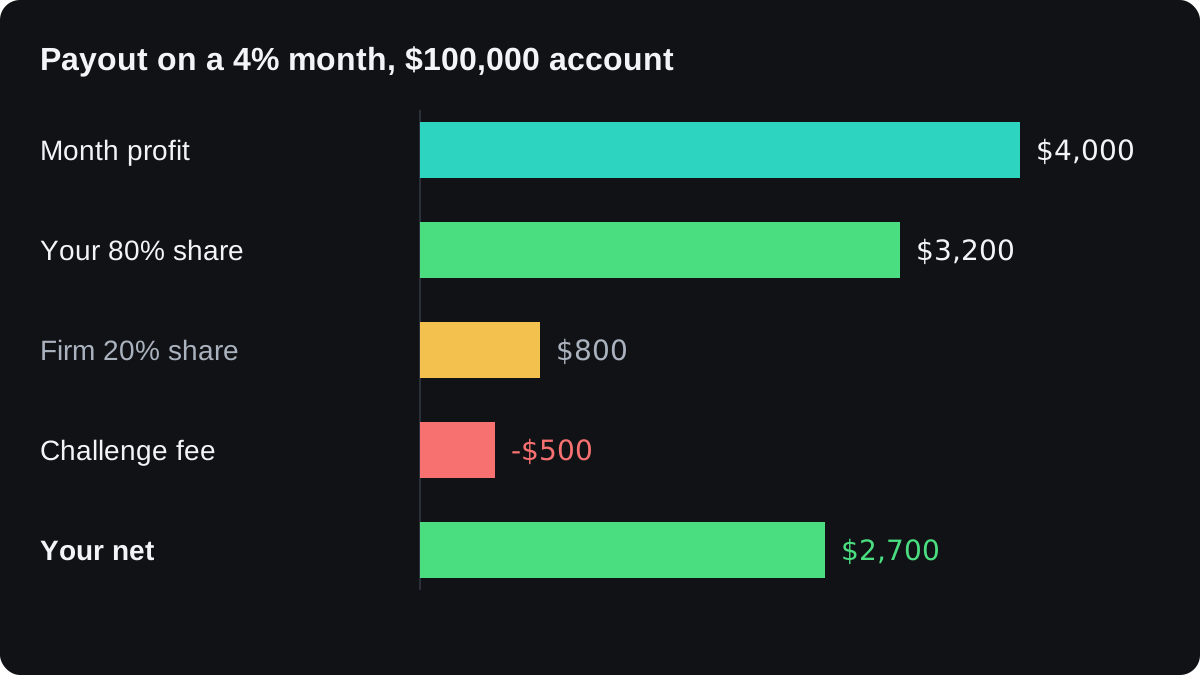
Suppose you pass and trade the funded $100,000 account. In your first month you make 4%, and the firm pays an illustrative 80% of profit to you.
- Profit: 4% of $100,000 = $4,000.
- Your share: 80% × $4,000 = $3,200.
- The firm's share: $4,000 minus $3,200 = $800.
- After the $500 challenge fee, your net result is $3,200 minus $500 = $2,700.
Some firms refund the fee with the first payout, in which case your net is the full $3,200. Check the terms, since this varies.
The fee also sets a breakeven. With an 80% split, you need $500 ÷ 0.80 = $625 of profit to earn the fee back, which is 0.625% of the account.
That sum only starts once you have passed. If your first challenge fails and you buy a second, your fees total $1,000, and breakeven rises to $1,000 ÷ 0.80 = $1,250, or 1.25%.
Where does the firm's money come from?
An online prop firm has two possible sources of income: the fees it charges and any profit from trading.
The terms of many online firms say that funded accounts are simulated. Your trades are not sent to the market, and payouts come from the firm's own revenue, which includes fees paid by traders who failed.
That model can work for both sides, yet it creates a conflict. The firm can earn money when customers fail, so tight rules and repeat challenges suit its income.
Few firms publish independently audited figures on how many traders pass or get paid, so treat success claims in ads with care.
Because the fee buys a service, many online prop firms hold no broker licence. Check who owns the firm, where it is registered and which platform it uses, much as you would when you check a broker's licence.
The rules and risks lesson goes further into what can go wrong.
How is a prop firm different from your own broker account?
The biggest differences are whose money takes the loss and who sets the rules.
| What differs | Online prop firm | Your own broker account |
|---|---|---|
| Money you put in | A challenge fee | Your trading deposit |
| Account size | Set by the plan, such as $100,000 | Whatever you deposit |
| Most you can lose | Usually the fees you paid | Your deposit (more without negative balance protection) |
| Profit you keep | Your split, such as 80% | All of it, after costs |
| Rules | The firm's target and loss limits | Your own plan and the broker's margin rules |
| Losing too much | Account closed | Trades closed at the broker's stop out level |
A challenge rewards the same habits as any careful account: small risk per trade and a plan you follow. A demo account is a free way to see whether you can stay inside a 5% daily limit before you pay a fee.
Questions
Are prop firms legit?
Some firms pay traders as their terms promise, and some have changed rules or stopped trading. Read the payout terms, check where the company is registered and look for independent reports of payouts before you pay.
Do you trade real money at a prop firm?
Often you do not. Many online firms state that funded accounts are simulated and pay you from their own revenue, so read the terms to see which model a firm uses.
Can you lose more than the challenge fee?
Under the usual online model, the fees you pay are the most you can lose, because the account balance belongs to the firm. Check the terms of any firm for extra charges, such as reset or renewal fees.
How much does a prop firm challenge cost?
Prices vary by firm and account size, with larger accounts costing more. This lesson uses $500 for a $100,000 account purely as an illustration.
What is a typical profit split?
It varies by firm and plan, and some firms change it as you keep trading with them. The 80% used here is an example for the arithmetic, not a market figure.
Keep learning
 Chapter 1How prop firm challenges work.A prop firm challenge is a paid test on a firm's account. You must reach a profit target, such as 10%, without breaking a daily loss limit or a maximum loss limit, and follow rules on trading days and news. Pass and you trade a funded account for a share of profits. Fail and the fee is usually gone.
 Chapter 1Prop firm rules and risks.Prop firm accounts usually end on a rule breach, typically a daily loss limit or a maximum drawdown, and floating losses often count. Trailing drawdown rules move the floor up as you profit. The firm itself also carries risk: funded accounts are often simulated, payouts can be refused and rules can change.

