What happens if you trade forex with $100?
With $100 and 1:100 leverage, 0.01 lot of EUR/USD at 1.10000 uses $11 of margin and can move about 890 pips against you before a 100% margin call. At 0.05 lot the margin call comes after 90 pips, and 0.10 lot cannot be opened at all. Trade size decides how much room you have.
هذا المحتوى متاح حاليًا باللغة الإنجليزية فقط.

Picture a fresh account with $100 in it. The deposit is the same whatever you trade, yet how long it survives a losing move depends almost entirely on the trade size you pick.
This lesson runs the numbers for several sizes, using the margin call and stop out rules from the previous example.
The setup behind every example
All figures here are illustrative, chosen to keep the arithmetic clean:
- A US dollar account with a balance of $100 and no open trades.
- EUR/USD at 1.10000, where one pip is 0.0001.
- Account leverage of 1:100, so used margin is 1% of the position's value.
- A margin call at 100% margin level and a stop out at 50%.
Margin level is equity divided by used margin, times 100. At the margin call your broker warns you, and with free margin at or below zero you cannot open new trades. At the stop out it starts closing your positions.
The examples ignore spread, commission and swap, and keep used margin at its opening value. On a large move your platform may recalculate margin at the new price, which shifts the results slightly.
How much margin does each trade size use?
A lot is 100,000 units of the base currency, so 0.01 lot of EUR/USD is 1,000 euros. At 1.10000 that position is worth 1,000 × 1.10000 = $1,100.
At 1:100 the broker sets aside 1% of that as used margin: $1,100 ÷ 100 = $11. Larger sizes scale in a straight line.
| Trade size | Position value | Used margin at 1:100 | Value of 1 pip |
|---|---|---|---|
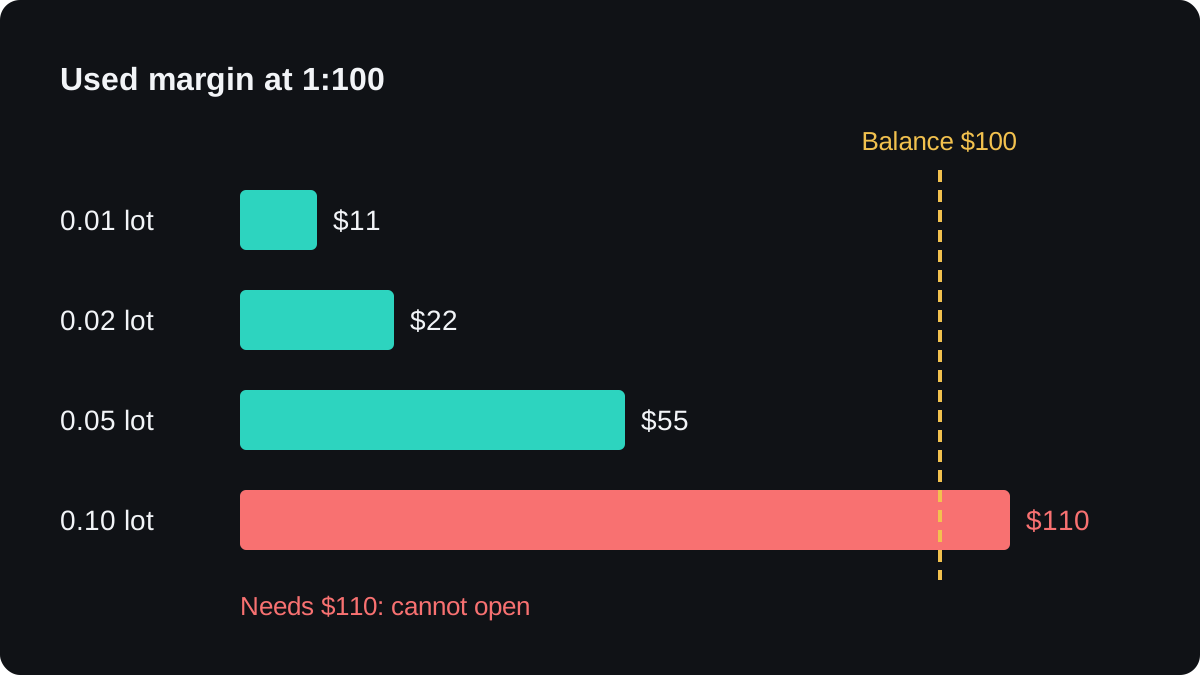
| 0.01 lot | $1,100 | $11 | $0.10 |
| 0.02 lot | $2,200 | $22 | $0.20 |
| 0.05 lot | $5,500 | $55 | $0.50 |
| 0.10 lot | $11,000 | $110 | $1.00 |
The 0.10 lot trade needs $110 of margin, more than the whole $100 balance. Your free margin is too small, so the platform rejects the order before it opens.
How many pips until the margin call?
Take the 0.05 lot trade and buy at 1.10000. Each pip against you takes $0.50 off your equity, while used margin stays at $55.
- A 100% margin call comes when equity falls to 100% of used margin, which is $55.
- From $100 down to $55 is a loss of $100 − $55 = $45.
- At $0.50 a pip, $45 ÷ $0.50 = 90 pips.
- So the margin call arrives near 1.10000 − 0.00900 = 1.09100.
The stop out follows the same steps. At 50%, equity must fall to $27.50, a loss of $72.50. That is $72.50 ÷ $0.50 = 145 pips, near 1.08550.
Both calculations fit one formula: pips to the level = (balance − used margin × level) ÷ pip value. Here it is for every size that fits in the account.
| Trade size | Used margin | Pips to margin call (100%) | Pips to stop out (50%) |
|---|---|---|---|
| 0.01 lot | $11 | 890 | 945 |
| 0.02 lot | $22 | 390 | 445 |
| 0.05 lot | $55 | 90 | 145 |
| 0.09 lot | $99 | 1.1 | 56 |
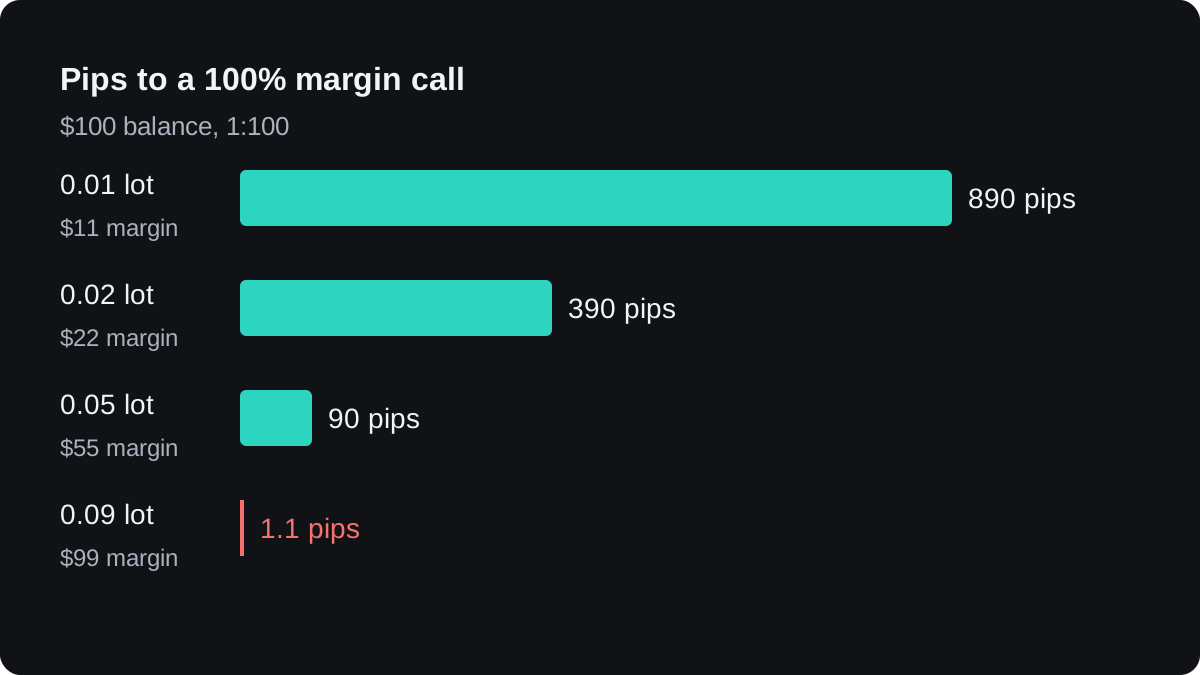
Moving from 0.01 lot to 0.05 lot makes the trade five times larger, yet the room before the margin call shrinks from 890 pips to 90. A bigger size raises the pip value and also locks more of the balance away as margin.
The 0.09 lot trade opens with a margin level of 100 ÷ 99 × 100 = 101%.
If the spread is 1 pip, it costs $0.90 at that size, which leaves the trade about a tenth of a pip from the margin call as it opens.
To judge whether 90 pips is a big move, open a daily EUR/USD chart and compare it with the height of recent candles.
Does higher leverage give you more room?
Leverage sets how much margin a trade needs. The pip value depends only on the trade size, so leverage leaves it unchanged.
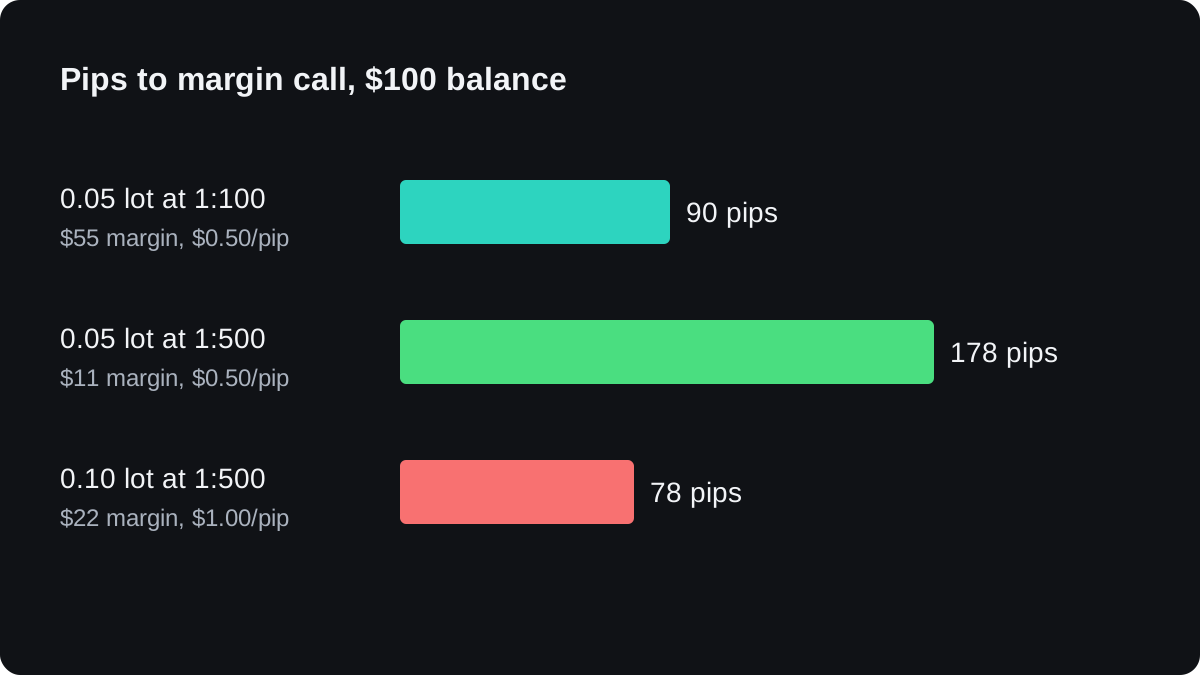
Keep the 0.05 lot trade and switch the account to 1:500. Used margin becomes $5,500 ÷ 500 = $11, so the margin call waits until equity reaches $11.
That is a loss of $100 − $11 = $89, or $89 ÷ $0.50 = 178 pips. The same trade now has almost twice the room it had at 1:100.
Higher leverage also lets you open 0.10 lot, which needs only $22 of margin at 1:500. The pip value is $1, so the margin call comes after ($100 − $22) ÷ $1 = 78 pips, and the stop out after 89.
Effective leverage measures this directly: position value divided by equity. A 0.10 lot trade is $11,000 on $100, which is 110 times your money, whatever the account setting says. A 0.01 lot trade is 11 times.
What a $100 account can realistically gain and lose
The margin call is a last line, and a sensible plan exits long before it. A stop loss 20 pips away on 0.01 lot loses 20 × $0.10 = $2, which is 2% of the account.
Small accounts hit a hard limit here. If you choose to risk 1% per trade, that is $1, and at $0.10 a pip it allows a stop only 10 pips wide on 0.01 lot.
On many standard accounts 0.01 lot is the smallest size. Some brokers offer accounts with smaller contracts, and the contract specification shows the size of one lot.
The profit side is small too. A 50 pip win on 0.01 lot is $5, or 5% of the account. Making more per trade means a bigger size, and the tables above show what that does to your room.
The stop out price is also no guarantee. Over a weekend or on big news, price can jump past it, so your positions close at a worse price and equity can end below the 50% level or even below zero.
Whether a broker covers a negative balance depends on its terms, so read them. The next lesson explains why margin call and stop out levels vary, and the margin calculator repeats these sums for other pairs.
أسئلة شائعة
Can you trade forex with $100?
Yes, if your broker's minimum deposit allows it. In this lesson's numbers, 0.01 lot of EUR/USD at 1:100 needs $11 of margin and leaves plenty of free margin.
How many pips can a $100 account lose before a margin call?
It depends on trade size and leverage. With $100 at 1:100 and a 100% margin call, it is about 890 pips on 0.01 lot, 90 pips on 0.05 lot and about 1 pip on 0.09 lot.
What lot size should I use with $100?
Work backwards from the amount you accept losing on one trade and the distance to your stop. At $0.10 a pip, 0.01 lot with a 20 pip stop risks $2, and the position size lesson shows the full method.
Does more leverage make a $100 account safer?
Only in a narrow sense. At the same trade size, higher leverage lowers used margin and pushes the margin call further away, while the loss per pip stays the same. It also allows bigger trades whose pip value drains the balance faster.
Why can't I open 0.10 lot with $100?
At 1:100, 0.10 lot of EUR/USD at 1.10000 needs $110 of margin. That is more than the $100 balance, so the platform refuses the order.
تابع التعلّم
 الفصل 6What is margin trading?Margin trading means opening a position worth more than the money in your account. The broker sets aside part of your balance, the margin, as a deposit while the trade is open. Profit and loss are counted on the full position size, so small price moves change your balance much faster than the margin suggests.
 الفصل 6What is account balance in forex?Your account balance is the money in your trading account from deposits, withdrawals and closed trades, after booked costs such as commission and swap. It does not include open positions. While a trade is open the balance stays the same, and the floating profit or loss shows up in your equity instead.
 الفصل 6What is floating (unrealized) profit and loss?Floating profit and loss is the result your open trades would show if you closed them at the current price. It changes with every tick and moves your equity, while your balance stays the same. It becomes realized, and is added to or taken from your balance, only when the trade closes.
 الفصل 6ما هو الهامش ومستوى الهامش والإغلاق القسري في الفوركس؟الهامش هو جزء من أموالك تحجزه شركة الوساطة وديعةً طوال فترة فتح صفقة بالرافعة المالية. ومستوى الهامش هو حقوق الملكية مقسومة على الهامش المستخدم، مضروبة في 100%. وعندما ينخفض إلى مستوى نداء الهامش لدى شركة الوساطة يُوضع على حسابك تنبيه، وعند مستوى الإغلاق القسري تبدأ شركة الوساطة في إغلاق مراكزك تلقائيًا.
 الفصل 6What is used margin?Used margin is the total amount your broker sets aside to keep all your open positions open. Each position's margin is its notional value divided by your leverage, and used margin adds them up. It is not a fee: the money returns to free margin when you close the trades.
 الفصل 6What is equity in a trading account?Equity is your account balance plus or minus the floating profit or loss of your open trades. It shows what the account would be worth if you closed everything at current prices. With no trades open, equity equals balance. Brokers use it to work out free margin, margin level and stop outs.
 الفصل 6What is free margin?Free margin is the money in your trading account that is not locked up as margin for open trades. It equals equity minus used margin. You need free margin to open new positions, and it falls as open trades lose and rises as they gain. At zero, your margin level is 100%.
 الفصل 6What is margin level?Margin level is your equity divided by your used margin, multiplied by 100 and shown as a percentage. It tells you how much cushion your open trades have. At 100%, equity equals used margin and free margin is zero. Brokers set their margin call and stop out levels on this number, and the levels differ between brokers.
 الفصل 6What is a margin call?A margin call is your broker's warning that your margin level, equity divided by used margin, has fallen to a set threshold such as 100%. You usually cannot open new trades from that point. The call closes nothing by itself. If losses continue, the broker's stop out level is where positions start to be closed for you.
 الفصل 6What is a stop out level?The stop out level is the margin level at which your broker starts closing your open positions automatically, often beginning with the largest loss. If your stop out level is 50%, closing begins when equity falls to half your used margin. It is meant to stop your account sinking further, though a price gap can still push it below zero.
 الفصل 6Margin call example: margin call at 100% with no separate stop out.When a broker sets the margin call and the stop out both at 100%, the warning and the forced close happen at the same moment. In this example, a $1,000 account buys 0.50 lot of EUR/USD with $550 of margin at 1:100, and the trade is closed after a 90 pip fall, a $450 loss.
 الفصل 6Margin call and stop out example: 100% and 50%.In this example a $2,000 account buys 1 lot of EUR/USD at 1.10000 with $1,100 of used margin. The margin call at 100% arrives when equity falls to $1,100, 90 pips lower at 1.09100. The stop out at 50% closes the trade when equity reaches $550, at 1.08550, a loss of $1,450.
 الفصل 6Why margin call and stop out levels differ between brokers.Margin call and stop out levels are set by each broker, often per account type, within any rules from the regulator that licenses the account. In this lesson's example, one trade is closed after 90 pips at one broker and after 178 pips at another, so look up your own levels before you trade.
 الفصل 6ما هي الرافعة المالية في الفوركس؟تتيح لك الرافعة المالية التحكم في مركز أكبر بكثير من إيداعك. فعند رافعة 1:100، يتحكم كل $1 من الهامش في $100 من العملة، لذا يحتاج مركز قيمته $110,000 إلى $1,100. وتحدد الرافعة مقدار الهامش المحجوز، لا قيمة النقطة. أما خطرك الحقيقي فيأتي من حجم المركز الذي تختاره.
 الفصل 6Margin cheat sheet.Balance is the cash from deposits, withdrawals and closed trades. Equity is balance plus the floating profit or loss on open trades. Used margin is the deposit your open trades hold, and free margin is equity minus used margin. Margin level is equity divided by used margin, times 100. A margin call warns; a stop out closes trades.
 الفصل 6How can you avoid a margin call?Margin level is your equity divided by your used margin, and a margin call comes when it falls to your broker's threshold. To stay clear, keep positions small compared with your equity, set stop losses that close losing trades long before that point, and leave plenty of free margin unused.

