How central banks move currencies.
Central banks move currencies mainly through interest rates. A higher policy rate, or a signal that one is coming, tends to attract money and lift a currency, and a lower one tends to weigh on it. Prices react most to the gap between what the bank does and what markets expected, and guidance and bond buying also move them.
Konten ini baru tersedia dalam bahasa Inggris.
A central bank decision can move a currency pair by dozens of pips in minutes. The size of that move depends mostly on how far the decision differs from what traders expected beforehand.
The previous lesson explained why interest rates matter to a currency. This one covers the tools a central bank uses and how traders read its announcements.
What does a central bank control?
A central bank sets the short-term interest rate for its currency, called the policy rate. Banks lend to each other overnight close to that rate, so it feeds into loans, savings and bond yields across the economy.
Most large central banks have a mandate centred on stable prices. Several aim for inflation of about 2% a year, and the US Federal Reserve also has a goal of maximum employment.
When inflation runs above target, a bank tends to raise rates or keep them high. When the economy weakens and inflation is low, it tends to cut. The interest rates lesson showed why a higher rate can draw money into a currency.
Traders call a bank hawkish when it leans toward higher rates, and dovish when it leans toward lower ones.
Rate changes are often quoted in basis points. One basis point is 0.01 percentage point, so a 0.25 point move is 25 basis points.
Why the surprise matters more than the decision
Markets trade on what they think will happen. Weeks before a meeting, traders already hold positions based on the likely outcome, so much of the expected move is already in the price.
You can see that expectation in interest rate futures and swaps. Data providers turn their prices into a probability for each outcome at the next meeting.
A worked example, with illustrative numbers:
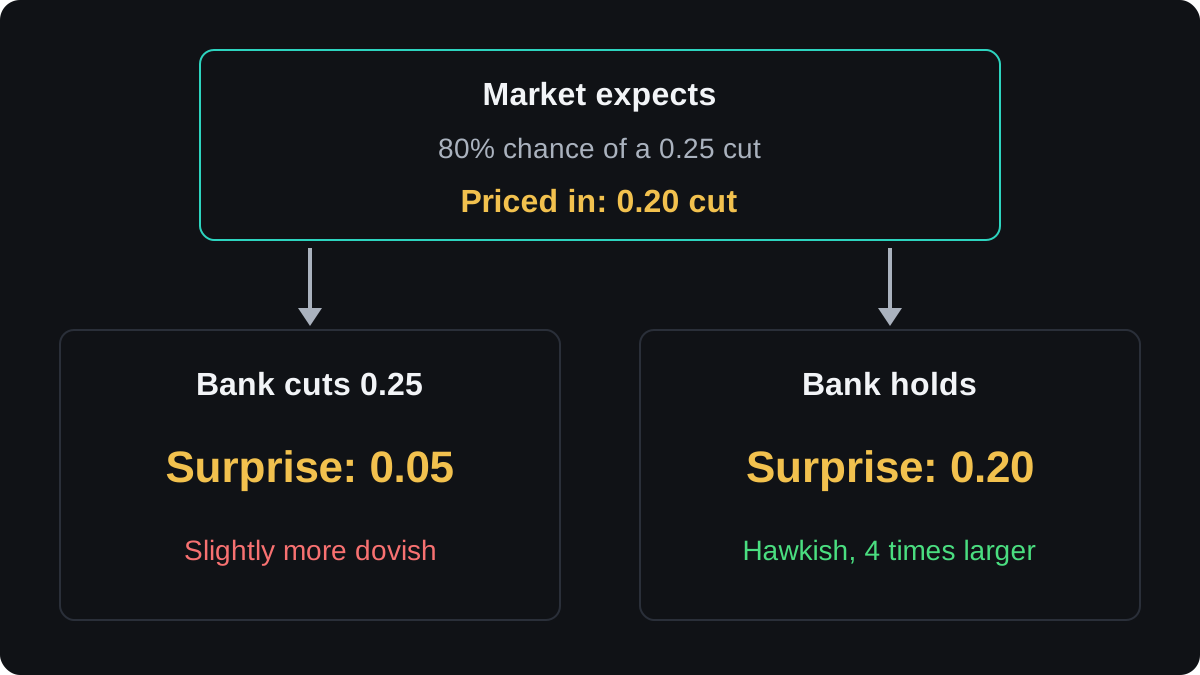
- The market gives an 80% chance that the bank cuts by 0.25 point and a 20% chance that it holds.
- The expected change is 0.80 × 0.25 = 0.20 point of cuts. That is what is priced in.
- If the bank cuts 0.25, the surprise is 0.25 minus 0.20 = 0.05 point, slightly more dovish than priced.
- If the bank holds, the surprise is 0.20 point in the hawkish direction, four times as large.
A hold can therefore lift the currency more than a cut would weaken it, although the rate itself stays where it was.
The expectations versus actual lesson applies the same logic to economic data releases.
Forward guidance: when words move prices
Because markets trade on expectations, central banks try to shape them. Forward guidance is what a bank says about its likely future policy.
Guidance can be loose, such as a line saying rates will stay high "for some time". It can also tie future moves to data, for example a promise to hold rates until inflation is back near target.
Guidance shifts the expected path of rates, so a meeting with no rate change can still move a currency sharply. If the bank hints that cuts are closer than traders thought, the currency tends to fall on the day of the hold.
Speeches between meetings count too. Markets listen to the governor and other policymakers, since their comments can confirm or undo the guidance from the last statement.
Balance sheets: buying and selling bonds
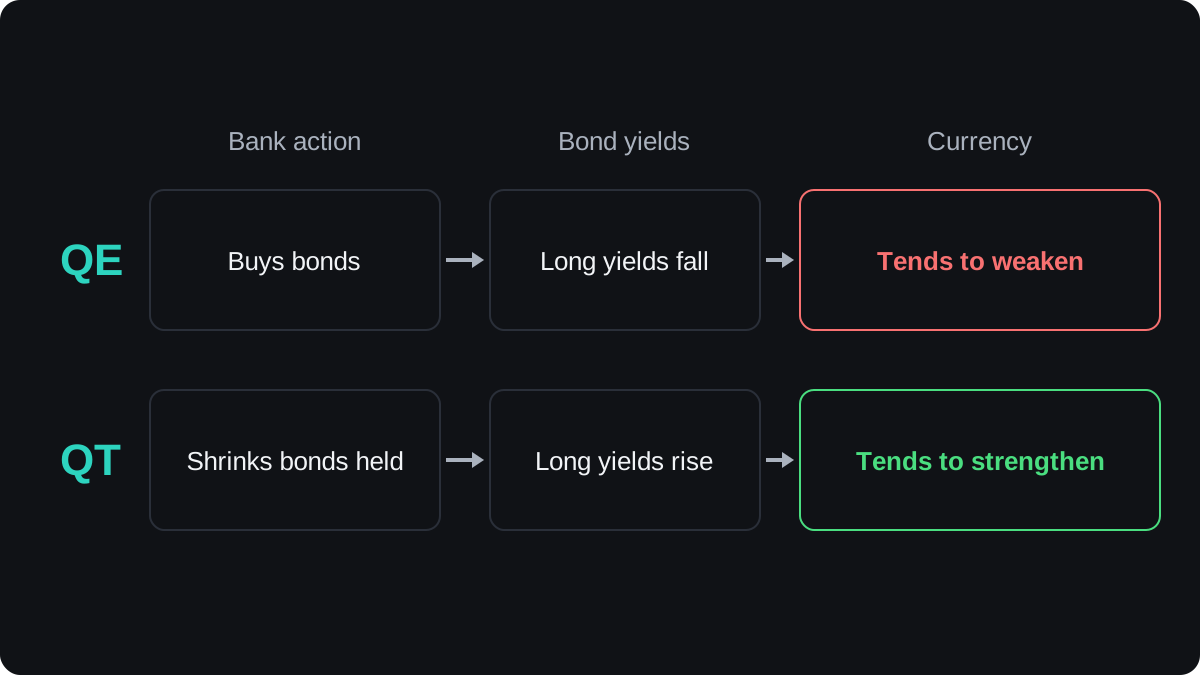
When the policy rate is already near zero, a bank can still ease policy by buying bonds with newly created central bank money. This is called quantitative easing (QE).
Large purchases push bond prices up and long-term yields down. Lower yields make the currency less attractive to hold, so QE tends to weigh on it.
The reverse is quantitative tightening (QT). The bank lets bonds mature without replacing them, or sells them, and its holdings shrink. That tends to push long-term yields up, which can support the currency.
Balance sheet plans are usually announced in advance and run for months. Their effect on a currency is slower and harder to isolate than a rate surprise, and the bond yields lesson follows that link further.
How traders read a policy statement
Each scheduled decision comes with a written statement, released at a time published well ahead. You can find the date and time on an economic calendar. Many banks follow with a press conference and, at some meetings, new forecasts.
Traders usually work through a release in roughly this order:
- Compare the decision with what was priced in.
- Check the vote, if the bank publishes it. A split vote can signal that the next move is closer.
- Compare the wording with the previous statement, line by line, because banks change words on purpose.
- Read any new forecasts for inflation and growth, and at some banks for the policy rate itself.
- Listen to the press conference, where answers to questions can change the tone of the whole release.
A small wording change can carry the message. Suppose a statement used to say "further increases may be needed" and now says "the committee will judge the need for further changes". The wording is illustrative, but a shift like it would read as dovish.
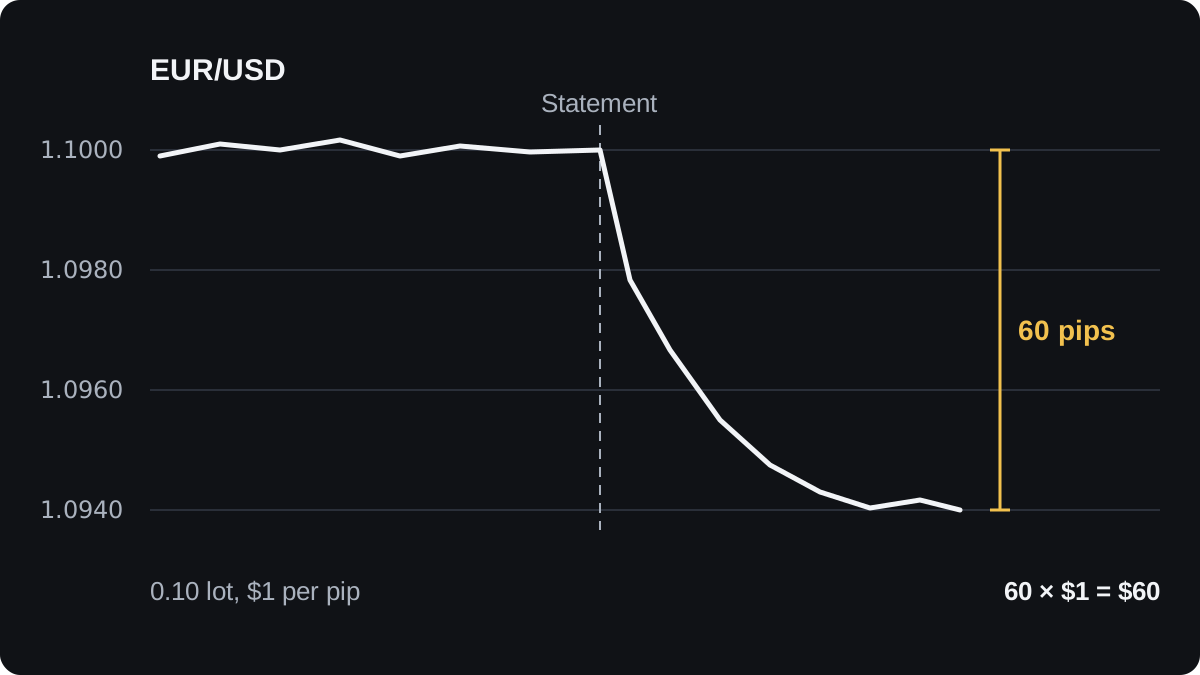
Take a hawkish surprise with round illustrative prices. The US central bank holds rates when markets expected a cut, and EUR/USD falls from 1.10000 to 1.09400 within the hour.
That is a fall of 0.00600, or 60 pips. On 0.10 lot, one pip is 10,000 × 0.0001 = $1, so the move is worth 60 × $1 = $60. A long position loses that amount and a short position gains it.
The first move after a release is often fast and uneven. Spreads can widen and orders can fill at worse prices, which the news reaction lesson covers.
Where the link between policy and currency breaks
Everything above describes tendencies. They fail often enough that you should treat each one as a question to check against the price.
A rate cut can lift a currency if traders think it will rescue growth. A hike can hurt one if it looks like a desperate response to a crisis, so the reason for a decision matters as much as its size.
Global mood can swamp local policy. In a sharp risk-off period, money can flow into currencies seen as safe even while their central bank is cutting.
A pair also has two central banks. A hawkish shift in one country can be matched by a hawkish shift in the other, leaving the pair close to where it started.
The first reaction can reverse within hours as traders read the full statement and hear the press conference.
Direct buying or selling of a currency is a separate tool, covered in the currency intervention lesson. In some countries the finance ministry makes that decision and the central bank carries it out.
Central banks react above all to inflation, which is the subject of the next lesson.
Pertanyaan
Does a rate hike always strengthen a currency?
No. A hike that was fully expected may barely move the price, and a hike seen as harming growth can even weaken the currency.
What does hawkish mean in forex?
A hawkish central bank leans toward raising interest rates or keeping them high to fight inflation. A hawkish surprise tends to support the currency.
How often do central banks meet?
Each bank sets its own calendar and publishes it in advance. The large ones usually hold several scheduled policy meetings a year, roughly every six weeks for some.
What is quantitative easing?
Quantitative easing is when a central bank buys bonds with newly created money to push down long-term interest rates. It tends to weaken the currency, though other forces can outweigh it.
Why did a currency fall after a rate hike?
Usually because traders expected more, such as a larger hike or more hawkish guidance. The price had already moved for the hike before it was announced.
Lanjut belajar
 Bab 1What moves exchange rates?Exchange rates move when demand for one currency changes against another. In normal markets, the driver that moves prices most often is the expected gap in interest rates between two countries. Growth and inflation matter mainly through what they imply for rates. Risk appetite can take over in a crisis, and trade balances work slowly, over years.
 Bab 1Interest rates and currencies.A currency tends to rise when its interest rates are expected to go up, because higher rates draw in money looking for a better return. Prices move on expectations, so a hike the market already expected may change little. Inflation and fear can also break the link.
 Bab 1Inflation and currencies.Inflation moves a currency mainly through interest rate expectations. When an inflation report comes in above forecast, traders expect the central bank to raise rates or keep them higher, so the currency often rises. A figure below forecast often weakens it. Over many years, high inflation that is not controlled tends to erode a currency's value.

