Inflation and currencies.
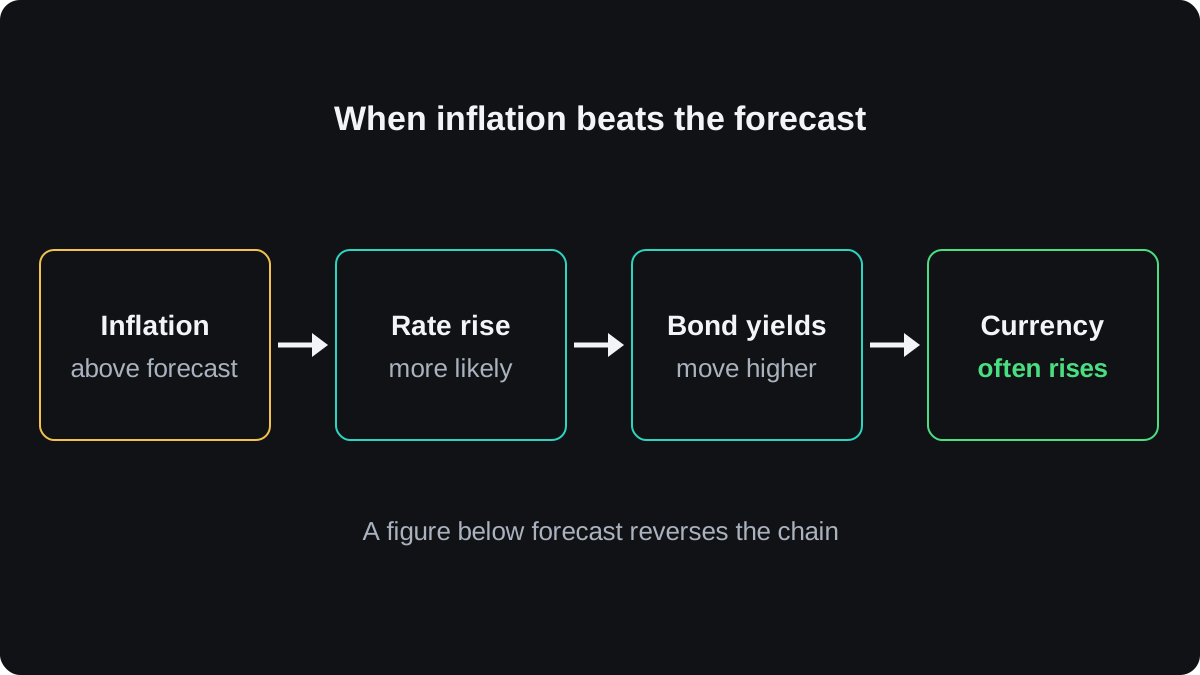
Inflation moves a currency mainly through interest rate expectations. When an inflation report comes in above forecast, traders expect the central bank to raise rates or keep them higher, so the currency often rises. A figure below forecast often weakens it. Over many years, high inflation that is not controlled tends to erode a currency's value.
Konten ini baru tersedia dalam bahasa Inggris.

A country publishes its monthly inflation figure, and within seconds its currency jumps or drops.
The currency reacts because traders read the figure as a clue to the central bank's next interest rate decision. Interest rates, in turn, pull money toward a currency or push it away.
What does an inflation figure measure?
Say a fixed basket of everyday goods and services cost 200.00 a year ago and costs 206.00 today. Prices have risen by 6.00 ÷ 200.00 = 3.0% over the year.
Inflation is that rise in the general price level over time. Most countries measure it with a consumer price index (CPI), which tracks the cost of a basket meant to reflect what households buy.
Reports usually give two versions. Headline inflation covers the whole basket. Core inflation usually leaves out food and energy, whose prices swing a lot, so it shows the slower trend underneath.
You will also see two time frames. Year-on-year compares with the same month last year. Month-on-month compares with last month: a basket going from 205.40 to 206.00 is 0.60 ÷ 205.40, about 0.3%.
Small monthly numbers add up. A steady 0.3% a month compounds to roughly 3.7% over a year.
Why inflation changes interest rate expectations
Many large central banks aim to keep inflation near 2% a year. When inflation runs above target, their usual tool is a higher interest rate, which makes borrowing dearer and slows spending.
So each inflation report updates the market's guess about future rates. A higher figure makes a rate rise more likely, or a planned cut less likely. A lower figure does the opposite.
Higher expected rates lift bond yields, and higher yields attract investors looking for a better return. Foreign investors need the currency to buy those bonds, which raises demand for it.
The interest rates lesson covers that pull of yields on money in more detail.
The central bank may not meet for weeks, yet the currency moves on the day of the report. Prices adjust to the new guess about rates at once, without waiting for the decision.
How central banks move currencies explains how rate meetings and speeches feed the same guess.
Why the surprise matters more than the number
Before each release, economists publish forecasts. An economic calendar shows the consensus, the middle of those forecasts, and the market has already priced that figure in.
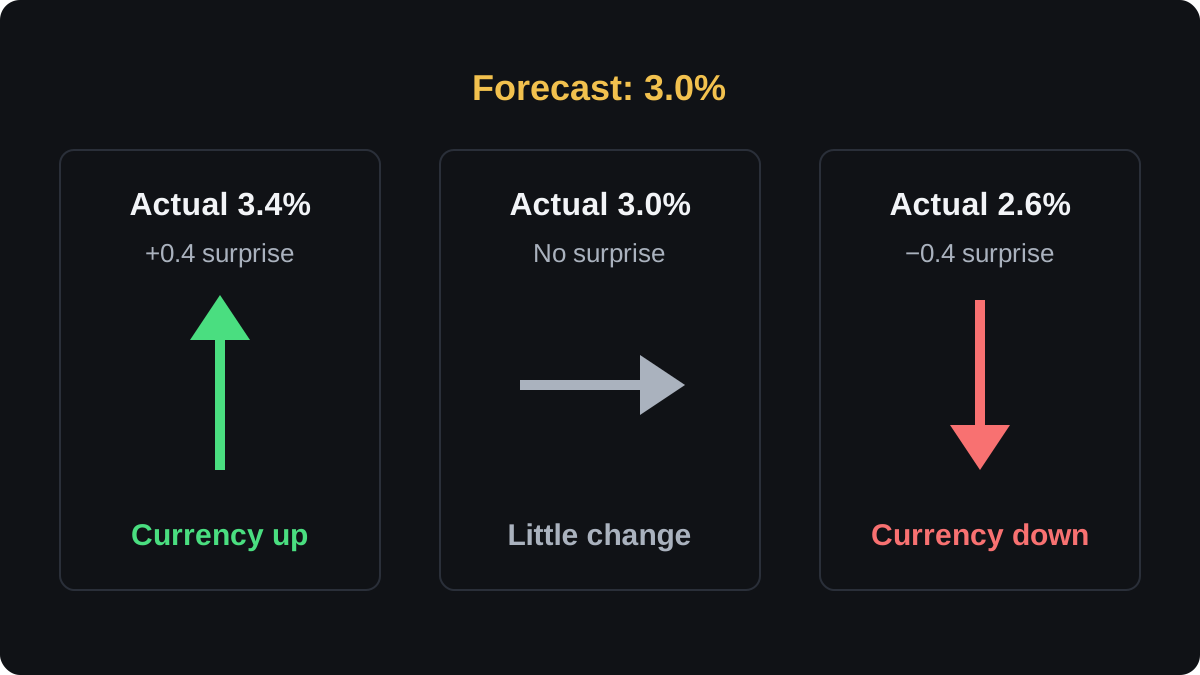
The move comes from the gap between forecast and actual. Suppose the forecast is 3.0% and the actual figure is 3.4%, a surprise of +0.4 point: the currency often rises.
A figure of 3.0% tends to change little. A figure of 2.6%, a surprise of −0.4 point, often makes the currency fall.
This is why a currency can fall on a report showing high inflation. If traders expected 3.6% and got 3.4%, prices are still rising fast, yet the pressure for higher rates is weaker than they planned for.
The expectations versus actual lesson applies the same idea to every kind of economic data.
Core and headline can also disagree. If headline beats the forecast because of an oil spike while core comes in soft, the reaction can be small or switch direction within minutes.
A worked example around a CPI release
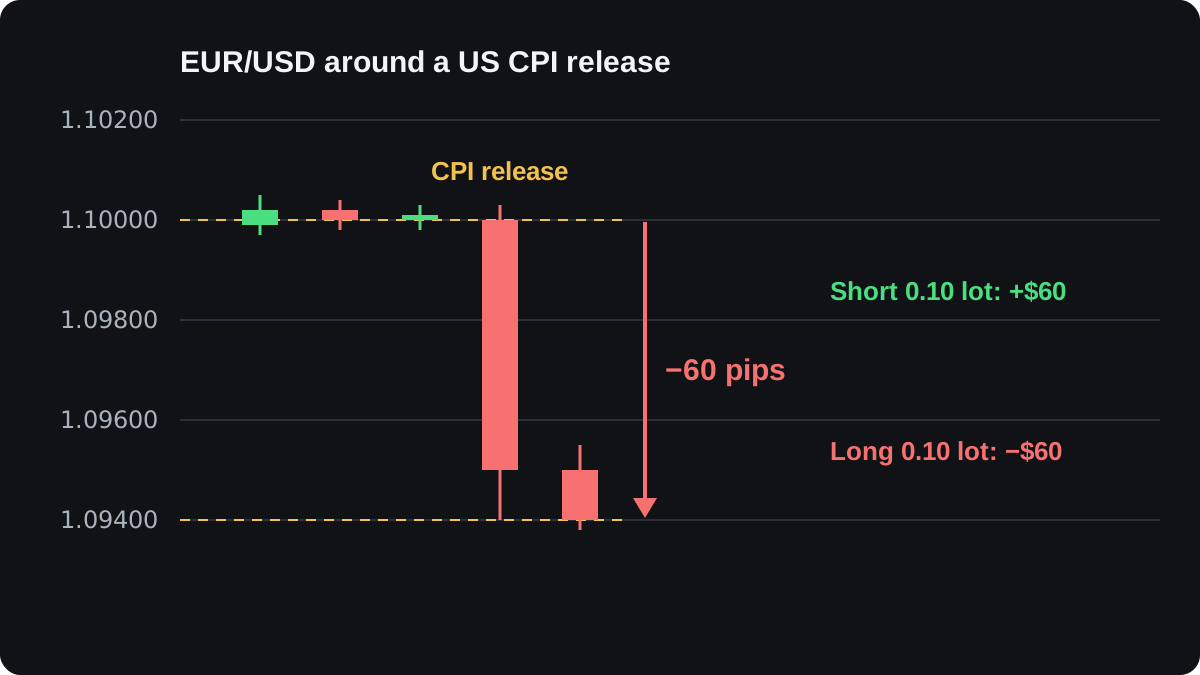
The prices here are illustrative. EUR/USD sits at 1.10000 just before a US CPI report.
The figure comes in well above forecast, the market expects higher US rates, and the dollar strengthens. A stronger dollar means one euro buys fewer dollars, so EUR/USD falls to 1.09400 within minutes.
- The move is 1.10000 minus 1.09400 = 0.00600, which is 60 pips.
- A trade of 0.10 lot is 10,000 euros, so one pip is worth 10,000 × 0.0001 = $1.
- A short of 0.10 lot opened at 1.10000 and closed at 1.09400 gains 60 × $1 = $60.
- A long of the same size over the same move loses 60 × $1 = $60.
These sums use one price for simplicity. In a real trade, the spread would come out of both results.
Release moments are harder to trade than the sum suggests. Spreads often widen around the figure, and orders can fill at a worse price than you asked for, which is called slippage.
Say the long trader had a stop loss at 1.09800, a planned loss of 20 pips or $20. If the price jumps through it and the stop fills at 1.09750, the loss is 25 pips, or $25.
Real interest rates and the long run
Inflation has a second, slower effect. A high interest rate is less attractive when prices are rising almost as fast, because inflation eats the return.
Take two illustrative countries. Country A pays 5% with 4% inflation, leaving 1% after inflation. Country B pays 3% with 1% inflation, leaving 2%.
That leftover is the real interest rate, roughly the interest rate minus inflation.
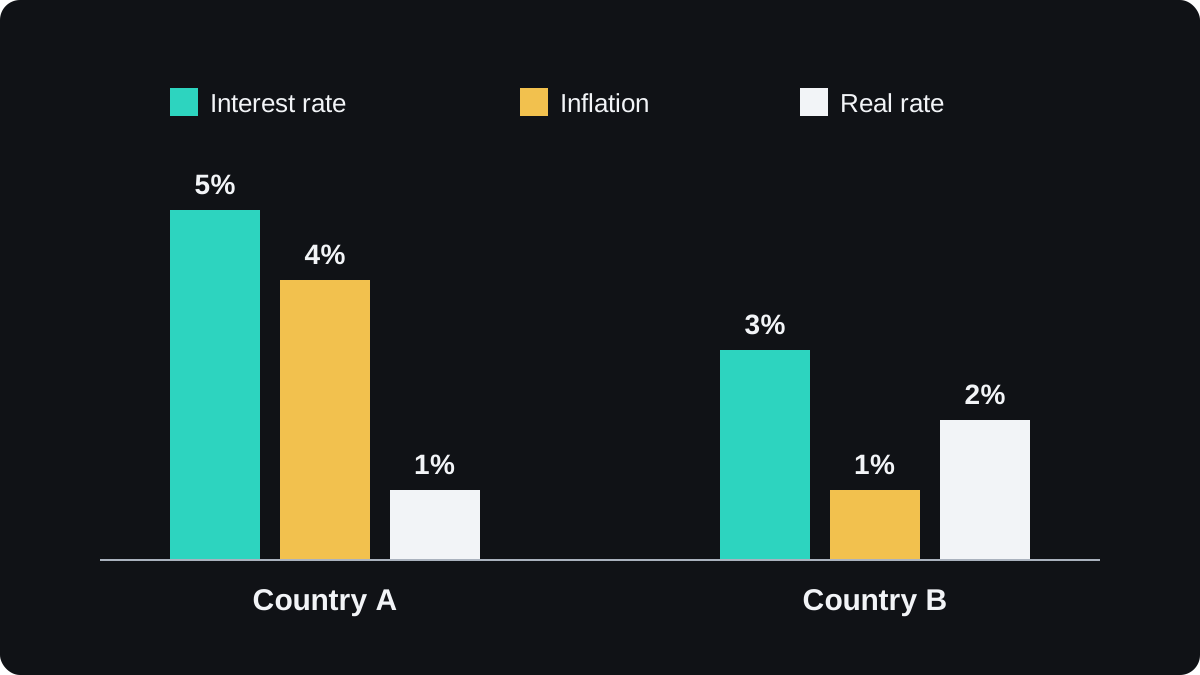
Country A has the higher rate, yet Country B pays more after inflation. Investors who think in real terms may prefer Country B's currency, so comparing headline rates alone can mislead.
Over many years, a currency with higher inflation than another tends to lose value against it, because each unit buys less at home. This idea is called purchasing power parity. It explains little over months and holds only loosely over long periods.
The two effects can point in opposite directions. A report above forecast often lifts a currency in the short run. If inflation stays high and the central bank does not respond, the real rate falls and the currency tends to weaken.
The Turkish lira is one example. It fell sharply against the US dollar in 2021, a year in which inflation was rising and the central bank cut rates.
When the inflation link breaks down
The path from inflation to currency is a tendency, and several things can bend it.
If the economy is already weak, high inflation can raise fears of stagflation, slow growth with rising prices. Traders may doubt the central bank can raise rates far, and the currency can fall.
A central bank may say it will look past a temporary price jump, such as one caused by energy. A report above forecast then moves rate expectations very little.
A report never arrives alone. Jobs data or a central bank speech in the same week can outweigh it, and a swing in risk appetite across markets can swamp a single country's figure.
The first reaction can also reverse. A spike in the first minute shows how fast traders reacted, and where the price settles by the end of the day can be quite different.
Inflation is one of several releases that move forex, and the next lesson covers the others.
Pertanyaan
Does high inflation make a currency stronger or weaker?
It depends on the timescale. In the short run, inflation above forecast often lifts a currency because traders expect higher rates. Over years, persistently high inflation that the central bank does not control tends to weaken it.
What is CPI in forex?
CPI is the consumer price index, the most watched measure of inflation. Forex traders compare each release with its forecast, because a surprise changes the expected path of interest rates.
Why did a currency fall when inflation was high?
Usually the figure was lower than the forecast, or core inflation was soft. The market had priced in the forecast, so a smaller rise than expected reduced the chance of higher rates.
Is core or headline inflation more important?
Central banks often watch core inflation closely because it strips out volatile food and energy prices. Traders watch both, and the reaction depends on which one surprises and by how much.
What is a real interest rate?
It is roughly the interest rate minus inflation. A 5% rate with 4% inflation is a real rate of about 1%.
Lanjut belajar
 Bab 1What moves exchange rates?Exchange rates move when demand for one currency changes against another. In normal markets, the driver that moves prices most often is the expected gap in interest rates between two countries. Growth and inflation matter mainly through what they imply for rates. Risk appetite can take over in a crisis, and trade balances work slowly, over years.
 Bab 1Interest rates and currencies.A currency tends to rise when its interest rates are expected to go up, because higher rates draw in money looking for a better return. Prices move on expectations, so a hike the market already expected may change little. Inflation and fear can also break the link.
 Bab 1How central banks move currencies.Central banks move currencies mainly through interest rates. A higher policy rate, or a signal that one is coming, tends to attract money and lift a currency, and a lower one tends to weigh on it. Prices react most to the gap between what the bank does and what markets expected, and guidance and bond buying also move them.

