Margin cheat sheet.
Balance is the cash from deposits, withdrawals and closed trades. Equity is balance plus the floating profit or loss on open trades. Used margin is the deposit your open trades hold, and free margin is equity minus used margin. Margin level is equity divided by used margin, times 100. A margin call warns; a stop out closes trades.
Konten ini baru tersedia dalam bahasa Inggris.

Every margin number on your platform is built from a few others. Once you see how they connect, you can work out how far a trade can move before the broker closes it.
All numbers here are round and illustrative, and the example ignores the spread.
What do the six account numbers mean?
Balance changes only when a trade closes or money moves in or out. Floating P/L, equity, free margin and margin level move with every price tick.
| Number | What it is |
|---|---|
| Balance | Cash from deposits, withdrawals and closed trades |
| Floating P/L | Profit or loss on trades still open |
| Equity | Balance plus floating P/L |
| Used margin | The deposit held while trades are open |
| Free margin | Equity minus used margin |
| Margin level | Equity as a percentage of used margin |
A margin call is the warning a broker gives when your margin level falls to a set level. A stop out is the level where the broker starts closing your trades.
Which formulas connect them?
Five formulas cover the module:
- Equity = Balance + Floating P/L
- Notional value = Lots × 100,000 units of the base currency, converted to your account currency
- Used margin = Notional value ÷ Leverage
- Free margin = Equity − Used margin
- Margin level = Equity ÷ Used margin × 100
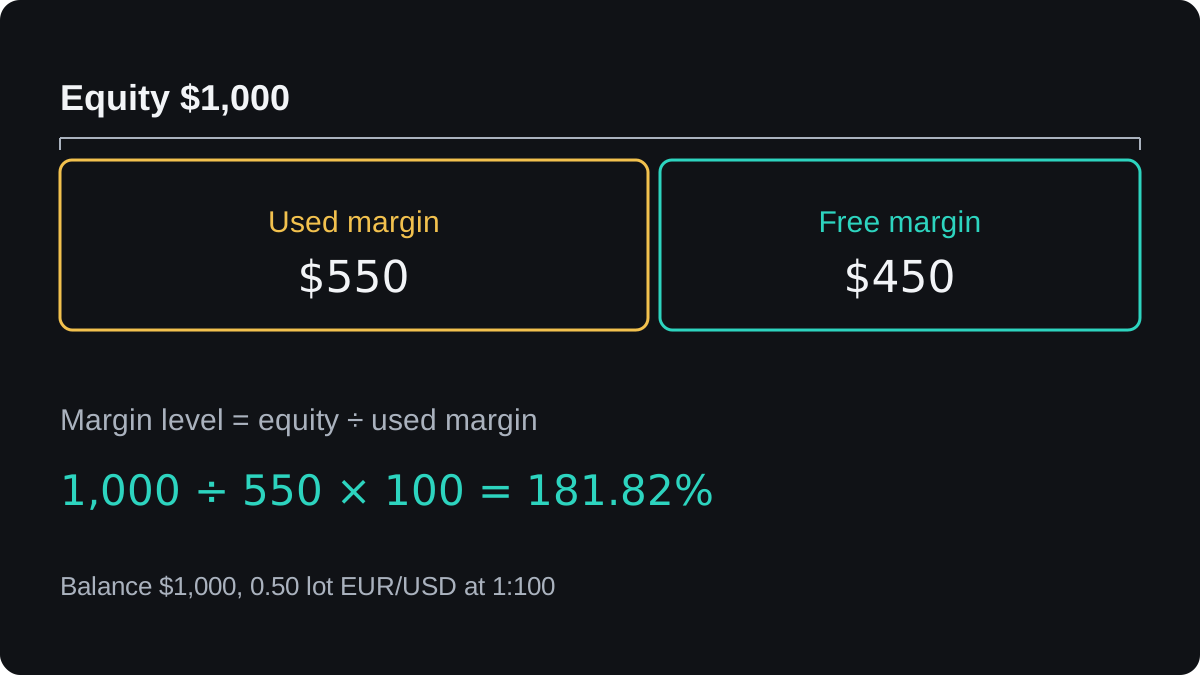
Example: a $1,000 balance, 1:100 leverage, and a buy of 0.50 lot of EUR/USD at 1.10000.
- Notional value: 0.50 × 100,000 = 50,000 euros, which at 1.10000 is $55,000.
- Used margin: $55,000 ÷ 100 = $550.
- Equity: the price has not moved, so it equals the balance, $1,000.
- Free margin: $1,000 − $550 = $450.
- Margin level: $1,000 ÷ $550 × 100 = 181.82%.
What happens when one trade moves against you?
On 0.50 lot of EUR/USD each pip is worth 0.50 × $10 = $5. Assume an illustrative margin call at 100% and stop out at 50%.
| Price | Floating P/L | Equity | Used margin | Free margin | Margin level |
|---|---|---|---|---|---|
| 1.10000 | $0 | $1,000 | $550 | $450 | 181.82% |
| 1.09500 | −$250 (50 pips) | $750 | $550 | $200 | 136.36% |
| 1.09100 | −$450 (90 pips) | $550 | $550 | $0 | 100.00% |
| 1.08550 | −$725 (145 pips) | $275 | $550 | −$275 | 50.00% |
The loss an account can take before any level is Equity − (level × Used margin), with the level as a decimal, so 100% is 1.00.
Margin call: $1,000 − (1.00 × $550) = $450 of loss, or 90 pips at $5. The price is 1.10000 − 0.00900 = 1.09100.
Stop out: $1,000 − (0.50 × $550) = $725 of loss, or 145 pips. The price is 1.10000 − 0.01450 = 1.08550.
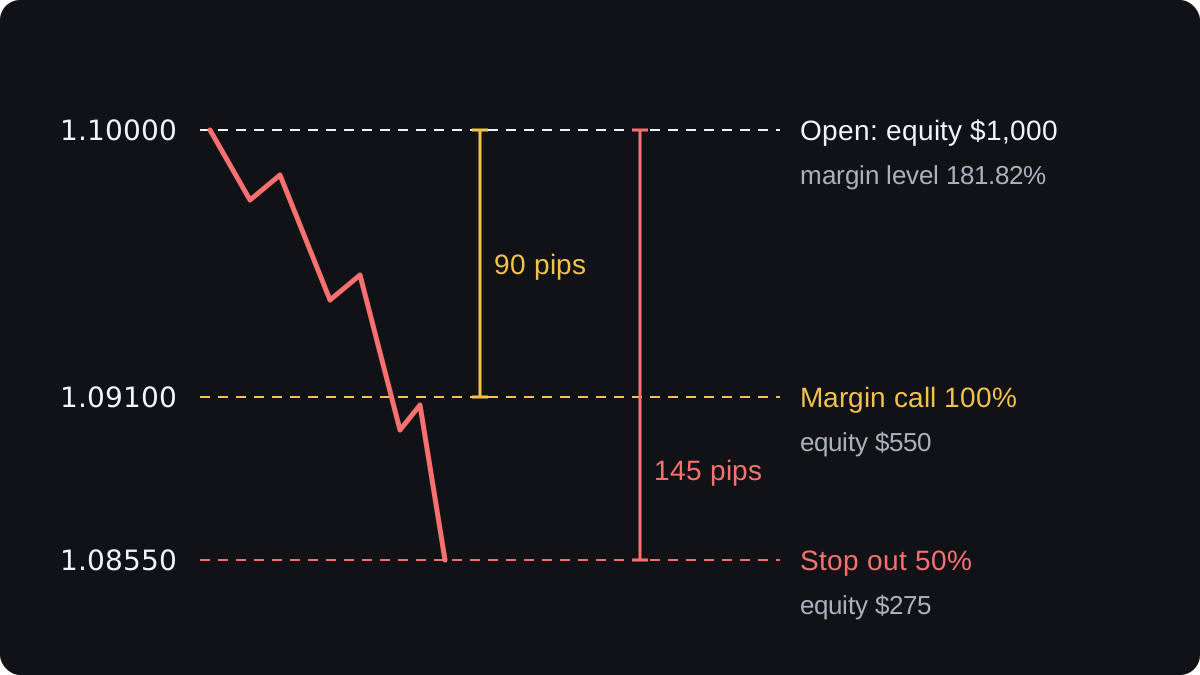
The balance stays at $1,000 until the trade closes. A stop out at 1.08550 makes the loss real and leaves $275.
In a fast market the close can come at a worse price, and platforms that recalculate margin as the price moves shift these figures slightly.
How do a margin call and a stop out differ?
A margin call closes nothing. At or below a 100% margin level your free margin is zero or negative, so the platform refuses new trades that need margin. Open trades stay open.
A stop out acts on its own, often closing the largest loss first, until the margin level recovers or nothing is left open.
Brokers set both levels per account type, and some use one level for both. Why the levels differ between brokers shows how to find yours.
How does leverage change the numbers?
This table runs the same trade with a $1,000 balance and a 50% stop out, changing only the leverage. Each pip is still worth $5.
| Leverage | Used margin | Margin level at open | Pips to stop out | Equity left at stop out |
|---|---|---|---|---|
| 1:30 | $1,833.33 | Order refused | Not opened | Not opened |
| 1:100 | $550 | 181.82% | 145 | $275 |
| 1:200 | $275 | 363.64% | 172.5 | $137.50 |
| 1:500 | $110 | 909.09% | 189 | $55 |
At 1:30 the trade needs more margin than the whole balance, so it is refused. At 1:500 a stop out leaves only $55 of the original $1,000.
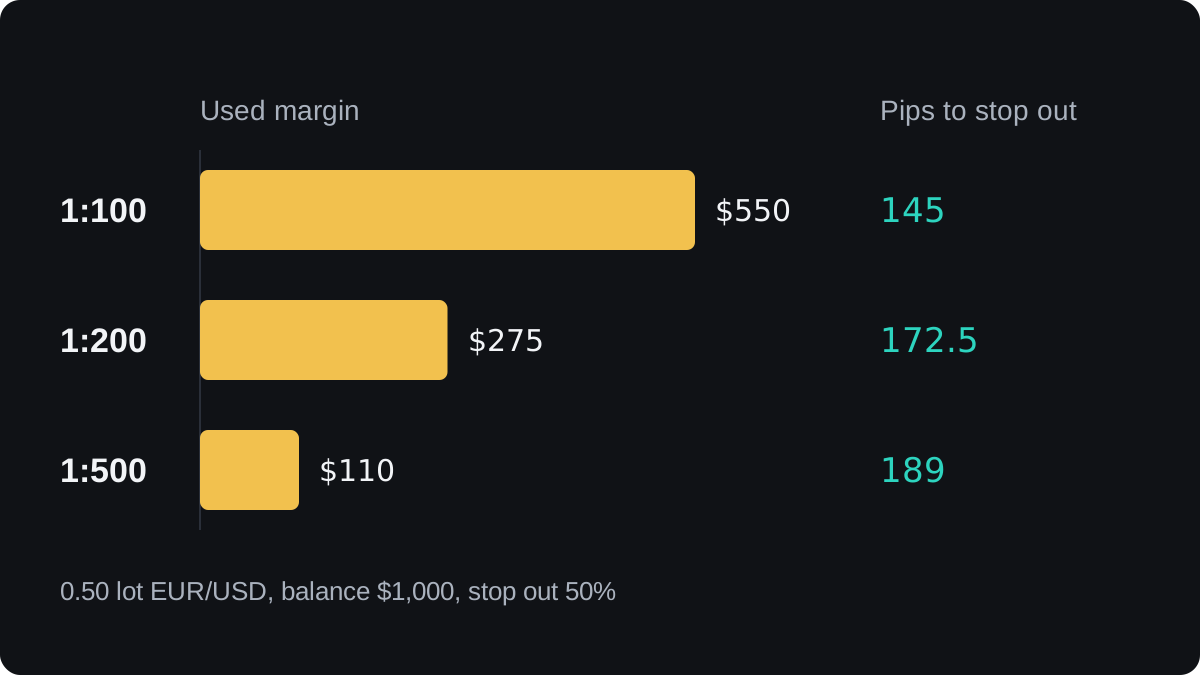
Higher leverage holds less margin while each pip still costs $5, so more of the balance can be lost before stop out.
Which numbers should you check before opening a trade?
The margin calculator gives the margin a trade will hold for any pair, lot size and leverage.
Pips to stop out = (Equity − stop out level × used margin) ÷ pip value, with used margin totalled across all open trades. Compare it with how far the pair often moves in a day.
Balance ignores open trades, so the next lesson, on how to avoid a margin call, works from equity and margin level.
Pertanyaan
What is the difference between balance and equity?
Balance counts deposits, withdrawals and closed trades. Equity adds the floating profit or loss of open trades.
Does a margin call close my trades?
No. Trades close at the stop out level, which may be lower than the margin call level or the same.
What margin level is safe?
No single number is safe. What matters is how many pips the price can move against you before stop out.
Why is margin level blank when I have no open trades?
With no open trades used margin is zero, and equity divided by zero has no answer.
Can I lose more than my balance?
Prices can jump past the stop out level. Whether your balance can go below zero depends on your broker's negative balance policy.
Lanjut belajar
 Bab 6What is margin trading?Margin trading means opening a position worth more than the money in your account. The broker sets aside part of your balance, the margin, as a deposit while the trade is open. Profit and loss are counted on the full position size, so small price moves change your balance much faster than the margin suggests.
 Bab 6What is account balance in forex?Your account balance is the money in your trading account from deposits, withdrawals and closed trades, after booked costs such as commission and swap. It does not include open positions. While a trade is open the balance stays the same, and the floating profit or loss shows up in your equity instead.
 Bab 6What is floating (unrealized) profit and loss?Floating profit and loss is the result your open trades would show if you closed them at the current price. It changes with every tick and moves your equity, while your balance stays the same. It becomes realized, and is added to or taken from your balance, only when the trade closes.
 Bab 6Apa itu margin, level margin, dan stop out dalam forex?Margin adalah bagian dari uang Anda yang ditahan broker sebagai jaminan selama transaksi ber-leverage terbuka. Level margin adalah ekuitas dibagi margin terpakai, dikali 100%. Saat level ini turun ke level margin call broker, akun Anda diberi peringatan, dan pada level stop out broker mulai menutup posisi Anda secara otomatis.
 Bab 6What is used margin?Used margin is the total amount your broker sets aside to keep all your open positions open. Each position's margin is its notional value divided by your leverage, and used margin adds them up. It is not a fee: the money returns to free margin when you close the trades.
 Bab 6What is equity in a trading account?Equity is your account balance plus or minus the floating profit or loss of your open trades. It shows what the account would be worth if you closed everything at current prices. With no trades open, equity equals balance. Brokers use it to work out free margin, margin level and stop outs.
 Bab 6What is free margin?Free margin is the money in your trading account that is not locked up as margin for open trades. It equals equity minus used margin. You need free margin to open new positions, and it falls as open trades lose and rises as they gain. At zero, your margin level is 100%.
 Bab 6What is margin level?Margin level is your equity divided by your used margin, multiplied by 100 and shown as a percentage. It tells you how much cushion your open trades have. At 100%, equity equals used margin and free margin is zero. Brokers set their margin call and stop out levels on this number, and the levels differ between brokers.
 Bab 6What is a margin call?A margin call is your broker's warning that your margin level, equity divided by used margin, has fallen to a set threshold such as 100%. You usually cannot open new trades from that point. The call closes nothing by itself. If losses continue, the broker's stop out level is where positions start to be closed for you.
 Bab 6What is a stop out level?The stop out level is the margin level at which your broker starts closing your open positions automatically, often beginning with the largest loss. If your stop out level is 50%, closing begins when equity falls to half your used margin. It is meant to stop your account sinking further, though a price gap can still push it below zero.
 Bab 6Margin call example: margin call at 100% with no separate stop out.When a broker sets the margin call and the stop out both at 100%, the warning and the forced close happen at the same moment. In this example, a $1,000 account buys 0.50 lot of EUR/USD with $550 of margin at 1:100, and the trade is closed after a 90 pip fall, a $450 loss.
 Bab 6Margin call and stop out example: 100% and 50%.In this example a $2,000 account buys 1 lot of EUR/USD at 1.10000 with $1,100 of used margin. The margin call at 100% arrives when equity falls to $1,100, 90 pips lower at 1.09100. The stop out at 50% closes the trade when equity reaches $550, at 1.08550, a loss of $1,450.
 Bab 6What happens if you trade forex with $100?With $100 and 1:100 leverage, 0.01 lot of EUR/USD at 1.10000 uses $11 of margin and can move about 890 pips against you before a 100% margin call. At 0.05 lot the margin call comes after 90 pips, and 0.10 lot cannot be opened at all. Trade size decides how much room you have.
 Bab 6Why margin call and stop out levels differ between brokers.Margin call and stop out levels are set by each broker, often per account type, within any rules from the regulator that licenses the account. In this lesson's example, one trade is closed after 90 pips at one broker and after 178 pips at another, so look up your own levels before you trade.
 Bab 6Apa itu leverage dalam forex?Leverage memungkinkan Anda mengendalikan posisi yang jauh lebih besar daripada setoran Anda. Pada 1:100, setiap $1 margin menahan posisi mata uang senilai $100, jadi posisi $110,000 membutuhkan $1,100. Leverage menentukan berapa margin yang ditahan, bukan berapa nilai satu pip. Risiko sebenarnya berasal dari ukuran posisi yang Anda pilih.
 Bab 6How can you avoid a margin call?Margin level is your equity divided by your used margin, and a margin call comes when it falls to your broker's threshold. To stay clear, keep positions small compared with your equity, set stop losses that close losing trades long before that point, and leave plenty of free margin unused.

