Can you get rich trading forex?
A few people make large sums trading forex, but the loss figures that EU and UK brokers must publish show that most retail CFD accounts at those brokers lose money. Getting rich would need a large starting balance and years of steady returns. Small accounts chasing big targets usually take risks large enough to wipe them out.
이 내용은 현재 영어로만 제공됩니다.
Some people have made large sums trading currencies. Far more have lost money, and brokers' own published figures show it.
Whether trading could make you rich comes down to two plain numbers: how much money you start with and how much of it you risk on each trade.
What do brokers' own loss figures show?
Open the website of a CFD broker serving retail clients in the European Union or the UK. You will usually see a risk warning near the top or bottom of the page.
The warning gives the share of that broker's retail accounts that lost money trading CFDs. A CFD (contract for difference) is the contract many online brokers use for retail forex: you and the broker settle the price change in cash, and no currency is delivered.
Regulators in those regions require the warning, and each broker calculates the figure from its own client accounts. The figures are usually well above half, so at these brokers more retail accounts lose than win.
The numbers change over time and differ between brokers, so read the current warning yourself instead of trusting a figure quoted elsewhere. Brokers regulated in other places may not have to publish one at all.
The warning counts accounts. It does not say how much the winners made or whether skill or luck produced their results.
How much does your starting balance matter?
Picture a trader who makes 20% in one year after all costs. That number is only an illustration, and no trader is guaranteed a positive year.
Here is what the same 20% means in money:
| Starting balance | Gain from a 20% year | Balance after one year |
|---|---|---|
| $1,000 | $200 | $1,200 |
| $10,000 | $2,000 | $12,000 |
| $100,000 | $20,000 | $120,000 |
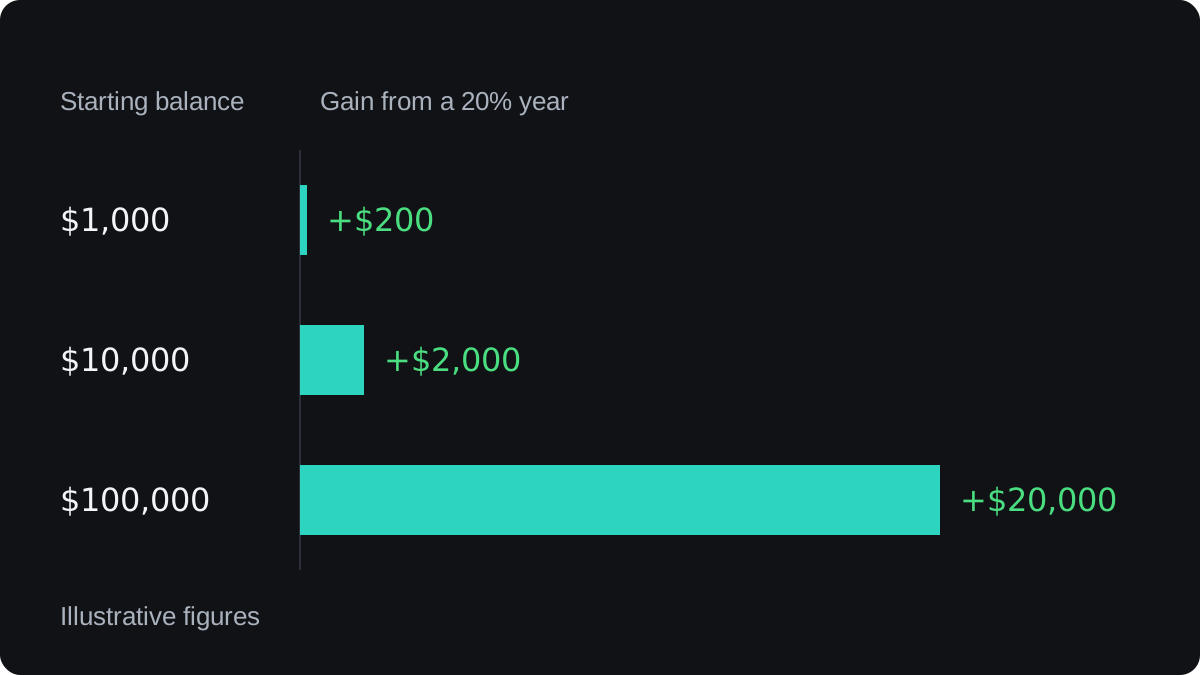
A 20% year on $1,000 pays $200, which will not change anyone's life. To earn a living from a small account, you would need returns many times larger, year after year.
That gap tempts small accounts into large positions. Large positions are also the fastest way to empty a small account, as the example further down shows.
What would steady compounding take?
Compounding means each month's gain is added to the balance, so the next month's percentage applies to a larger sum. Say you start with $1,000 and make 5% every month with no losing months, an illustrative rate.
- Month 1: $1,000 × 1.05 = $1,050.00.
- Month 2: $1,050.00 × 1.05 = $1,102.50.
- After 12 months: $1,000 × 1.05^12 = $1,795.86.
- To pass $1,000,000, the balance must grow 1,000 times. At 5% a month that takes 142 months, almost 12 years, with no losing month.
No real record is that smooth: a losing month shrinks the base, and the next gain applies to the smaller balance. You can try other rates in the compounding calculator.
There is no trustworthy average return for retail forex traders that anyone can quote. A promise of a fixed monthly percentage is one no market can keep, and it is a common feature of forex scams.
Screenshots of huge gains online come from people who chose to post them. The accounts that were wiped out stay silent, so the sample you see is skewed. This is called survivorship bias.
Why do big targets push you into big losses?
Suppose you have $1,000 and want to double it this month. With high leverage, a broker may let you open 1 standard lot of EUR/USD for a small margin deposit. The numbers below are round and illustrative.
- One standard lot is 100,000 euros. At 1.10000 that is $110,000 of currency, 110 times your balance.
- At an illustrative leverage of 1:500, the margin is $110,000 ÷ 500 = $220.
- On one lot of EUR/USD, each pip is worth $10.
- A rise of 100 pips makes 100 × $10 = $1,000, doubling the account.
- A fall of 50 pips costs 50 × $10 = $500, half the account.
EUR/USD can move 50 pips or more in a single day. A fall close to 100 pips would wipe out almost everything, and the broker's stop out would usually close the trade first, at a level set by the broker.
Regulators in some regions cap retail leverage far below 1:500, so this trade would not be allowed there. The lesson holds anyway: the target set the position size, and the position size set the risk.
Starting from the loss you can accept and working backwards gives a much smaller trade.
Why does risk matter more than the target?
A loss and the gain that repairs it are different sizes. Lose 20% of $10,000 and you have $8,000. Getting back to $10,000 needs $2,000, which is 25% of $8,000.
The bigger the loss, the faster the repair grows. A 50% loss leaves $5,000, and you then need a 100% gain just to get back to where you started.
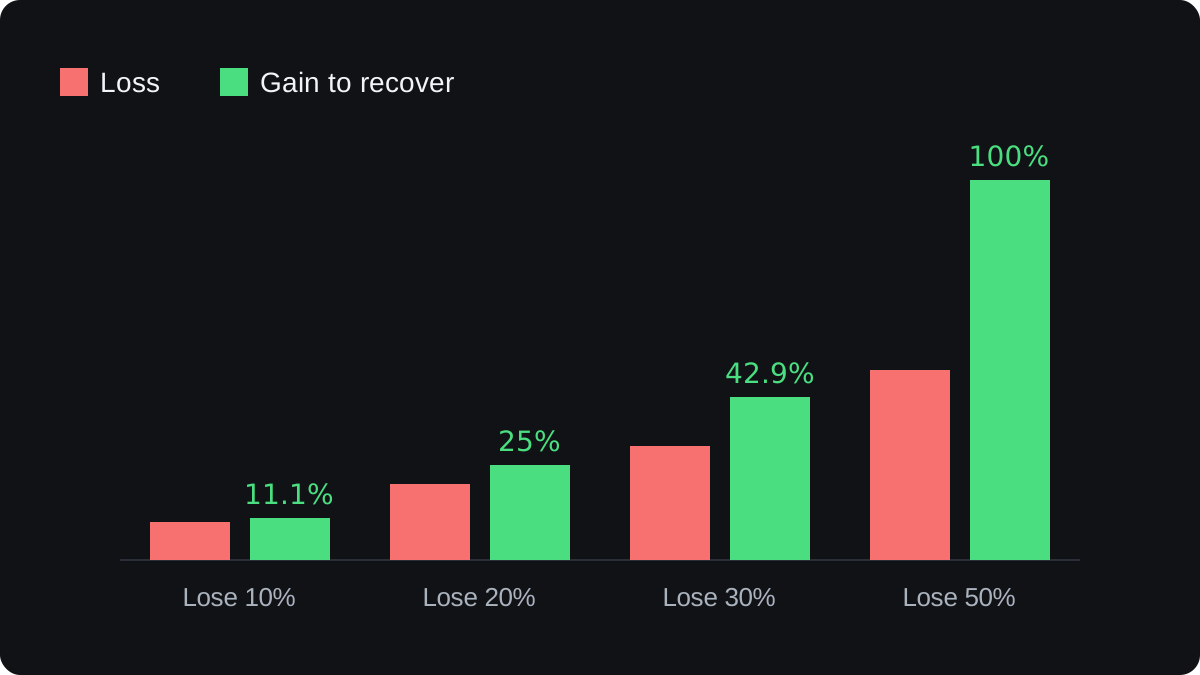
The formula is gain needed = loss ÷ (1 minus loss), with both written as decimals. For a 30% loss: 0.30 ÷ 0.70 = 0.429, or 42.9%. The drawdown and recovery lesson goes further.
Now take two traders with $10,000 each who hit five losing trades in a row. One risks 1% of the current balance per trade. The other risks 10%.
| Losing trades | Risking 1% | Risking 10% |
|---|---|---|
| 0 | $10,000 | $10,000 |
| 1 | $9,900 | $9,000 |
| 2 | $9,801 | $8,100 |
| 3 | $9,703 | $7,290 |
| 4 | $9,606 | $6,561 |
| 5 | $9,510 | $5,905 |
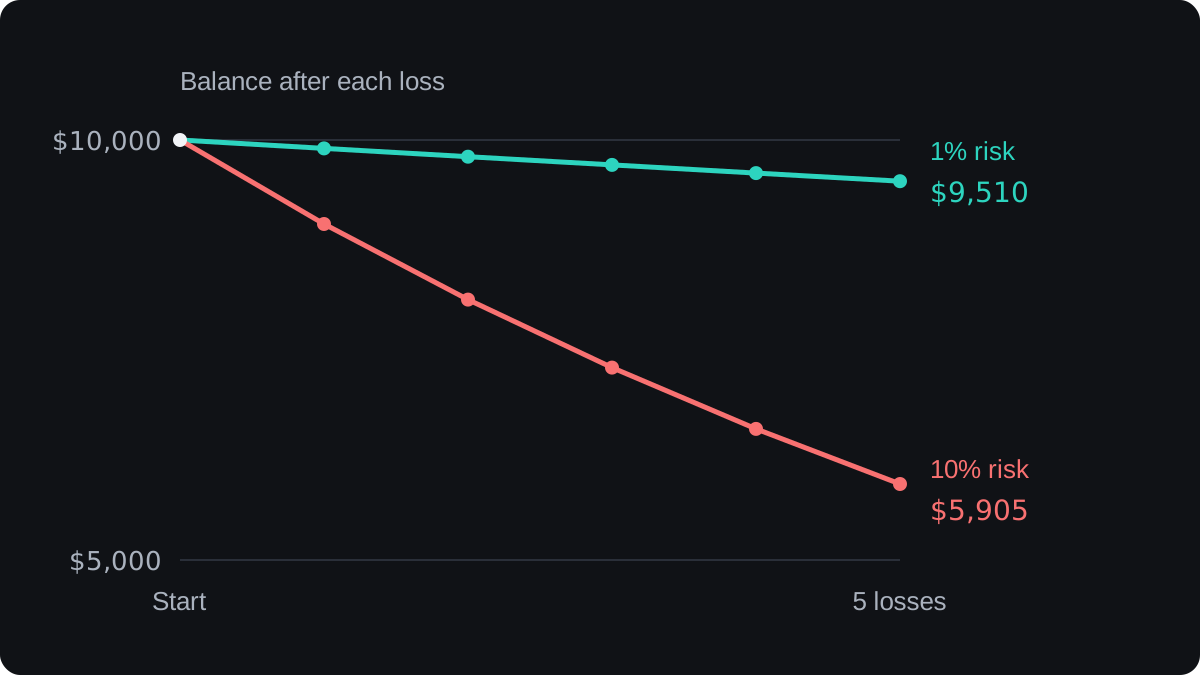
The first trader has lost 4.9% and needs a gain of 5.2% to get back to $10,000. The second has lost 41.0% and needs 69.4%, after the same five trades.
Any method, including one that makes money over time, will have losing streaks. So decide how much you risk per trade before you think about any profit target.
What can you control if you still want to try?
Price is outside your control. How much you risk and how you practise are yours to decide, and those choices decide whether a bad month is a setback or the end of the account.
- Choose the most you will lose on one trade before you set a profit target.
- Practise on a demo account until you follow your own rules, and remember that demo fills can be kinder than live ones.
- Count costs. The spread and any commission are paid on every trade, win or lose.
- Record every trade, so you judge your results from written data.
- Fund the account only with money you could lose in full without harming your bills or savings.
자주 묻는 질문
Can you get rich trading forex with $100?
It is very unlikely. A 20% year on $100 is $20, so a small account can only grow fast by taking risks large enough to empty it. The lesson on trading with $100 works through the numbers.
What percentage of forex traders lose money?
There is no single global figure. CFD brokers serving retail clients in the EU and UK publish their own share of losing retail accounts, and those figures are usually well above half, so check the warning on the broker's own site.
Is a 10% monthly return realistic?
No one can promise it. Compounded, 10% a month is 1.10^12 = 3.14 times your money in a year, a gain of about 214%, and no market pays a steady rate like that.
Do professional traders get rich?
Traders at banks and funds usually trade the firm's capital under risk limits and are paid as employees. Their position is very different from a retail trader with a small account of their own.
이어서 배우기
 챕터 2How does a forex trade make or lose money?A forex trade makes money when the pair moves in your direction by more than the trade costs, and loses when it moves against you. A buy gains as the price rises and a sell gains as it falls. Profit is the price change times trade size, less commission and swap.
 챕터 2When do you buy or sell a currency pair?You buy a currency pair when you expect the first currency, the base, to strengthen against the second, and you sell when you expect it to weaken. If your view is about one currency, find which side of the pair it sits on: a weaker quote currency pushes the pair up, so you buy.
 챕터 2외환 거래에서 핍(pip)이란 무엇인가요?핍은 트레이더가 가격 움직임을 재는 표준 단위입니다. 대부분의 통화쌍에서는 소수점 넷째 자리인 0.0001이고, 일본 엔으로 호가되는 통화쌍에서는 0.01입니다. 피펫은 핍의 10분의 1입니다. EUR/USD 표준 랏 1개에서 1핍은 $10입니다.
 챕터 2외환 거래에서 랏(lot)이란 무엇인가요?랏은 외환 거래의 규모를 정하는 단위입니다. 표준 랏 1개는 기준 통화 100,000단위, 미니 랏은 10,000단위, 마이크로 랏은 1,000단위입니다. EUR/USD에서는 1핍이 각각 $10, $1, $0.10입니다. 금 같은 다른 상품은 저마다의 계약 크기를 씁니다.
 챕터 2외환 거래에서 스프레드란 무엇인가요?스프레드는 내가 팔 수 있는 Bid 가격과 살 수 있는 Ask 가격의 차이입니다. 모든 거래에서 포지션을 여는 순간 이 비용을 냅니다. EUR/USD에서는 보통 한두 핍 이하이며, 매일 롤오버 시간, 주간 개장, 큰 뉴스 전후에 넓어집니다.
 챕터 2외환 거래에서 Bid와 Ask 가격이란 무엇인가요?모든 외환 호가에는 가격이 두 개 있습니다. Bid는 매도할 수 있는 가격이고, Ask는 매수할 수 있는 더 높은 가격입니다. 두 가격의 차이가 스프레드입니다. Ask에 매수하고 Bid에 청산하므로, 모든 새 거래는 스프레드만큼 약간 불리한 상태에서 시작합니다.
 챕터 2Forex terms you will hear every day.The everyday words of forex describe what a trade is doing and what it costs. Long means you bought, short means you sold. A pip is the standard price step, a lot is the trade size, the spread is the gap between bid and ask, and margin is the deposit your broker holds while a trade is open.
 챕터 2What types of orders can you place in forex?A market order buys or sells straight away at the current price. A pending order waits for a price you choose: a limit order waits for a better price, and a stop order joins a move once price breaks a level. Stop loss and take profit orders close an open trade at prices you set in advance.
 챕터 2Forex order types cheat sheet.A market order fills now at the current price. A limit order waits for a better price: a buy limit below the market, a sell limit above it. A stop order waits for a worse price: a buy stop above, a sell stop below. Buy orders trigger on the ask, sell orders on the bid.
 챕터 2What is a forex demo account, and how should you use it?A forex demo account is a practice account funded with virtual money. You trade on the broker's platform with live or near-live prices, so you can learn orders, stops and margin without risking your own cash. Set it up with the balance and leverage you would really use, and expect live fills and feelings to differ.
 챕터 2외환 기초 요약 정리: 통화쌍, 핍, 랏, 레버리지, 증거금.이 요약 페이지는 외환 기초 챕터를 한 페이지에 정리합니다. 개념마다 짧은 요약과 공식, 전체 강의 링크가 있습니다. 빠른 참고 표로 거래 전에 핍 크기, 핍 가치, 계약 크기, 증거금을 확인할 수 있고, 거래 예시 하나로 모든 내용을 연결합니다.

