Equity flows and currencies.
When foreign investors buy a country's shares, they usually have to buy its currency first, which adds demand for that currency. When they sell and take the money home, they sell it again. The effect is weaker when investors hedge currency risk, and other forces such as interest rates can outweigh it.
이 내용은 현재 영어로만 제공됩니다.

Suppose a pension fund in the United States decides to buy shares listed in Tokyo. Those shares are priced in yen, so before the fund can buy a single one, it has to turn dollars into yen.
That currency trade is the link between stock markets and exchange rates. Foreign money flowing into a stock market usually buys the local currency first, and money leaving sells it again.
How does buying foreign shares move a currency?
Take a round, illustrative order. A US fund wants ¥150,000,000 of Japanese shares, and USD/JPY trades at 150.00. It sells $1,000,000, receives ¥150,000,000 and uses the yen to pay for the shares.
The fund's bank carries out the currency trade in the forex market. Selling dollars to buy yen is the same as selling USD/JPY, so on its own this order pushes the pair slightly lower and the yen slightly higher.
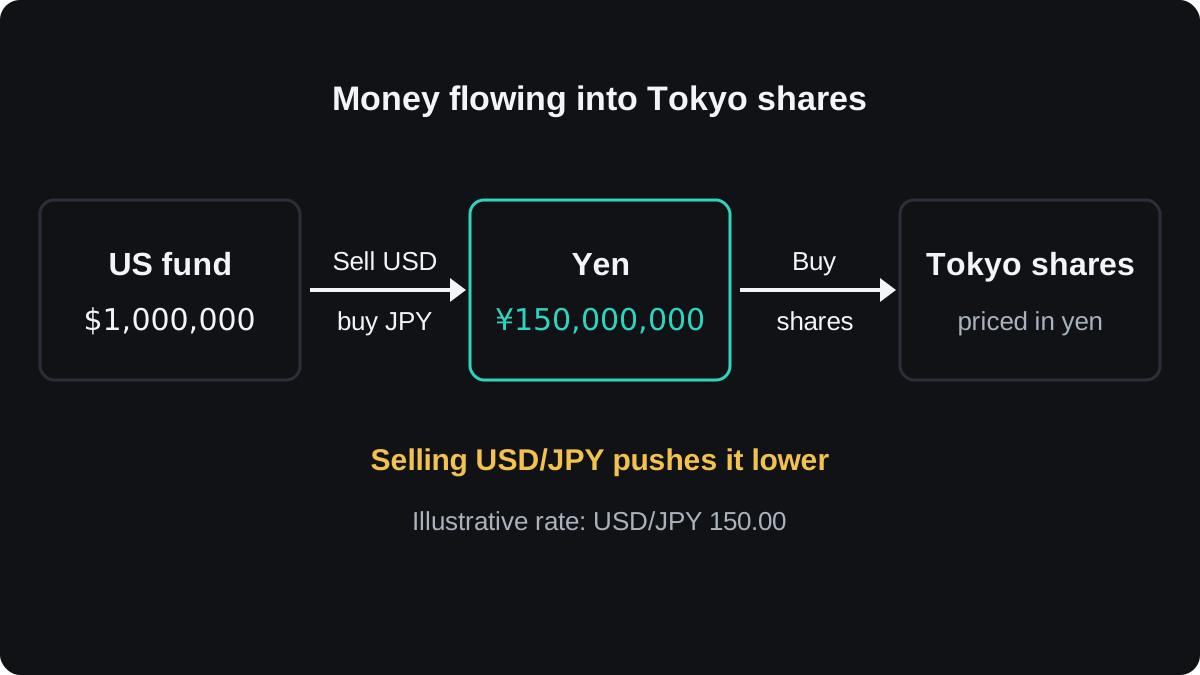
An equity flow is money crossing a border to buy or sell shares. One order rarely moves a pair much, because the forex market is very large, as the market size lesson explains.
Flows start to matter when many foreign investors push the same way for weeks or months. A steady stream of buying from abroad adds steady demand for the currency.
Statisticians record these trades as portfolio investment in a country's balance of payments, the record of money moving in and out. A company buying a whole firm abroad counts as direct investment, but the currency step works the same way.
What happens when foreign money leaves?
The chain runs backwards on the way out. When the US fund sells its Japanese shares, it receives yen. If it wants dollars back, it sells the yen and buys dollars, which pushes USD/JPY up.
Dividends follow the same path. A foreign shareholder paid in yen who sends the money home has to sell yen at some point, a step called repatriation.
Outflows can arrive in a rush. In a sell-off, as the lesson on stock markets and risk appetite described, investors may pull money out of riskier markets at the same moment.
When that happens, foreign holders sell both the shares and the currency they bought to own them. The local currency can then fall at the same time as the local stock market.
How does the exchange rate change a foreign investor's return?
A foreign investor earns the share return and the currency return together. Go back to the US fund and its Japanese shares, bought at an illustrative USD/JPY rate of 150.00.
- The fund converts $1,000,000 at 150.00: 1,000,000 × 150.00 = ¥150,000,000.
- A year later the shares are up 10%: ¥150,000,000 × 1.10 = ¥165,000,000.
- If USD/JPY is still 150.00, the fund gets ¥165,000,000 ÷ 150.00 = $1,100,000, a 10% gain.
- If the yen has weakened to 165.00, it gets ¥165,000,000 ÷ 165.00 = $1,000,000, a 0% gain.
- If the yen has strengthened to 137.50, it gets ¥165,000,000 ÷ 137.50 = $1,200,000, a 20% gain.
| USD/JPY at sale | Shares in yen | Value in dollars | Return in dollars |
|---|---|---|---|
| 137.50 (yen stronger) | ¥165,000,000 | $1,200,000 | +20% |
| 150.00 (unchanged) | ¥165,000,000 | $1,100,000 | +10% |
| 165.00 (yen weaker) | ¥165,000,000 | $1,000,000 | 0% |
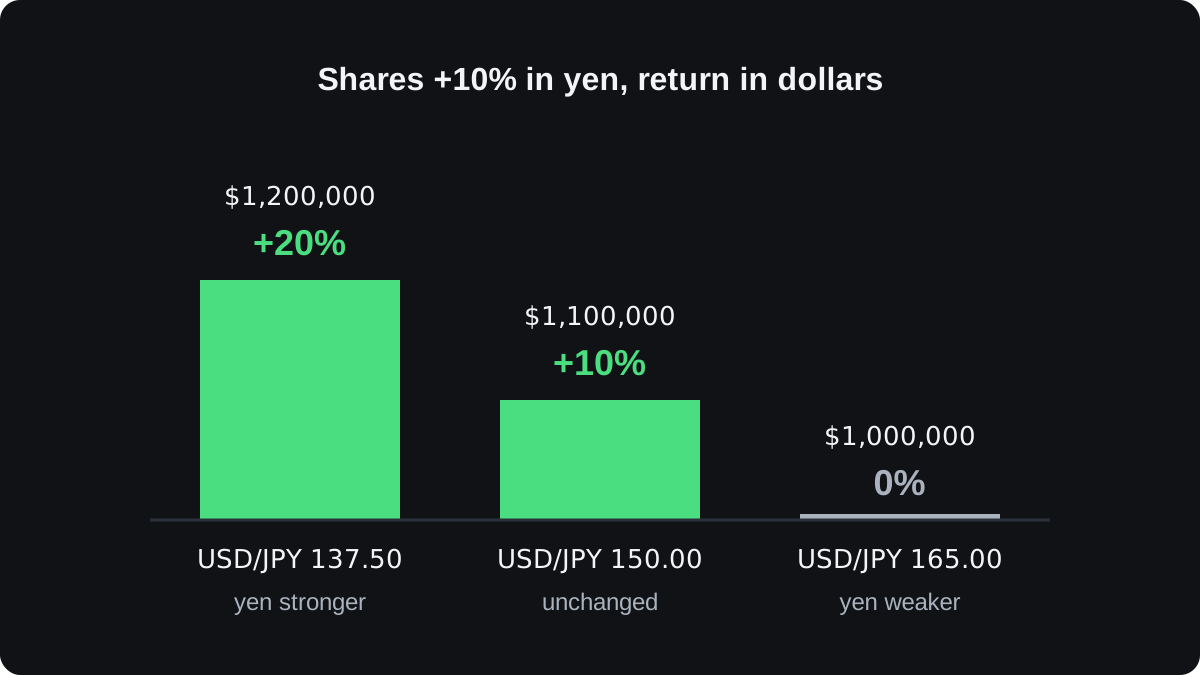
The same 10% share gain becomes anything from 0% to 20% in dollars. A stronger local currency adds to a foreign investor's return, and a weaker one takes it away.
This can feed on itself for a while. Inflows lift the currency, the stronger currency improves returns for foreign buyers, and more buyers may follow. The loop can also run in reverse when money leaves.
You can redo these conversions at other rates with the currency converter.
Why does hedged money move the currency less?
Some investors do not want the currency swings in that table. They hedge, which means they fix in advance the rate at which they will change the foreign currency back, usually with a forward contract.
A hedged fund still buys ¥150,000,000 in the spot market to pay for the shares. At the same time it agrees to sell about ¥150,000,000 forward, so its net position in yen is close to zero.
The spot purchase and the forward sale together make an FX swap, one of the products in ways to trade forex. A fully hedged inflow leaves far less lasting demand for the yen than an unhedged one.
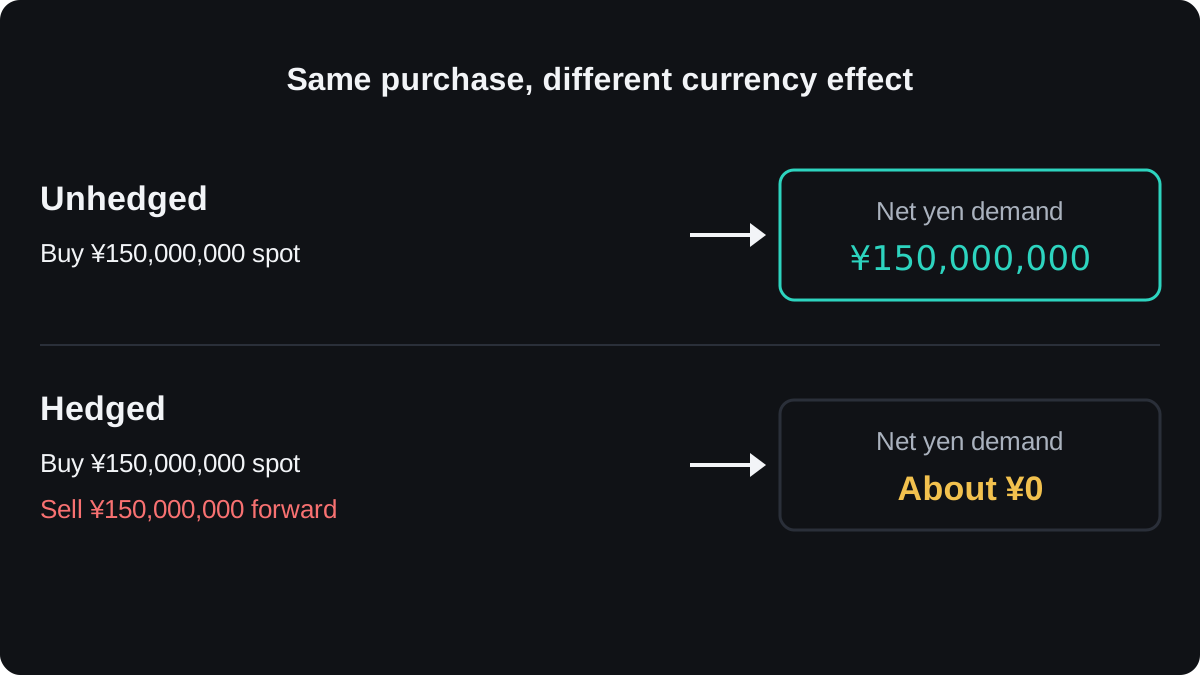
The forward rate differs from the spot rate by roughly the gap between the two countries' interest rates. That is why hedging costs some investors money and earns others money, a link covered in interest rates and currencies.
Hedging habits also change over time. When a group of investors decides to hedge more of what it already owns, those new forward sales are a currency flow in their own right, even though no shares change hands.
When do stocks and the currency move in opposite directions?
Equity flows are one force among many. Interest rates, trade balances, central banks and risk appetite all pull on a currency as well, as what moves exchange rates explains.
A second link between shares and currencies can run the other way. A weaker currency raises the home-currency value of profits that exporters earn abroad, so a falling currency can lift the shares of large exporting companies.
Japan is the usual example. Its main stock indices include many big exporters, and there have been long periods when Japanese shares rose while the yen fell. In such periods, forces such as interest rate gaps mattered more to the yen than foreign buying did.
Hedged buyers make that pattern easier to sustain. A hedged foreign investor gains from rising Japanese shares without holding yen risk, so heavy buying need not lift the yen at all.
A rising stock market therefore does not reliably mean a rising currency. The relationship differs between countries and shifts over time, so check it on the pair and period you care about before you rely on it.
How can you follow equity flows?
Nobody sees cross-border share buying live. What you can see is official data, and it arrives late.
- The US Treasury publishes TIC (Treasury International Capital) data each month on foreign buying and selling of US securities, several weeks after the month ends.
- Japan's Ministry of Finance publishes weekly figures on cross-border buying and selling of stocks and bonds, one of the more frequent official sources.
- Most countries publish balance of payments figures monthly or quarterly, with portfolio investment shown as its own line.
Because the data is late, the price has usually moved by the time you read it. These figures explain a trend after the fact more easily than they time a trade.
A faster but rougher check is to put a country's main stock index and its currency on the same chart over several months, and see whether they have been rising together or apart.
The US stock and bond markets are the largest in the world, so flows into and out of them reach almost every pair. That is one reason the US dollar has a lesson of its own.
자주 묻는 질문
Does a rising stock market make a currency stronger?
It can, because foreign buying of shares adds demand for the local currency. Hedging, interest rates and the exporter effect can outweigh it, so the two can move apart for long periods.
Why do foreign investors need to buy the local currency?
Shares on a local exchange are usually priced and settled in the local currency. An investor holding another currency has to convert first.
What is currency hedging for stock investors?
It is a trade, usually a forward contract, that fixes the rate for changing the foreign currency back later. It removes most of the currency effect on the investor's return and most of the flow's lasting effect on the exchange rate.
Where can I find data on foreign stock buying?
Official sources include the US Treasury's TIC data, Japan's weekly Ministry of Finance securities figures and national balance of payments releases. All of them are published with a delay.