The euro.
The euro is the shared currency of 21 European Union countries, managed by the European Central Bank in Frankfurt. The ECB sets one interest rate for economies that can need different ones, aiming for 2% inflation across the whole area. EUR/USD, the euro against the US dollar, is the world's most traded currency pair.
이 내용은 현재 영어로만 제공됩니다.

Twenty-one European countries share one currency and one central bank. They do not share one economy, and that gap explains much of how the euro behaves.
A busy industrial region in one member and a quiet tourist coast in another can need different interest rates in the same year, yet both get the same rate. The US dollar profile covers the other side of EUR/USD.
What is the euro, and who uses it?
The euro (code EUR, symbol €) is the currency of the euro area, the European Union members that have adopted it. It started on 1 January 1999 as a currency for banks and markets. Notes and coins followed on 1 January 2002.
Membership grows from time to time, so check the current list on the European Central Bank's website. Some EU members, such as Denmark and Sweden, keep their own currencies.
The euro is the second most traded currency in the world after the US dollar, and the second largest held in central bank reserves. By market custom it is written first in its pairs, so platforms show EUR/USD, EUR/GBP and EUR/JPY.
How does the ECB set one interest rate for many economies?
The European Central Bank (ECB), based in Frankfurt, sets monetary policy for the whole euro area. Its main task is price stability, which it defines as inflation of 2% over the medium term.
Decisions come from the Governing Council: the six members of the ECB's Executive Board plus the governor of each member's national central bank. It meets on monetary policy about every six weeks.
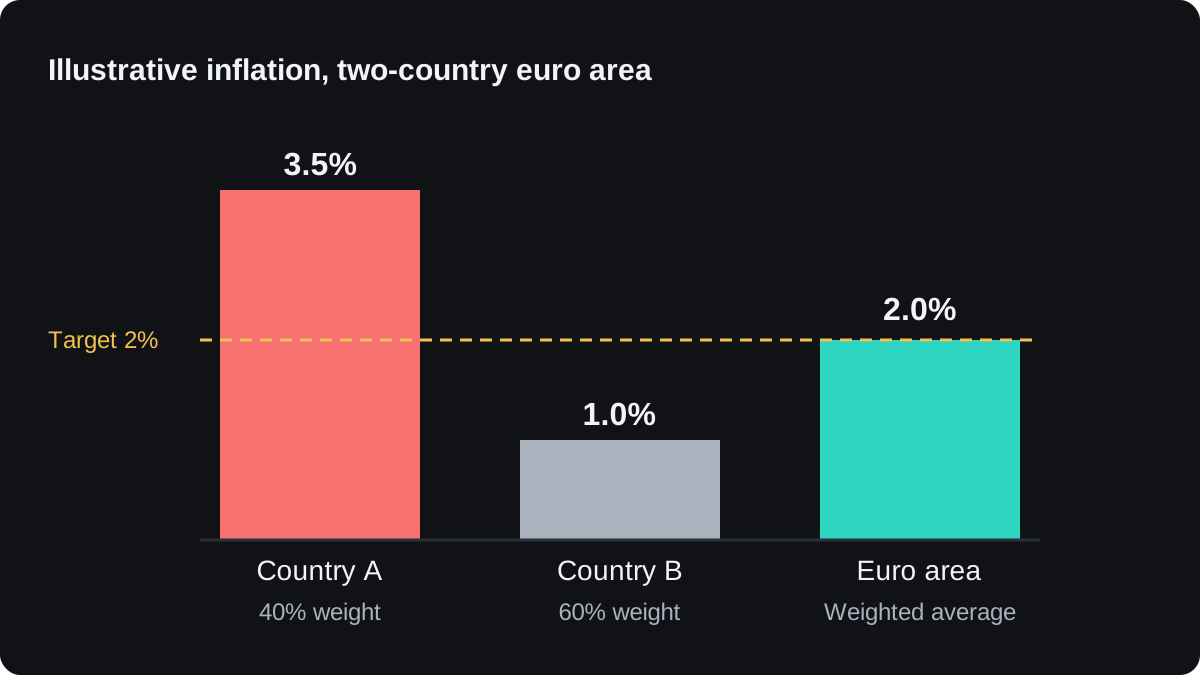
The ECB steers by an average, and an average can hide wide gaps. Here is a simplified euro area of two countries, with round illustrative numbers:
- Country A is 40% of the area's economy, with inflation of 3.5%.
- Country B is 60% of the economy, with inflation of 1.0%.
- The area figure is a weighted average: 0.40 × 3.5% + 0.60 × 1.0% = 1.4% + 0.6% = 2.0%.
- The average sits exactly on target, so the ECB has no reason to change rates.
Country A still has inflation well above target and could use higher rates. Country B might prefer lower ones, and a single rate cannot suit both.
The real measure, the Harmonised Index of Consumer Prices (HICP), is built in a similar way: each country's prices count in proportion to its share of household spending in the area.
Member governments cannot set their own interest rate or let a national currency fall. Differences have to be absorbed through wages, prices and government budgets. The inflation lesson explains why inflation drives rate decisions in the first place.
Why do government bond spreads matter for the euro?
The euro area has one currency but many governments, and each issues its own bonds. The gap between two countries' bond yields is a bond spread, a different thing from the bid and ask spread you pay on a trade.
A widely watched gauge is the gap between Italian and German 10-year yields. When it widens fast, investors are pricing more risk that a member will struggle to finance itself, and the euro has often weakened at such times.
The clearest case is the debt crisis of 2010 to 2012. Greece, Ireland and Portugal needed rescue loans, and investors openly questioned whether the euro would hold together.
Bond spreads narrowed after the ECB said in 2012 that it would do what was needed to preserve the euro. In 2022 it added the Transmission Protection Instrument, which lets it buy a member's bonds if yields rise in a way it judges disorderly.
Euro news is partly political for this reason. Elections or budget disputes in a large member can move EUR/USD even when the ECB says nothing.
What moves the euro from week to week?
Interest rate expectations come first. If markets expect the ECB to hold rates while the US Federal Reserve cuts, the gap in returns tends to favour the euro. The central banks lesson shows why expected rates matter more than today's rate.
Each ECB decision comes with a statement and a press conference by the president. The rate change is often expected in advance, so the tone of the answers can move the euro more than the decision.
The euro area releases traders watch most closely are:
- Flash HICP inflation from Eurostat, published around the end of each month
- Purchasing managers' index (PMI) surveys of business activity
- German business surveys, such as Ifo and ZEW
- Quarterly GDP for the euro area and for Germany, its largest economy
What moves the price is the gap between the result and the forecast, as expectations versus actual explains. Release times appear on the economic calendar.
Energy prices count as well. The euro area imports much of its oil and gas, so an energy price spike worsens its trade balance. In 2022, as gas prices soared, EUR/USD fell below 1.00 for the first time in about twenty years.
Euro rates can also sit at unusual levels. The ECB's deposit rate was below zero from 2014 to 2022, so banks paid to keep spare cash at the central bank.
None of these drivers is a reliable signal on its own. The same surprise can push the euro one way in the first minute and reverse within the hour, and a driver that mattered last year can be ignored this year.
How are the main euro pairs priced?
EUR/USD is the most traded currency pair in the world, according to the Bank for International Settlements' survey of global turnover. The euro crosses you will see most often are EUR/GBP, EUR/JPY and EUR/CHF.
The euro is the base currency in all of these, so one standard lot is 100,000 euros, and 0.10 lot is 10,000 euros. The pip value lands in the quote currency. With round illustrative rates, in a US dollar account:
| Pair | Pip size | Pip value, 0.10 lot | In US dollars |
|---|---|---|---|
| EUR/USD | 0.0001 | $1.00 | $1.00 |
| EUR/GBP | 0.0001 | £1.00 | $1.30 at GBP/USD 1.3000 |
| EUR/JPY | 0.01 | ¥100 | $0.67 at USD/JPY 150.00 |
The sums are 10,000 × 0.0001 = 1 unit of quote currency on the first two pairs, and 10,000 × 0.01 = ¥100 on EUR/JPY. Then £1.00 × 1.3000 = $1.30, and ¥100 ÷ 150.00 = $0.67.
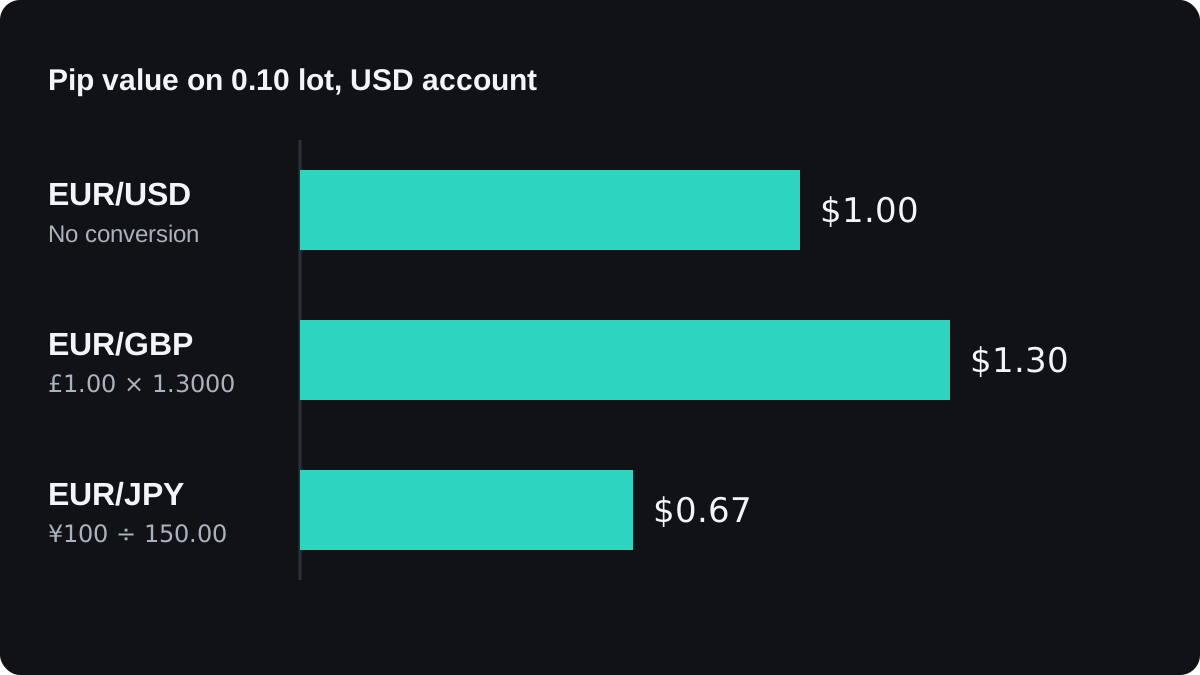
At these rates, a 20-pip move is worth $20.00 on EUR/USD, $26.00 on EUR/GBP and about $13.33 on EUR/JPY. The pip value calculator handles other sizes and account currencies.
A worked EUR/USD trade
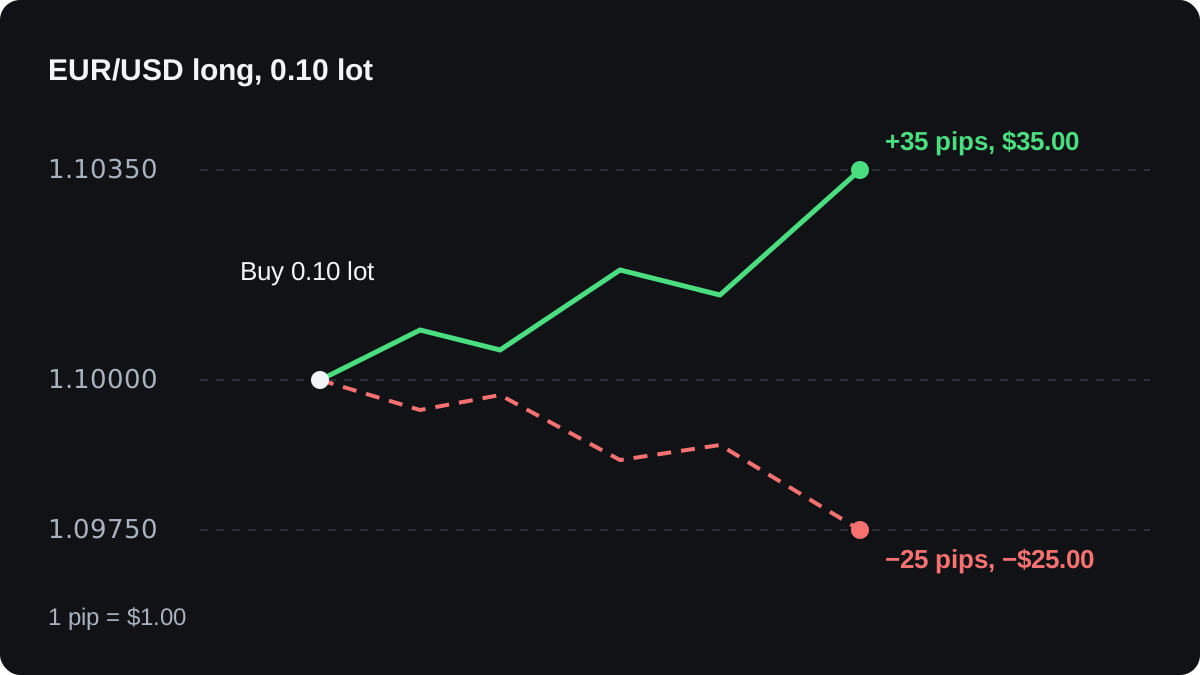
Suppose a flash HICP reading comes in above forecast, and you expect the ECB to sound firmer. You buy 0.10 lot of EUR/USD. The prices are illustrative, and the scenario is an example rather than a trade idea.
- You buy at the ask of 1.10000.
- The pip value on 0.10 lot is 10,000 × 0.0001 = $1.00.
- Later the bid reaches 1.10350, and you sell to close: 1.10350 − 1.10000 = 0.00350, which is 35 pips.
- The profit is 35 × $1.00 = $35.00.
- Had the bid fallen to 1.09750 instead, the move would be 1.09750 − 1.10000 = −0.00250, or 25 pips against you, a loss of $25.00.
Both results already include the spread, because you bought at the ask and sold at the bid. A data surprise can justify a view, and the price can still go against it.
The next profile, the Japanese yen, covers the quote currency of EUR/JPY.
자주 묻는 질문
What is the ECB's inflation target?
The ECB aims for inflation of 2% over the medium term, measured by the HICP. It treats inflation above and below that level as equally unwelcome.
Why is the euro always written first in a pair?
It is market custom. The euro ranks first in the order traders use to decide the base currency, so you see EUR/USD and EUR/GBP rather than the reverse.
Does the euro rise when the ECB raises rates?
Not reliably. If markets already expected the rise, the euro may barely move or even fall, especially if the ECB hints that no more increases are coming.
Which countries use the euro?
The EU members in the euro area, plus a few small European states that use it by agreement or on their own. The list changes over time, so check the ECB's website for the current one.
Why does Italy matter so much for the euro?
Italy is one of the largest euro area economies and has a large stock of government debt. A sharp rise in its borrowing costs raises questions about the whole area, which can weigh on the euro.
이어서 배우기
 챕터 4The US dollar.The US dollar is on one side of most forex trades because it is the main reserve, trade and funding currency. Its value moves largely on what traders expect from the Federal Reserve, and those expectations shift with US jobs, inflation and growth data. In a global panic it often rises.
 챕터 4The Japanese yen.The Japanese yen is shaped by decades of very low interest rates set by the Bank of Japan, which made it a popular funding currency for carry trades. It often rises when markets panic, though not always. Japan's Ministry of Finance sometimes intervenes, and on yen pairs a pip is 0.01.
 챕터 4The British pound.The British pound, or sterling (GBP), moves mainly on Bank of England interest rate expectations and on data from a services-heavy UK economy. GBP/USD, nicknamed cable, is one of the most traded pairs. The pound has often swung further in a day than the euro, so a trade on it may need a wider stop and a smaller position.
 챕터 4The Australian, Canadian and New Zealand dollars.The Australian, Canadian and New Zealand dollars are called commodity currencies because their countries export large amounts of raw materials. The Aussie tends to follow metals and Chinese demand, the loonie oil and the US economy, and the kiwi dairy prices. Interest rates and global risk appetite also move all three, and can outweigh commodities.
 챕터 4The Swiss franc.The Swiss franc (CHF) is the currency of Switzerland, a small economy with a currency that investors often buy in times of stress. That safe-haven demand can push the franc too high, so the Swiss National Bank has fought it with negative rates and currency intervention, including a 1.20 floor on EUR/CHF that it dropped without warning in 2015.

