Buying coins vs trading crypto CFDs.
Buying coins gives you the asset itself, which you can hold or send, and you must guard the keys. A crypto CFD gives you only the price change, settled in cash by your broker. CFDs make shorting and leverage easy but usually charge swap each night, so long holds tend to cost more.
เนื้อหานี้ยังมีเฉพาะภาษาอังกฤษ

You expect bitcoin to rise and want exposure to 0.1 BTC. At an illustrative price of 60,000 dollars, that is $6,000 worth.
You can buy the coins, or you can trade a crypto CFD at a broker. If the price rises 10%, both gain about $600. Almost everything else about them differs.
What you own in each case
Buy 0.1 BTC on a crypto exchange and you own the coin. It sits in your exchange account, or you withdraw it to a wallet you control.
In your own wallet, whoever has the seed phrase controls the coins. Keeping that phrase safe is your job alone.
Open 0.10 lot of BTCUSD at a broker, at an illustrative 1 coin per lot, and you hold a crypto CFD.
It is a contract that pays or charges the price change in cash. There is no coin to send or stake.
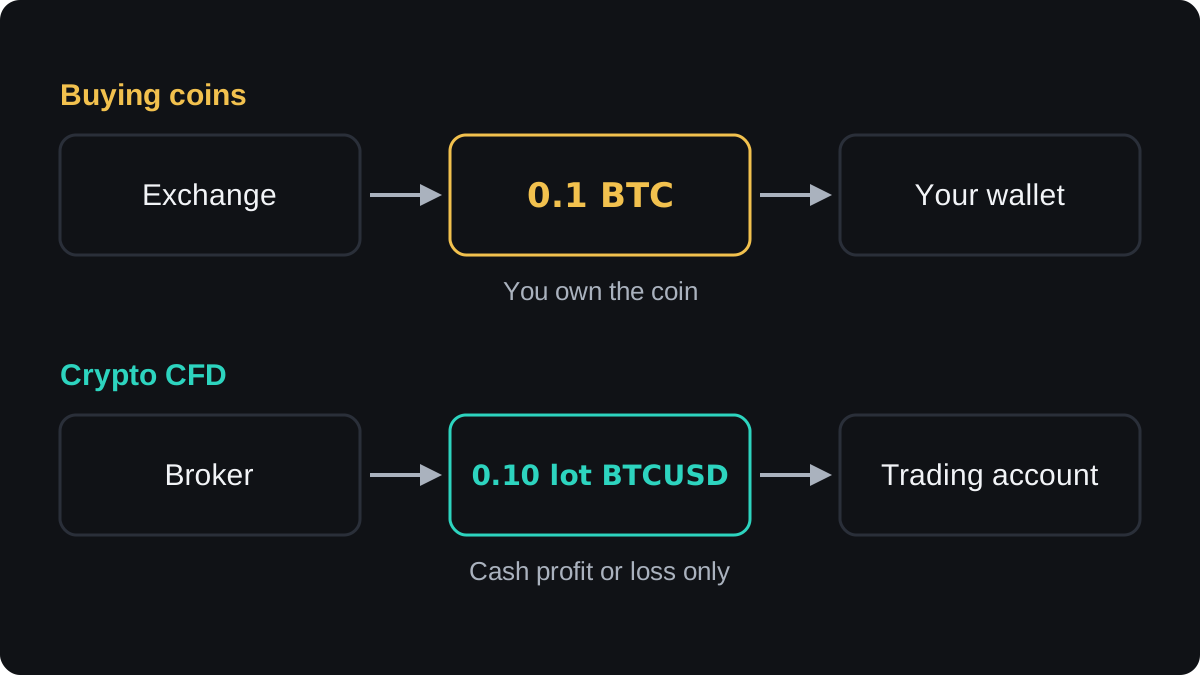
The main differences:
| Buying coins | Crypto CFD | |
|---|---|---|
| What you hold | The coin | A cash-settled contract |
| Where it sits | Exchange account or your wallet | Your broker account |
| Gaining from a fall | Needs borrowed coins or a derivative | Open a sell position |
| Leverage | None on a plain purchase | Yes, within broker and regulator limits |
| One-off costs | Trading fee, spread, withdrawal fee | Spread, commission on some accounts |
| Cost of holding | Usually none | Usually swap for each night |
| Trading hours | Exchanges run all week | Set by the broker's sessions |
| Main risks | Lost keys, theft, exchange failure | Leverage, stop out, broker failure |
Costs: one-off fees or a charge every night
On an exchange you pay a trading fee each time you buy or sell. Moving coins to your own wallet adds a network fee. After that, holding costs nothing.
A CFD has no coin withdrawal or network fee. You pay the spread when you trade, commission on some account types, and usually swap for every night the position stays open.
In this worked example, with illustrative figures, both routes hold 0.1 BTC of exposure worth $6,000, and the price ends where it started:
- Coins: a fee of 0.1% on the buy and again on the sell is 2 × $6 = $12.
- CFD closed the same day: a spread of $40 per coin costs 40 × 1 × 0.10 = $4, with no swap.
- CFD held 30 nights: the same $4, plus swap of $3 per night × 30 = $90, makes $94.
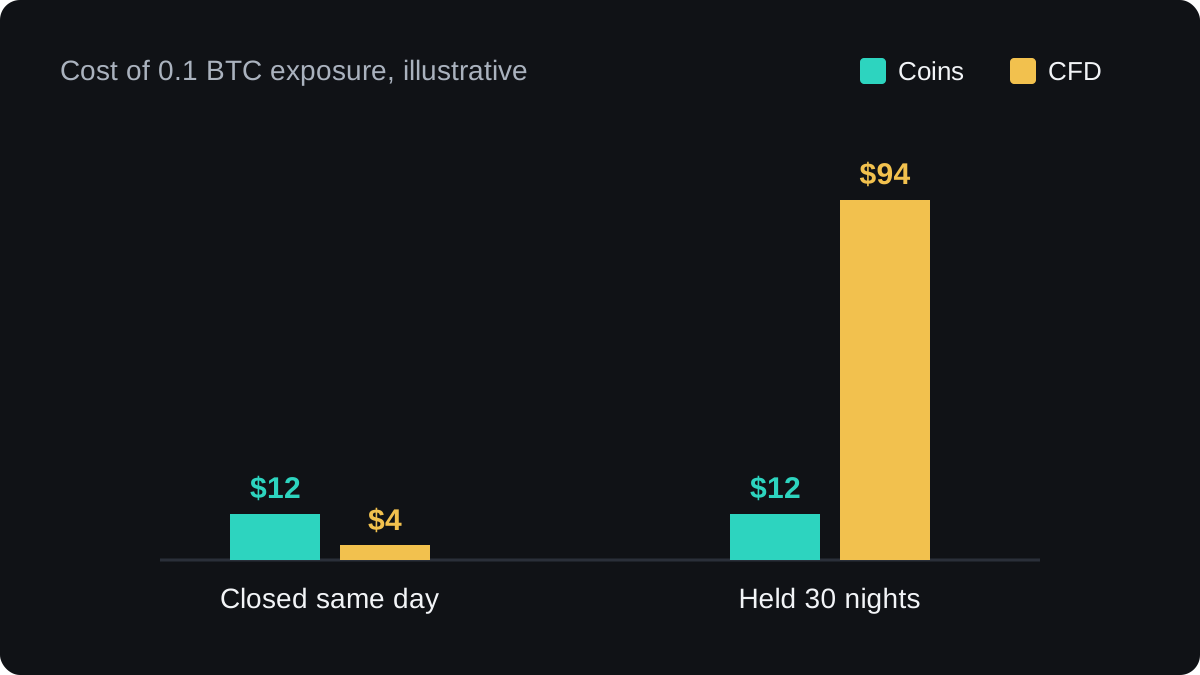
Your own rates will differ, and the exchange's spread is left out here for simplicity. As long as the CFD charges swap, its cost grows every night while a coin costs nothing to keep.
What it costs to trade crypto CFDs shows where to find each rate.
Selling short and using leverage
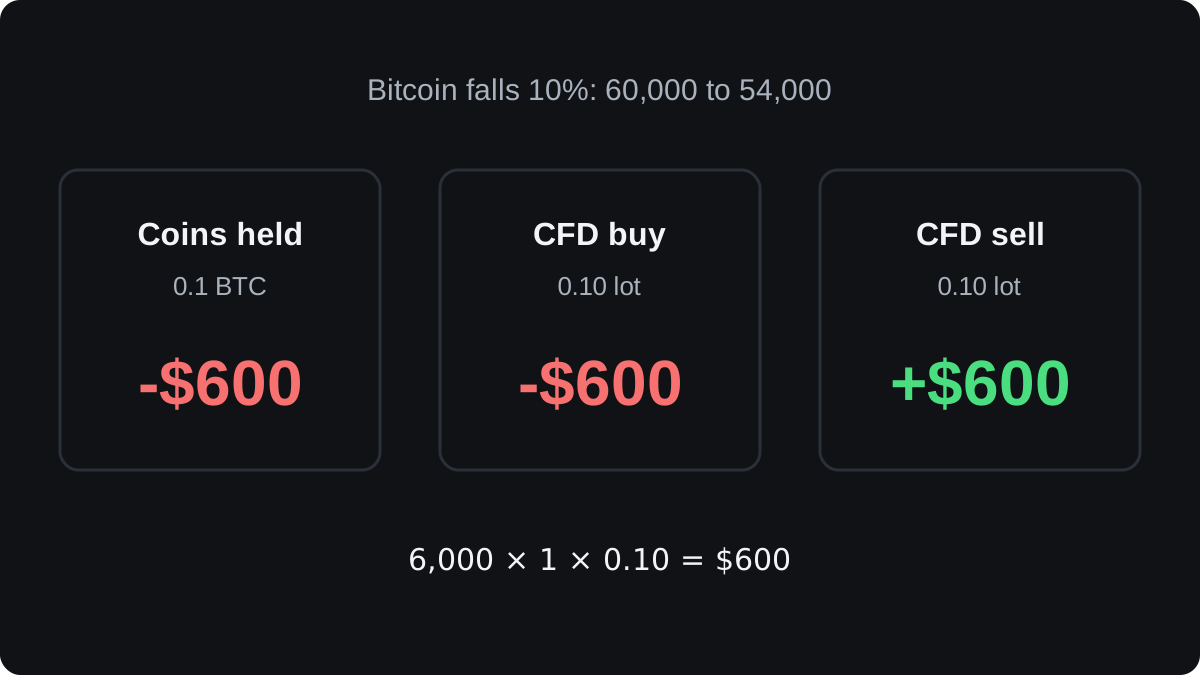
A CFD lets you sell first as easily as you buy. If bitcoin falls 10%, from 60,000 to 54,000, a 0.10 lot sell gains 6,000 × 1 × 0.10 = $600.
The coin holder and the CFD buyer each lose the same $600.
A CFD also needs only margin. Buying 0.1 BTC outright takes the full $6,000. The CFD locks $600 at an illustrative leverage of 1:10, or $3,000 at 1:2.
The smaller deposit leaves the risk the same size. A 10% fall still costs $600 on the CFD, which is all of the $600 margin. Leverage on crypto CFDs shows how that leads to a stop out.
Different risks, different safeguards
Owning coins puts security in your hands. Lose the seed phrase, or let someone steal it, and the coins are gone, because a blockchain transfer cannot be reversed.
Coins left on an exchange depend on that exchange staying solvent and honest. Scams aimed at coin holders are widespread, and common crypto scams shows how they work.
A plain coin purchase has no margin call. If the price halves, you still hold the coin and can choose whether to wait.
A CFD swaps those risks for others. Leverage can bring a stop out that closes the trade before any recovery. The broker is your counterparty, so its licence and finances matter.
A CFD also trades only when the broker's sessions allow, even though coins trade all week. Trading crypto CFDs at weekends covers what that means for gaps and swap.
What each route is built for
Neither route is better in general. Each one fits a different job.
Only a coin can be sent to someone, used in an app or held in a wallet that you alone control. Holding for months without a nightly charge also points to the coin.
A CFD is built for trading price moves in both directions, often from the same account and platform as forex. Its costs stay smallest when holding periods are short and swap has little time to build up.
Check first that the CFD route is open to you. In the UK, for example, firms have not been allowed to sell crypto CFDs to retail clients since January 2021, and rules elsewhere can change too.
คำถามที่พบบ่อย
Is it cheaper to buy crypto or trade CFDs?
It depends on how long you hold. For a trade closed the same day, a CFD's spread can cost less than exchange fees, while weeks of nightly swap usually make the CFD dearer.
Can I move a crypto CFD to my wallet?
No. A CFD is a contract with your broker, so there is nothing to withdraw. To hold coins in a wallet you have to buy them on an exchange or a similar service.
Is a crypto CFD price the same as the exchange price?
They are close but can differ slightly. Each broker sets its own quote from the price feeds it chooses, and adds its spread.
Can I earn staking rewards on a crypto CFD?
No. Staking rewards go to real coins staked on a network, and a CFD holds none. Only coins you own can be staked.
เรียนต่อ
 บทที่ 2What is a crypto CFD?A crypto CFD is a contract with your broker that settles the change in a cryptocurrency's price in cash. You never own the coin, so you need no wallet or private key. You can buy or sell, profit or loss lands in your account currency, and the broker sets the contract's terms.
 บทที่ 2What does it cost to trade crypto CFDs?Trading a crypto CFD costs the spread on every trade, commission on some account types, and swap for each night the position stays open. Slippage can add to the bill. The spread matters most on short trades and swap on long ones. Your broker sets every rate, so read them in the symbol's specification.
 บทที่ 2How does leverage work on crypto CFDs?Leverage on a crypto CFD lets you open a position worth more than the margin you put up. At 1:10, a $6,000 bitcoin position locks $600. Leverage sets the margin and position size sets the risk. Because crypto moves fast, brokers and regulators usually allow far less leverage on crypto than on forex.
 บทที่ 2Trading crypto CFDs at weekends.Coins trade on exchanges seven days a week, but a crypto CFD trades only when your broker's sessions allow. Some brokers quote crypto CFDs through the weekend, others pause them. Either way, weekend markets can be thinner, spreads can widen, prices can gap, and swap may count Saturday and Sunday nights.

