How do ETF flows move the Bitcoin price?
When investors put more money into spot Bitcoin ETFs than they take out, new shares are created and bitcoin is bought to back them. Outflows work in reverse. That buying and selling can move the price, but hedged trades, other sellers and timing mean a flow figure never maps neatly onto a price change.
เนื้อหานี้ยังมีเฉพาะภาษาอังกฤษ
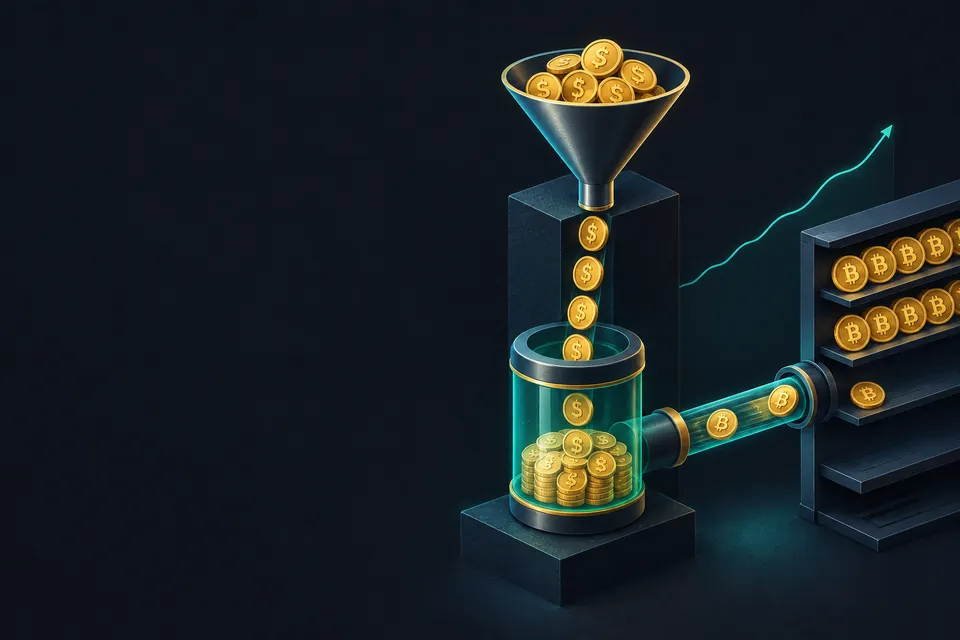
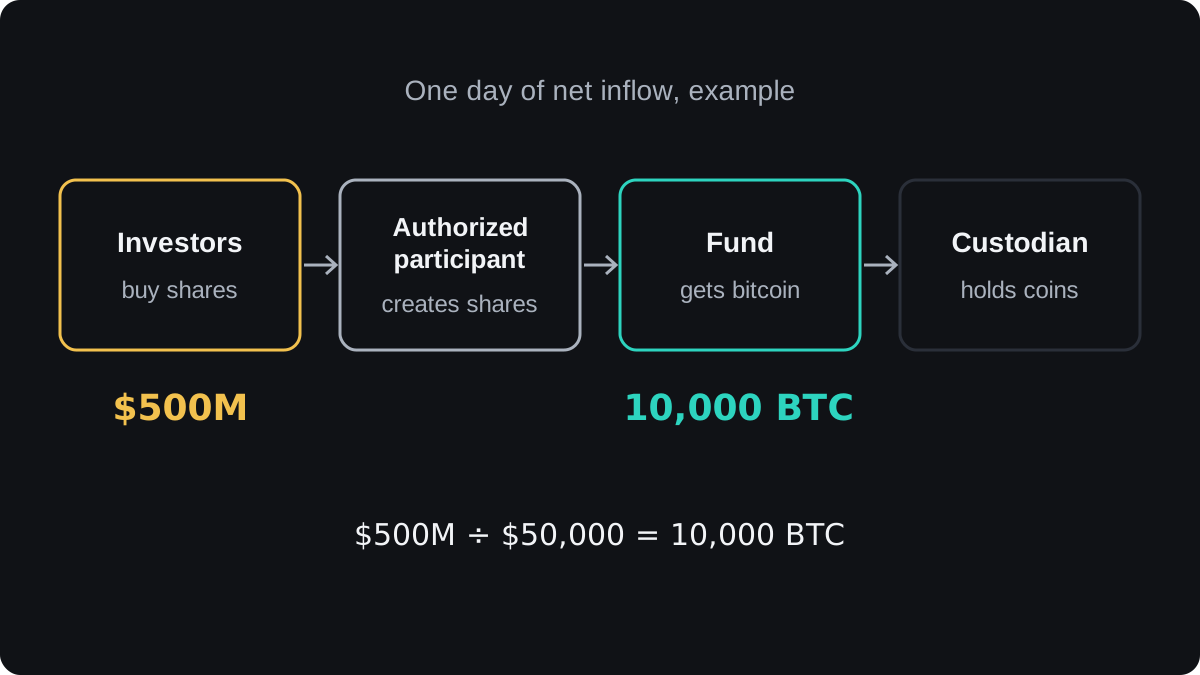
On one day, investors put $500 million more into spot Bitcoin ETFs than they took out. With Bitcoin at $50,000, the funds need 10,000 more bitcoin to back the new shares. Those coins have to be bought from someone.
The figures in this lesson are round numbers for illustration. The mechanism is real, and it is why traders watch ETF flow tables each morning.
What ETF flows measure
A fund's net flow for a day is the value of shares created minus the value of shares redeemed. A positive figure is an inflow, a negative one an outflow.
Data sites add up all the funds to give a total for the day. A flow is different from a change in fund size, which also moves with the price.
Say a fund grows from $10 billion to $11 billion in a week. A rise in Bitcoin's price may explain $600 million of that, and new money the other $400 million, which is the flow.
Flows are counted after the stock market closes, from the share counts and holdings each fund publishes once a day. Totals come out that evening or the next day, after the price has already moved.
How an inflow becomes bitcoin buying
The chain runs through the creation process described in the spot Bitcoin ETF lesson:
- Investors buy more shares than others sell, and the share price edges above the fund's net asset value.
- An authorized participant, a large trading firm, creates new shares to sell into that demand.
- Bitcoin is bought to back the new shares. In a cash creation the fund buys it, and in an in-kind creation the participant buys it and hands the coins over.
- The coins go to the fund's custodian and stay there until shares are redeemed.
A fund paid in cash buys the coins itself, either directly from large trading firms in private over-the-counter deals or through a broker that routes orders to several exchanges.
Either way, less of the buying lands on one public order book at once. The fund's prospectus names the firms it trades with.
Outflows run the same chain backwards. Shares are redeemed, and the fund sells bitcoin or hands it to the participant to sell.
Sizing a flow against new supply
A common way to size a flow is to compare it with the coins miners create. Since the 2024 halving, new supply has been about 3.125 × 144 = 450 BTC a day.
The $500 million inflow buys $500,000,000 ÷ $50,000 = 10,000 BTC. That is 10,000 ÷ 450, or about 22 days of newly mined coins, bought in a single day.
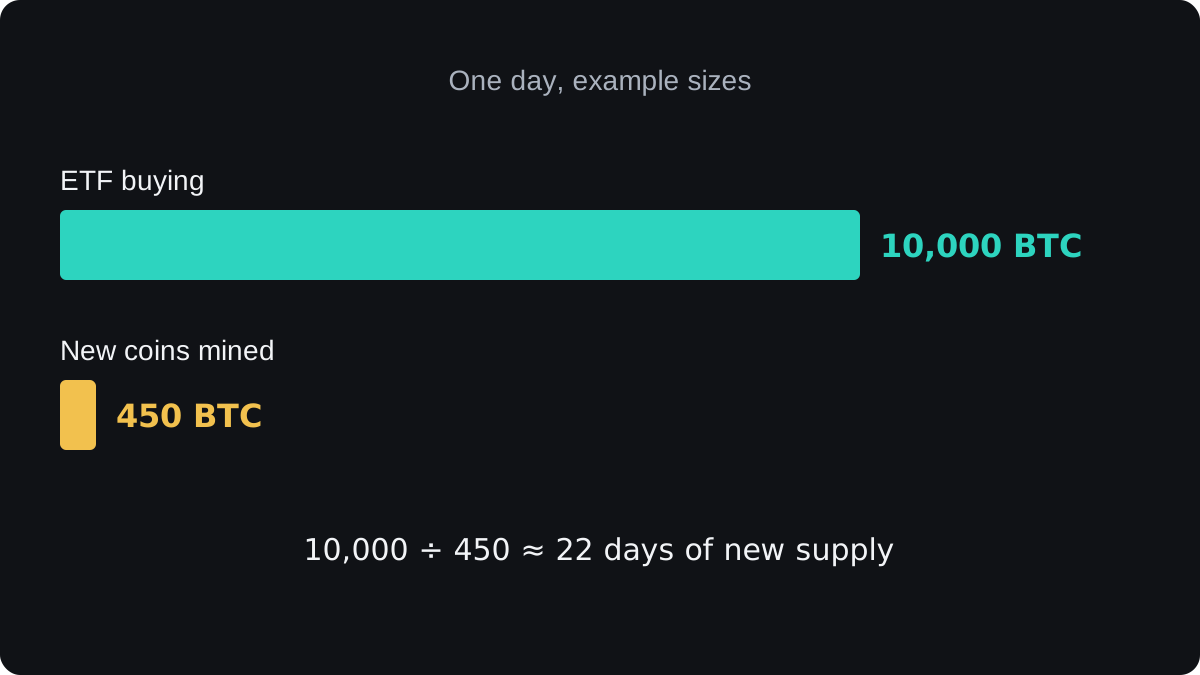
The comparison flatters the effect. Most coins sold on any day come from existing holders, and Bitcoin's daily trading on exchanges is far larger than both numbers.
What moves the price is whether buyers have to pay up to find sellers. That depends on liquidity. When the order book is deep, 10,000 BTC can be absorbed with a small change in price.
When long-term holders are selling at the same time, the same inflow may barely move the price at all.
Flows that do not bet on the price
Some inflows come from traders who want no exposure to Bitcoin's direction. A well-known example is the basis trade: buy ETF shares and sell an equal amount of Bitcoin futures.
Futures often trade above spot. Say a hedge fund buys $100 million of ETF shares and sells $100 million of futures priced 1% above spot.
As the futures converge on the spot price at expiry, the hedge fund earns about $1 million before costs, whatever Bitcoin does. The ETF shows a $100 million inflow, yet the hedge fund has made no bet on the price.
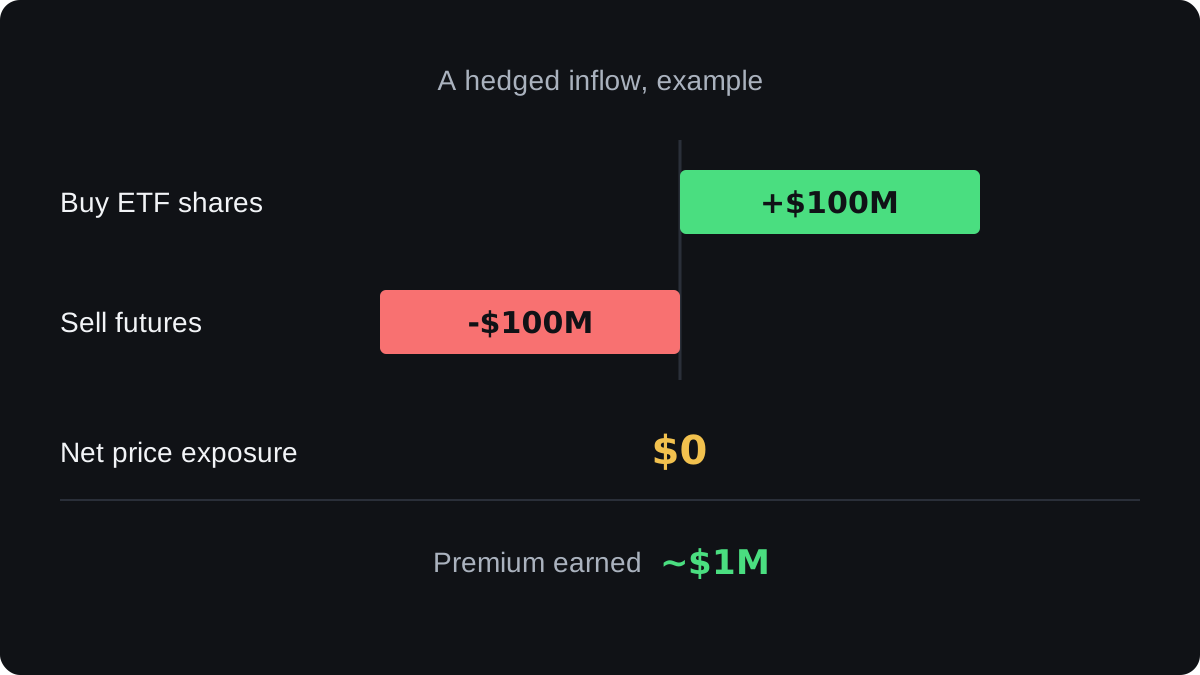
Bitcoin is bought for the new ETF shares, while the futures sale pushes futures prices down. Traders who link the two markets pass that selling back to spot, so the net push on the price is close to zero.
When the premium shrinks, these traders unwind. They redeem shares and buy back futures, which shows up as an outflow without any change of view on Bitcoin.
Money switching between funds nets out as well. If one fund loses $200 million to another, the total flow is zero, so the total for all funds is the figure to watch.
Do flows lead the price or follow it?
Both happen. Rising prices draw in buyers who chase performance, so inflows often come after a rally has started. Inflows then add buying, which can extend it.
Because the two feed each other, a strong link between daily flows and daily price changes does not show which one caused the other. Flow data also arrives after the close, when the day's move has already happened.
ETF flows are also different from exchange flows, which track coins moving on the blockchain into and out of crypto exchanges. Each measures a different group of holders, and the two can point in opposite directions.
Read flows over weeks, next to the price and the futures premium. A single day's figure, on its own, tells you little.
คำถามที่พบบ่อย
Where can I see Bitcoin ETF flows?
Each fund publishes its holdings daily, and several data sites add them into a total. Check which date a figure covers before you compare two sites.
Do ETF inflows always push Bitcoin up?
They do not. An inflow tied to a futures hedge adds no net demand, and sellers elsewhere can absorb plain buying without a big price change.
What does an ETF outflow mean?
More shares were redeemed than created, so the funds sold bitcoin or handed it to authorized participants to sell. It can come from investors leaving or from a hedge being unwound.
Are ETF flows the same as exchange flows?
They measure different things. ETF flows count fund shares created and redeemed, while exchange flows track coins moving on the blockchain into and out of crypto exchanges.
เรียนต่อ
 บทที่ 1What is a Bitcoin futures ETF?A Bitcoin futures ETF is a fund listed on a stock exchange that tracks Bitcoin by holding Bitcoin futures contracts, plus cash as collateral. It owns no bitcoin. Because futures expire, the fund keeps replacing them, and when later contracts cost more, that roll makes the fund lag the Bitcoin price over time.
 บทที่ 1What is a spot Bitcoin ETF?A spot Bitcoin ETF is a fund that owns actual bitcoin, kept by a custodian, and whose shares trade on a stock exchange. Each share stands for a fixed slice of the fund's coins, minus fees. Large trading firms create and redeem shares to keep the share price close to the value of that bitcoin.
 บทที่ 1What is a spot ether ETF?A spot ether ETF is a fund that holds ether (ETH), the coin of the Ethereum network, with a custodian, and whose shares trade on a stock exchange. It works like a spot Bitcoin ETF. The main difference is staking: some funds lock part of their ether to earn network rewards, and others do not.

