What is a spot Bitcoin ETF?
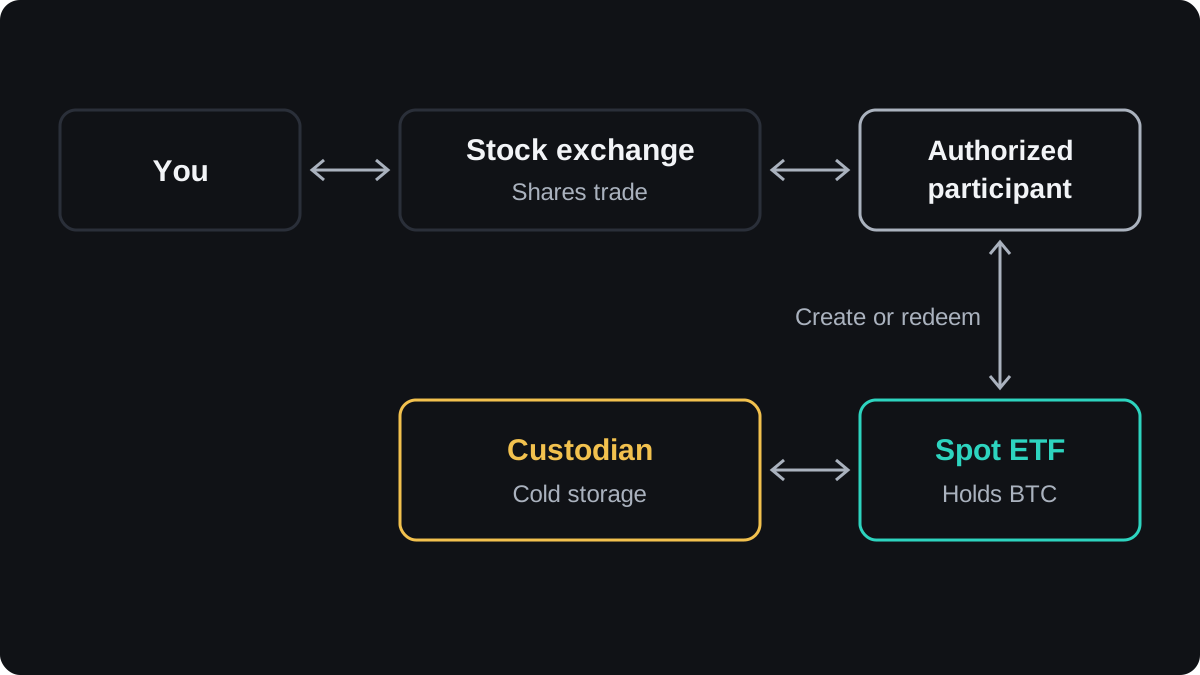
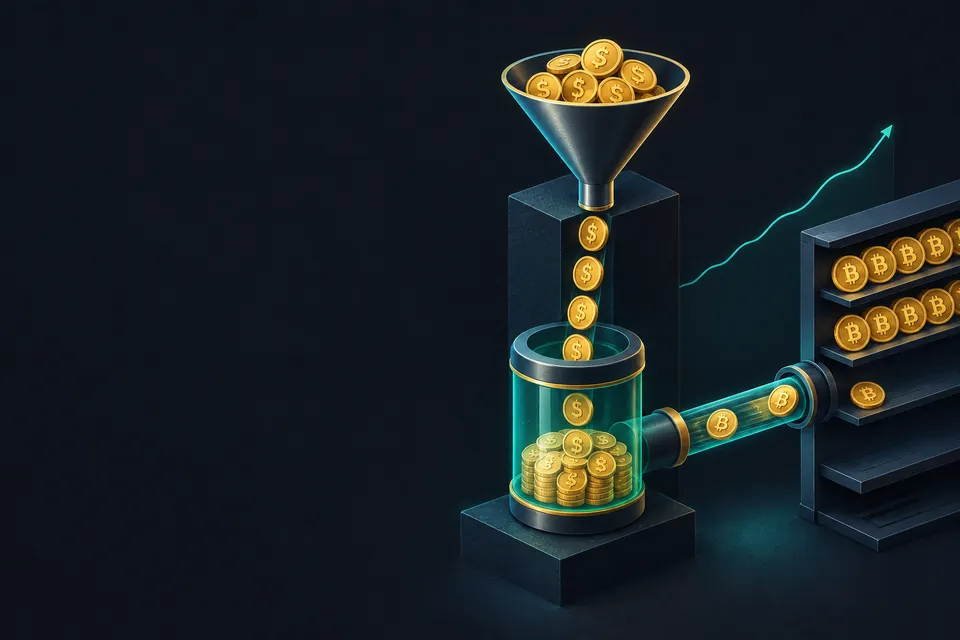
A spot Bitcoin ETF is a fund that owns actual bitcoin, kept by a custodian, and whose shares trade on a stock exchange. Each share stands for a fixed slice of the fund's coins, minus fees. Large trading firms create and redeem shares to keep the share price close to the value of that bitcoin.
เนื้อหานี้ยังมีเฉพาะภาษาอังกฤษ

Say each share of a fund stands for 0.001 BTC, held for you by a specialist company. At $50,000 per bitcoin, each share is worth about $50, using round numbers for illustration.
You buy and sell the share in a brokerage account, and you never touch a wallet or a private key.
What a spot Bitcoin ETF holds
A spot Bitcoin ETF is an exchange-traded fund that holds bitcoin itself. Spot means the coins are bought for delivery now, unlike a Bitcoin futures ETF, which holds contracts.
The coins sit with a custodian, a regulated firm that keeps the private keys. Most of those keys are kept offline in cold storage, out of reach of internet attacks.
Holding coins through a custodian moves the safekeeping risk from you to that firm. The fund's prospectus says who the custodian is, how the coins are kept and what insurance, if any, applies.
The bitcoin value behind one share is the net asset value (NAV). A fund with 10,000 BTC and 10 million shares holds 0.001 BTC per share, so at $50,000 its NAV is $500 million ÷ 10 million = $50.
Creation and redemption keep the price in line
Shares trade between investors all day, so their price can drift away from NAV. A few large trading firms, called authorized participants (APs), close that gap by creating or redeeming shares in big blocks.
When shares trade above NAV, an AP hands the fund cash or bitcoin, gets new shares and sells them. When shares trade below NAV, it buys shares cheaply and hands them back for the bitcoin or cash behind them.
Here is a creation, using a block of 10,000 shares and round numbers for illustration:
- NAV is $50.00 a share, but shares trade at $50.50, a 1% premium.
- 10,000 shares × 0.001 BTC = 10 BTC, which costs 10 × $50,000 = $500,000. The AP delivers that bitcoin, or the cash to buy it, to the fund.
- The fund issues 10,000 new shares to the AP.
- The AP sells them at $50.50 for $505,000, a gain of $5,000 before costs.
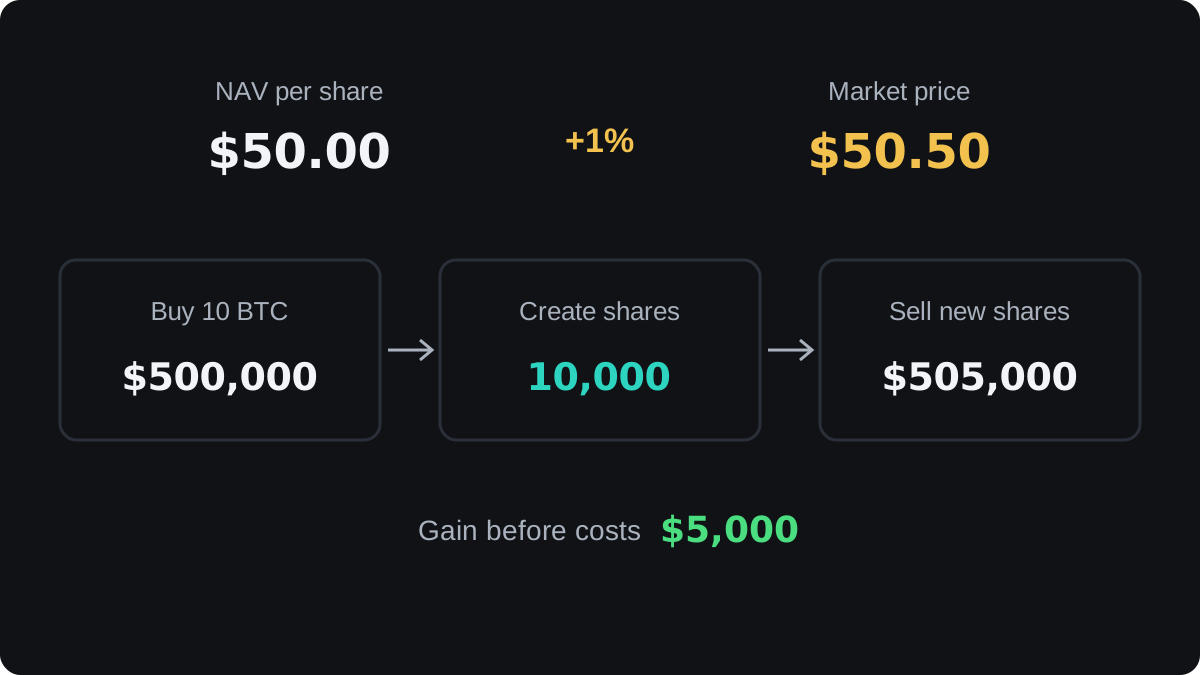
The extra shares for sale push the price back toward $50. Because many firms watch for these gaps, they usually stay small during market hours.
Some funds accept bitcoin when creating shares, called in kind, and others take only cash and buy the coins themselves. Either way, the share stays close to the value of the coins.
The rules on this have changed. US spot funds took only cash when they launched in January 2024, and the US regulator allowed in-kind creation from July 2025. A fund's prospectus says which method it uses now.
The fee comes out of your bitcoin
The fund pays its yearly fee by selling a little bitcoin. So the bitcoin behind each share shrinks slowly over time.
Take a fee of 0.5% a year, a round number for illustration. A share backed by 0.001 BTC is backed by 0.001 × 0.995 = 0.000995 BTC a year later.
On 100 shares, that is 0.0005 BTC less after a year, worth $25 at $50,000. Fees differ between funds and change over time, so compare them before you buy. Over many years, a small difference compounds.
Trading hours and weekend gaps
Bitcoin trades every hour of every day. The ETF trades only when its stock exchange is open, usually on weekdays during local business hours. The lesson on crypto market hours covers the round-the-clock side.
Say Bitcoin is at $50,000 at Friday's close, with the share at $50. Over the weekend Bitcoin rises to $53,000. On Monday the share opens near $53, and you could not trade at any price in between.
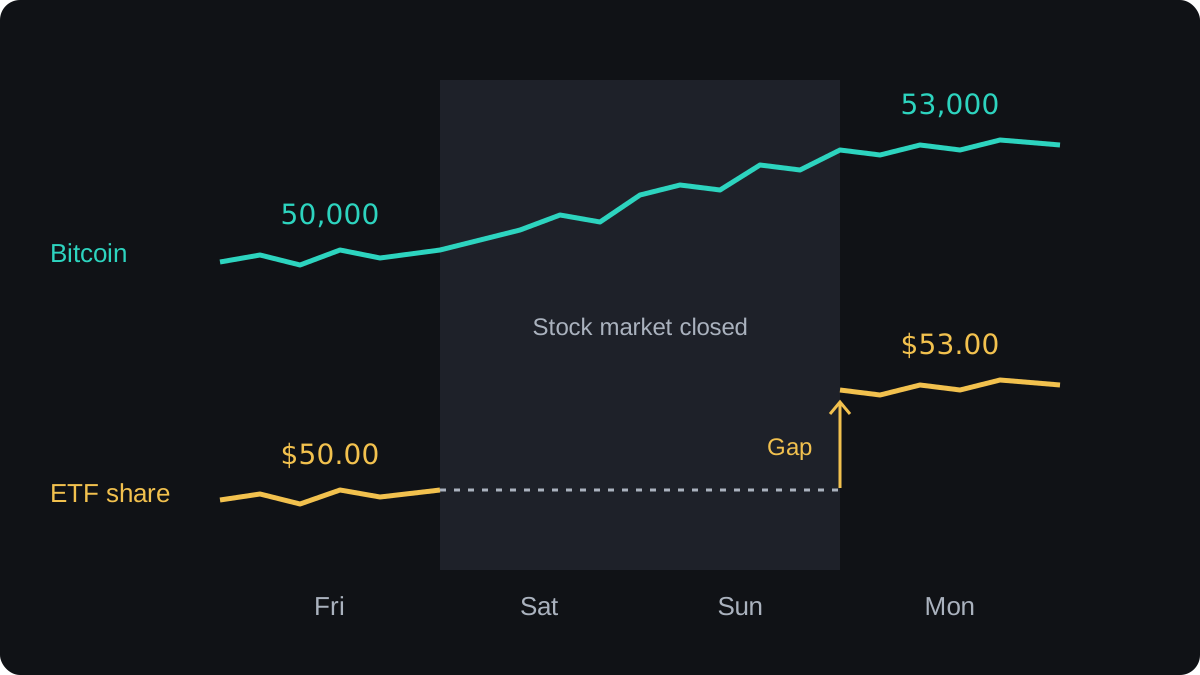
The same happens in reverse. A weekend crash reaches ETF holders all at once on Monday, and a stop loss on the ETF can only fill after the open, possibly well below its level.
Spot ETF or the coin itself?
Both follow Bitcoin's price. The difference is who holds the private keys and what you can do with what you own. A crypto wallet puts the keys in your hands.
| Coins in your own wallet | Spot Bitcoin ETF | |
|---|---|---|
| Who holds the keys | You | A custodian |
| When you can trade | Any time | Stock exchange hours |
| Cost of holding | No yearly fee | Yearly fee |
| Send on the blockchain | Yes | No |
| Account you need | A wallet or exchange | A brokerage account |
| Main risk beyond price | Losing your keys, scams | Fund, custodian, price gaps |
Neither choice removes Bitcoin's price swings. Fund shares fall 50% if Bitcoin does. The lesson on ETF flows explains how buying and selling of these funds can feed back into the Bitcoin price.
คำถามที่พบบ่อย
Can I withdraw bitcoin from a spot Bitcoin ETF?
Ordinary shareholders cannot. Only authorized participants deal with the fund directly, so you sell your shares on the exchange for cash.
Is a spot Bitcoin ETF safer than holding bitcoin?
It removes the risk of losing your own keys and adds others, such as the fund, its custodian and gaps while the stock market is shut. Bitcoin's price risk is the same either way.
Why does the ETF price differ slightly from Bitcoin's?
Each share tracks a fixed amount of bitcoin minus fees, and it trades only in market hours. Small premiums or discounts appear and are usually closed by authorized participants.
When were spot Bitcoin ETFs approved in the US?
US regulators approved the first spot Bitcoin ETFs in January 2024. Canada had listed them in 2021.
เรียนต่อ
 บทที่ 1What is a Bitcoin futures ETF?A Bitcoin futures ETF is a fund listed on a stock exchange that tracks Bitcoin by holding Bitcoin futures contracts, plus cash as collateral. It owns no bitcoin. Because futures expire, the fund keeps replacing them, and when later contracts cost more, that roll makes the fund lag the Bitcoin price over time.
 บทที่ 1What is a spot ether ETF?A spot ether ETF is a fund that holds ether (ETH), the coin of the Ethereum network, with a custodian, and whose shares trade on a stock exchange. It works like a spot Bitcoin ETF. The main difference is staking: some funds lock part of their ether to earn network rewards, and others do not.
 บทที่ 1How do ETF flows move the Bitcoin price?When investors put more money into spot Bitcoin ETFs than they take out, new shares are created and bitcoin is bought to back them. Outflows work in reverse. That buying and selling can move the price, but hedged trades, other sellers and timing mean a flow figure never maps neatly onto a price change.

