What is a Bitcoin futures ETF?
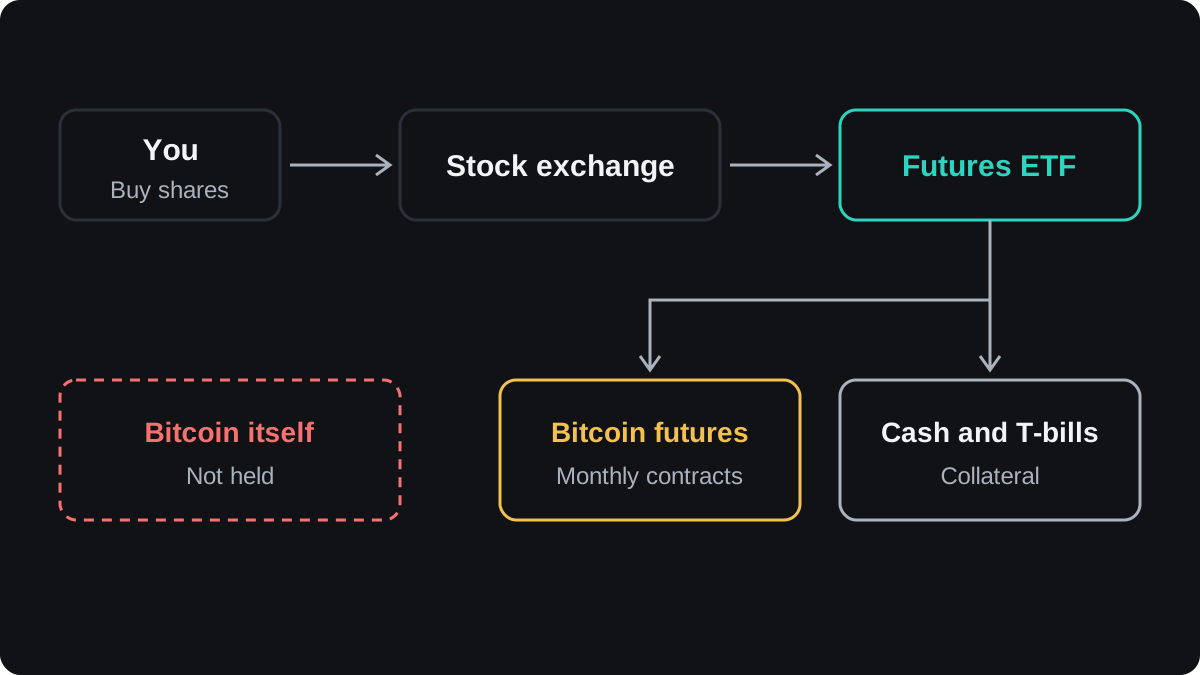
A Bitcoin futures ETF is a fund listed on a stock exchange that tracks Bitcoin by holding Bitcoin futures contracts, plus cash as collateral. It owns no bitcoin. Because futures expire, the fund keeps replacing them, and when later contracts cost more, that roll makes the fund lag the Bitcoin price over time.

Say you buy shares in a fund that moves up and down with Bitcoin. Look inside and you will not find a single bitcoin. The fund holds contracts that pay out according to Bitcoin's price on a future date.
How a Bitcoin futures ETF works
An ETF, or exchange-traded fund, is a fund whose shares trade on a stock exchange like company shares. You buy and sell it through an ordinary brokerage account.
A Bitcoin futures contract is an agreement to buy or sell Bitcoin at a set price on a set date. The ones these funds use are settled in cash, so no coins ever move.
They trade on regulated futures exchanges such as CME, the Chicago Mercantile Exchange, where the fund buys them like any other trader.
A Bitcoin futures ETF holds those contracts. The exchange asks for only part of each contract's value up front as margin, so most of the fund's money sits in cash and short-term government bills.
If you know futures from forex, the contracts work the same way. Only the underlying asset is different.
Why futures ETFs came first in the US
The first US Bitcoin futures ETF began trading in October 2021. Funds that hold the coins themselves, called spot ETFs, had to wait until January 2024.
US regulators were more willing to approve a fund built on futures. Those contracts trade on CME, which a US regulator already supervised, with surveillance against price manipulation.
Some other countries approved funds that hold bitcoin earlier. Canada listed its first in 2021.
The roll: where a futures fund loses ground
Each futures contract has an expiry date, usually monthly for the contracts these funds hold. Before it expires, the fund sells it and buys the next one. That swap is called the roll.
Later contracts often trade above the spot price, a state called contango. Part of the gap is the cost of money over the waiting period. Part is demand from traders who want Bitcoin exposure on borrowed money.
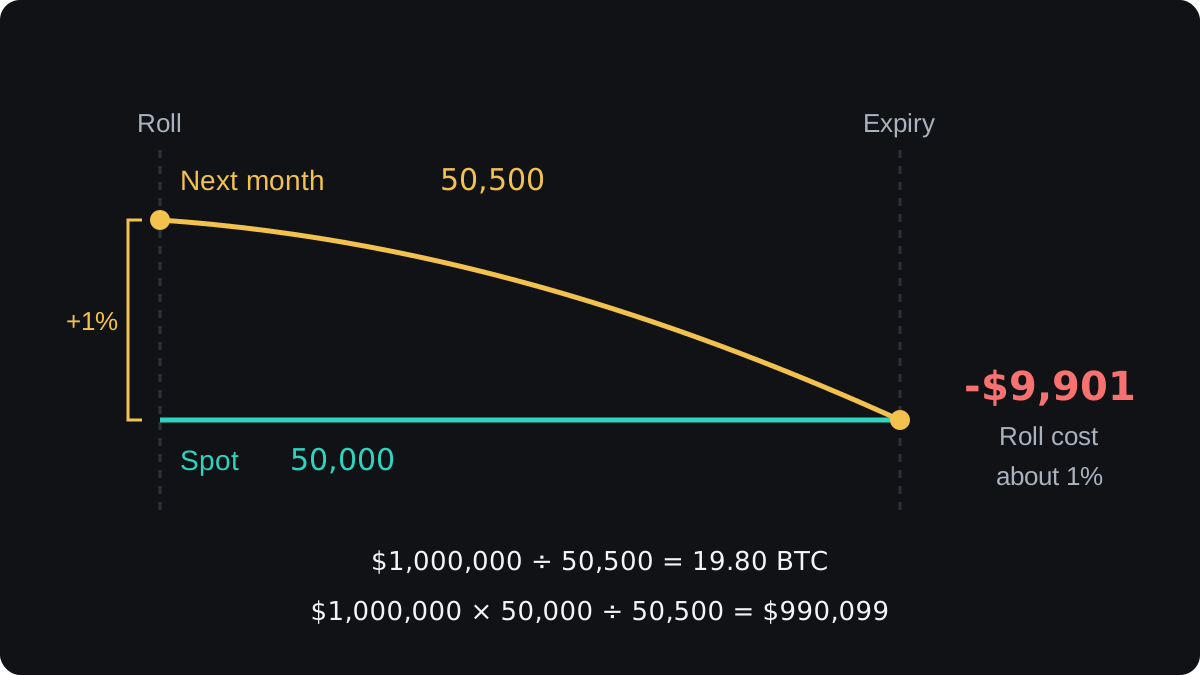
Contango makes each roll buy a little less exposure. The numbers below are round figures for illustration, with Bitcoin's spot price flat at $50,000 all month and no interest earned on cash.
- The fund has $1,000,000. At the roll, next month's contract trades at $50,500, a 1% premium.
- $1,000,000 ÷ 50,500 buys exposure to about 19.80 BTC, where the spot price would have covered 20 BTC.
- As expiry nears, the contract price drifts down to the spot price of $50,000.
- The position is now worth $1,000,000 × 50,000 ÷ 50,500 = $990,099. The fund lost $9,901, about 1%, while Bitcoin did not move.
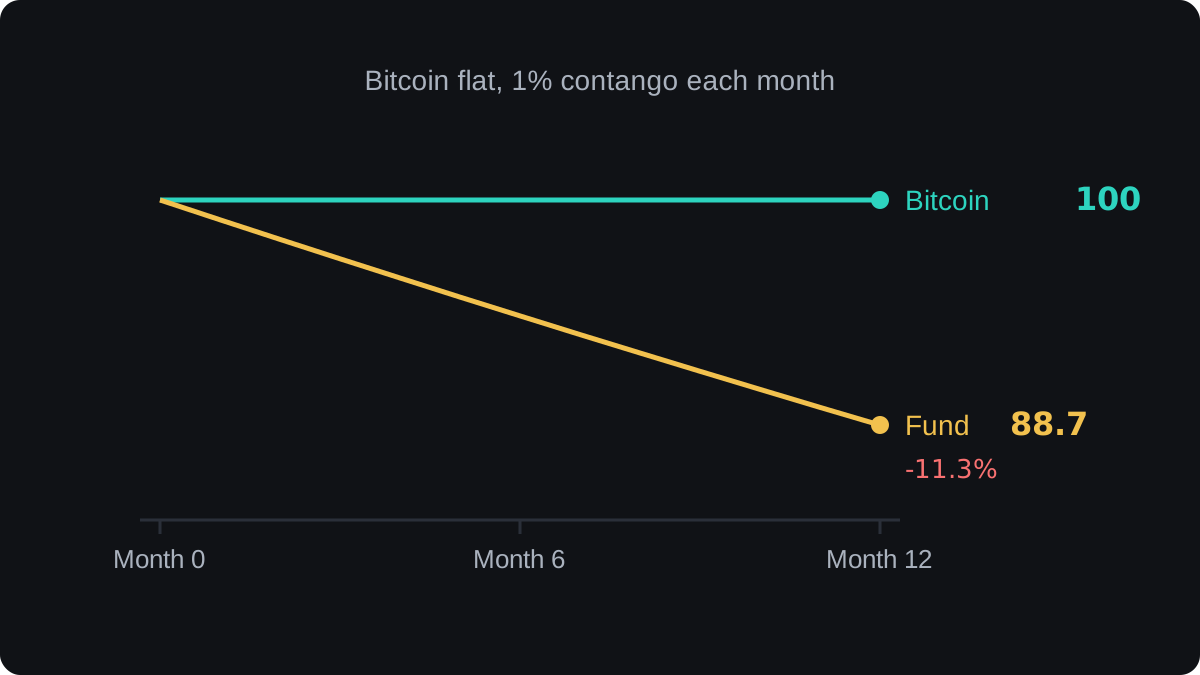
Repeat that every month and the losses compound. Twelve such rolls leave the fund at about 88.7% of where it started, an 11.3% lag in a year when Bitcoin ended flat.
The opposite state, backwardation, is when later contracts trade below spot, and each roll then buys a little more exposure. Bitcoin futures have spent much of their history in contango, though the gap varies a lot.
The fund's cash earns interest, which offsets part of the roll cost. If the premium only matched interest rates, the two would roughly cancel. The real drag is the part of the premium above interest rates.
Fees and tracking
Every ETF charges a yearly management fee, known as the expense ratio. It is taken from the fund's assets a little each day, so it shows up as a slightly lower share price.
The fund also pays trading costs each time it rolls. Together with contango, these explain the tracking difference, the gap between the fund's return and Bitcoin's over the same period.
You can measure it yourself. Compare the fund's return over a year with the change in Bitcoin's spot price over the same dates. The gap is roughly what holding the fund cost you.
Who uses them, and their limits
Futures ETFs trade only while the stock exchange is open, and Bitcoin trades around the clock. A big move on a weekend shows up as a gap at the next open, which the lesson on crypto market hours explains.
Because roll costs pile up with time, the lag matters most for long holds. Some traders use these funds for shorter positions, and in some markets they have been the only Bitcoin fund on offer.
Some versions offer two times the daily move, or the inverse. They reset every day, so over weeks their results can drift far from a simple multiple of Bitcoin's change.
A spot Bitcoin ETF holds the coins and has no roll. A crypto CFD also tracks Bitcoin without coins, usually with an overnight fee for holding it.
Questions
Does a Bitcoin futures ETF own any bitcoin?
It does not. It holds futures contracts and cash, so its value follows Bitcoin futures prices, which usually sit close to the spot price.
Why does a Bitcoin futures ETF lag the price of Bitcoin?
The main causes are roll costs when futures are in contango and the yearly fee. Interest earned on the fund's cash offsets part of them.
What is the difference between a futures and a spot Bitcoin ETF?
A spot ETF holds bitcoin with a custodian, so it has no roll. A futures ETF holds contracts that must be replaced before they expire, which costs money when later contracts trade higher.
Can I lose more than I invest in a Bitcoin futures ETF?
If you buy ordinary shares with your own money, the most you can lose is what you paid. Borrowing to buy, or using leveraged versions, changes that.
Keep learning
 Chapter 1What is a spot Bitcoin ETF?A spot Bitcoin ETF is a fund that owns actual bitcoin, kept by a custodian, and whose shares trade on a stock exchange. Each share stands for a fixed slice of the fund's coins, minus fees. Large trading firms create and redeem shares to keep the share price close to the value of that bitcoin.
 Chapter 1What is a spot ether ETF?A spot ether ETF is a fund that holds ether (ETH), the coin of the Ethereum network, with a custodian, and whose shares trade on a stock exchange. It works like a spot Bitcoin ETF. The main difference is staking: some funds lock part of their ether to earn network rewards, and others do not.
 Chapter 1How do ETF flows move the Bitcoin price?When investors put more money into spot Bitcoin ETFs than they take out, new shares are created and bitcoin is bought to back them. Outflows work in reverse. That buying and selling can move the price, but hedged trades, other sellers and timing mean a flow figure never maps neatly onto a price change.

