What are maker and taker fees?
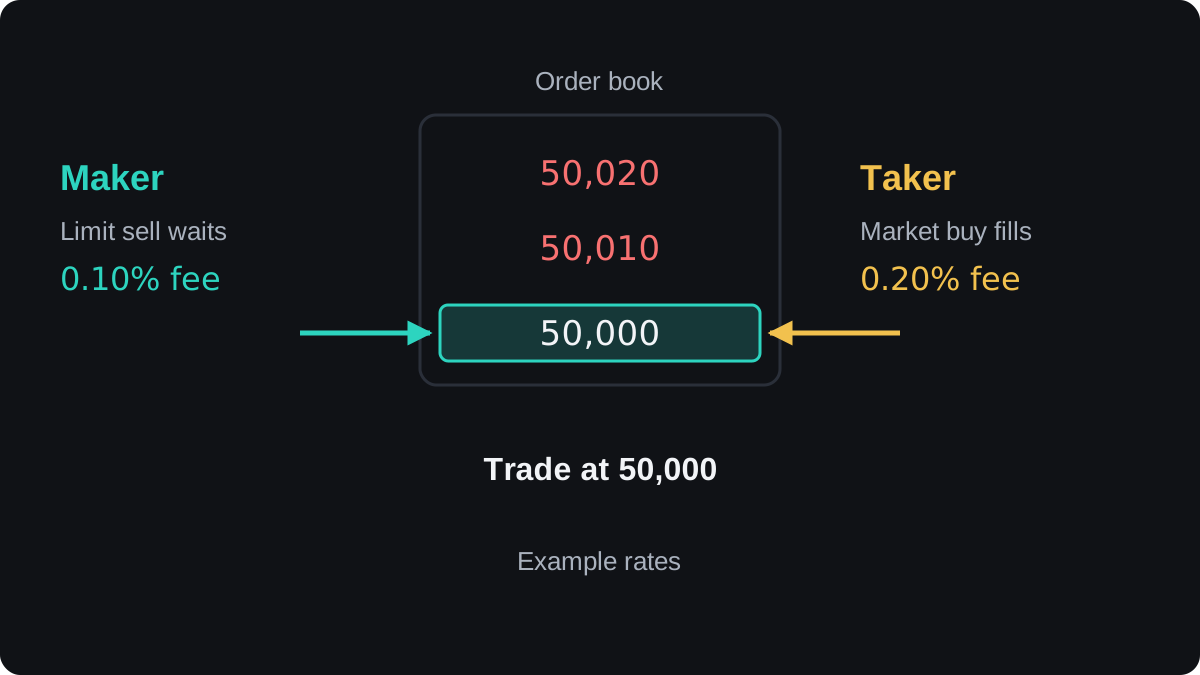
A maker fee applies when your order waits in the order book and someone else fills it later. A taker fee applies when your order fills straight away against an order that was already waiting. Exchanges usually charge takers more, because makers supply the orders that keep spreads narrow.
เนื้อหานี้ยังมีเฉพาะภาษาอังกฤษ
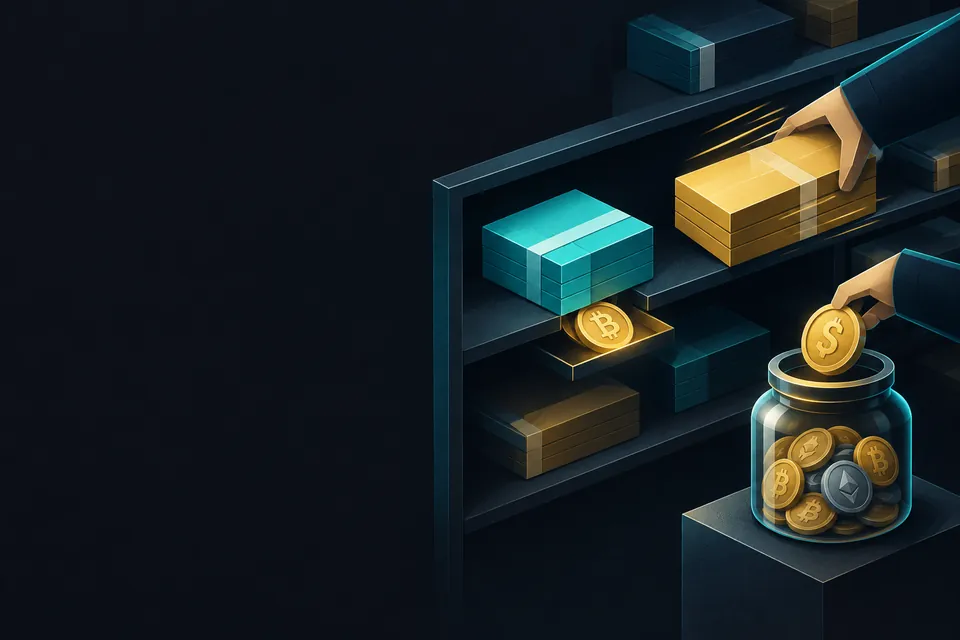
One trader sells 1 coin to another on an exchange. Both get the same price, yet they can pay different fees, and the difference comes down to which of them was waiting.
Makers and takers
Every trade on an exchange needs two orders. One was already sitting in the order book, and the other arrived and matched it.
The trader whose order was waiting is the maker, because that order made the book a little deeper. The trader whose order filled at once is the taker, because it took an order out of the book.
Each fill has one maker side and one taker side, and the exchange charges each side its own rate. Which side you are on depends on the order you send:
- A market order is always a taker. It fills at once against whatever is waiting.
- A limit order priced so it can match a waiting order fills at once too, and it pays the taker fee for that part.
- A limit order priced away from the other side waits in the book. When it fills later, it pays the maker fee.
If market and limit orders are new to you, the forex lesson on order types explains both. They work the same way on a crypto exchange.
Why takers usually pay more
Exchanges want full order books, because narrow spreads and deep books draw more traders. Makers provide those orders, so many exchanges charge them less.
Fee schedules often come in tiers based on how much you traded over a recent period, such as the last 30 days. Higher tiers pay lower rates on both sides.
At the top tiers, some exchanges pay makers a small amount on each fill. That shows up as a negative maker fee, also called a maker rebate.
Some exchanges also discount fees if you hold their own token or pay fees with it. Schedules change often, so read the exchange's current fee page before you compare.
Worked example: fees on a buy and a sell
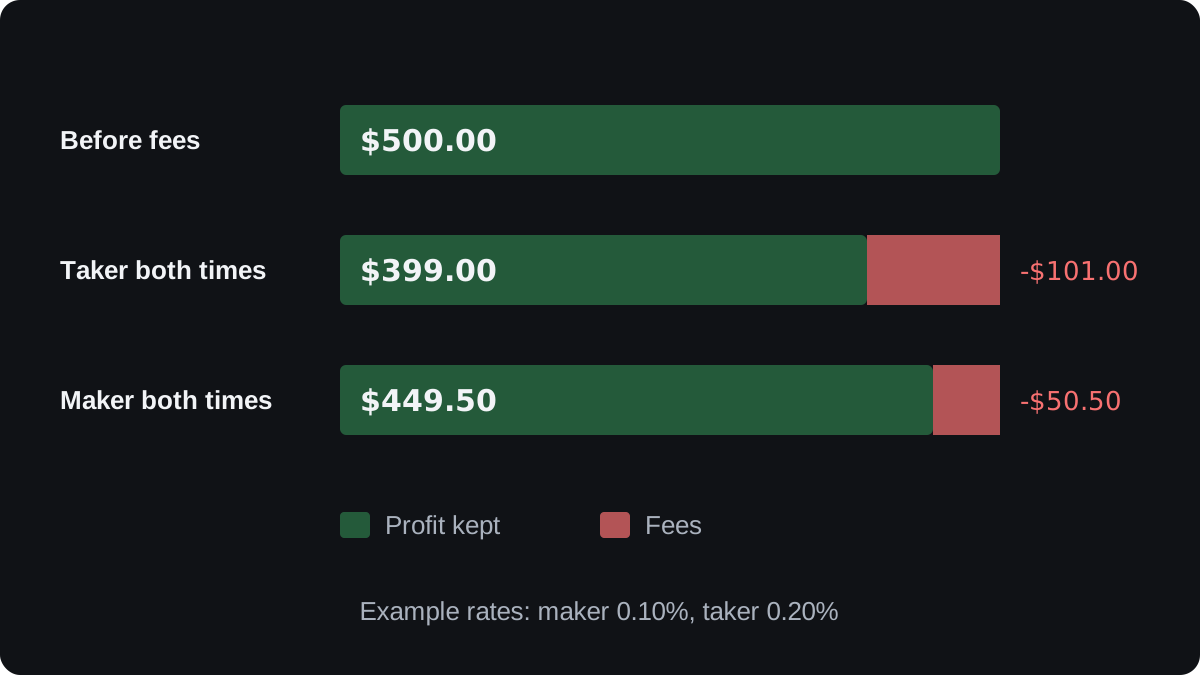
The fee rates and prices below are illustrative: a maker fee of 0.10% and a taker fee of 0.20%. Each fee is charged on the value of that trade.
You buy 0.5 coin at 50,000 and later sell it at 51,000.
- The buy is worth 0.5 × 50,000 = $25,000.
- The sale is worth 0.5 × 51,000 = $25,500.
- Before fees, the profit is 25,500 minus 25,000 = $500.
Now compare paying the taker fee both times with paying the maker fee both times:
| Fee | Taker both times | Maker both times |
|---|---|---|
| On the buy | $50.00 | $25.00 |
| On the sale | $51.00 | $25.50 |
| Total fees | $101.00 | $50.50 |
| Profit after fees | $399.00 | $449.50 |
The taker figures are 0.20% of $25,000 and of $25,500. The maker figures are 0.10% of the same amounts.
You pay these fees whether the trade wins or loses. A losing trade still pays on both the buy and the sale.
Exchanges also collect the fee in different ways. Some take it from what you receive: on a taker buy of 0.5 coin, the fee is 0.5 × 0.20% = 0.001 coin, so you receive 0.499 coin.
The spread is a separate cost. A taker who buys at the ask and sells at the bid pays the spread on top of the fees. The lesson on bid, ask and spread in crypto shows how to measure it.
The catch: a maker order may never fill
A maker order saves money only if it fills. If you place a buy limit below the price and the market rises away from it, you miss the trade completely.
Part of the order can also fill while the rest waits. You can end up with a smaller position than you planned, or a partial position you have to manage.
Many exchanges offer a post-only option. A post-only order that would fill at once is rejected or, on some exchanges, re-priced so it waits in the book. Either way, it only adds to the book as a maker.
So the choice is between speed and cost. A taker order gives you the fill now at the higher rate. A maker order gets the lower rate, with the risk that the price never comes to you.
Crypto CFDs and decentralized exchanges
A crypto CFD at a broker has no maker and taker split. You trade at the broker's quote and pay its spread, sometimes a commission per lot, and an overnight swap if you hold past its daily cut-off.
What it costs to trade crypto CFDs adds those costs up.
On many decentralized exchanges you swap against a pool of tokens, as the lesson on automated market makers explains. You pay the pool's fee and the network's transaction fee, with no maker or taker side.
Some decentralized exchanges run an order book instead, and those charge maker and taker fees much like a centralized exchange.
คำถามที่พบบ่อย
Is a limit order always a maker order?
A limit order pays the maker fee only for the part that waits in the book. If its price reaches a waiting order on the other side, that part fills at once and pays the taker fee.
What does a negative maker fee mean?
The exchange pays you a small amount on each maker fill instead of charging you. It usually applies only at high volume tiers.
Do I pay a fee on both the buy and the sale?
Yes. Each fill pays its own fee on the value of that trade, so buying and later selling pays twice.
Are maker and taker fees the same as the spread?
They are separate costs. The exchange charges the fee on each fill, while the spread is the gap between the best buy and sell orders, which a taker crosses.
เรียนต่อ
 บทที่ 1Bid, ask and spread in crypto.The bid is the highest price a buyer will pay for a coin right now, and the ask is the lowest price a seller will accept. You buy at the ask and sell at the bid. The gap is the spread, a cost you pay on every trade. Crypto traders measure it as a percentage of the price.
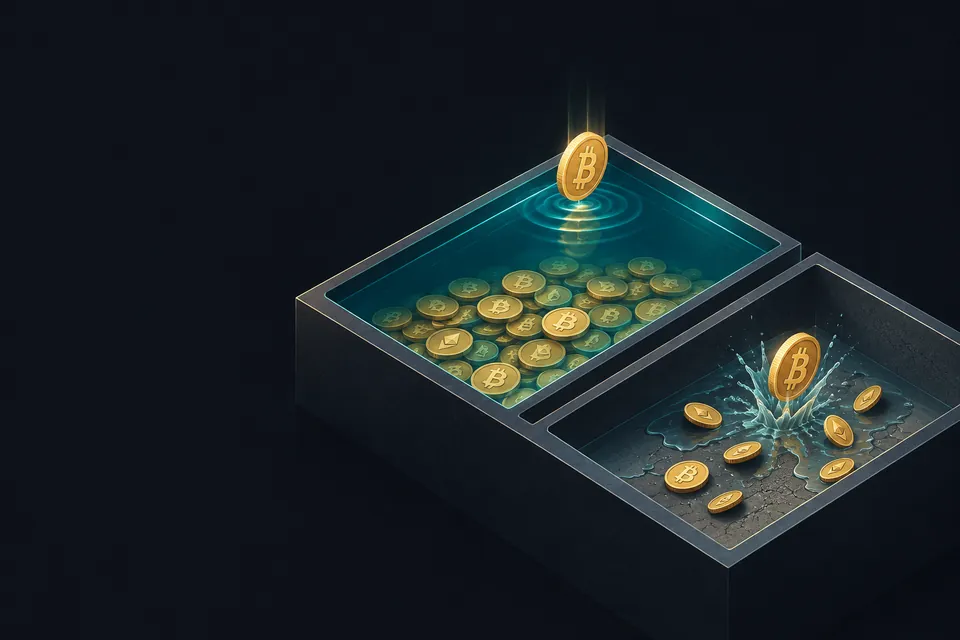 บทที่ 1What is liquidity in crypto?Liquidity is how easily you can buy or sell a coin without moving its price. A liquid coin has many orders close to the current price, so the spread is narrow and a large order fills near the quoted price. In a thin market, the same order eats through the book and fills at worse prices.
 บทที่ 1How to read a crypto order book.An order book is the live list of limit orders waiting on an exchange. Sell orders, the asks, sit above the price and buy orders, the bids, sit below it. Each row shows a price and an amount. The gap in the middle is the spread, and the running totals show how far a large order would move the price.
 บทที่ 1When does the crypto market trade?Crypto coins trade 24 hours a day, seven days a week, on exchanges around the world, with no official open or close. A crypto CFD at a broker follows the broker's own schedule, including any daily break and its weekend rules. You find those hours in the symbol's contract specification.

