Bid, ask and spread in crypto.
The bid is the highest price a buyer will pay for a coin right now, and the ask is the lowest price a seller will accept. You buy at the ask and sell at the bid. The gap is the spread, a cost you pay on every trade. Crypto traders measure it as a percentage of the price.
เนื้อหานี้ยังมีเฉพาะภาษาอังกฤษ

Look up a coin on a price website and you see one number. Open the trade screen on a crypto exchange and you see two.
The price to buy is a little higher than the price to sell. That gap is the first cost of every trade, and you pay it before the market moves at all.
The two prices on every crypto quote
The bid is the highest price anyone is offering to pay for the coin right now. The ask is the lowest price anyone is willing to sell at. The ask always sits above the bid.
When you buy straight away, you pay the ask. When you sell straight away, you get the bid. The difference between them is the spread.
Currency pairs work the same way, as the forex lesson on bid and ask prices shows. Crypto differs in who sets the two prices and in how the spread is measured.
Here is a quote with round illustrative prices: a bid of $49,990 and an ask of $50,010. The spread is 50,010 minus 49,990 = $20. Halfway between the two is the mid price, $50,000.
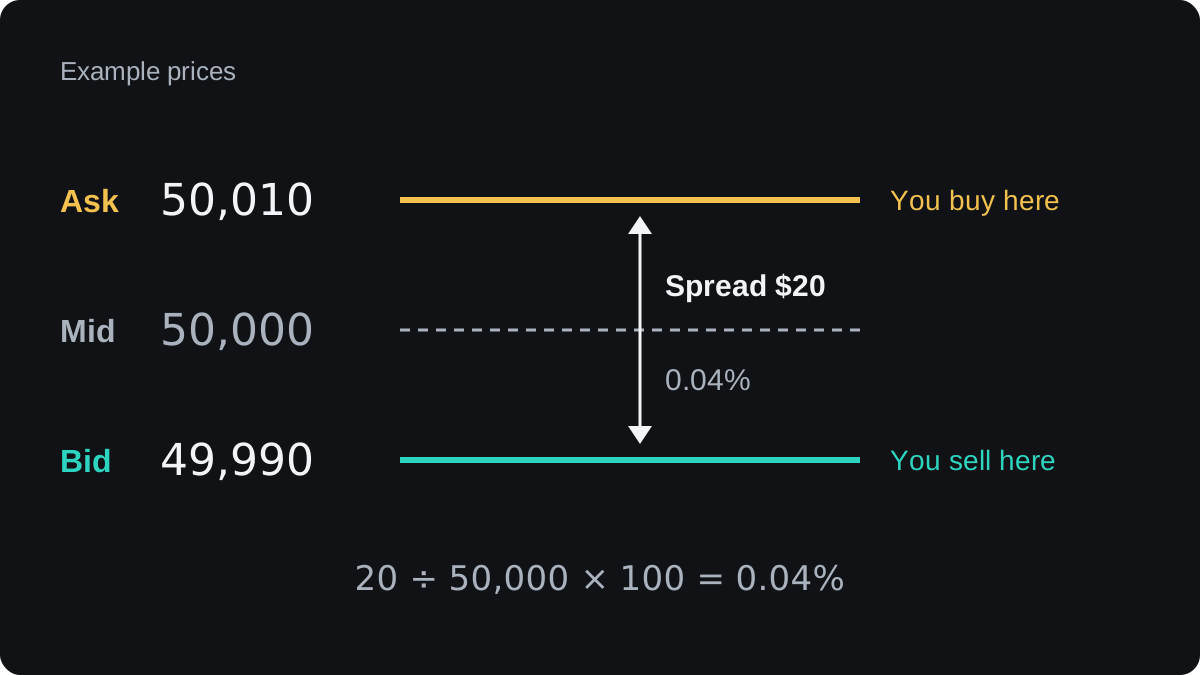
Price sites and charts often show a mid price, an average across exchanges or the last traded price. None of these is the price your order will get, so your fill can differ from the number you saw.
Who sets the bid and the ask
On a centralized exchange, other users set both prices. A buyer whose limit order waits in the book adds a bid, and a seller adds an ask. The highest bid and the lowest ask form the quote.
The full list of those waiting orders is the order book, and the order book lesson shows how to read it. The exchange matches the orders and charges a fee on each trade.
At a broker that offers a crypto CFD, the broker quotes both prices itself. It takes prices from the firms it trades with and sets its own spread, which can include a markup.
On a decentralized exchange built on a liquidity pool, there is no list of orders. The price comes from a formula and the pool's balances, so you pay a pool fee and price impact instead of a spread.
How to measure a crypto spread
Forex traders count spreads in pips. Crypto has no shared pip, and coin prices run from fractions of a cent to tens of thousands of dollars, so a spread in dollars says little on its own.
Traders compare crypto spreads as a percentage of the mid price instead:
Spread % = (ask minus bid) ÷ mid price × 100
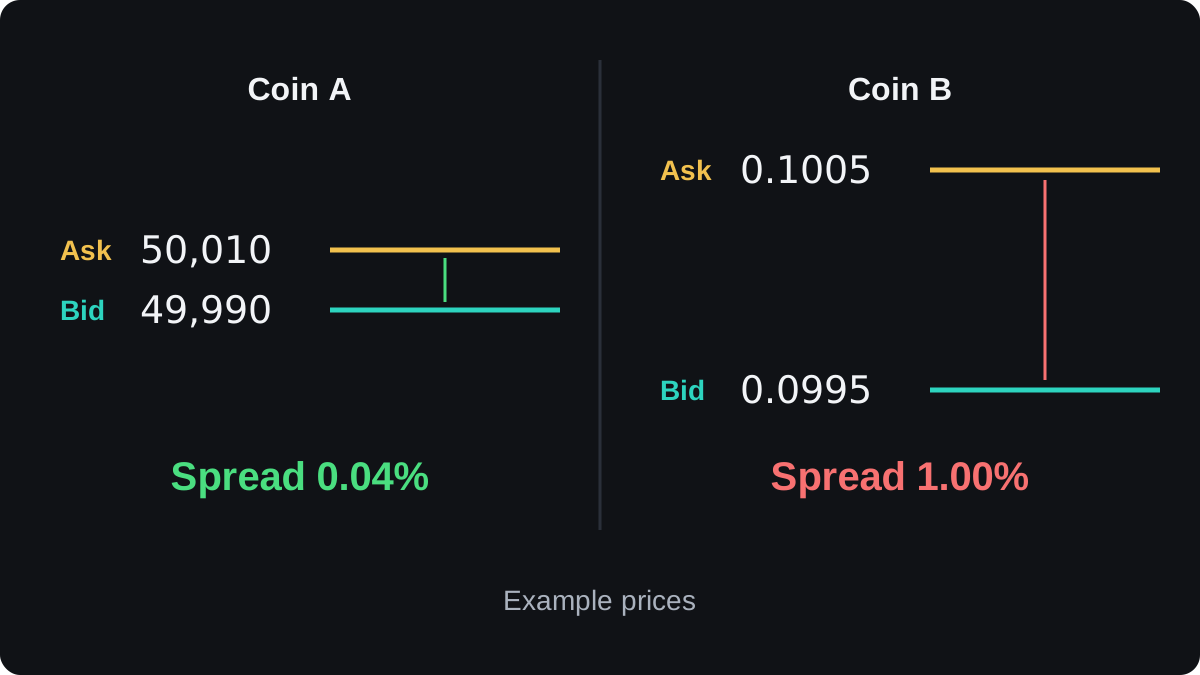
Two coins with round illustrative prices show why. Coin A is a large coin, and coin B is a small one.
| Quote | Coin A | Coin B |
|---|---|---|
| Bid | 49,990 | 0.0995 |
| Ask | 50,010 | 0.1005 |
| Spread | 20 | 0.0010 |
| Mid price | 50,000 | 0.1000 |
| Spread % | 0.04% | 1.00% |
Now buy each one and sell it straight back. What you lose is the spread:
- Buy 0.1 of coin A at the ask: 0.1 × 50,010 = $5,001.
- Sell it at the bid: 0.1 × 49,990 = $4,999. You lose $2, about 0.04% of the money.
- Buy 10,000 of coin B at the ask: 10,000 × 0.1005 = $1,005.
- Sell them at the bid: 10,000 × 0.0995 = $995. You lose $10, about 1% of the money.
The coin B trade was about a fifth of the size, yet it lost five times as many dollars: 1% of the money against 0.04%.
Why a new trade starts in the red
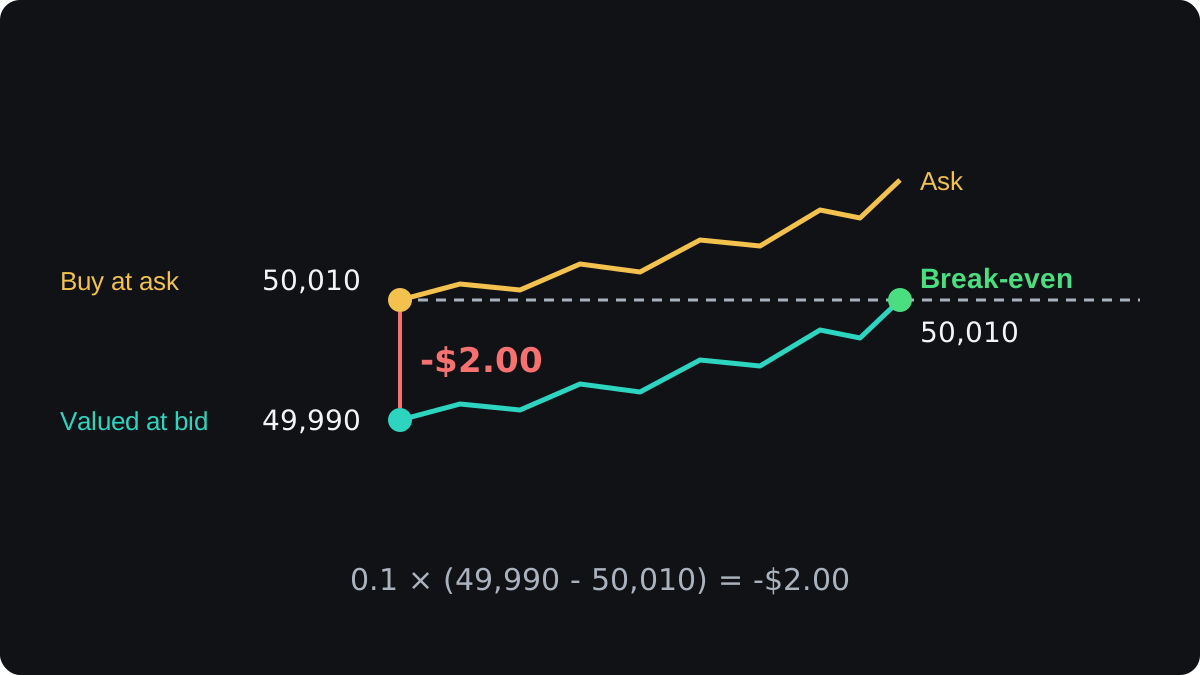
On a CFD platform such as MetaTrader 5, an open buy is valued at the bid, the price it would close at. Coin A bought at 50,010 and valued at 49,990 shows a $2 loss on 0.1 coin at once.
An exchange app may value your coins at a different price, so check which one it uses. A market sell would still get only the bid.
To break even, the bid has to rise to your entry price of 50,010, a move of the full spread.
If you sell first, as you can with a CFD, it works the other way: the ask has to fall below your entry before you are in profit.
When crypto spreads widen
A spread is wide when few orders sit near the price. Small coins and newly listed tokens often have wide spreads all the time, because few traders quote them.
Even a large coin's spread can jump for a while:
- During a sharp move, when traders who post orders on both sides pull them to avoid being caught.
- Around big news, such as a regulator's decision or trouble at a large exchange.
- In quiet hours and at weekends, when fewer traders are active.
- At a CFD broker, around times the broker sets, such as a daily break or a weekend session.
A wide spread usually means thin liquidity: few orders near the price, so even a modest trade can move it.
The spread is one cost among several
On an exchange you also pay a fee on each trade. Its size depends on whether your order waited in the book or filled at once, and maker and taker fees explains the difference.
On a crypto CFD you pay the spread, sometimes a commission, and an overnight swap if you hold past the broker's daily cut-off. Crypto CFD costs adds them up.
If you trade crypto CFDs through an introducing broker, part of the commission the broker pays that partner can be paid back into your trading account as a rebate, and the Exness rebate page lists the instruments it covers.
คำถามที่พบบ่อย
Is the bid or the ask higher in crypto?
The ask is higher. You buy at the ask and sell at the bid, and the gap between them is the spread.
Why did I pay more than the price on the chart?
Exchange charts usually show the last traded price, and price sites often show an average across exchanges. A market buy fills at the ask, which can sit above both.
How do I calculate a crypto spread as a percentage?
Subtract the bid from the ask, divide by the mid price and multiply by 100. A bid of 49,990 and an ask of 50,010 give 20 ÷ 50,000 × 100 = 0.04%.
Why are spreads wider on small coins?
Fewer traders post orders on small coins, so the best bid and the best ask sit further apart. The same thin book means a larger order can also move the price against you.
Do crypto exchanges charge a spread?
On an exchange the spread comes from the gap between users' orders, and the exchange earns a separate fee on each trade. A CFD broker quotes the spread itself.
เรียนต่อ
 บทที่ 1What is liquidity in crypto?Liquidity is how easily you can buy or sell a coin without moving its price. A liquid coin has many orders close to the current price, so the spread is narrow and a large order fills near the quoted price. In a thin market, the same order eats through the book and fills at worse prices.
 บทที่ 1How to read a crypto order book.An order book is the live list of limit orders waiting on an exchange. Sell orders, the asks, sit above the price and buy orders, the bids, sit below it. Each row shows a price and an amount. The gap in the middle is the spread, and the running totals show how far a large order would move the price.
 บทที่ 1What are maker and taker fees?A maker fee applies when your order waits in the order book and someone else fills it later. A taker fee applies when your order fills straight away against an order that was already waiting. Exchanges usually charge takers more, because makers supply the orders that keep spreads narrow.
 บทที่ 1When does the crypto market trade?Crypto coins trade 24 hours a day, seven days a week, on exchanges around the world, with no official open or close. A crypto CFD at a broker follows the broker's own schedule, including any daily break and its weekend rules. You find those hours in the symbol's contract specification.

