What is a dApp?
A dApp, short for decentralized application, is an app whose core rules run as smart contracts on a blockchain instead of on a company's servers. You use it through a website and a crypto wallet that signs each action. No company holds your funds, so contract bugs, fake sites and fees are yours to manage.
เนื้อหานี้ยังมีเฉพาะภาษาอังกฤษ
When you use a banking app, the bank's servers decide what happens to your money. If the bank freezes your account or its servers go down, you wait.
A dApp, short for decentralized application, moves those rules onto a blockchain. Decisions are made by smart contracts that anyone can call and no one can quietly edit.
How a dApp is put together
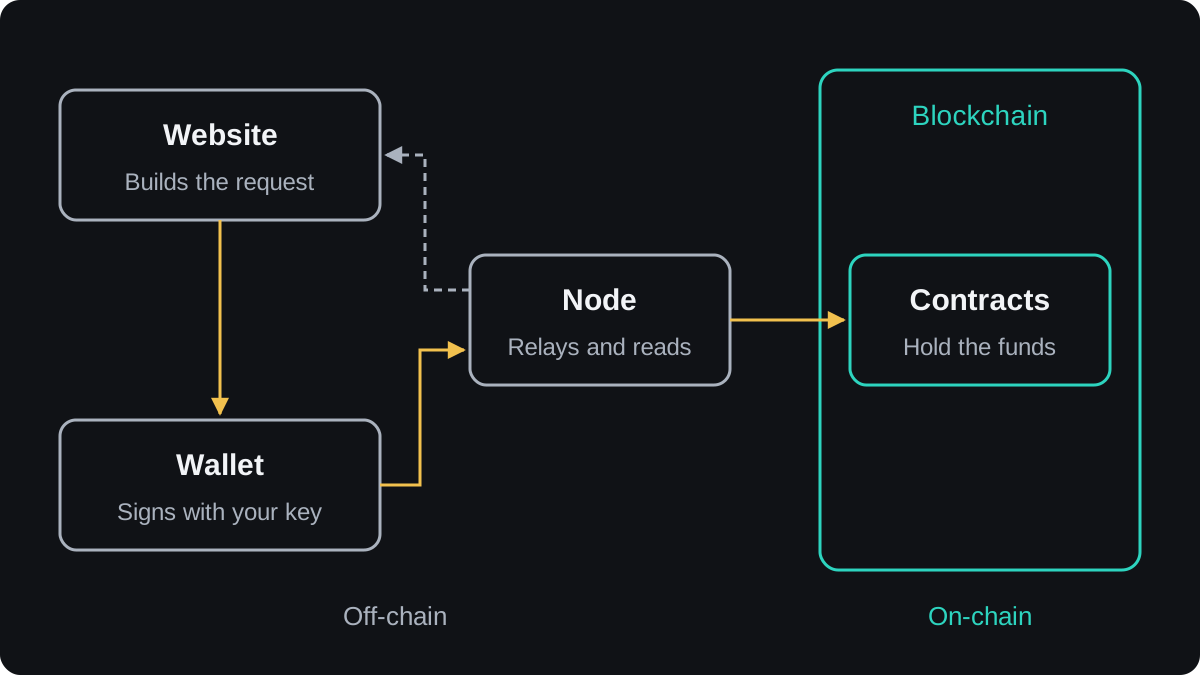
A dApp usually has four pieces, and only one of them lives on the blockchain.
The front end is the website you see. It looks like any web app and usually runs on ordinary servers.
Your crypto wallet holds your keys and signs transactions. Connecting it to a site shares your address, never your keys or your seed phrase. A real dApp never asks you to type your seed phrase.
A node passes your signed transaction to the network and reads data back from the chain. Many apps rent this service from a node provider.
The smart contracts hold the funds and enforce the rules. They are the part that sits on the blockchain.
What happens when you use one
Here is a token swap on a decentralized exchange, step by step:
- You open the app's website and connect your wallet.
- You choose to swap 1 ETH for a dollar stablecoin.
- The site builds the transaction and passes it to your wallet.
- Your wallet shows what you are signing and the estimated network fee.
- You approve, and the wallet signs with your private key and sends it out.
- A validator includes it in a block, the contract runs, and the stablecoins arrive at your address.
- The site reads your new balance from the chain.
The website never holds your funds. If you close the tab before signing, nothing happens.
What a dApp costs: a worked example
Two costs usually apply. The app's contract may charge a fee, and the network charges gas for every action.
Take an illustrative exchange pool that charges 0.3%, and a swap that uses 150,000 gas at a gas price of 20 gwei:
- App fee on 1 ETH: 1 × 0.3% = 0.003 ETH.
- Network fee: 150,000 × 20 = 3,000,000 gwei, which is 0.003 ETH.
- Total: 0.006 ETH, or 0.6% of the trade.
Now swap 0.1 ETH instead:
- App fee: 0.1 × 0.3% = 0.0003 ETH.
- Network fee: still 0.003 ETH, because gas does not grow with the amount.
- Total: 0.0033 ETH, or 3.3% of the trade.
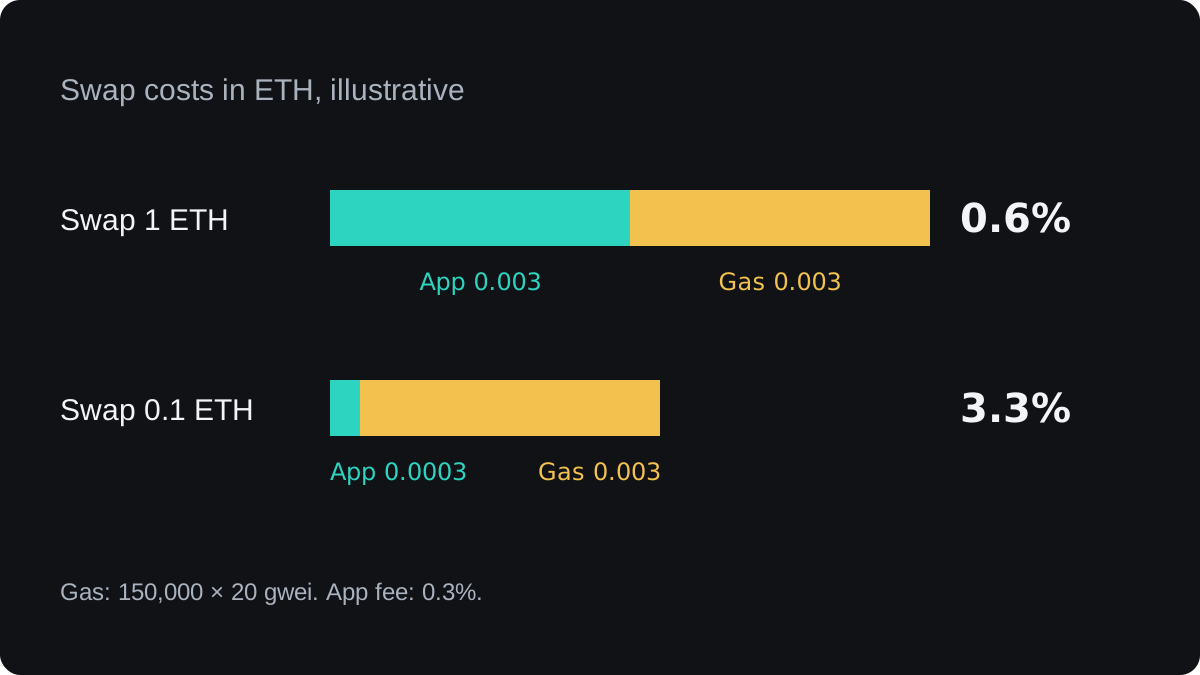
On small amounts, gas can cost far more than the app's own fee. That is one reason people use layer 2 networks, where gas costs much less.
The price can also move between signing and the block, the same slippage forex traders meet. Swap screens let you set the most slippage you will accept.
Common kinds of dApp
- Decentralized exchanges, where you trade tokens straight from your wallet, often against a pool run by an automated market maker.
- Lending markets, where you deposit tokens to earn interest or borrow against them.
- NFT marketplaces, where contracts record who owns each token.
- Games and prediction markets that keep their rules and payouts on-chain.
The finance apps on this list are known together as DeFi. How a decentralized exchange compares with a company-run one is covered in centralized vs decentralized exchanges.
How decentralized is a dApp, really?
Only the contracts live on the blockchain. The website can be taken offline or blocked in a country, and attackers have hijacked real dApp sites to serve fake pages.
Many contracts also have admin keys that let a team pause or upgrade them. That makes fixes possible, and it means a small group still holds real power.
If a dApp's website disappears but its contracts remain, your funds are normally still there. You can reach the contracts through another interface, though it takes more skill.
Risks before you connect a wallet
Fake copies of popular dApps are common. A look-alike website can ask you to sign an approval that later drains a token from your wallet, a pattern covered in how to spot a crypto scam.
Contract bugs are the second big risk. Audits reduce it, and audited contracts have still been drained.
There is no help desk. Nobody can reverse a transaction you signed, so a wrong address or a bad approval is your loss.
The tokens themselves carry risk too. A token you swap into can lose value fast or find no buyers at all.
คำถามที่พบบ่อย
Is a dApp the same as a crypto exchange?
Some are exchanges. A centralized exchange is a company that holds your funds, while a decentralized exchange is a dApp where you trade from your own wallet through smart contracts.
Do I need a wallet to use a dApp?
In almost every case, yes. You need a self-custody wallet that can sign transactions on that blockchain, plus a little of its native coin to pay gas.
Are dApps safe?
They remove some risks, such as a company losing your money, and add others: contract bugs, fake websites and approvals you did not mean to give. Treat every signature like a payment.
Can a dApp be shut down?
Its website can, and an admin key may be able to pause its contracts. A contract with no such controls keeps running for as long as its blockchain does.
เรียนต่อ
 บทที่ 3What is Ethereum?Ethereum is a public blockchain that records balances and also runs programs called smart contracts. Anyone can use it or build on it without asking permission. Its own currency, ether (ETH), pays the fee for every action. Since 2022 the network has been secured by proof of stake instead of mining.
 บทที่ 3What is a smart contract?A smart contract is a program stored on a blockchain such as Ethereum. It holds funds and follows fixed rules: when someone calls it and the conditions are met, it acts automatically, with no company in the middle. It cannot see outside data on its own, and a bug can lose money for good.
 บทที่ 3What is ether, and why does it have value?Ether (ETH) is the native currency of the Ethereum network. Every transaction pays its fee in ether, and validators lock it up as a deposit to secure the network. Its value comes from that demand meeting a supply with no fixed cap, which grows through new issuance and shrinks when fees are burned. Nothing guarantees its price.
 บทที่ 3What moves the price of ether?Ether's price moves when the balance between buyers and sellers shifts. Most days the biggest driver is the crypto market as a whole, led by bitcoin, which in turn reacts to interest rates and risk appetite. Ether's own supply, use of the network, fund flows and forced selling by leveraged traders add moves on top.

