Gold and the US dollar.
Gold is priced in US dollars, so a weaker dollar tends to raise the gold price and a stronger dollar tends to lower it. US real interest rates often push gold and the dollar in opposite directions too. The link often breaks: in a crisis both can rise together, and heavy gold buying can lift gold in every currency.
เนื้อหานี้ยังมีเฉพาะภาษาอังกฤษ
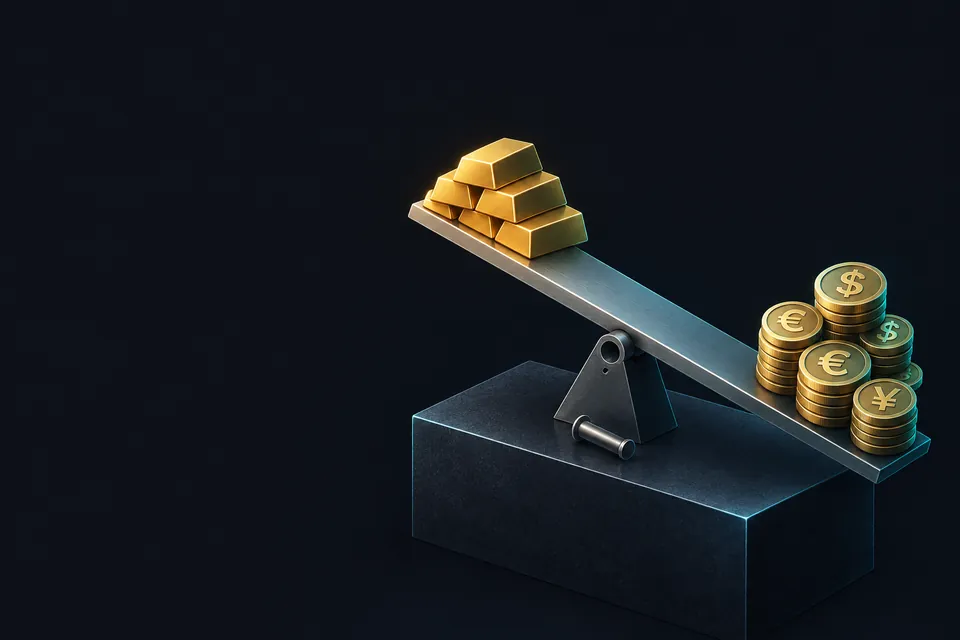
Most trading platforms show gold as XAU/USD, a price in US dollars. That ties gold to the dollar. When the dollar loses value, an ounce of gold tends to cost more dollars, and when the dollar gains, it tends to cost fewer.
The pattern is common but loose. This lesson explains why the two usually move in opposite directions and when they do not.
Why is gold quoted in dollars?
XAU is the currency code for one troy ounce of gold. XAU/USD reads like any currency pair: gold is the base, the dollar is the quote, and the price says how many dollars buy one ounce.
Gold belongs to no single country. Its main international benchmark prices are set in US dollars, so the dollar became its default unit of account.
Think of the dollar as the ruler you measure gold with. If the ruler changes length, the reading changes, even when the thing being measured has not.
How a weaker dollar lifts the gold price
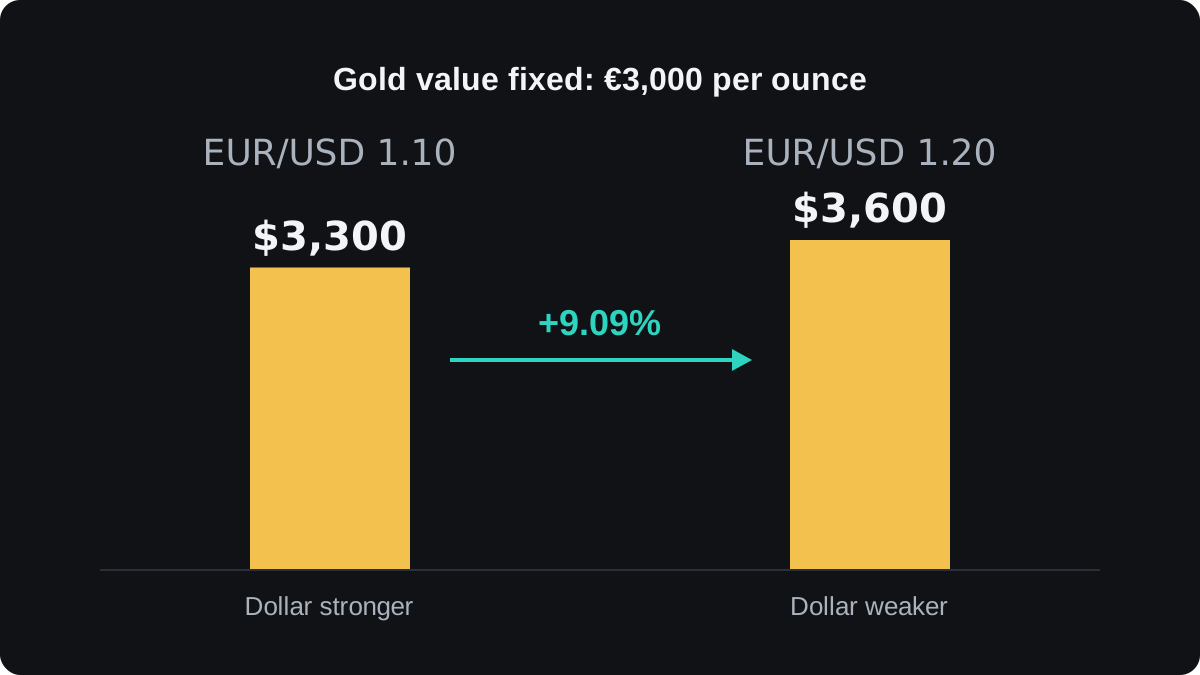
Here is the ruler effect with round illustrative numbers. Suppose buyers in Europe value an ounce at €3,000, and that value stays fixed while only the dollar moves.
- EUR/USD is 1.10, so one euro costs $1.10. The ounce costs 3,000 × 1.10 = $3,300.
- The dollar weakens and EUR/USD rises to 1.20. The same ounce now costs 3,000 × 1.20 = $3,600.
- In dollars, gold is up $300, which is 300 ÷ 3,300 = 9.09%.
- In euros, it has not moved at all.
EUR/USD itself rose 0.10 ÷ 1.10 = 9.09%, the same amount. The whole dollar gain in gold came from the weaker dollar.
The effect also runs through demand. A stronger dollar makes gold dearer for anyone paying in other currencies, which can cool buying and pull the dollar price down. A weaker dollar does the reverse.
Real markets are never this tidy, because demand for gold itself changes every day. The example isolates the part of a move that comes from the dollar alone.
Interest rates and the cost of holding gold
Gold pays no interest. A US government bond or a dollar deposit does, so holding gold means giving up that income.
Say you hold $3,300 of gold instead of a one-year bond paying 4%. You forgo 3,300 × 0.04 = $132 a year. These rates are illustrative.
Inflation eats into the bond's income, so the more useful measure is the real interest rate, the yield minus expected inflation. With a 4% yield and 2.5% expected inflation, the real yield is 1.5%, or 3,300 × 0.015 = $49.50 a year.
When US real yields rise, dollar assets pay more after inflation, which tends to support the dollar. The same rise makes gold more costly to hold.
Because one cause pushes the two in opposite directions, the inverse pattern shows up often. The bond yields lesson covers the dollar side of this.
This is a tendency, and it has failed for long stretches. There have been periods when gold rose while US real yields were also rising, usually explained by strong buying from central banks or by fear in markets.
When gold and the dollar move together
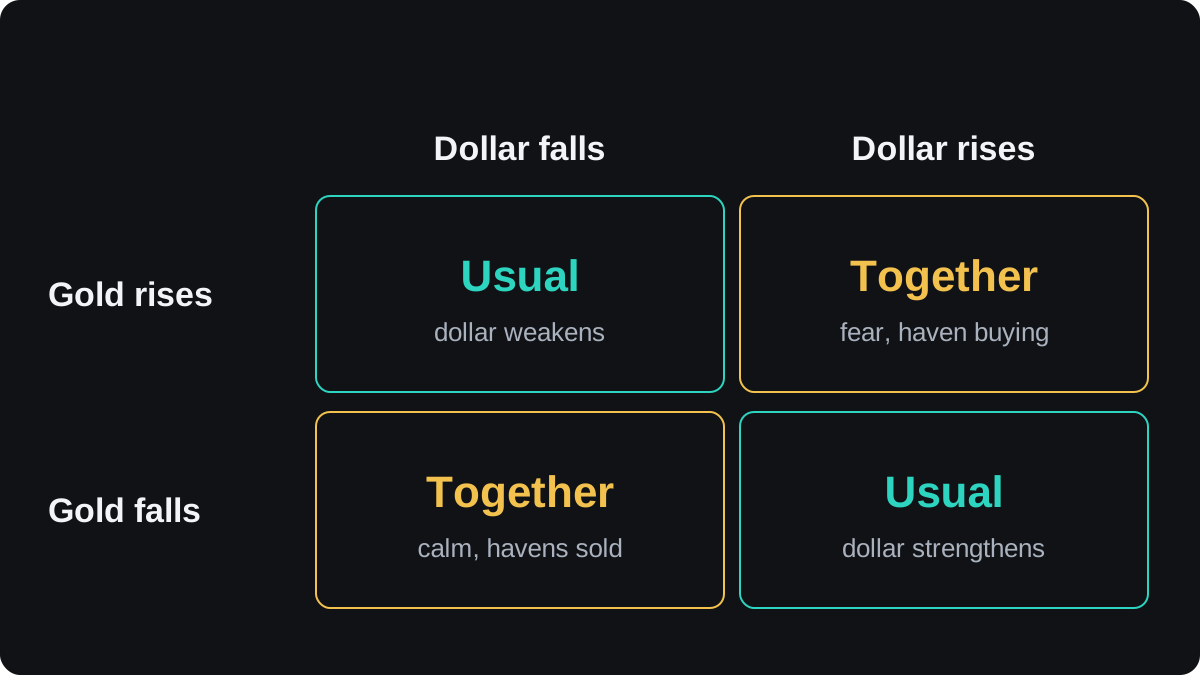
Gold and the dollar are both treated as safe havens, places money goes when investors are nervous. In a sharp crisis, buyers can rush into both at once, and the two rise together.
The calm version can happen too. When investors feel confident, money may leave both havens for stocks or higher-yielding currencies, and gold and the dollar can fall together. The risk-on and risk-off lesson explains these swings.
So the usual pattern covers two of the four possible combinations, and the other two tend to appear in moments of fear or of calm.
Demand that has nothing to do with the dollar can also break the pattern. Heavy buying by central banks or investors can lift gold in every currency at once, even while the dollar is gaining.
The opposite surprise exists as well. In a sudden panic, some investors sell gold to raise cash or cover losses elsewhere, so gold can drop at the very moment fear is high.
How to check the link yourself
Correlation measures how closely two prices move together, on a scale from +1 (moving in perfect step) to −1 (moving in perfect opposition). The currency correlation lesson shows how it is worked out.
Gold against the US dollar index has often shown a negative reading over long windows. The number changes with the period you choose, and it can turn positive for months. The correlation matrix shows current readings for the instruments it covers.
You can also strip out the dollar. Divide gold's dollar price by EUR/USD to get its price in euros, or use XAU/EUR if your broker lists it.
Suppose gold rises from $3,300 to $3,600 while EUR/USD rises from 1.10 to 1.15. The numbers are illustrative.
- Start in euros: 3,300 ÷ 1.10 = €3,000.
- End in euros: 3,600 ÷ 1.15 = €3,130.43.
- Gold gained 9.09% in dollars but only 130.43 ÷ 3,000 = 4.35% in euros.
The euro figure is the gain left after removing the dollar's move against the euro. Over the same period the euro rose 0.05 ÷ 1.10 = 4.55% against the dollar.
The two gains multiply rather than add. 1.0435 × 1.0455 is about 1.091, which matches the 9.09% rise in dollars, while 4.35% plus 4.55% would wrongly give 8.90%.
What the link means for your positions
Because gold is priced in dollars, a gold trade is partly a dollar trade. Holding it next to other dollar positions can stack your exposure without you noticing.
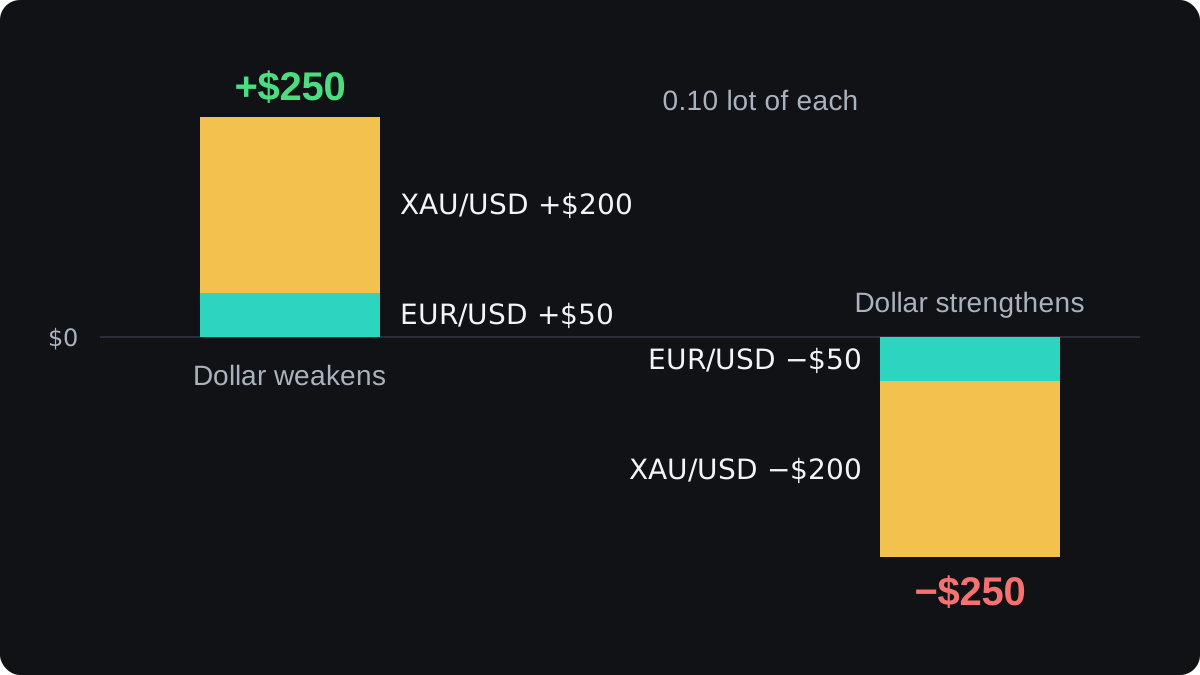
Say you buy 0.10 lot of EUR/USD and 0.10 lot of XAU/USD. Prices are illustrative, and gold contract sizes vary, so check your broker's specification. Here one lot of gold is 100 ounces.
- EUR/USD: 0.10 lot is 10,000 euros, so one pip (0.0001) is worth 10,000 × 0.0001 = $1.
- XAU/USD: 0.10 lot is 10 ounces. With the 0.01 gold pip this site uses, one pip is worth 10 × 0.01 = $0.10, so a $1 move is worth $10.
- The dollar weakens. EUR/USD rises 50 pips, worth 50 × $1 = $50, and over the same period gold rises $20 an ounce, worth 20 × $10 = $200.
- Together that is a gain of $250.
- If the dollar strengthens by the same amounts instead, both trades lose, for a loss of $250.
The two positions look separate, yet both are partly bets against the dollar, so one dollar move hits both in the same direction.
The pip value calculator works out these values for other sizes. The correlation and portfolio risk lesson shows how to count overlapping positions as one larger risk.
คำถามที่พบบ่อย
Why does gold go up when the dollar goes down?
Gold is priced in dollars, so a weaker dollar means more dollars are needed for the same ounce. Lower US real interest rates, which often weaken the dollar, also make gold cheaper to hold.
Does gold always move opposite to the US dollar?
No. In a crisis both can rise as safe havens, and strong gold demand can lift gold even while the dollar gains. In calm markets both can also fall.
What does XAU/USD mean?
XAU is the code for one troy ounce of gold and USD is the US dollar. The price is the number of dollars needed to buy one ounce.
Is gold a hedge against a falling dollar?
It has often risen when the dollar fell, but the link can break for long stretches. Treat it as a tendency and check the correlation over the period you care about.
เรียนต่อ
 บทที่ 2Bond yields and currencies.A bond yield is the return a government bond pays at its current price. The yield spread is one country's yield minus another's. When the spread moves in a currency's favour, that currency often strengthens, sometimes after a delay. The link is common but unreliable, and it can break in panics and debt scares.
 บทที่ 2Commodity currencies.Commodity currencies belong to countries whose exports lean on raw materials: the Australian dollar with iron ore and coal, the Canadian dollar and Norwegian krone with oil, and the New Zealand dollar with dairy. Higher export prices tend to lift these currencies, but the link is loose and changes strength over time.

