A crypto trade from plan to exit.
This example follows one bitcoin trade with round illustrative numbers. A $10,000 account risks 1%, so $100. Entry is $60,000, the stop $57,500 and the target $65,000, which gives a size of 0.04 BTC. The target is hit, and after $5 of fees the result is $195, or 1.95 times the amount risked.
Nội dung này hiện chỉ có bản tiếng Anh.

This lesson follows one trade from the first look at the chart to the note written after it closes. Every price is a round number chosen to make the arithmetic easy to follow.
It is an illustration only. Nothing here recommends buying bitcoin or any other coin, and the prices are not current. The trade happens on a spot exchange with an illustrative trading fee of 0.1% on each order.
The setup and the plan
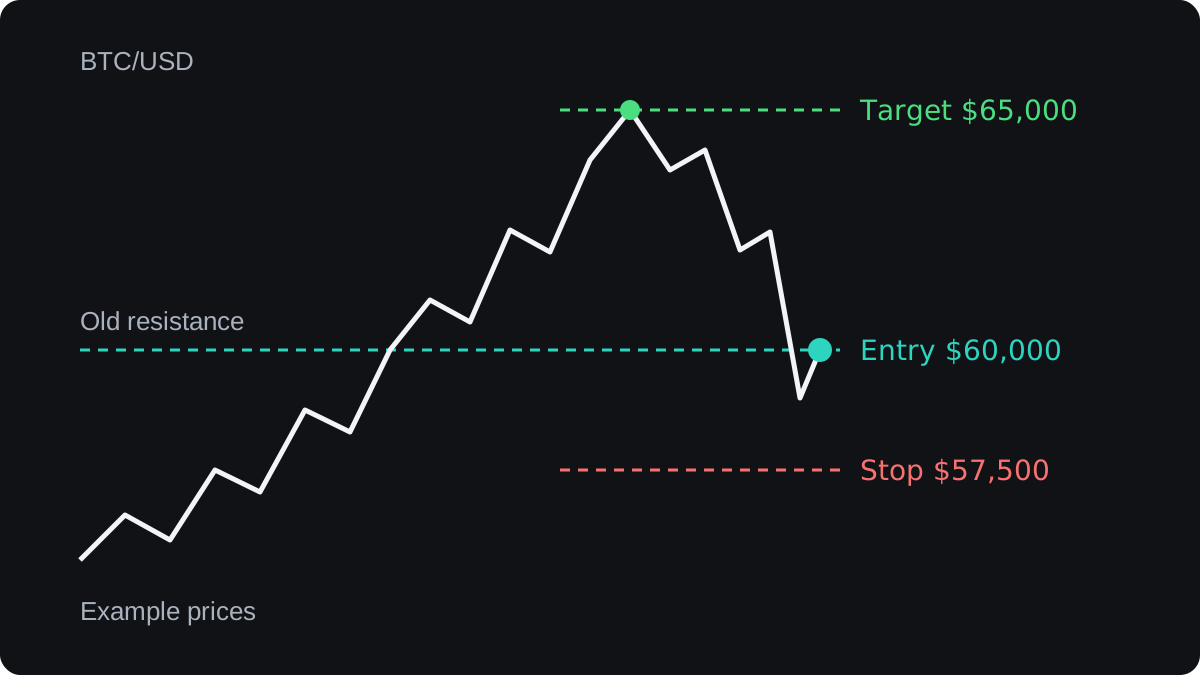
The daily chart of BTC/USD has made higher highs and higher lows for several weeks. Price broke above $60,000, climbed to $65,000, and has now pulled back to around $60,000.
The written plan says: in an uptrend, buy a pullback to old resistance once a 4-hour candle closes back above it. The lesson on how support and resistance swap roles explains the idea behind this setup.
A 4-hour candle closes back above the level, with price still close to it. The plan sets three prices before any order goes in:
- Entry: $60,000, with a limit order at the level.
- Stop loss: $57,500, below the low of the pullback.
- Target: $65,000, the recent high.
That puts the stop $2,500 below the entry and the target $5,000 above it, so the target is twice the risk.
Working out the position size
The account holds $10,000 and the plan risks 1% per trade. The size comes from the risk and the stop distance:
- Risk: 1% of $10,000 = $100.
- Size: $100 ÷ $2,500 per coin = 0.04 BTC.
- Position value: 0.04 × $60,000 = $2,400.
- At the stop: 0.04 × $2,500 = $100 lost. At the target: 0.04 × $5,000 = $200 gained.
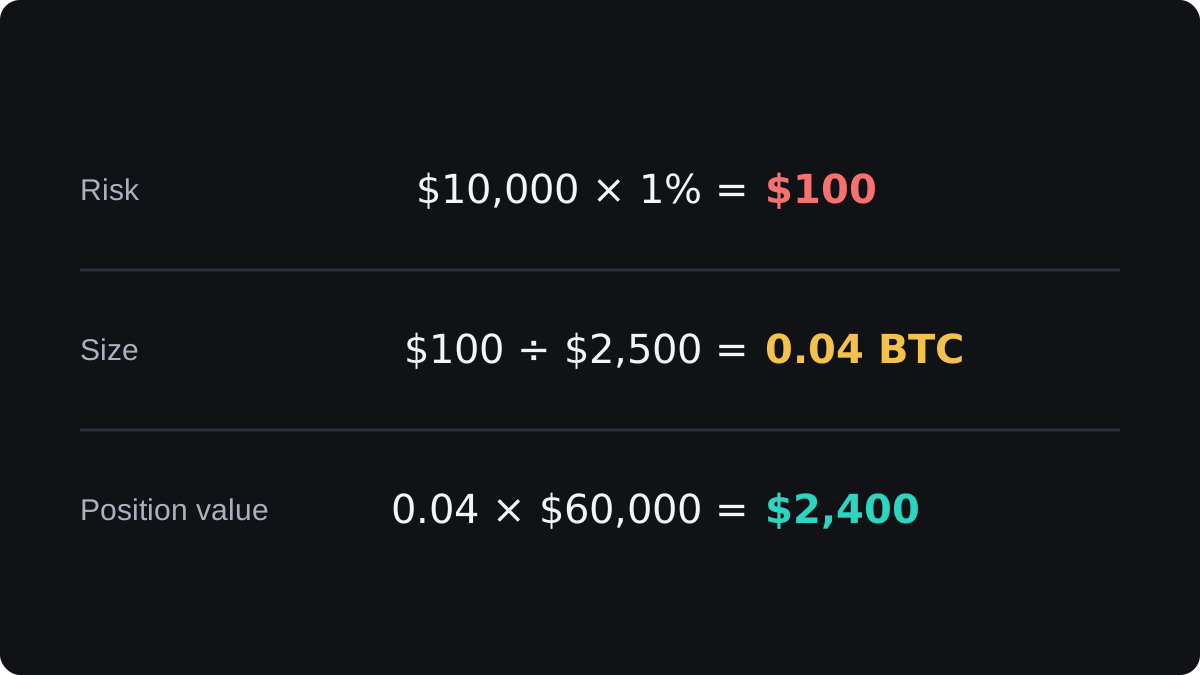
The position is worth $2,400, about a quarter of the account, yet the planned loss is only $100. The lesson on position sizing for crypto works through more cases.
On a CFD the steps are the same, but the broker sets the size in its own contract units. Check how many coins one unit or lot represents in its contract specification before you convert.
Placing the orders
Place the exits at the same time as the entry. Crypto trades all night, and the plan should not depend on you watching the screen at 3 a.m.
You buy 0.04 BTC at $60,000. The fee is 0.1% of $2,400, which is $2.40.
You then place both exits as one one-cancels-the-other (OCO) order: a stop at $57,500 and a limit sell at $65,000. When one fills, the exchange cancels the other.
Check whether your exchange offers OCO orders. Without one, the first sell order usually reserves the coins, so a second sell order on the same coins is refused.
Depending on the exchange and how you set it up, the stop part of an OCO can be a plain stop or a stop-limit order, so check which one you are placing.
A plain stop order turns into a market order at $57,500 and can fill lower in a sharp fall. A stop-limit order avoids a bad fill but may not fill at all if price gaps past its limit price.
Many exchanges charge a lower fee on a resting limit order than on a market order. This example uses 0.1% for both to keep the sums simple, and the lesson on maker and taker fees explains the difference.
While the trade is open
Two days later, price dips to $58,500. The position shows a floating loss of 0.04 × $1,500 = $60.
The stop is still $1,000 lower, and nothing in the plan says to act. Moving the stop down here would turn a $100 risk into a larger one that you never chose.
The lesson on sticking to your plan covers this moment.
Over the weekend, price climbs again. Exchanges trade on Saturdays and Sundays, so the OCO order stays live. With a CFD, check whether your broker quotes crypto at weekends, as the lesson on trading crypto at weekends explains.
The exit and the result
On day six, price reaches $65,000 and the limit order sells 0.04 BTC.
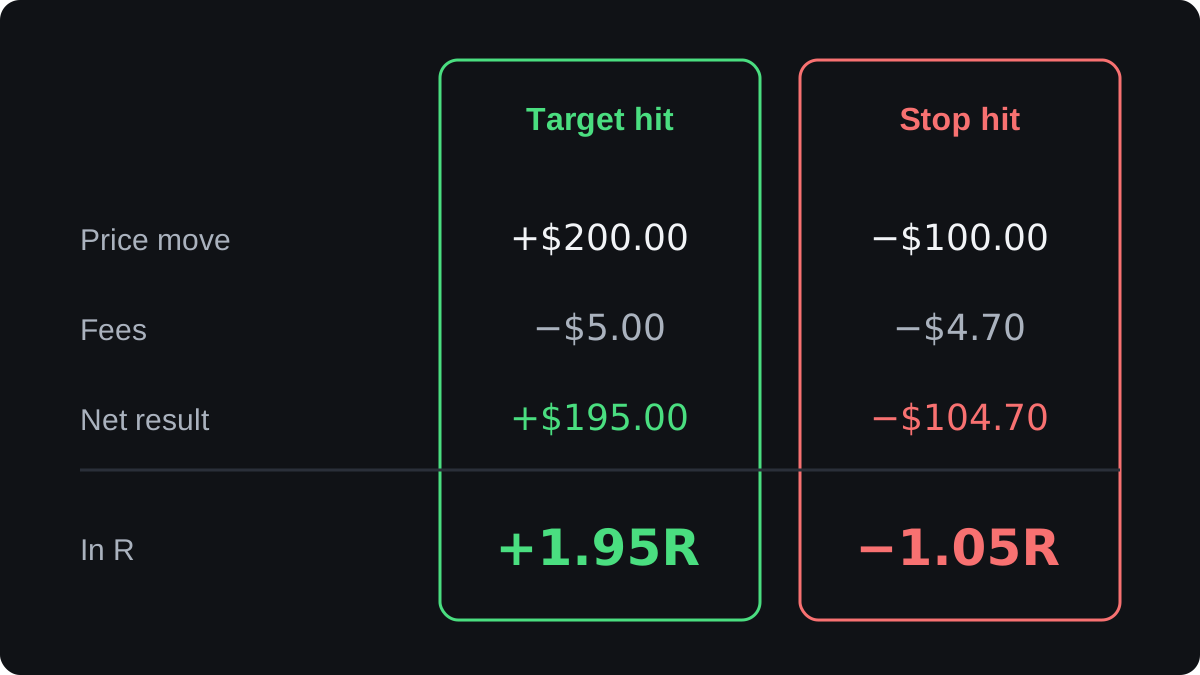
- Gross gain: 0.04 × ($65,000 minus $60,000) = $200.
- Entry fee: 0.1% of $2,400 = $2.40.
- Exit fee: 0.1% of 0.04 × $65,000, which is 0.1% of $2,600 = $2.60.
- Net result: $200 minus $2.40 minus $2.60 = $195.
- In R, the multiple of planned risk: $195 ÷ $100 = 1.95R.
Had the stop filled at $57,500 instead, the loss would have been $100 plus fees of $2.40 and $2.30. That is $104.70, about −1.05R.
What one trade can and cannot show
One winning trade says almost nothing about the strategy. The next three trades could all hit their stops, and that would say little too.
Only a long record of trades taken under the same rules gives evidence of an edge, and even that record describes the past.
What this trade does show is the process. Every number was set before the entry, and none changed while the trade was open, even during the dip to $58,500.
Write the trade up while you still remember it: the setup, the numbers, each fee, and how you felt during the dip. The lesson on keeping a crypto trading journal lists the fields.
Câu hỏi thường gặp
How do you calculate position size for a crypto trade?
Divide the money you will risk by the distance from entry to stop loss. Risking $100 with a $2,500 stop distance gives $100 ÷ $2,500 = 0.04 BTC.
Where should the stop loss go on a crypto trade?
Put it at a price that shows your trade idea was wrong, such as below the low of a pullback. Then size the position so that a stop at that price costs your planned amount.
Should I move my stop loss when price comes close to it?
Moving the stop further away raises the loss you agreed to before entry. If you want rules for moving a stop closer as a trade gains, write them into the plan before you trade.
Do fees matter on a single crypto trade?
In this example they took $5 from a $200 gain, which is 2.5%. On smaller targets, or across hundreds of trades, that share grows.
Học tiếp
 Chương 2How to start trading crypto.To start trading crypto, first decide whether you want to own coins on an exchange or trade the price through a broker's CFDs. Then secure the account with 2FA, learn what each trade costs, practise on a demo or with tiny sizes, and set a fixed risk per trade before you choose a coin.
 Chương 2Crypto trading principles that hold up.The crypto trading principles that hold up rest on arithmetic and behaviour, so they apply to any coin. Risk a small fixed share of the account on each trade, let the stop decide the size, expect fills worse than your stop, size the trade before leverage, count every fee, and keep your money safe outside the trade.
 Chương 2How to build a crypto trading strategy.To build a crypto trading strategy, choose one market, instrument and timeframe, then pick one idea you can explain, such as following trends. Write exact rules for the filter, entry, stop, target and size, so every number comes from the rules. Test them on past prices with fees included, then forward test before risking real money.
 Chương 2How to keep a crypto trading journal.Keep a crypto trading journal by writing the plan before each trade: venue, pair, setup, entry, stop, target, size in coins and risk in money. After the exit, record each fee as charged, the net result and R, and whether you followed the plan. Log deposits, withdrawals and wallet moves in a separate transfer log.

