How to keep a crypto trading journal.
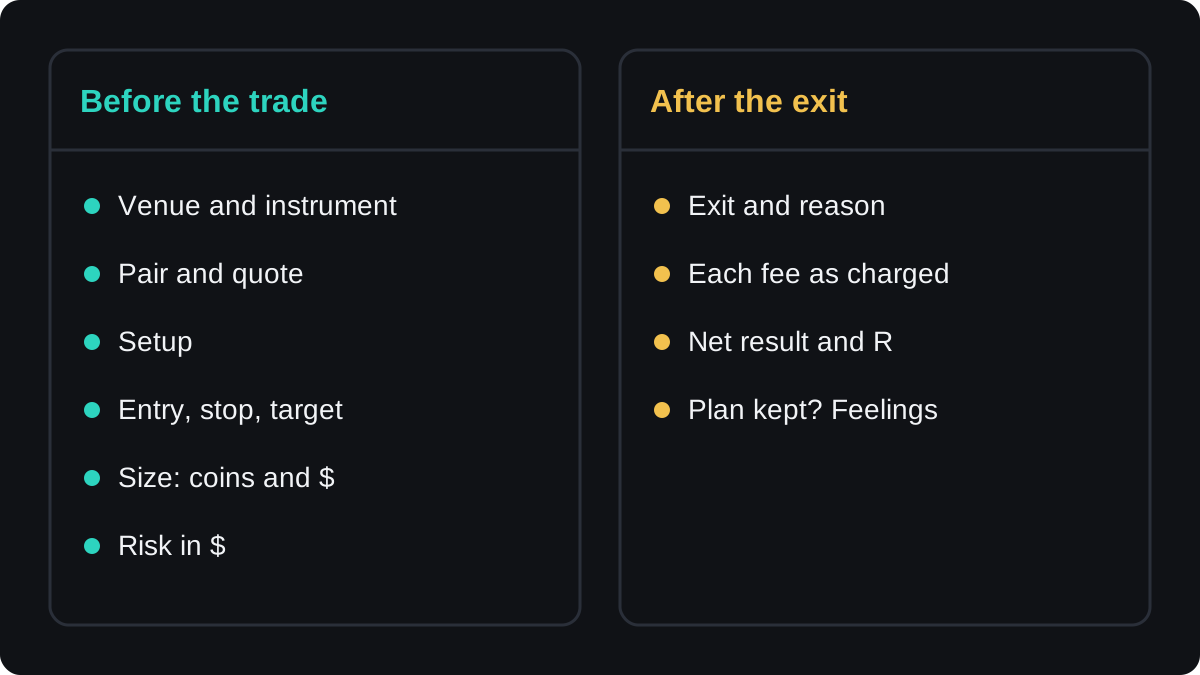
Keep a crypto trading journal by writing the plan before each trade: venue, pair, setup, entry, stop, target, size in coins and risk in money. After the exit, record each fee as charged, the net result and R, and whether you followed the plan. Log deposits, withdrawals and wallet moves in a separate transfer log.
Nội dung này hiện chỉ có bản tiếng Anh.

Say you close an ETH trade that the chart shows as a $100 profit. Your balance rises by only $96.90. The missing $3.10 went on two trading fees, and a journal is where that becomes visible.
A crypto trading journal is a record of each trade: the plan, the numbers, every fee and your own notes. The forex lessons on why to keep a journal and what to record cover the general method.
This lesson adds the fields crypto needs and works through one entry. All prices and fees are round figures for illustration.
What a crypto journal needs on top of the usual fields
Crypto trading has a few habits of its own, and each one needs a field:
- Venue and instrument: which exchange or broker, and whether you traded the coin or a CFD. Prices differ slightly from venue to venue.
- Pair and quote: ETH/USD and ETH/USDT are different markets. A stablecoin quote adds the small risk that it drifts from one dollar.
- Size in coins and in money: 0.5 ETH and $1,500, because fees and transfers are often charged in coins.
- Fees as charged: some exchanges take the fee in the coin you receive, others in the quote currency.
- Time in UTC: the market never closes, so one fixed time zone keeps trades in the right order. Note whether a trade was open over a weekend.
Before you enter: write the plan
Fill in the first half before you place the order. A reason written afterwards tends to drift toward whatever the market did.
Take the example from the lesson on building a crypto trading strategy. The account holds $6,000 and risks 1% per trade. A 4-hour candle on ETH/USD closes above its 20-candle high, with the daily close above the 50-day average.
The plan section of the entry reads:
- Venue: a spot exchange, fee 0.1% per order, charged in USD.
- Entry $3,000, stop $2,880, target $3,240.
- Size: 0.5 ETH, a position of $1,500.
- Risk: 0.5 × $120 = $60, which is 1% of the account.
After you exit: every fee on its own line
The trade rose to $3,200 and stalled late on a Friday. You sold by hand at $3,200 rather than hold over the weekend. The numbers:
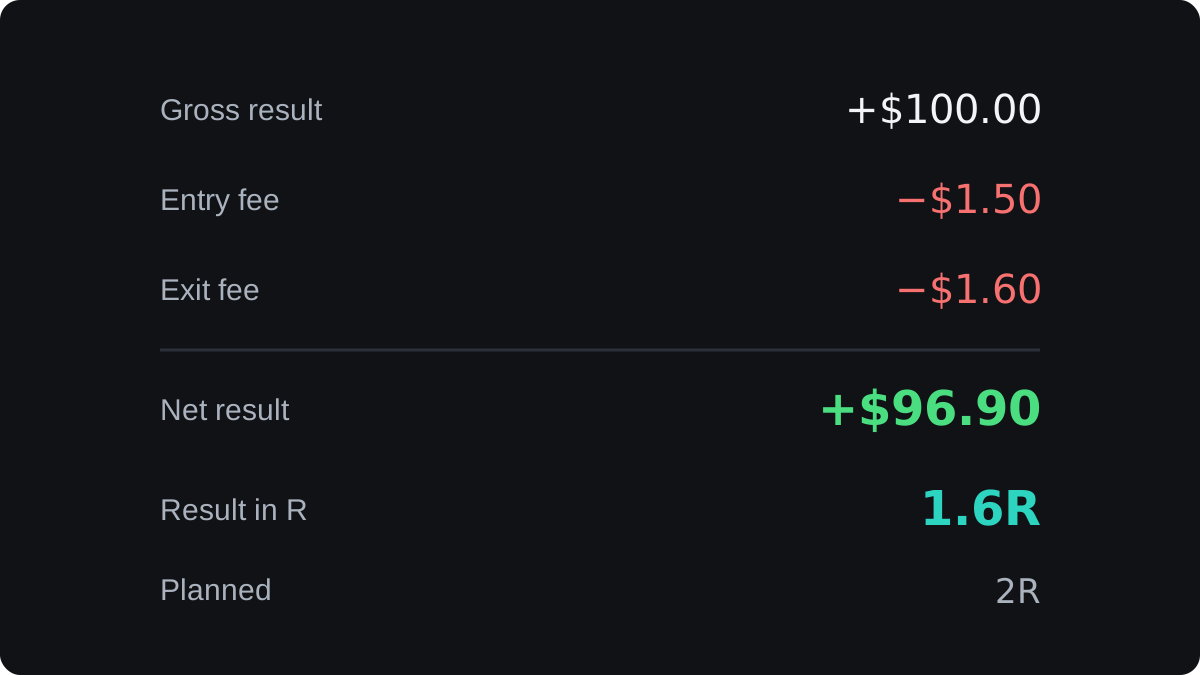
- Gross result: 0.5 × ($3,200 minus $3,000) = $100.00.
- Entry fee: 0.1% of $1,500 = $1.50.
- Exit fee: 0.1% of 0.5 × $3,200, which is 0.1% of $1,600 = $1.60.
- Net result: $100.00 minus $1.50 minus $1.60 = $96.90.
- In R, the multiple of planned risk: $96.90 ÷ $60 = 1.615, about 1.6R against the 2R planned.
If the exchange takes its fee in the coin you buy, you receive 0.4995 ETH instead of 0.5, because 0.1% of 0.5 is 0.0005. Record the amount that actually arrived, since that is what you can sell.
On a CFD the cost lines are different: the spread, any commission and a swap for each night held. Copy them from the account history rather than estimating them. The lesson on crypto CFD costs explains each one.
Notes on how you traded
Add a yes or no: did you follow the plan? Here the entry followed it and the exit did not.
A short note might read: 'Sold by hand at $3,200 on Friday evening to avoid holding over the weekend, though the plan said to hold to $3,240 or the stop.'
Give the note a tag, such as 'early exit', so you can count it later. Crypto adds tags worth tracking, such as trades opened late at night and trades taken after a social media post.
Keep transfers in a separate log
Deposits, withdrawals and moves between your own wallets change your balances without being trades. Many of them carry a network fee.
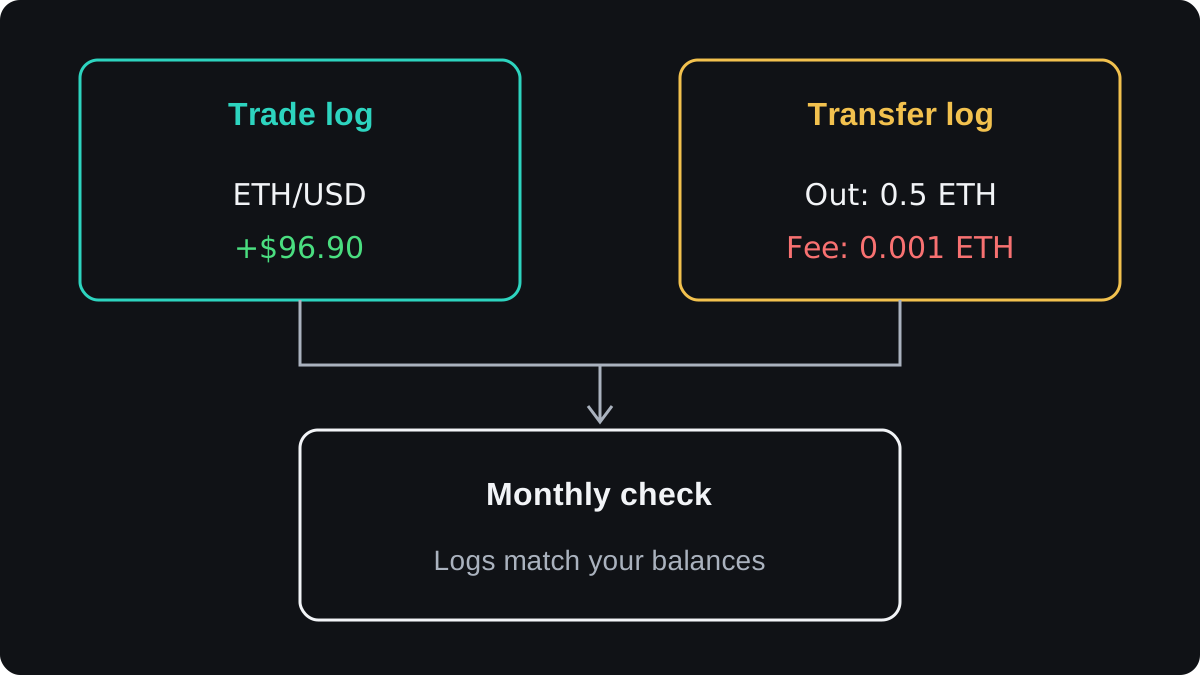
Log each one on its own sheet: date, from, to, coin, amount, fee and the transaction ID. For example, withdrawing 0.5 ETH with an illustrative network fee of 0.001 ETH lands 0.499 ETH in your wallet.
Once a month, check both logs against the balances your exchange and wallets show. A gap means something is missing from one of the logs.
In many countries, selling or swapping crypto can count as a taxable event. Complete logs make the paperwork easier, so check the rules where you live.
Reviewing the journal each week
Once a week, sort the trades by tag and add up the result in R for each tag. The lesson on reviewing your trades gives the full method.
Say three of ten trades carry the 'early exit' tag. Check on the chart what each of those trades would have done under the plan.
If holding would have done better, add a rule, such as placing the target order at entry and leaving it alone.
Câu hỏi thường gặp
What should a crypto trading journal include?
Before the trade, write the venue, the pair and the plan with entry, stop, target and size. After the exit, add each fee as charged, the net result in money and in R, and whether you followed the plan.
Is a spreadsheet enough for a crypto trading journal?
Yes. One row per trade and a second sheet for transfers cover every field in this lesson. Exchange exports can fill in prices and fees, but you still write the reasons yourself.
Why does my profit not match the price move?
Fees, the spread and overnight charges come out of each trade, and some exchanges take fees in the coin you bought. A journal with each cost on its own line shows where the difference went.
Should I record my trades in UTC?
It helps, because crypto trades around the clock and some exchanges export trade history in UTC. One time zone everywhere keeps trades and transfers in the right order.
Học tiếp
 Chương 2How to start trading crypto.To start trading crypto, first decide whether you want to own coins on an exchange or trade the price through a broker's CFDs. Then secure the account with 2FA, learn what each trade costs, practise on a demo or with tiny sizes, and set a fixed risk per trade before you choose a coin.
 Chương 2Crypto trading principles that hold up.The crypto trading principles that hold up rest on arithmetic and behaviour, so they apply to any coin. Risk a small fixed share of the account on each trade, let the stop decide the size, expect fills worse than your stop, size the trade before leverage, count every fee, and keep your money safe outside the trade.
 Chương 2How to build a crypto trading strategy.To build a crypto trading strategy, choose one market, instrument and timeframe, then pick one idea you can explain, such as following trends. Write exact rules for the filter, entry, stop, target and size, so every number comes from the rules. Test them on past prices with fees included, then forward test before risking real money.
 Chương 2A crypto trade from plan to exit.This example follows one bitcoin trade with round illustrative numbers. A $10,000 account risks 1%, so $100. Entry is $60,000, the stop $57,500 and the target $65,000, which gives a size of 0.04 BTC. The target is hit, and after $5 of fees the result is $195, or 1.95 times the amount risked.

