What is a distributed ledger?
A distributed ledger is a record of who owns what that many independent computers keep in full, with no master copy. Each new entry is checked by the participants and added to every copy in the same agreed order. A blockchain is the best known kind of distributed ledger, and other designs exist too.
Nội dung này hiện chỉ có bản tiếng Anh.

Picture a sports club whose money is tracked in one notebook kept by the treasurer. If the treasurer makes an error, or quietly changes a line, the other members have no easy way to notice.
Now give every member an identical copy, and agree that a new line only counts once the members have checked it. Nobody can edit the record alone anymore. Run that arrangement on computers and you have a distributed ledger.
What a ledger records
A ledger is a list of entries showing who owns what and how that changed. Your bank statement is a view of your bank's ledger: a starting balance, then each payment in and out, in order.
Balances can always be worked out from the entries. If an account starts with 100, receives 40 and pays out 25, its balance is 100 plus 40 minus 25, which is 115.
Crypto ledgers work the same way. They record transfers, and your balance is whatever those transfers left you.
Central ledger or distributed ledger
In a central ledger, one party holds the master copy. A bank, a payment app or a share registry decides what goes in, and everyone else trusts its version.
In a distributed ledger, many independent computers each hold a full copy. They follow shared rules to accept new entries, and no copy is the master.
If one computer goes offline or lies, the others carry on with the correct record.
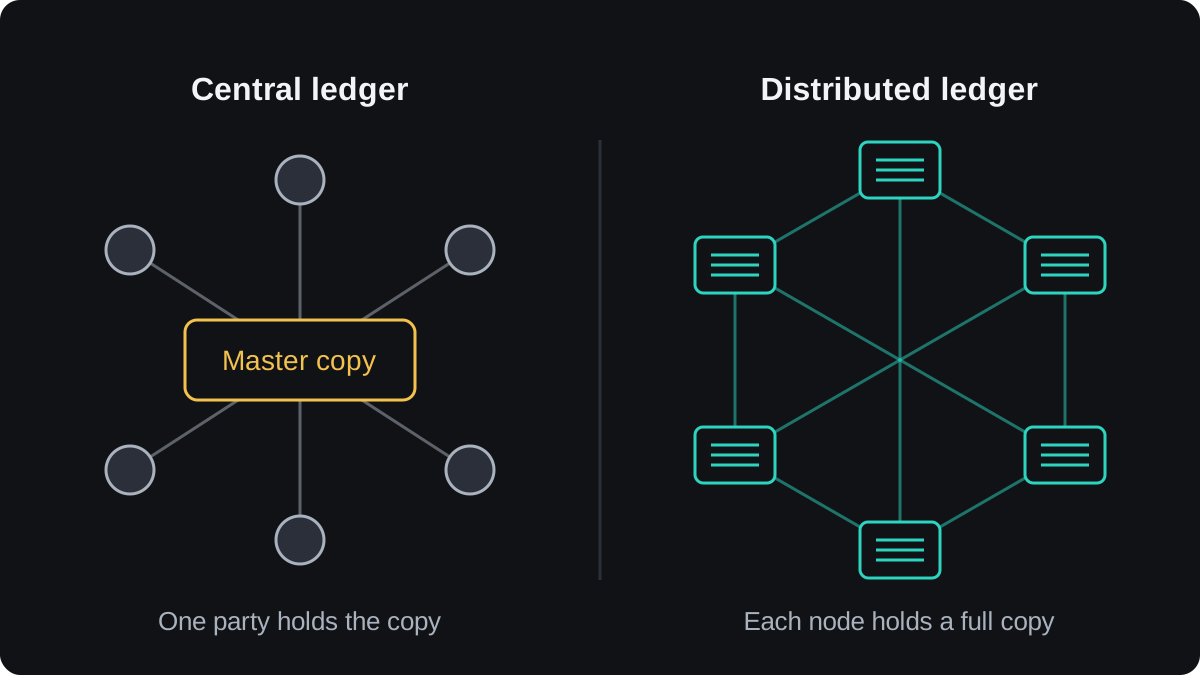
The computers that keep copies are called nodes. You can read what they store and check in what is a node.
How the copies stay in agreement
Every node checks every new entry against its own copy. On a crypto ledger that means two questions. Does the sender's digital signature prove they control the funds, and do they actually have them?
Checking is the easy part. The harder part is order. Two entries can reach different nodes in a different sequence, and the order decides which one is valid.
Here is a worked example with round numbers, for illustration. Account A holds 10 units, B holds 5 and C holds 0. At the same moment, A sends 10 units to B and another 10 units to C.
- Both requests are signed correctly, so each looks fine on its own.
- The network agrees on one order. Say the payment to B comes first.
- After it, A has 10 minus 10 = 0 units and B has 5 + 10 = 15.
- The payment to C now spends units A no longer has, so every node rejects it. C stays at 0.
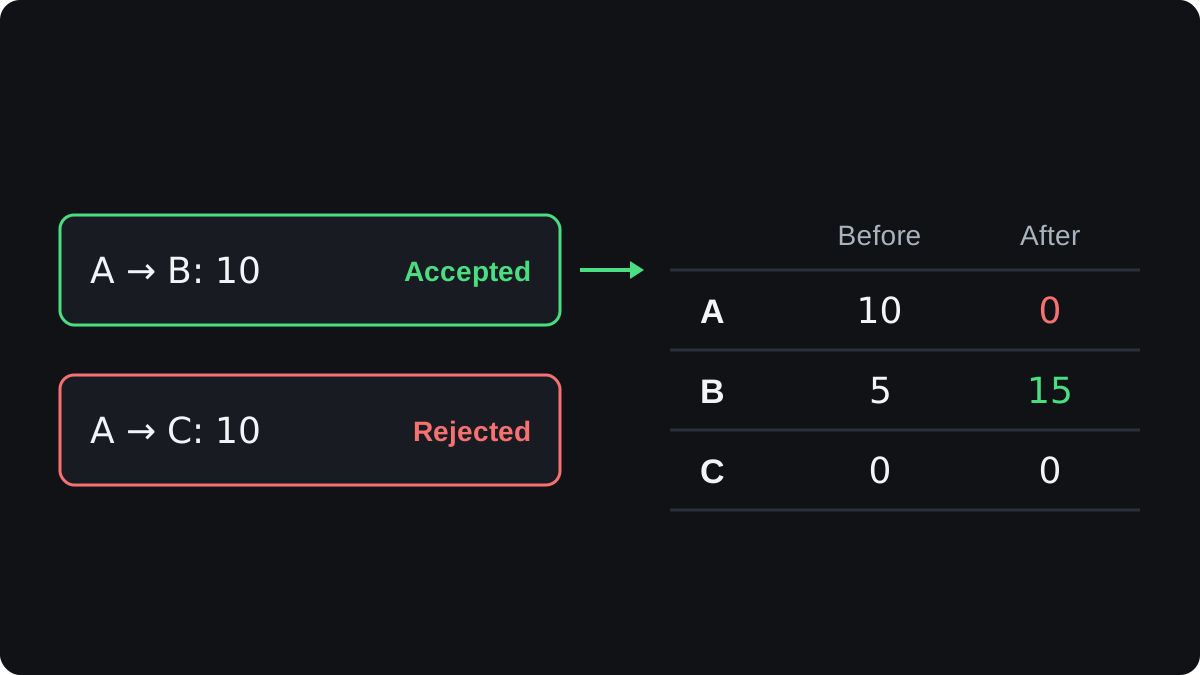
Spending the same funds twice is called a double spend. Stopping it without a central referee is the main problem any distributed ledger has to solve.
The method a network uses to agree on order is its consensus mechanism. Proof of work vs proof of stake covers the two most common ones.
Permissionless and permissioned ledgers
Distributed ledgers differ in who is allowed to join. In a permissionless ledger, anyone can run a node, read the record and send transactions. Bitcoin and Ethereum work this way.
In a permissioned ledger, a known group decides who may run nodes and who may read. A group of banks or shipping firms might share one to track settlements or cargo.
Hyperledger Fabric and Corda are two software platforms built for this kind of ledger.
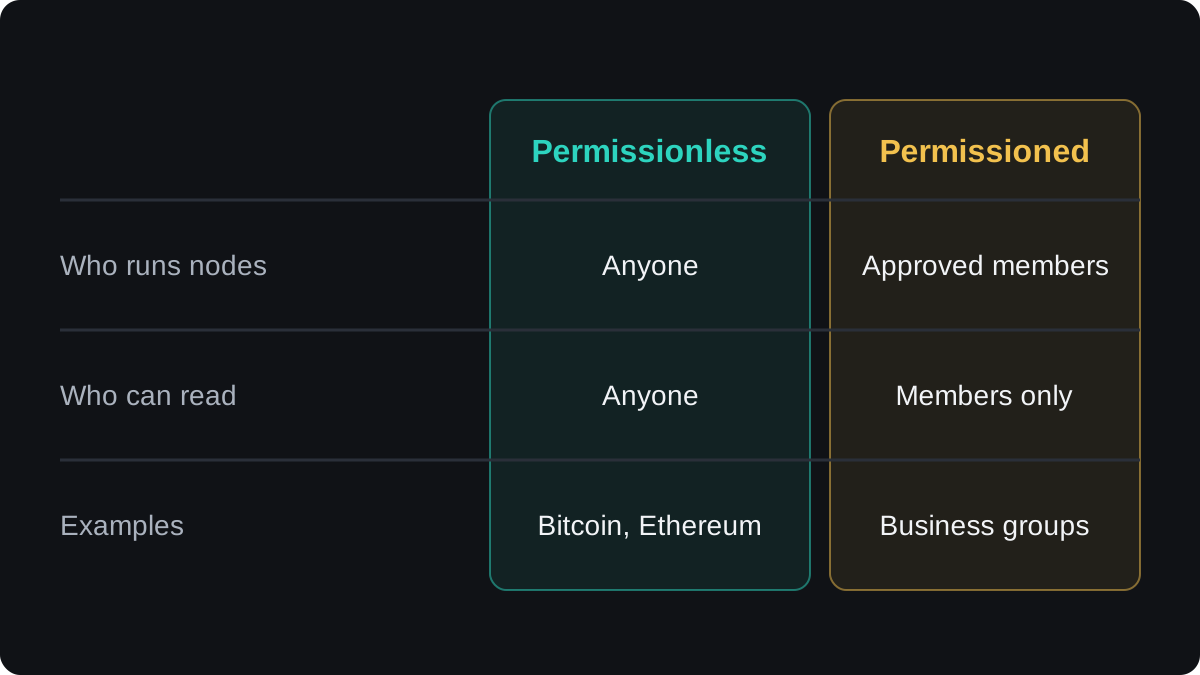
Permissioned ledgers are usually faster and more private, because there are fewer nodes and only members can read the record. The trade-off is trust: if a few members run most of the nodes, they can agree to change the record.
Is every distributed ledger a blockchain?
No. A blockchain is one design for a distributed ledger, where entries are grouped into blocks and each block points to the one before it.
Other designs skip blocks. Some link each transaction directly to earlier ones, forming a web of entries instead of a single chain. Others share each record only between the parties to a deal and a notary that checks it.
So every blockchain is a distributed ledger, and some distributed ledgers are not blockchains. In crypto, though, nearly every coin you will meet runs on a blockchain.
What you gain and what you pay
A distributed ledger removes the single point of failure. No single party can edit balances or quietly hide entries, and the record survives when some nodes go offline.
The price is speed and flexibility. Every node repeats the same checks and stores the same data, so updates are slower and storage is multiplied many times over.
Mistakes are also hard to undo, because there is no administrator to call. What makes a blockchain different from a database weighs these costs in detail.
Câu hỏi thường gặp
Is a distributed ledger the same as a blockchain?
A blockchain is one type of distributed ledger. Others record entries without grouping them into a chain of blocks.
Who controls a distributed ledger?
On a permissionless ledger, no single party does: the rules are enforced by every node that runs the software. On a permissioned ledger, the approved members control it together.
What is the difference between distributed and decentralized?
Distributed means the copies sit on many computers. Decentralized means no single party controls them. One company could spread its ledger across ten data centres and still be fully in charge of it.
Why can't someone just change their own copy of the ledger?
They can, but the other nodes will not accept it. Entries that break the shared rules are rejected, so the altered copy stops agreeing with the network.
Học tiếp
 Chương 1What is a blockchain?A blockchain is a record of transactions stored in batches called blocks. Each block carries a fingerprint, called a hash, of the block before it, and thousands of computers keep identical copies. Changing an old entry would break every link that follows it, which makes the record very hard to rewrite.
 Chương 1What makes a blockchain different from a database?An ordinary database is run by one owner, who can add, change and delete records in milliseconds. A blockchain is shared by many computers with no owner, and its records can only be added to. That makes it slower and more expensive, and worth using only when several parties need a record that none of them controls alone.

