What is a mempool?
A mempool is the waiting area for crypto transactions that have been sent but not yet added to a block. Each node keeps its own copy in memory. When blocks are full, miners pick the transactions that pay the highest fee for each unit of space first, so a low-fee payment can wait for hours or longer.
Nội dung này hiện chỉ có bản tiếng Anh.

You send some bitcoin and your wallet marks the payment as pending. The transaction exists, but it is not on the blockchain yet. For now it sits in a queue with other payments, often thousands of them.
That queue is the mempool, short for memory pool: the set of valid, unconfirmed transactions a node keeps in its memory while they wait for a block.
Where a pending transaction waits
When you press send, your wallet passes the signed transaction to a node, a computer running the network's software. The node checks the signature and makes sure the coins have not been spent already.
If the transaction passes, the node adds it to its mempool and forwards it to the nodes it is connected to. Within seconds it has spread across most of the network.
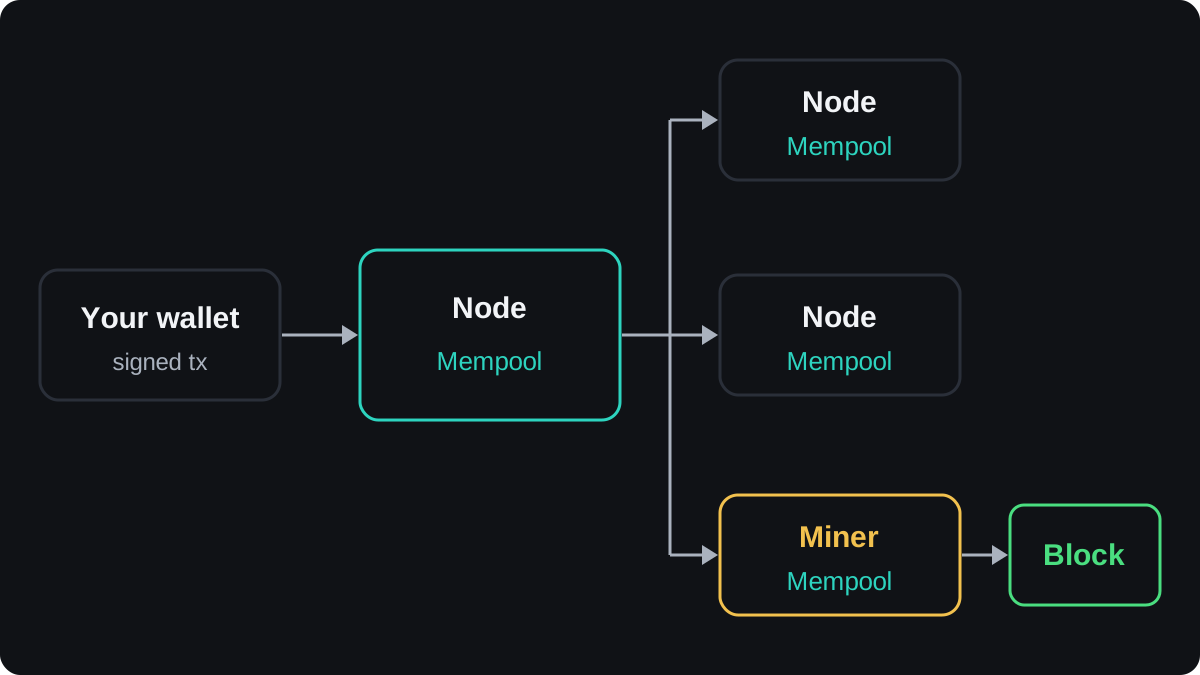
There is no single, official mempool. Every node keeps its own, and they mostly match because transactions spread fast. They can still differ at the edges: one node may have dropped a cheap transaction that another still holds.
A miner builds its next block from its own mempool. Once your transaction is in a block, nodes remove it from their mempools and your wallet shows the first confirmation. The Bitcoin transaction lesson covers what the transaction itself contains.
How miners choose which transactions go first
A block has limited room. On Bitcoin, size is counted in virtual bytes (vB), and a transaction that spends many small amounts takes more room than a simple one.
Miners want the most fees from that room, so they rank transactions by fee rate: the fee divided by the size. On Bitcoin it is quoted in satoshis per virtual byte (sat/vB). One satoshi is 0.00000001 BTC.
Take a toy block with room for only 1,000 vB. Real blocks are far larger, and every fee below is illustrative.
| Transaction | Size | Fee | Fee rate |
|---|---|---|---|
| A | 200 vB | 6,000 sats | 30 sat/vB |
| B | 500 vB | 10,000 sats | 20 sat/vB |
| C | 300 vB | 3,000 sats | 10 sat/vB |
| D | 400 vB | 2,000 sats | 5 sat/vB |
The miner fills the block from the top of the fee rate list:
- A goes in first: 200 vB used.
- B goes in next: 200 + 500 = 700 vB used.
- C fills the rest: 700 + 300 = 1,000 vB, and the block is full.
- D does not fit and waits for a later block.
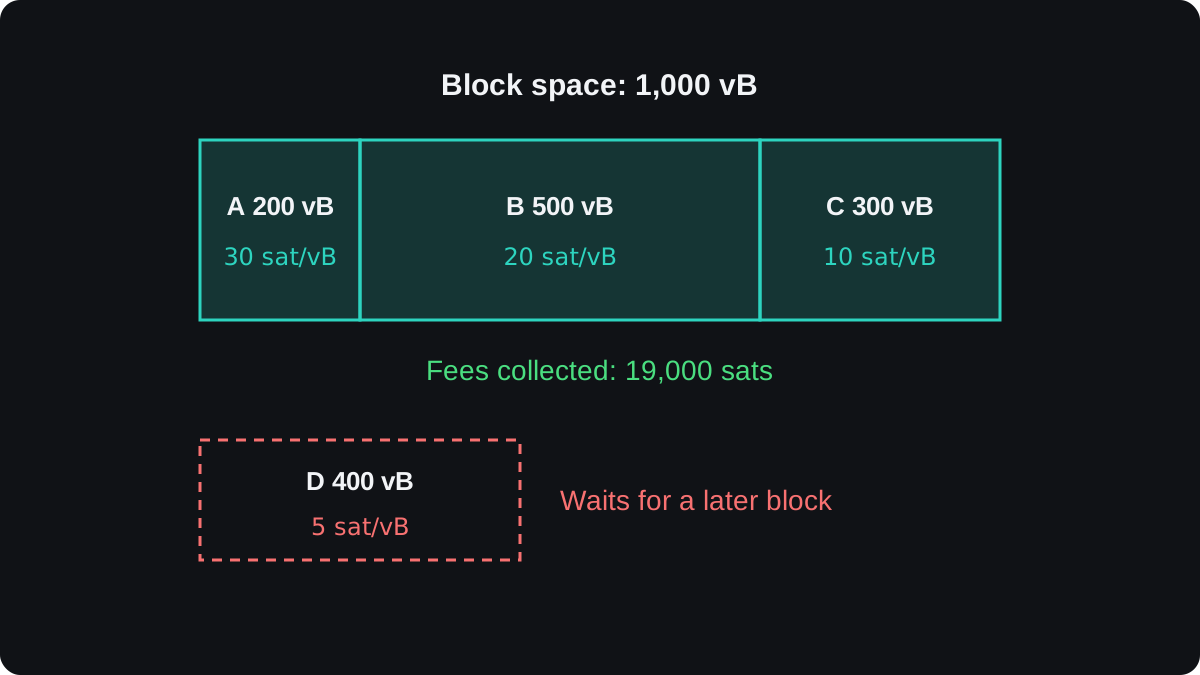
The miner collects 6,000 + 10,000 + 3,000 = 19,000 sats. B paid the biggest fee in total, yet A went in first, because A paid more for each vB it used.
Why fees rise and fall
The mempool works like a live auction for block space. Blocks arrive at a roughly steady pace, but demand does not. When many people send at once, the queue grows and the fee rate needed for the next block climbs.
Busy periods often come with sharp price moves, when traders rush coins to and from exchanges, and with popular token launches. On quiet days the queue empties and even low fees clear quickly.
Your wallet's fee suggestion comes from reading the mempool. A fast setting picks a fee rate high enough to beat most of the queue. A slow setting accepts a wait until the queue thins out.
Ethereum prices block space differently. Each block has a base fee that rises after busy blocks and falls after quiet ones, and that part of what you pay is destroyed.
A tip on top goes to whoever adds the block, so a higher tip moves you ahead of others.
When a transaction gets stuck
Set a low fee during a busy period and your transaction can wait for hours or days. Until it is in a block, the payment has not happened, and the coins are still recorded at your address.
Each node caps its mempool's size and, when it is full, drops the lowest fee rate transactions first. Bitcoin Core, the reference node software, also drops a transaction after two weeks by default. Operators can change both settings.
Once nodes drop your transaction, it is as if it was never sent, and the coins can go into a new one. A wallet or node can still rebroadcast the old version, so replacing it is the cleaner fix.
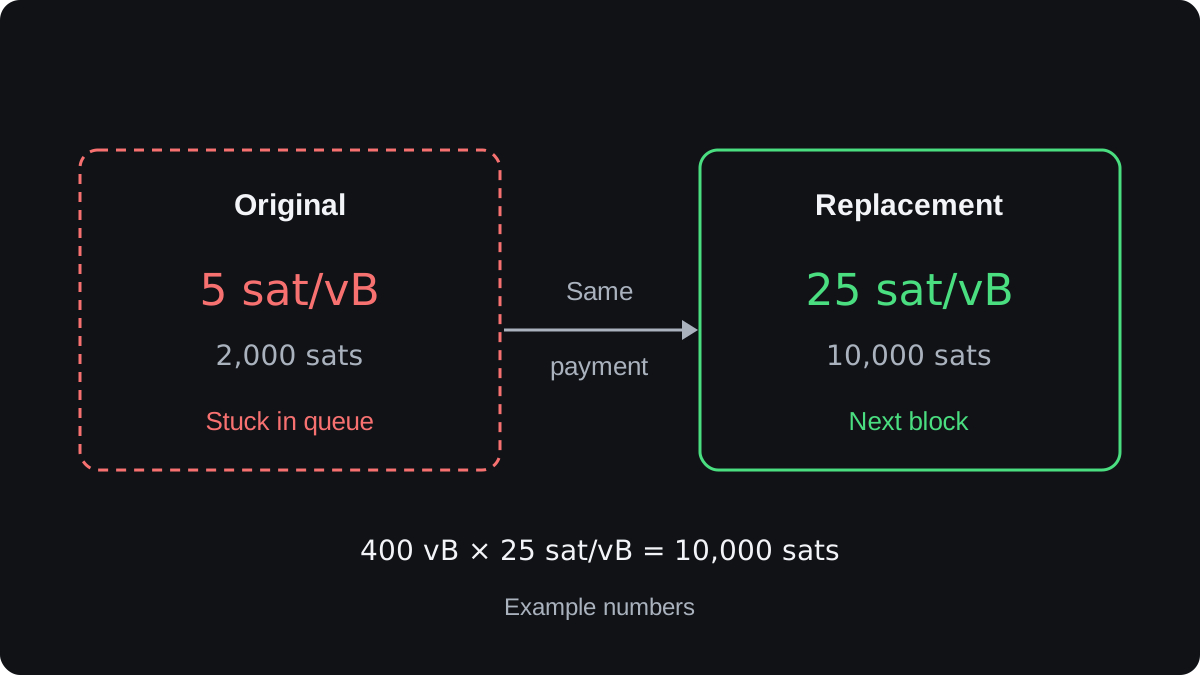
You can often speed things up. Replace-by-fee (RBF) lets your wallet send a new version of the same payment with a higher fee, and nodes swap it in for the old one. Many Bitcoin wallets support it.
Say your 400 vB payment went out at 5 sat/vB, a fee of 400 × 5 = 2,000 sats, and the next few blocks are clearing at 25 sat/vB. Both numbers are illustrative.
Replacing it at 25 sat/vB costs 400 × 25 = 10,000 sats. You pay 8,000 sats more, which is 0.00008 BTC, and the payment should make one of the next blocks.
Child-pays-for-parent (CPFP) works from the receiving side. The recipient spends the pending coins in a new transaction with a high fee. A miner that wants that fee has to include both transactions.
On Ethereum, each account numbers its transactions in order. A new transaction with the same number and a clearly higher fee replaces the pending one. Nodes ignore a replacement whose fee rises by less than a minimum step.
What the mempool means for traders
Until a payment is in a block, the sender can try to replace it with a higher fee version that pays someone else. Never hand over goods or cash against a screenshot of an unconfirmed payment.
Each exchange sets how many confirmations it waits for before crediting a deposit. A crowded mempool can delay your coins just when a fast market makes you want them there, so match your fee to the queue or move early.
The mempool is public. On Ethereum and similar chains, bots watch it for large swaps on decentralised exchanges. They trade just before and just after a big swap, which worsens the price the original trader gets.
A tight limit on slippage in the swap settings caps that damage. The swap then fails if the price moves too far, and you lose only the network fee.
Some analysts track mempool size as part of on-chain analysis. It shows how busy the chain is, but a token launch fills it as easily as buyers do, so on its own it says little about price direction.
Câu hỏi thường gặp
How long can a transaction stay in the mempool?
There is no single limit for the whole network. Bitcoin Core drops a transaction after two weeks by default, or sooner when its mempool is full, and each node operator can change those settings.
Can I cancel a pending crypto transaction?
Once it is broadcast, you cannot recall it. If your wallet supports replace-by-fee, you can replace the payment with one that sends the coins back to yourself at a higher fee, which cancels it once the replacement confirms.
Why are other transactions confirming while mine is still pending?
They pay a higher fee rate. Miners fill blocks from the top of the fee rate list, so a low-fee payment waits until the queue above it clears.
Is there one mempool for the whole Bitcoin network?
Every node keeps its own mempool, so there is no single official one. They are usually close to identical, but they can differ for low-fee transactions.
Học tiếp
 Chương 4What is crypto mining?Crypto mining is the work of packing pending transactions into a block, then racing other computers to find a number that makes the block valid. The winner adds the block to the blockchain and collects newly created coins plus the fees inside it. Bitcoin is the best-known coin that is secured this way.
 Chương 4How does Bitcoin mining work?Bitcoin miners build a candidate block, then hash its header over and over, changing a number called the nonce each time. The block counts only when its hash comes out below a target set by the network. Every 2,016 blocks the network resets the target so that blocks keep arriving about every ten minutes.
 Chương 4Proof of work vs proof of stake.Proof of work and proof of stake are two ways for a blockchain to decide who adds the next block. In proof of work, miners spend electricity on a guessing race. In proof of stake, validators lock up the network's own coins as a deposit, get picked in proportion to that stake, and lose part of it if they cheat.
 Chương 4What is staking?Staking is locking up coins on a proof of stake blockchain so they can help secure it. The coins back a validator that proposes and checks blocks, and the network pays rewards in new coins and fees. You can run a validator, delegate to one, or stake through a pool or an exchange, and each route carries its own risks.

