What is staking?
Staking is locking up coins on a proof of stake blockchain so they can help secure it. The coins back a validator that proposes and checks blocks, and the network pays rewards in new coins and fees. You can run a validator, delegate to one, or stake through a pool or an exchange, and each route carries its own risks.
Nội dung này hiện chỉ có bản tiếng Anh.

Say you hold 1,000 coins on a proof of stake network. Staked for a year at an illustrative rate, they could become 1,054 coins. Whether you end up better off depends on new supply and the coin's price.
Staking is locking coins on a proof of stake network so they help secure it. In return, the network pays rewards in the same coin. Staking also brings lock-ups and risks that a bank deposit does not have.
What staking does for the network
On a proof of stake network, validators propose new blocks and vote on blocks proposed by others. Each validator puts up coins as a security deposit, and the protocol picks validators in proportion to that deposit.
If a validator cheats, the protocol destroys part of its stake. That threat is what keeps the record honest, and staked coins are the deposit that can be taken.
When you stake, your coins add weight to a validator. More weight means it is picked more often and earns more, which it shares with the people whose coins back it.
Four ways to stake
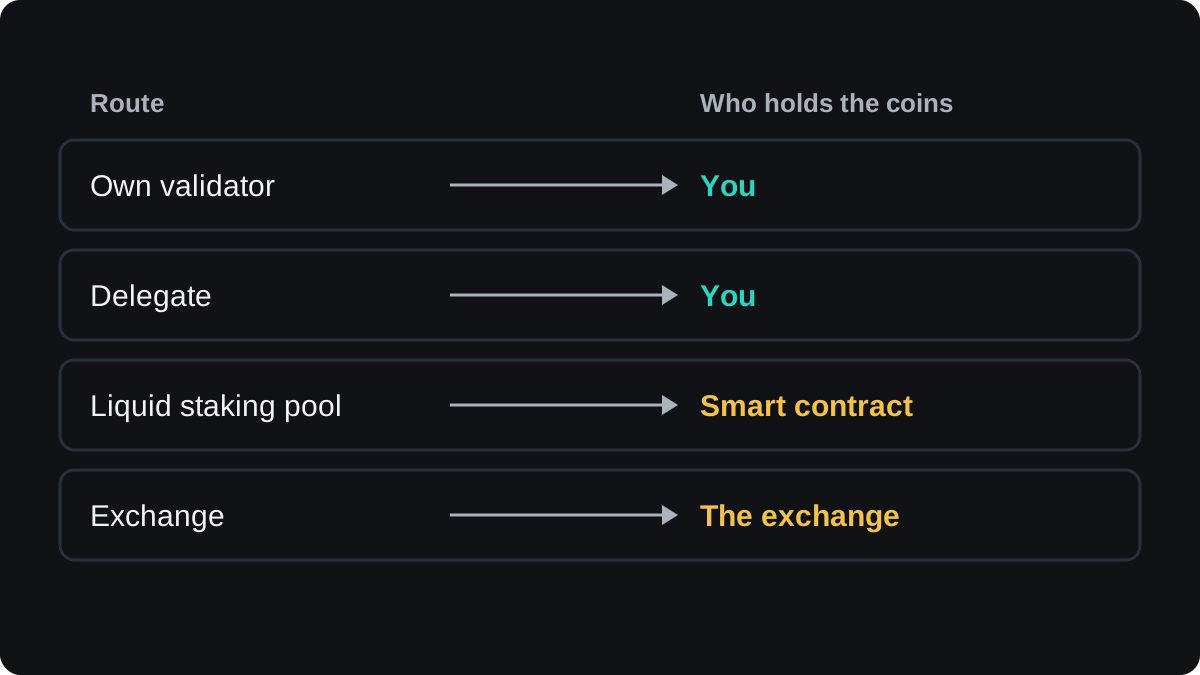
Run your own validator
You run the validator software on a computer that stays online and stake your own coins. You keep your keys and all the rewards, and you carry every penalty.
Some networks set a minimum deposit. On Ethereum it is 32 ETH as of 2026, and a protocol upgrade could change it.
Delegate to a validator
On many networks you can assign your coins to someone else's validator while they stay in your wallet. The validator keeps a cut of the rewards as commission.
On some networks, if that validator is slashed, part of your delegated stake goes too.
Use a staking pool
A pool gathers coins from many people into validators through a smart contract. With liquid staking, the pool hands you a receipt token that tracks your staked coins and that you can trade.
The receipt can trade below the coins behind it, and a bug in the contract can lose the deposit.
Stake through an exchange
A crypto exchange stakes coins held in your account and passes on part of the reward. It is the simplest route. The exchange holds the keys, so your coins are only as safe as the exchange.
Where staking rewards come from
Staking rewards are paid in the network's own coin. They come from new coins the protocol creates and from part of the transaction fees. Platforms quote them as a yearly percentage, which shifts as more or fewer coins are staked.
That percentage is counted in coins, and part of it only keeps pace with the new supply. Every number in this example is illustrative.
- The network has 1,000,000 coins, and 500,000 of them are staked.
- It creates 30,000 new coins a year, all paid to stakers: 30,000 ÷ 500,000 = 6% a year on staked coins.
- You stake 1,000 coins through a validator and earn 6% of that, which is 60 coins.
- The validator keeps 10% as commission, 6 coins, so you receive 54 and now hold 1,054 coins.
- Total supply is now 1,000,000 + 30,000 = 1,030,000 coins.
Now compare your share of all coins:
- At the start: 1,000 ÷ 1,000,000 = 0.1000%.
- After staking: 1,054 ÷ 1,030,000 = 0.1023%.
- Had you not staked: 1,000 ÷ 1,030,000 = 0.0971%.
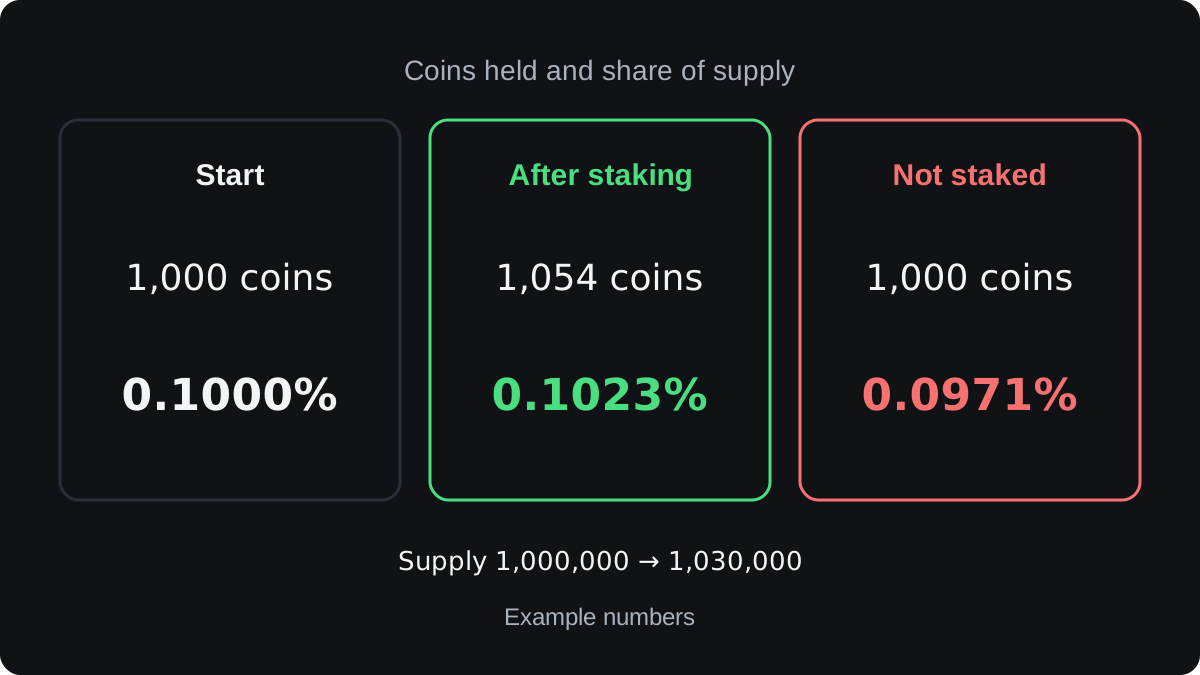
You earned 5.4% more coins, but supply grew 3%, so your share of all coins is only about 2.3% larger than before. The holder who did nothing now has a share about 2.9% smaller, without selling a coin.
Rewards in coins do not protect you from the price. If the coin falls from $100 to $80 over the year, your stake started at 1,000 × $100 = $100,000 and ends at 1,054 × $80 = $84,320.
Lock-ups and unbonding
Many networks make you wait to unstake. After you ask to withdraw, your coins pass through an unbonding period before you can move them. During it they usually earn nothing, and you cannot sell them.
Take an illustrative case: the unbonding period is 14 days, and you ask to unstake with the coin at $100.
If the price slides to $70 before your coins are free, you take the full 30% fall with no way to sell. On 1,054 coins, that is 1,054 × $30 = $31,620 of value gone while you wait.
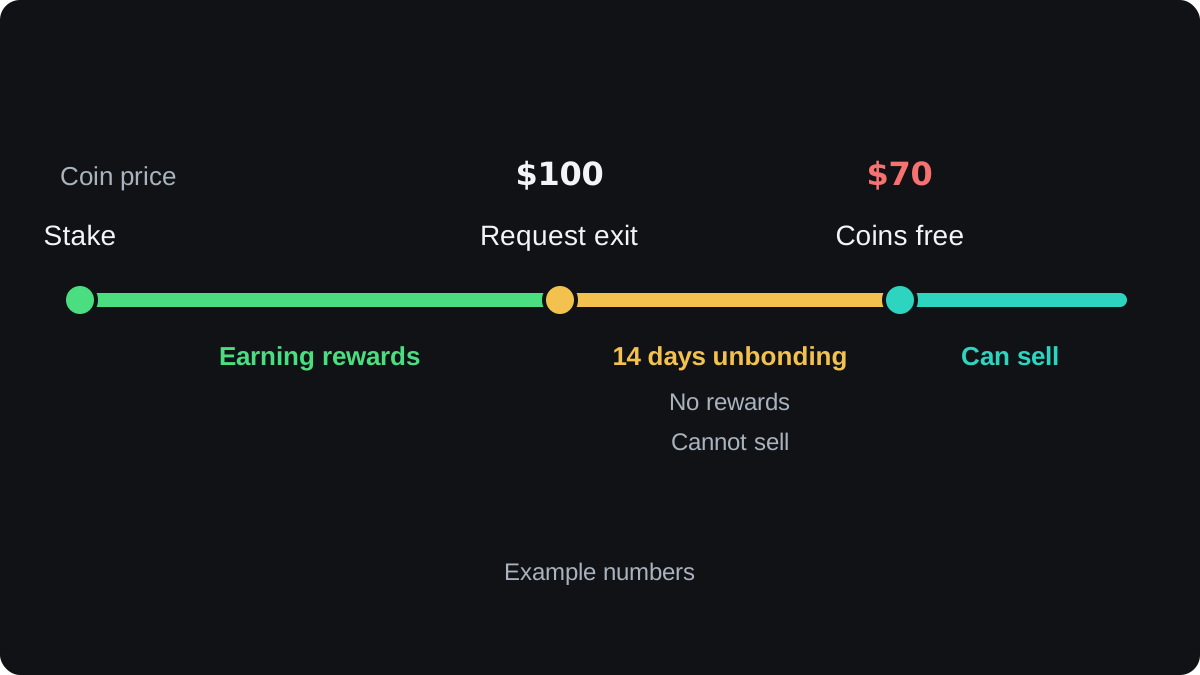
Liquid staking tokens are one answer to this. You can sell the receipt at any time, at whatever price the market gives for it, which may be below the value of the coins behind it.
The risks that come with staking
Slashing and downtime
If a validator signs conflicting blocks or votes, part of its stake is destroyed, and on some networks its delegators share the loss. Downtime usually costs less, and some networks do not penalise it at all.
Choosing validators with a long clean record, and spreading stake across more than one, reduces this risk.
Custody
When an exchange or a staking service holds your coins, you depend on it staying solvent and honest. Check whether a product stakes at all.
Some earn products lend your coins to borrowers, and the DeFi lending lesson explains where that risk sits.
Fraud and taxes
Real staking rewards move with how much is staked and how validators perform, so no network pays a fixed daily return. A site that promises one is a classic sign of a scheme paying old users with new deposits.
The common crypto scams lesson shows the pattern.
Tax rules for staking rewards differ by country and are still changing in places, so check how yours treats them before you start.
Staking and crypto CFDs
Staking needs coins you own on the network. A crypto CFD is a contract on the price with a broker, so a CFD position earns no staking rewards. Holding it overnight can cost a swap fee instead.
Câu hỏi thường gặp
Is staking the same as earning interest?
It looks similar because you see a yearly percentage. The rate is not guaranteed, the reward is paid in the coin itself and partly offsets new supply, and the coin's price can fall by far more than the reward.
Can you lose money staking?
Yes. The coin's price can fall, a validator can be slashed, the exchange or contract holding your coins can fail, and a lock-up can stop you selling in time.
Can you stake Bitcoin?
Bitcoin uses proof of work, so the network itself has no staking. Products that pay a yield on bitcoin usually lend it out or lock it to help secure another network, so check where the return comes from.
What is liquid staking?
Liquid staking gives you a token that represents your staked coins and their rewards. You can sell or use that token while the coins stay staked, though it can trade below the value of the coins behind it.
Học tiếp
 Chương 4What is crypto mining?Crypto mining is the work of packing pending transactions into a block, then racing other computers to find a number that makes the block valid. The winner adds the block to the blockchain and collects newly created coins plus the fees inside it. Bitcoin is the best-known coin that is secured this way.
 Chương 4What is a mempool?A mempool is the waiting area for crypto transactions that have been sent but not yet added to a block. Each node keeps its own copy in memory. When blocks are full, miners pick the transactions that pay the highest fee for each unit of space first, so a low-fee payment can wait for hours or longer.
 Chương 4How does Bitcoin mining work?Bitcoin miners build a candidate block, then hash its header over and over, changing a number called the nonce each time. The block counts only when its hash comes out below a target set by the network. Every 2,016 blocks the network resets the target so that blocks keep arriving about every ten minutes.
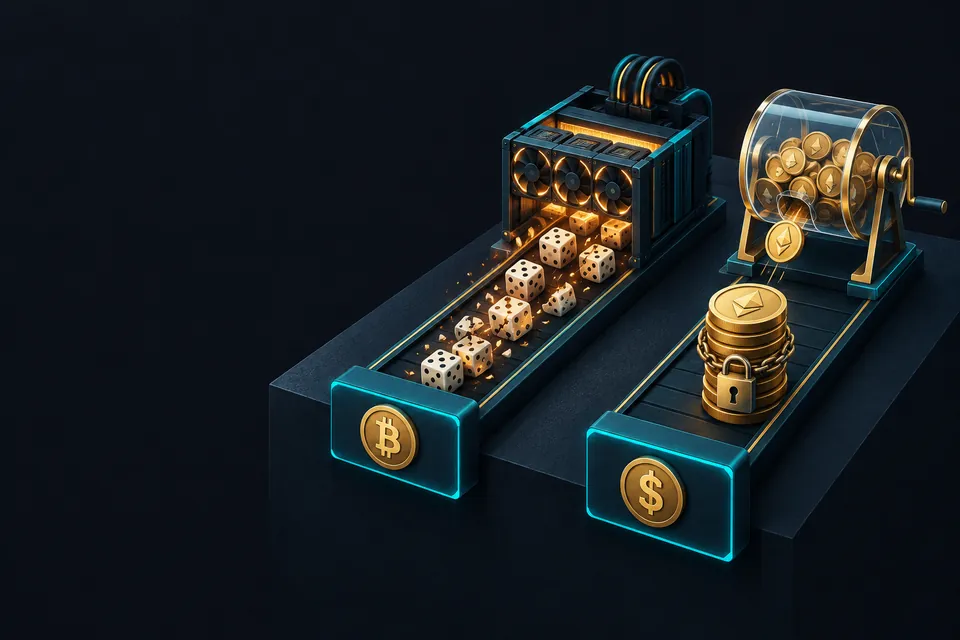 Chương 4Proof of work vs proof of stake.Proof of work and proof of stake are two ways for a blockchain to decide who adds the next block. In proof of work, miners spend electricity on a guessing race. In proof of stake, validators lock up the network's own coins as a deposit, get picked in proportion to that stake, and lose part of it if they cheat.

