What is crypto mining?
Crypto mining is the work of packing pending transactions into a block, then racing other computers to find a number that makes the block valid. The winner adds the block to the blockchain and collects newly created coins plus the fees inside it. Bitcoin is the best-known coin that is secured this way.
Nội dung này hiện chỉ có bản tiếng Anh.
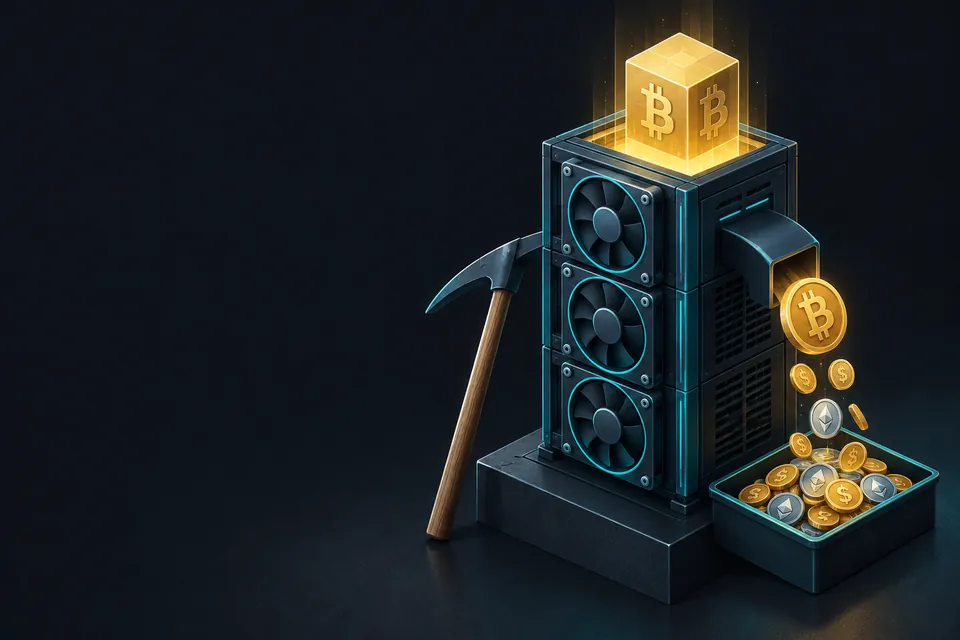
About every ten minutes, one computer somewhere adds the next page to Bitcoin's shared record. Nobody appoints it. It wins a guessing race against a huge number of other machines, and the network pays it in new bitcoin.
That race is crypto mining: spending computing power to add blocks to a blockchain in return for new coins and fees. The name borrows from gold, which also appears only after costly digging.
What a miner does, step by step
A miner is a computer, these days usually a specialised machine, running the network's software. Its work is a loop that repeats for every block:
- Collect transactions that people have sent but that are not recorded yet. They wait in the mempool.
- Check each one: the signature is valid and the coins have not been spent already.
- Pack them into a candidate block, with one extra line that pays the reward to the miner.
- Run a short summary of the block through a hash function again and again, changing one number each time, until the result meets the network's target.
- Broadcast the finished block. Other computers check it and add it to their copy of the chain.
- Start again on the next block.
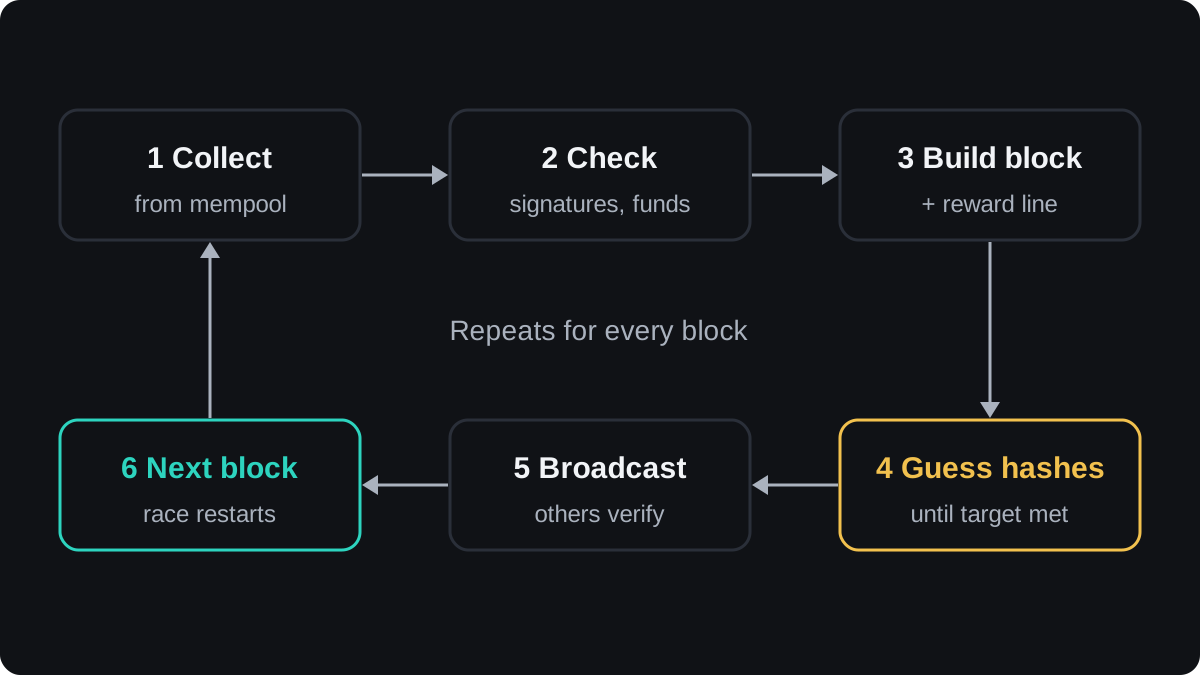
Step 4 is the expensive part. Finding a valid result takes an enormous number of guesses, while checking one takes a single calculation. The Bitcoin mining lesson walks through that puzzle in detail.
Why a blockchain needs miners
A blockchain has no bank in the middle deciding which payments count. Thousands of computers keep copies of the record, and they need a fair way to agree on one version of it.
The hardest case is a double spend: sending the same coins to two people at once. Mining settles it one block at a time. Whichever payment lands in a block first counts, and the other is rejected.
Mining also makes the past expensive to change. To rewrite an old block, an attacker would have to redo its work and the work of every block since, faster than all the honest miners combined.
How miners get paid
Each new block pays its miner from two sources. The block subsidy is a fixed amount of brand new coins set by the network's rules, and it is how new coins enter circulation.
Bitcoin's first blocks paid a subsidy of 50 BTC each, and the amount halves every 210,000 blocks, roughly every four years. The halving lesson covers that schedule.
The miner also keeps the transaction fees paid by everyone whose transaction is in the block. Fees work like an auction: when many people want fast confirmation, they bid higher, and miners pick the highest bids first.
Worked example: does one machine make money?
Mining income is a game of averages. A machine with a tiny share of the network's computing power wins a tiny share of the blocks over time.
Every number below is illustrative, for a Bitcoin-style network. None of them is a current reward or price.
- The network makes 144 blocks a day: one every ten minutes for 24 hours.
- Each block pays a subsidy of 4.5 coins plus 0.5 coins in fees, 5 coins in total.
- That is 144 × 5 = 720 coins a day, shared by all miners.
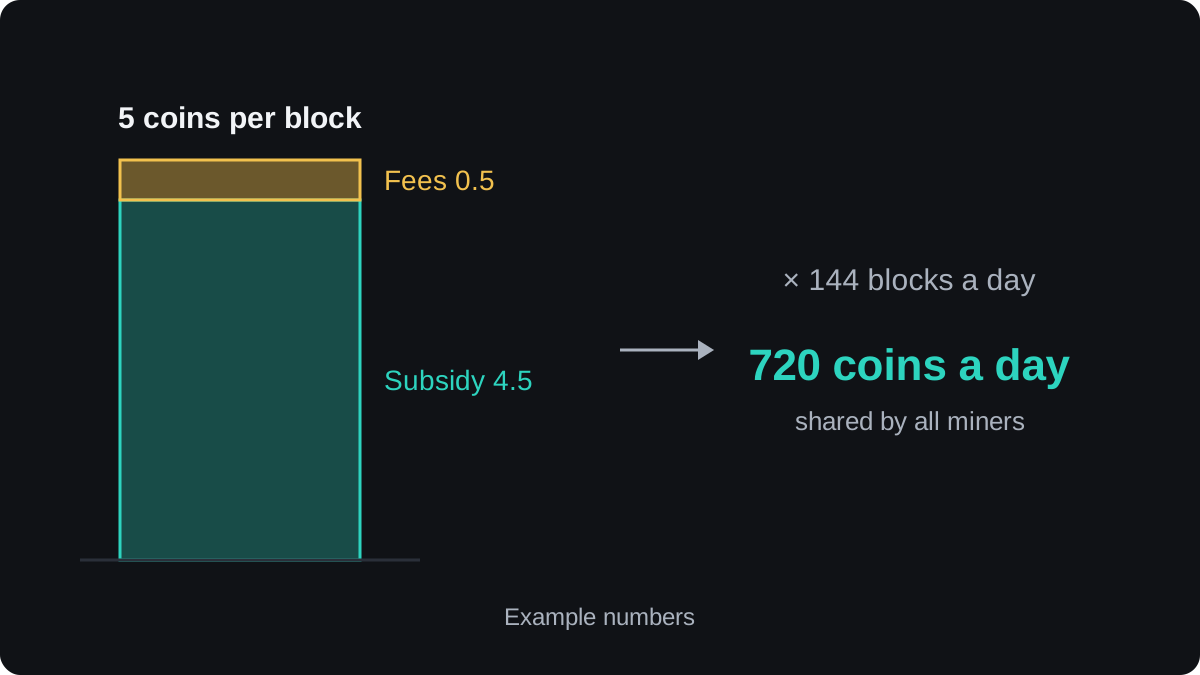
Your machine has one millionth of the network's computing power, so on average it earns 720 ÷ 1,000,000 = 0.00072 coins a day. At a coin price of $10,000, that is 0.00072 × $10,000 = $7.20 a day.
The machine draws 3 kilowatts around the clock, which is 3 × 24 = 72 kilowatt hours a day. At $0.08 per kilowatt hour, power costs 72 × $0.08 = $5.76 a day.
That leaves $7.20 minus $5.76 = $1.44 a day, before paying for the machine, cooling and repairs.
Then the coin price falls 25%, to $7,500. Income drops to 0.00072 × $7,500 = $5.40 a day, while power still costs $5.76. The same machine now loses $0.36 a day.
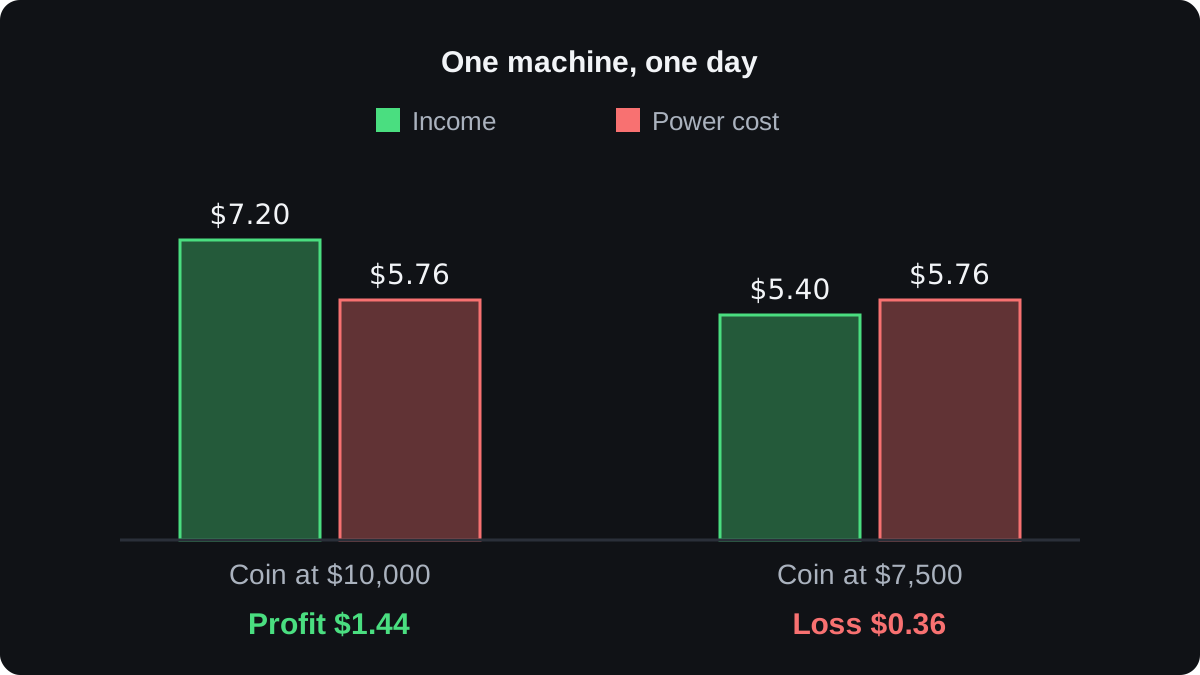
This is why miners switch machines off when the price drops, starting with the ones that burn the most power per guess. Your share also shrinks whenever other miners add machines, even if yours runs exactly as before.
Which coins are mined, and with what
Mining belongs to networks that use proof of work, the guessing race described above. Bitcoin is the largest, and Litecoin, Dogecoin, Bitcoin Cash and Monero use it too.
Ethereum was mined until 2022, when it moved to proof of stake.
In Bitcoin's early years, people mined on ordinary computer processors. Graphics cards took over because they run many simple calculations at once. Today Bitcoin mining runs on ASICs, chips built to do nothing except Bitcoin's hash function.
That shift changed who mines. A home computer cannot keep up with racks of ASICs, so most mining now happens in large sites near cheap electricity.
Most miners also join a mining pool, which combines many machines and splits each reward between them, so income arrives in small, regular amounts.
Where mining goes wrong for beginners
Mining burns money every hour, and the income depends on a price nobody controls.
Machines also age fast. Each new generation makes more guesses per watt, and as miners plug them in, difficulty rises and older models fall out of profit.
The bigger danger for most people is fraud that borrows the word. Cloud mining offers with a fixed daily return, and phone apps that claim to mine while you sleep, are common traps.
A phone earns close to nothing next to ASICs, so a steady payout must come from somewhere else, often newer depositors. The lesson on common crypto scams shows how these schemes work.
A quieter risk is cryptojacking: malware that mines on your computer or cloud account without asking. The signs are a machine that runs hot and slow for no reason, or a power or cloud bill that suddenly jumps.
Câu hỏi thường gặp
Can you mine crypto on a phone or a laptop?
You can run mining software on one, but for Bitcoin the expected income is close to zero next to specialised machines. Apps that promise steady mining income on a phone are usually reward schemes or scams.
Does mining create new coins forever?
That depends on the coin. Bitcoin's subsidy halves on a fixed schedule, so issuance stops just under 21 million BTC and miners then earn fees only. Some other mined coins keep issuing a small amount forever.
What happens to mining when the price falls?
Income in dollars falls while power bills stay the same, so the least efficient machines switch off. Bitcoin then lowers its difficulty at the next adjustment, so the remaining miners keep finding blocks about every ten minutes.
Is crypto mining legal?
Rules differ by country and change over time, and some places restrict or ban it. Check local law and your power contract before you buy any equipment.
Học tiếp
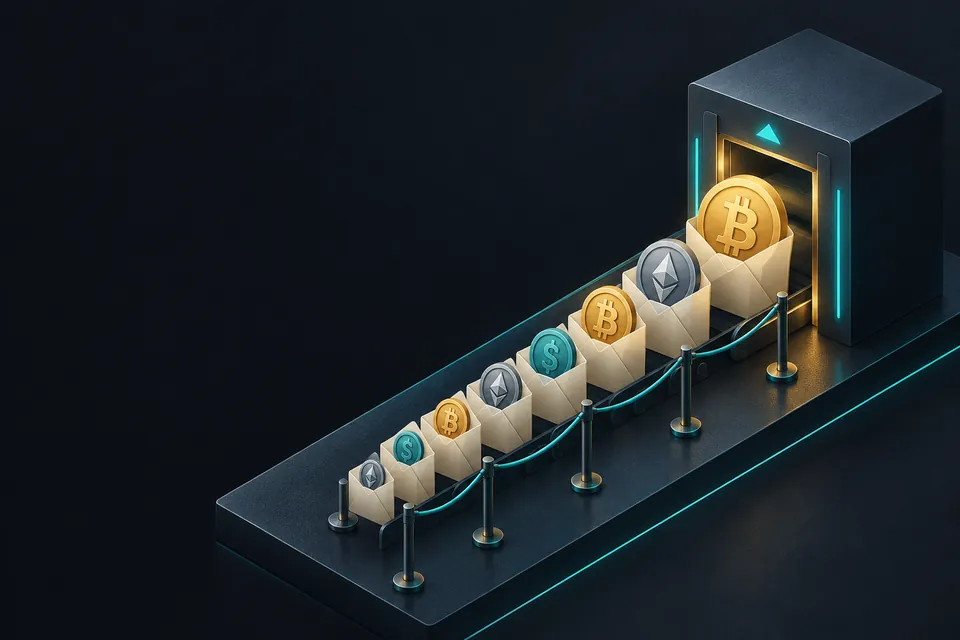 Chương 4What is a mempool?A mempool is the waiting area for crypto transactions that have been sent but not yet added to a block. Each node keeps its own copy in memory. When blocks are full, miners pick the transactions that pay the highest fee for each unit of space first, so a low-fee payment can wait for hours or longer.
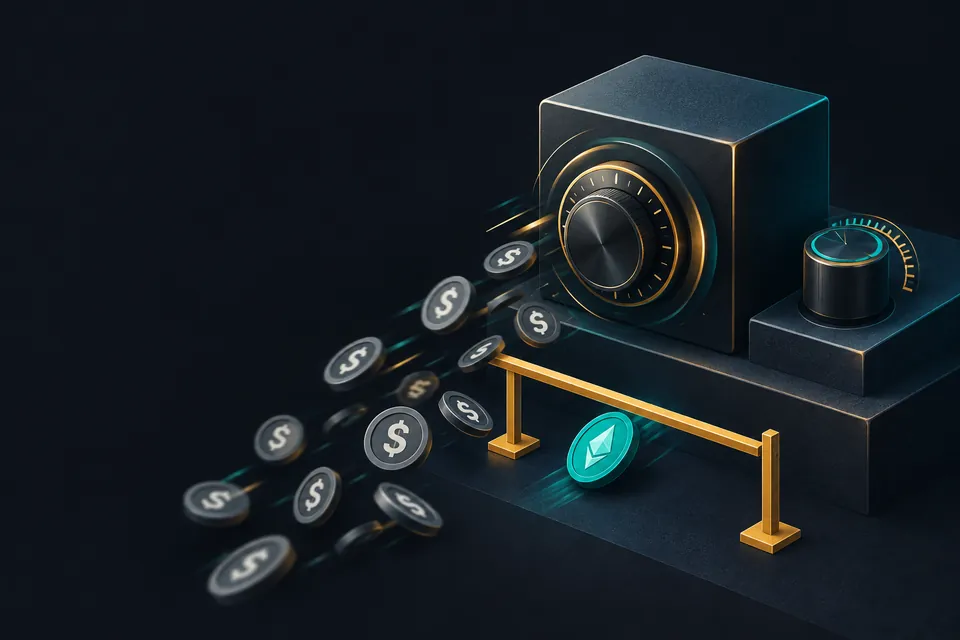 Chương 4How does Bitcoin mining work?Bitcoin miners build a candidate block, then hash its header over and over, changing a number called the nonce each time. The block counts only when its hash comes out below a target set by the network. Every 2,016 blocks the network resets the target so that blocks keep arriving about every ten minutes.
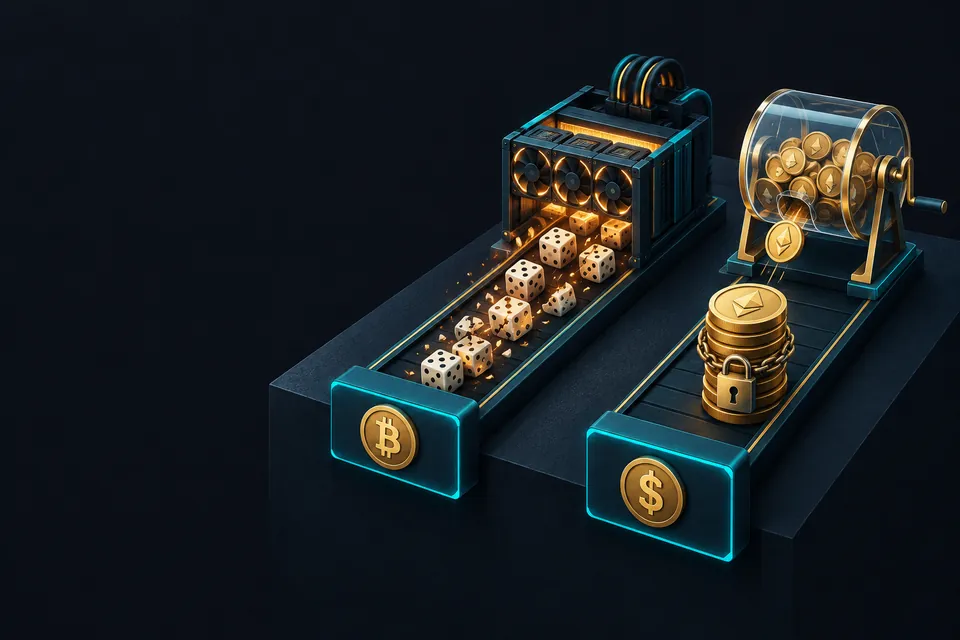 Chương 4Proof of work vs proof of stake.Proof of work and proof of stake are two ways for a blockchain to decide who adds the next block. In proof of work, miners spend electricity on a guessing race. In proof of stake, validators lock up the network's own coins as a deposit, get picked in proportion to that stake, and lose part of it if they cheat.
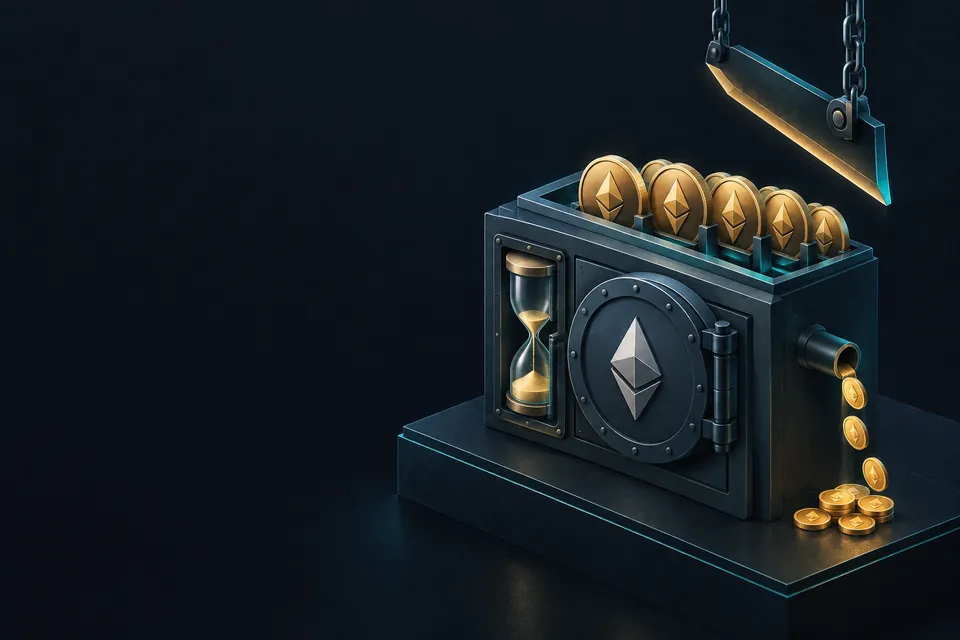 Chương 4What is staking?Staking is locking up coins on a proof of stake blockchain so they can help secure it. The coins back a validator that proposes and checks blocks, and the network pays rewards in new coins and fees. You can run a validator, delegate to one, or stake through a pool or an exchange, and each route carries its own risks.

