What is liquidity in crypto?
Liquidity is how easily you can buy or sell a coin without moving its price. A liquid coin has many orders close to the current price, so the spread is narrow and a large order fills near the quoted price. In a thin market, the same order eats through the book and fills at worse prices.
Nội dung này hiện chỉ có bản tiếng Anh.

Two coins both show a price of $1.00, and you sell 10,000 of each. The first sale brings in $10,000. The second brings in $9,690, with no news at all.
The second coin had too few buyers waiting near $1.00. Your order had to keep selling to buyers at lower and lower prices until it was done.
What liquidity means in crypto
Liquidity is how easily you can buy or sell an amount without moving the price much. In a liquid market, many traders post orders close to the current price, so your order finds someone at or near the quote.
In a thin market, few orders sit near the price. A modest order has to reach further away to find enough buyers or sellers, and that pushes the price as it goes.
The forex lesson on market size and liquidity covers the idea for currencies. Crypto adds a twist: each coin's liquidity is split across many exchanges and trading pairs, and each has its own order book.
How liquidity shows up on the screen
You cannot see liquidity directly, but four measures point to it.
The spread
A narrow gap between the best bid and the best ask means many traders compete to quote the coin. Bid, ask and spread in crypto shows how to measure it as a percentage.
Depth
Depth is how much is waiting to trade near the price. Some data sites quote it as the value of orders within 2% of the price, and the order book lesson shows how to read it.
Volume
Volume is how much traded over a period, often the last 24 hours. High volume usually goes with deep books, but a coin can trade a lot while very little waits near the price.
Reported volume can also include wash trading: trades made only to look busy, with no real change in who owns the coins. Treat a volume figure as a hint and confirm it in the book.
Price impact
Price impact is how far your own order moves the price. On a liquid coin it is close to zero for normal sizes. On a thin coin it can cost more than the spread and the fee together.
Worked example: selling into a thin book
Here are the two coins from the start, with round illustrative numbers. Both quote $1.00 as the best bid.
Coin A has 50,000 coins wanted at $1.00. Coin B's buy side is much thinner:
| Price | Coins wanted on coin B |
|---|---|
| $1.00 | 2,000 |
| $0.98 | 3,000 |
| $0.95 | 5,000 |
You place a market sell for 10,000 coins of each. On coin A, the whole order fills at $1.00 and you receive $10,000. On coin B, it fills from the best price down:
- 2,000 coins at $1.00 = $2,000.
- 3,000 coins at $0.98 = $2,940.
- 5,000 coins at $0.95 = $4,750.
- Total: $9,690, an average of 9,690 ÷ 10,000 = $0.969 per coin.
You expected $10,000 and received $9,690. The $310 shortfall, 3.1% of the trade, is price impact, and traders often call the gap slippage.
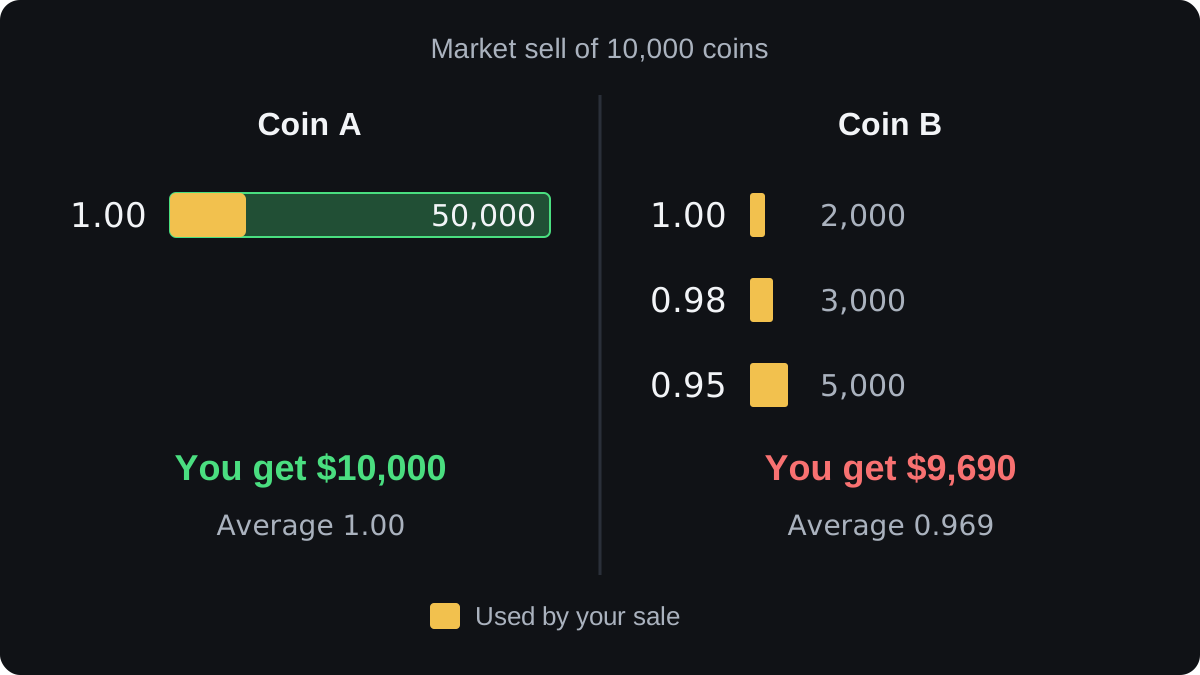
Your sale also emptied all three of coin B's top levels. The next seller meets a best bid below $0.95, and the book stays thin until new buyers post orders.
Why some coins are more liquid than others
Coins that many people hold and trade attract market makers, firms that post buy and sell orders all day. Their orders are much of the depth you see near the price.
A market maker aims to earn the spread, and it risks losses on the coins it holds while the price moves. That risk is why market makers pull back when prices swing hard.
Where a coin trades matters too. A coin listed on many large exchanges has more orders in total. Liquidity on one exchange does not help your order on another, though, because each exchange has its own book.
The trading pair matters as well. A coin can have a deep book against a major stablecoin and a thin one against a smaller currency on the same exchange.
Market capitalization, the price times the number of coins in circulation, does not measure liquidity.
A token can show a large market cap while most of its coins sit with a few holders who are not selling, so little of it is on offer near the price.
When liquidity disappears
Liquidity is not a fixed property of a coin. It changes by the hour, and it tends to thin out when you need it most.
- In a crash, buyers step back just when many holders want to sell, so the bid side empties.
- Around big news, market makers often widen their quotes or pull them until prices settle.
- At weekends and in quiet hours, fewer traders are active. When the crypto market trades covers the hours.
- When an exchange halts withdrawals or announces a delisting, its book for that coin can dry up fast.
A stop loss that turns into a market order fills close to its level on a calm day. In a thin market it can fill well beyond that level, at whatever prices are left in the book.
How to check liquidity before you trade
A few minutes with the trade screen tells you most of what you need:
- Look at the spread as a percentage of the price.
- In the order book, add up what sits within 1% or 2% of the price on the side you will trade against.
- Compare your order with that total.
- On an unfamiliar coin, place a small order first and compare the fill with the quote.
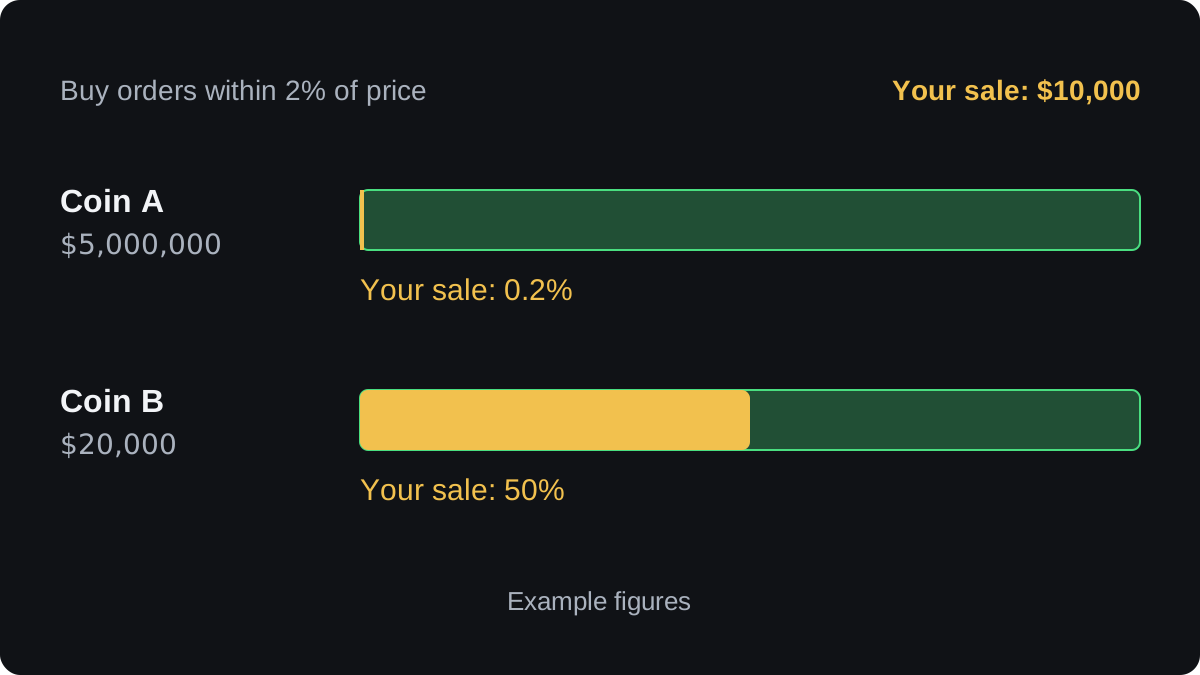
Here is step 3 with illustrative figures. Say coin A has $5,000,000 of buy orders within 2% of its price and coin B has $20,000.
A $10,000 sale is 0.2% of coin A's depth and half of coin B's.
When you trade a crypto CFD at a broker, you see the broker's quote and no order book. The coin's liquidity still shows up in that quote: the spread tends to widen when the coin's own markets thin out.
Câu hỏi thường gặp
Is Bitcoin a liquid market?
On large exchanges, bitcoin is usually among the most liquid crypto assets, with deep books against major currencies and stablecoins. Its liquidity still thins at weekends, in quiet hours and during sharp falls.
What is a liquidity pool?
A liquidity pool is a stock of tokens, usually two, locked in a smart contract on a decentralized exchange. Traders swap against the pool instead of an order book, and its price moves with every trade.
Does high trading volume mean a coin is liquid?
Often, but check the order book too. Reported volume can include wash trading, and a coin can trade a lot while little waits near the price.
Why did my market order fill at a worse price than the quote?
The best price held fewer coins than your order, so the rest filled at the next prices in the book. That gap is slippage, and it grows as liquidity thins.
Học tiếp
 Chương 1Bid, ask and spread in crypto.The bid is the highest price a buyer will pay for a coin right now, and the ask is the lowest price a seller will accept. You buy at the ask and sell at the bid. The gap is the spread, a cost you pay on every trade. Crypto traders measure it as a percentage of the price.
 Chương 1How to read a crypto order book.An order book is the live list of limit orders waiting on an exchange. Sell orders, the asks, sit above the price and buy orders, the bids, sit below it. Each row shows a price and an amount. The gap in the middle is the spread, and the running totals show how far a large order would move the price.
 Chương 1What are maker and taker fees?A maker fee applies when your order waits in the order book and someone else fills it later. A taker fee applies when your order fills straight away against an order that was already waiting. Exchanges usually charge takers more, because makers supply the orders that keep spreads narrow.
 Chương 1When does the crypto market trade?Crypto coins trade 24 hours a day, seven days a week, on exchanges around the world, with no official open or close. A crypto CFD at a broker follows the broker's own schedule, including any daily break and its weekend rules. You find those hours in the symbol's contract specification.

