When does the crypto market trade?
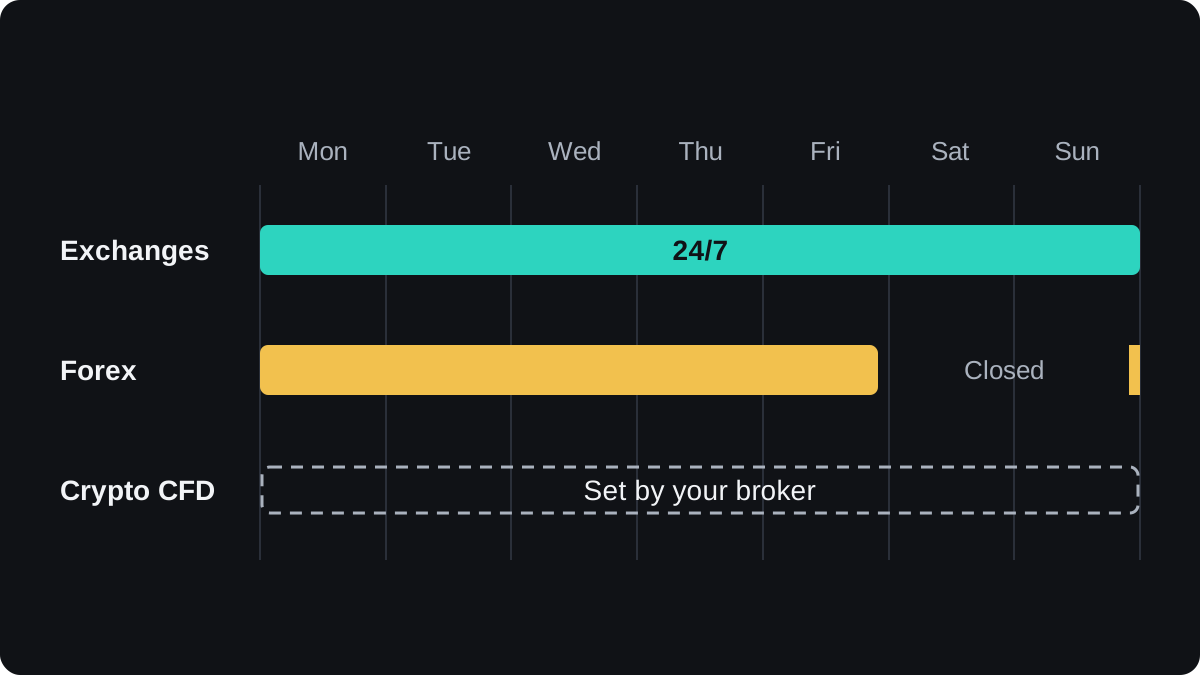
Crypto coins trade 24 hours a day, seven days a week, on exchanges around the world, with no official open or close. A crypto CFD at a broker follows the broker's own schedule, including any daily break and its weekend rules. You find those hours in the symbol's contract specification.
Nội dung này hiện chỉ có bản tiếng Anh.

At 3 a.m. on a Sunday, the forex market is closed, and so are the stock exchanges in New York, London and Tokyo. Bitcoin is still trading, and new blocks are still being added to its chain.
Whether you can trade it at that hour depends on where you trade it. On a crypto exchange you almost always can. With a broker's crypto CFD, the broker decides.
Coins trade around the clock
A blockchain network has no opening time. Its computers run all day, every day, and transactions keep being confirmed at weekends and on public holidays.
Exchanges match orders around the clock too. There is no opening bell and no official closing price, so the week runs from one day into the next without a gap.
The usual exception is maintenance. An exchange may pause trading for a short planned upgrade and announce the window in advance. Unplanned outages also happen, for example when traffic surges in a fast market.
Charts still need a daily candle, so each platform picks a time to close it. Some close it at midnight UTC and others at another hour, so two platforms can show different daily candles for the same coin.
Busy hours and quiet hours
Open all the time does not mean equally busy all the time. Crypto traders are spread around the world, and activity rises and falls as different regions start and end their working day.
Bitcoin trading has tended to be busiest around the opening hours of the large stock markets, and prices often react to major economic news such as interest rate decisions. Weekend days see less trading than weekdays.
Less activity usually means thinner liquidity: wider spreads, and bigger jumps on the same order size. A thin weekend market can move sharply on orders that would barely register on a weekday.
The forex trading sessions give you a rough clock for those regional shifts, and the market hours tool shows them in your own time zone.
Crypto CFDs keep your broker's hours
A crypto CFD is a contract with your broker on the price of a coin. You never hold the coin, so the trading hours are the broker's, set by its own risk policy and the rules where it is licensed.
Schedules differ from broker to broker. Some quote crypto CFDs every day of the week, some close them at weekends, and some pause them briefly each day when the trading day rolls over.
Weekend trading can come with its own terms, such as wider spreads or higher margin. The lesson on trading crypto CFDs at weekends covers them.
Holding a CFD overnight usually costs a swap. For crypto CFDs, the broker decides which nights it is charged on and whether weekend nights count.
How to check your broker's crypto hours
In MetaTrader 5, the hours sit inside the symbol's contract specification:
- Open Market Watch and find the crypto symbol, such as BTCUSD. Names vary by broker.
- Right-click the symbol and choose Specification.
- Scroll down to Sessions. It lists quote times and trade times for each day of the week.
- Read the swap lines too, including the swap multiplier for each day.
- Note that the times are in the broker's server time, which may differ from yours.
The broker's website usually has the same details on a contract specifications page, along with notices about holiday hours.
Converting server time to your time
Here is a conversion with illustrative numbers. Say the specification shows Friday trading ending at 23:00 server time, the server runs at UTC+2, and you live at UTC+7.
- Take 2 hours off server time to get UTC: 23:00 minus 2 hours = 21:00 UTC on Friday.
- Add 7 hours to get your time: 21:00 plus 7 hours = 04:00 on Saturday.
- So your last chance to trade before the weekend is 4 a.m. on Saturday, your time.
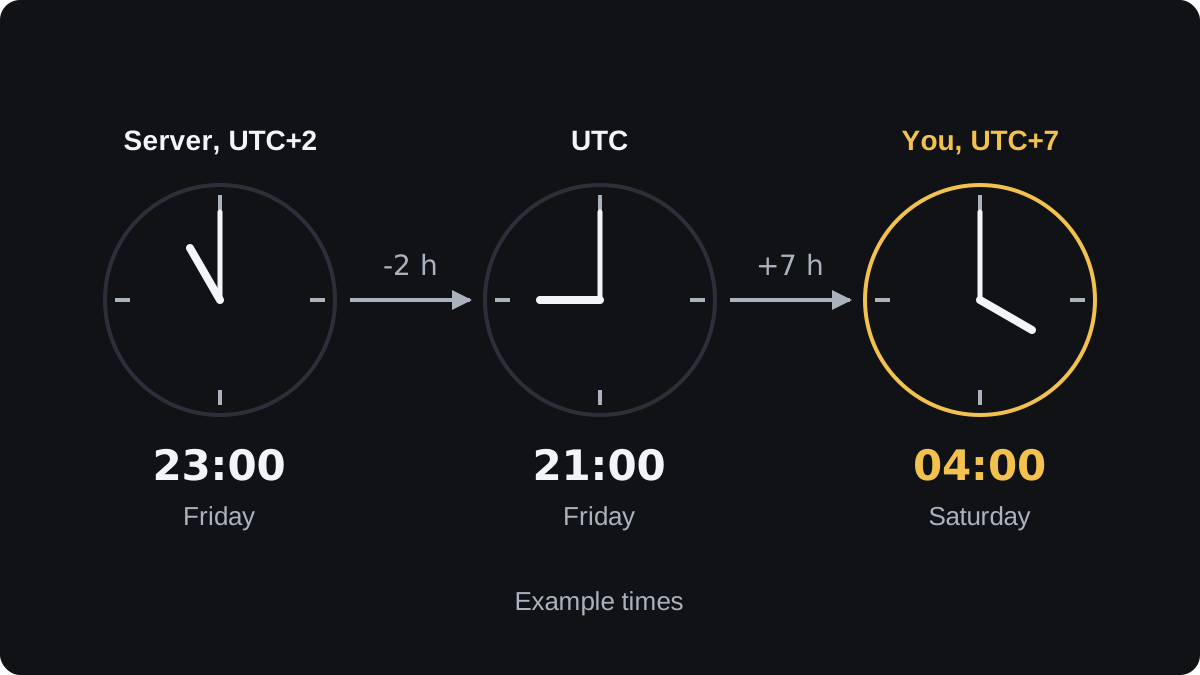
Some servers change their UTC offset when clocks change for summer, so check again after a daylight saving switch.
Worked example: the weekend gap
When a broker closes a crypto CFD at the weekend, the coin keeps trading on exchanges. The CFD then reopens wherever the coin's price has gone. The numbers below are illustrative.
- You hold a CFD on 0.5 BTC, bought at 50,000, with a stop loss at 49,000. The planned risk is 0.5 × 1,000 = $500.
- The broker closes the symbol on Friday with the price at 50,000.
- Over the weekend, bitcoin falls on exchanges, and the CFD reopens at 47,500.
- Your stop fills at the first available price, about 47,500. The loss is 0.5 × 2,500 = $1,250, two and a half times the plan.
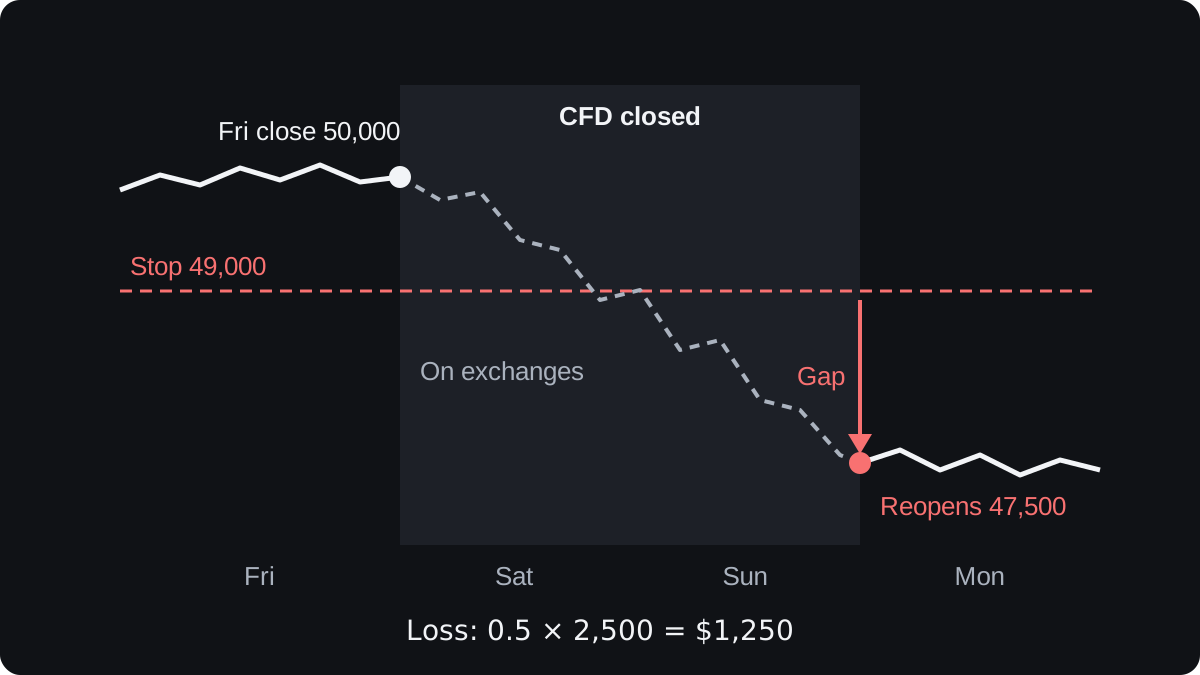
A broker that quotes through the weekend has no closing gap. Its weekend quotes may still carry wider spreads, which can trigger a stop sooner than on a weekday.
Câu hỏi thường gặp
Is the crypto market open on weekends?
Yes. Coins trade on exchanges every day of the week, including weekends and holidays, while a crypto CFD at a broker may follow a different schedule.
What time does the crypto market close?
It has no official close. Each charting platform picks a time for the daily candle, such as midnight UTC, so daily closing prices can differ between platforms.
Why is my broker's crypto CFD closed when bitcoin is trading?
The CFD is a contract with your broker, and the broker sets when it can be traded. The coin keeps trading on exchanges, so the CFD can reopen at a different price.
What time zone are MT5 trading hours shown in?
MT5 shows sessions in the broker's server time, which can differ from yours. The quote time in the Market Watch window runs on the same clock, so compare it with your own clock to find the difference.
Học tiếp
 Chương 1Bid, ask and spread in crypto.The bid is the highest price a buyer will pay for a coin right now, and the ask is the lowest price a seller will accept. You buy at the ask and sell at the bid. The gap is the spread, a cost you pay on every trade. Crypto traders measure it as a percentage of the price.
 Chương 1What is liquidity in crypto?Liquidity is how easily you can buy or sell a coin without moving its price. A liquid coin has many orders close to the current price, so the spread is narrow and a large order fills near the quoted price. In a thin market, the same order eats through the book and fills at worse prices.
 Chương 1How to read a crypto order book.An order book is the live list of limit orders waiting on an exchange. Sell orders, the asks, sit above the price and buy orders, the bids, sit below it. Each row shows a price and an amount. The gap in the middle is the spread, and the running totals show how far a large order would move the price.
 Chương 1What are maker and taker fees?A maker fee applies when your order waits in the order book and someone else fills it later. A taker fee applies when your order fills straight away against an order that was already waiting. Exchanges usually charge takers more, because makers supply the orders that keep spreads narrow.

