The London session: hours and what moves.
The London session is usually the busiest part of the forex day. By common convention it runs from 08:00 to 17:00 London time, which is 08:00 to 17:00 UTC in winter and 07:00 to 16:00 UTC in summer. Euro, pound and Swiss franc pairs tend to move most, and the overlap with New York usually lasts four hours.
本頁目前僅提供英文版。
When the working day starts in London, banks across Europe join a market that has been quiet for hours. Prices on many pairs start to move faster.
That stretch is the London session, one of the main trading sessions, and for many pairs it is the most active part of the day.
What hours does the London session cover?
The London session is the part of the 24-hour forex day when trading desks in London are open. By common convention it runs from 08:00 to 17:00 London time.
Some platforms start it at 07:00, so treat the edges as approximate. Forex has no central exchange and no opening bell.
Banks trade with each other all day on weekdays, so a session is a name for the hours when one big financial centre is at work.
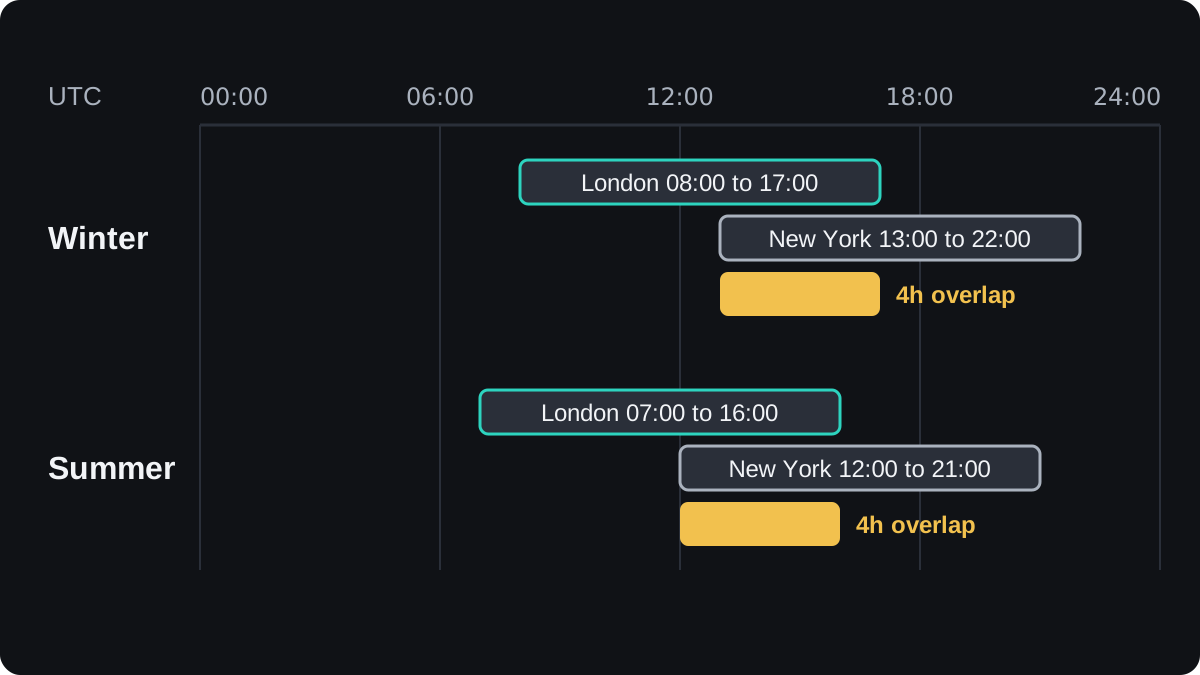
The session moves in UTC because the UK changes its clocks. In winter the UK keeps GMT, which equals UTC, so the session runs 08:00 to 17:00 UTC.
In summer the UK uses British Summer Time, one hour ahead of UTC, so the session runs 07:00 to 16:00 UTC. The clocks go forward on the last Sunday in March and back on the last Sunday in October.
At its start, London meets the end of the Tokyo session, which by the usual convention closes around 09:00 UTC all year, because Japan does not change its clocks. At its end, London meets New York.
New York is usually given as 08:00 to 17:00 New York time: 13:00 to 22:00 UTC in winter and 12:00 to 21:00 UTC in summer. The overlap, the hours when both centres are open, lasts four hours in each season.
The US changes its clocks on other dates: the second Sunday in March and the first Sunday in November.
In the gaps between the two countries' changes, two to three weeks in March and one week around the start of November, the overlap runs five hours, from 12:00 to 17:00 UTC.
How do you convert London hours to your own clock?
Work from UTC and add or subtract your own offset. Take a trader in Dubai, which stays on UTC+4 all year:
- Winter session in UTC: 08:00 to 17:00. Add 4 hours: 12:00 to 21:00 in Dubai.
- Summer session in UTC: 07:00 to 16:00. Add 4 hours: 11:00 to 20:00 in Dubai.
- The winter overlap with New York, 13:00 to 17:00 UTC, becomes 17:00 to 21:00 in Dubai.
- The summer overlap, 12:00 to 16:00 UTC, becomes 16:00 to 20:00 in Dubai.
The same sum for a few other cities:
| City and offset | Winter session, local time | Summer session, local time |
|---|---|---|
| Lagos, UTC+1 all year | 09:00 to 18:00 | 08:00 to 17:00 |
| Dubai, UTC+4 all year | 12:00 to 21:00 | 11:00 to 20:00 |
| Singapore, UTC+8 all year | 16:00 to 01:00 | 15:00 to 00:00 |
| New York, changes clocks | 03:00 to 12:00 | 03:00 to 12:00 |
In cities that never change their clocks, the session starts an hour earlier in summer. New York sees the same local hours all year, except in the weeks when the US and UK change on different dates.
The market hours tool shows every session in your own time zone, including the weeks when the clock changes fall apart.
Why is the London session so busy?
London is the largest centre for currency trading in the world. In the Bank for International Settlements survey of forex turnover, run every three years, the United Kingdom has ranked first by a wide margin in recent editions.
Banks in London quote prices to each other, to funds and to companies through the European day. More dealers quoting means more liquidity, the ease of buying or selling a large amount without moving the price much.
For you, high liquidity tends to mean narrower spreads on the main European pairs than in the quiet hours after New York closes.
Prices also tend to cover more ground in an hour, so a stop set for quiet Tokyo trading is reached more easily. Both are tendencies, and a data surprise can widen spreads within seconds.
Which pairs and events move during London hours?
Pairs that include the euro, the pound or the Swiss franc are usually the most active, since their home markets are open. Typical examples are EUR/USD, GBP/USD, EUR/GBP, USD/CHF and EUR/CHF.
Yen crosses such as EUR/JPY and GBP/JPY often pick up too, because European money arrives while Tokyo is still trading.
Scheduled news adds to the flow. UK and euro area figures on inflation, jobs and business activity mostly come out in the London morning, and Bank of England and European Central Bank rate decisions are announced in London hours.
The economic calendar lists the exact release times in your time zone.
US data arrives during the overlap. Major US releases such as the monthly jobs report usually come out at 08:30 New York time, which is 13:30 UTC in winter and 12:30 UTC in summer.
Near the close, a widely used benchmark rate is set at 16:00 London time, often called the London fix. Funds that value their holdings at that rate may trade close to it, which can bring a short burst of volume.
After London closes, New York carries the market on its own until its close, as the New York session lesson explains.
What often happens at the London open?
Many pairs drift inside a narrow band during the quieter Tokyo hours. The Asian range is the high and low price set in that period.
When Europe arrives, price often leaves the band. Sometimes it keeps going for the rest of the day, and sometimes it returns within minutes.
Some traders try to catch that first move with a plan often called a London breakout. With round, illustrative EUR/USD prices on 0.10 lot, which is 10,000 euros, one pip is worth 10,000 × 0.0001 = $1.00:
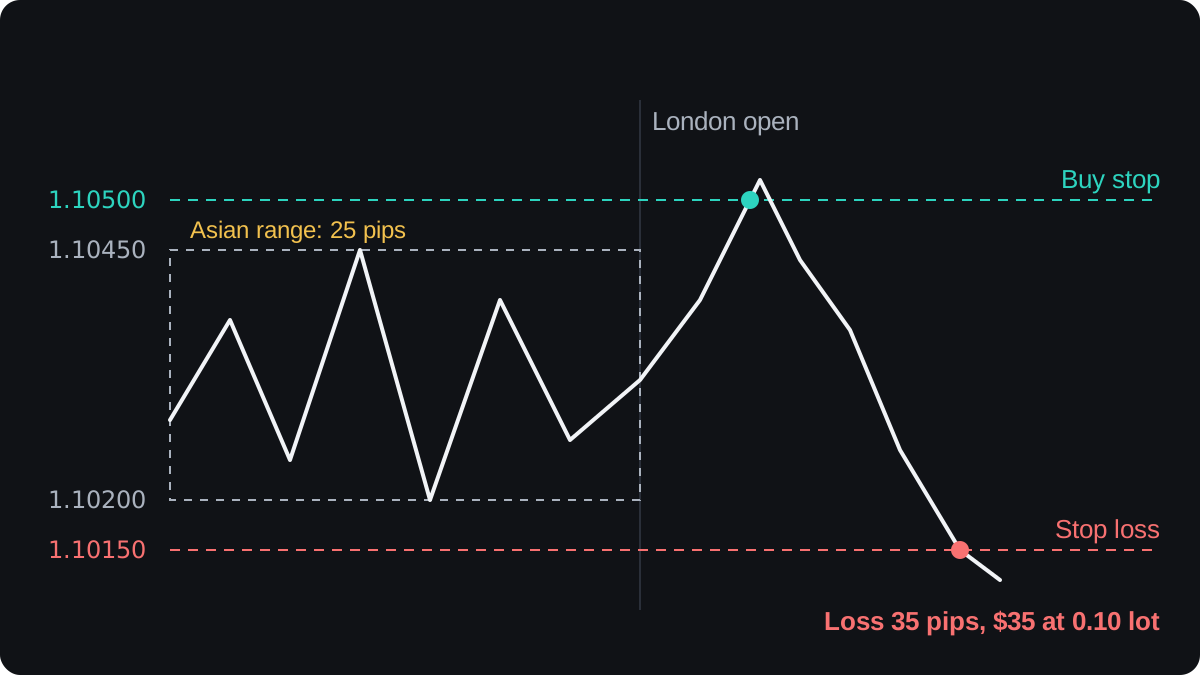
- On a winter day, between 00:00 and 08:00 UTC, EUR/USD trades between 1.10200 and 1.10450. The range is 1.10450 minus 1.10200 = 0.00250, or 25 pips.
- You place a buy stop 5 pips above the high, at 1.10500, and a stop loss 5 pips below the low, at 1.10150.
- The risk is 1.10500 minus 1.10150 = 0.00350, or 35 pips. At $1.00 per pip, that is $35.
- If price runs to 1.10850, the gain is 1.10850 minus 1.10500 = 0.00350, which is 35 pips or $35.
- If price rises to 1.10520, fills your buy stop, then falls through 1.10150, you lose the full 35 pips, or $35.
Spread and slippage come on top of these figures, and both can be larger in the first minutes after the open.
Moves that break out and then reverse, like the one in step 5, are common at the open, and the false breakouts lesson shows how they form.
Read the plan as a picture of how price can behave when Europe arrives. Published evidence that it makes money after costs is thin and mixed.
常見問題
What time does the London session open?
By the usual convention it opens at 08:00 London time, which is 08:00 UTC in winter and 07:00 UTC in summer. Some platforms use 07:00 London time instead.
What time does the London session close?
Around 17:00 London time, which is 17:00 UTC in winter and 16:00 UTC in summer. Trading carries on after that through the New York session.
When do the London and New York sessions overlap?
From 13:00 to 17:00 UTC in winter and from 12:00 to 16:00 UTC in summer. In the weeks when US and UK clock changes fall on different dates, the overlap runs from 12:00 to 17:00 UTC.
Which pairs move most in the London session?
Pairs with the euro, the pound or the Swiss franc, such as EUR/USD, GBP/USD and EUR/GBP, are usually the most active. Their spreads also tend to be narrower during these hours.
Is the London session good for beginners?
Spreads on major pairs tend to be narrow, but prices move faster and news lands often, so stops are hit more easily. Watching it on a demo account first shows you the pace.
繼續學習
 第 3 章What are the forex trading sessions?The forex day runs in four overlapping sessions named after Sydney, Tokyo, London and New York, each following that city's working hours. Together they cover 24 hours from Monday morning in Asia to Friday evening in New York. The busiest stretch is usually the four hours when London and New York are both open.
 第 3 章The Tokyo session: hours and what moves.The Tokyo session is the Asian part of the forex day, roughly 00:00 to 09:00 UTC. Japan does not use daylight saving time, so those hours stay fixed all year. Yen pairs and the Australian and New Zealand dollars are most active, and ranges on European pairs are often smaller than in London.
 第 3 章The New York session: hours and what moves.The New York session runs from about 08:00 to 17:00 New York time, which is roughly 13:00 to 22:00 UTC in winter and 12:00 to 21:00 UTC in summer. Its first four hours overlap London, usually the busiest stretch of the day. Much of the major US data comes out at 08:30 New York time.
 第 3 章What is the best time of day to trade forex?For most major pairs the best conditions come when London and New York are both open, about 12:00 to 16:00 UTC in the northern summer and 13:00 to 17:00 UTC in winter. Liquidity is deepest and spreads are usually tightest then, although big US data releases also land in that window.
 第 3 章What are the best days of the week to trade forex?Forex opens around 17:00 New York time on Sunday and closes at the same time on Friday. Monday's first hours are often thin and can gap. Tuesday to Thursday are often busier, with many scheduled releases. Friday afternoons thin out before the close. No day is best for everyone, so check your own pairs.

