When do you buy or sell a currency pair?
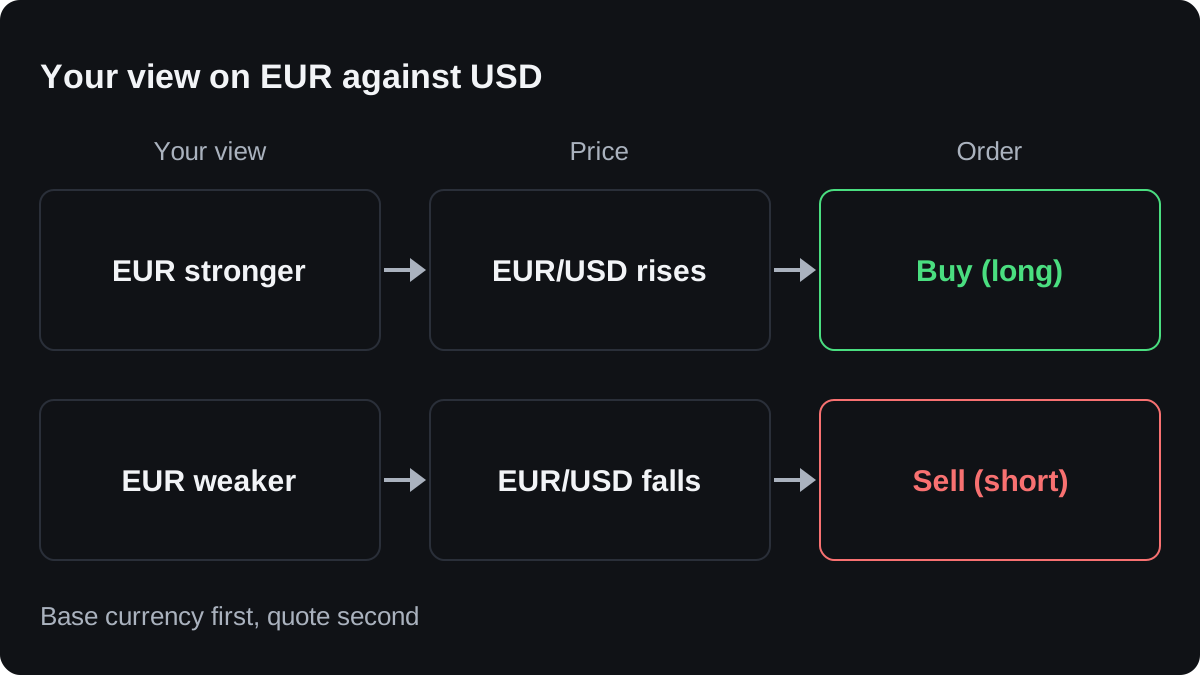
You buy a currency pair when you expect the first currency, the base, to strengthen against the second, and you sell when you expect it to weaken. If your view is about one currency, find which side of the pair it sits on: a weaker quote currency pushes the pair up, so you buy.
本頁目前僅提供英文版。

Every trade starts with one button: buy or sell. You buy a currency pair when you expect the first currency to gain value against the second, and you sell when you expect it to lose value.
The harder part comes when your opinion is about a single currency, such as "the yen will weaken". You then have to pick a pair and work out which button matches your view.
What does a buy or a sell say about your view?
Take EUR/USD at an illustrative price of 1.10000. That price means one euro costs 1.10000 US dollars. If you think a euro will soon cost more dollars, you buy, and if you think it will cost fewer, you sell.
The euro here is the base currency, the first one in the pair, and the dollar is the quote currency. A rising price always means one unit of the base buys more of the quote.
That gives one rule for every pair:
- Expect the base to strengthen against the quote: buy, also called going long.
- Expect the base to weaken against the quote: sell, also called going short.
Selling first is normal in forex. You do not need to own euros to sell EUR/USD, because a retail trade is a contract with your broker. You open with a sell and close later with a buy.
The lesson on how a forex trade makes or loses money shows how the result of each kind of trade is calculated.
Why can a pair move because of either currency?
A pair's price compares two currencies, so it changes when either one changes. EUR/USD can rise because the euro gains in general, because the dollar loses, or both at once.
A buy on EUR/USD is therefore a bet on the euro relative to the dollar. Being right about the euro on its own is not enough.
Here is an illustrative day. The euro gains 0.3% against the yen, and the dollar gains 0.8% against the yen.
The euro had a good day, yet EUR/USD falls. The pair moves by the ratio of the two changes: 1.003 ÷ 1.008 = 0.995, a fall of about 0.5%.
Before any trade, ask which of the two currencies you expect to do better from here. The lesson on pairing a strong currency with a weak one builds on this idea.
How do you turn a view on one currency into a trade?
Most opinions start with one currency. You might read that a central bank may cut rates and decide its currency looks weak. The pair you choose then decides which button you press.
Three steps turn that opinion into an order:
- Find where your currency sits in the pair, on the left or on the right.
- On the left, it is the base: buy if you expect it to strengthen, sell if you expect it to weaken.
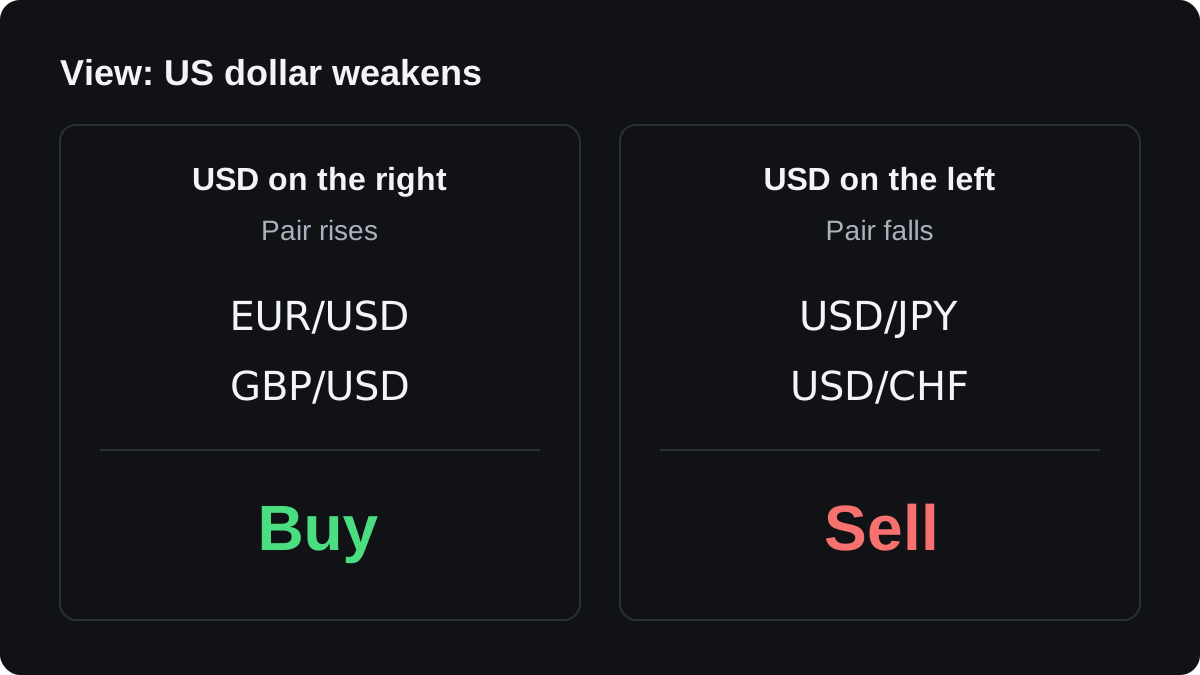
- On the right, it is the quote and the logic flips: a weaker quote currency lifts the pair, so you buy, and a stronger one pushes it down, so you sell.
Here is one view, that the US dollar will weaken, applied to four major pairs:
| Pair | Where USD sits | Expected move | Order |
|---|---|---|---|
| EUR/USD | Right (quote) | Rises | Buy |
| GBP/USD | Right (quote) | Rises | Buy |
| USD/JPY | Left (base) | Falls | Sell |
| USD/CHF | Left (base) | Falls | Sell |
The same check works for any currency. If you expect the yen to weaken, USD/JPY and EUR/JPY should both rise, so you would buy either one.
Each pair also carries a view on its other currency. Buying EUR/USD and buying GBP/USD both bet against the dollar, yet one also bets on the euro and the other on the pound.
Worked example: one dollar view, two trades
Say you expect the dollar to weaken over the next few days. Both trades below express that view. The prices are illustrative, and the spread is left out to keep the arithmetic clear.
Both trades use 0.10 lot, which is 10,000 units of the base currency.
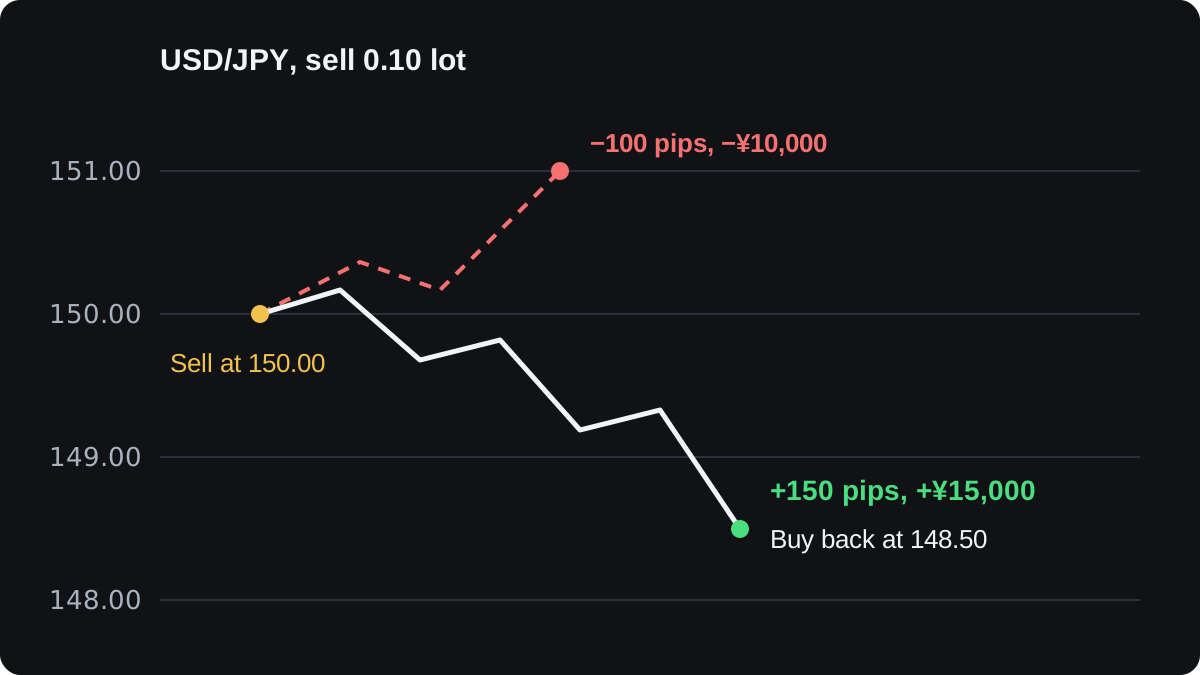
Trade A: sell USD/JPY
- You sell 0.10 lot of USD/JPY at 150.00, a position of 10,000 dollars.
- You buy it back at 148.50. The price fell by 150.00 − 148.50 = 1.50, in your favour.
- On yen pairs a pip, the standard price step, is 0.01, so 1.50 is 150 pips.
- One pip on 10,000 dollars is 10,000 × 0.01 = ¥100, so the gain is 150 × ¥100 = ¥15,000.
- In a US dollar account at 148.50, that is 15,000 ÷ 148.50 = $101.01.
If the dollar had risen instead and you closed at 151.00, the result would be 150.00 − 151.00 = −1.00, or −100 pips. That is −¥10,000, or 10,000 ÷ 151.00 = $66.23 lost.
Trade B: buy EUR/USD
- You buy 0.10 lot of EUR/USD at 1.10000, a position of 10,000 euros.
- You sell it at 1.10800. The price rose by 1.10800 − 1.10000 = 0.00800.
- On this pair a pip is 0.0001, so the move is 80 pips.
- One pip on 10,000 euros is 10,000 × 0.0001 = $1.00, so the gain is 80 × $1.00 = $80.00.
Both trades made money because the dollar fell in this example. The amounts differ because the yen and the euro had their own moves too.
Had the yen weakened faster than the dollar, USD/JPY would have risen and Trade A would have lost, even with your dollar view correct. You can rerun these sums with other prices in the profit and loss calculator.
What should you settle before you press buy or sell?
A buy or sell is a forecast, and forecasts are often wrong. The direction is only one of the choices a trade needs.
Traders form their expectation from price charts, from economic news and data, or from how other traders are positioned. The three types of analysis lesson compares these approaches.
None of them predicts short-term moves reliably. Evidence that any of them gives a lasting edge after costs is mixed, so treat every direction call as a guess you can test.
Before you open a trade, decide:
- the reason you expect this direction, in one sentence you could write down
- the price at which that reason is proven wrong, where a stop loss would close the trade
- a position size whose loss at that stop you can accept
- whether the move you expect is large enough to cover the spread and other costs
Price level alone is no reason to buy or sell. USD/JPY near 150 is not expensive and EUR/USD near 1.10 is not cheap, because each number only reflects the size of the currency units. A pair that has already fallen far can keep falling.
A demo account lets you practise choosing a direction and an exit with virtual money before any real money is at risk.
常見問題
Should I buy or sell if I think the yen will weaken?
In pairs where the yen is the quote currency, such as USD/JPY or EUR/JPY, a weaker yen pushes the price up, so the matching order is a buy. Check your view on the other currency in the pair as well.
Can I sell a currency pair I do not own?
Yes. A retail forex trade is a contract with your broker, so you can open with a sell and close it later with a buy.
Is it better to buy or sell?
Neither direction has a built-in advantage. A trade gains only if the price moves your way by more than its costs, and overnight swap can differ between a long and a short on the same pair.
What does going long or short mean?
Going long means you bought the pair and gain if it rises. Going short means you sold the pair and gain if it falls.
Does a falling price mean I should buy?
A fall on its own tells you little about what comes next, and a falling pair can keep falling. A trade in either direction needs a reason and a set price where you would exit if you are wrong.
繼續學習
 第 2 章How does a forex trade make or lose money?A forex trade makes money when the pair moves in your direction by more than the trade costs, and loses when it moves against you. A buy gains as the price rises and a sell gains as it falls. Profit is the price change times trade size, less commission and swap.
 第 2 章外匯的點(pip)是什麼?點(pip)是交易者衡量價格變動的標準單位。大多數貨幣對的 1 點是 0.0001,也就是小數點後第四位;以日圓報價的貨幣對則是 0.01。微點(pipette)是 1 點的十分之一。1 標準手 EUR/USD 每點價值 $10。
 第 2 章外匯的「手」(lot)是什麼?手(lot)是設定外匯交易規模的單位。1 標準手是 100,000 單位的基礎貨幣,迷你手是 10,000,微型手是 1,000。以 EUR/USD 來說,每點價值分別是 $10、$1 與 $0.10。黃金等其他商品則有各自的合約大小。
 第 2 章外匯點差是什麼?點差是您能賣出的賣價(bid)與能買入的買價(ask)之間的差距。每筆交易在開倉的那一刻就要支付。EUR/USD 的點差通常只有一兩點,甚至更低,而在每日轉倉、每週開盤與重大新聞前後會擴大。
 第 2 章外匯的賣價(Bid)與買價(Ask)是什麼?每個外匯報價都有兩個價格。賣價(Bid)是您可以賣出的價格,買價(Ask)則是較高、您可以買進的價格。兩者之間的差距就是點差。您以買價買進、以賣價平倉,所以每筆新交易一開始都會落後一個點差的幅度。
 第 2 章Forex terms you will hear every day.The everyday words of forex describe what a trade is doing and what it costs. Long means you bought, short means you sold. A pip is the standard price step, a lot is the trade size, the spread is the gap between bid and ask, and margin is the deposit your broker holds while a trade is open.
 第 2 章What types of orders can you place in forex?A market order buys or sells straight away at the current price. A pending order waits for a price you choose: a limit order waits for a better price, and a stop order joins a move once price breaks a level. Stop loss and take profit orders close an open trade at prices you set in advance.
 第 2 章Forex order types cheat sheet.A market order fills now at the current price. A limit order waits for a better price: a buy limit below the market, a sell limit above it. A stop order waits for a worse price: a buy stop above, a sell stop below. Buy orders trigger on the ask, sell orders on the bid.
 第 2 章What is a forex demo account, and how should you use it?A forex demo account is a practice account funded with virtual money. You trade on the broker's platform with live or near-live prices, so you can learn orders, stops and margin without risking your own cash. Set it up with the balance and leverage you would really use, and expect live fills and feelings to differ.
 第 2 章Can you get rich trading forex?A few people make large sums trading forex, but the loss figures that EU and UK brokers must publish show that most retail CFD accounts at those brokers lose money. Getting rich would need a large starting balance and years of steady returns. Small accounts chasing big targets usually take risks large enough to wipe them out.
 第 2 章外匯基礎速查表:貨幣對、點、手、槓桿與保證金。這份速查表把外匯基礎章節濃縮在一頁裡。每個觀念都附上簡短摘要、公式,以及完整課程的連結。下單前,您可以用速查表核對點的大小、每點價值、合約大小與保證金,最後再用一筆完整的交易範例把所有內容串起來。

