Why and when to trade crosses.
A currency cross lets you trade a view on two currencies without the US dollar, so a move driven only by the dollar cancels out. Crosses suit themes such as diverging central banks or risk appetite. The trade-off is usually a wider spread, thinner liquidity outside the home sessions and pip values that need conversion.
이 내용은 현재 영어로만 제공됩니다.

Suppose you think the euro will gain on the pound, and you have no view on the US dollar. Buying EUR/USD would tie your result to the dollar as well. EUR/GBP lets you trade only the two currencies you have an opinion about.
That focus is the main reason to trade a currency cross. You usually pay for it with a wider spread and thinner trading at some hours of the day.
What does a cross isolate that a major does not?
A cross rate can be built from two dollar pairs. EUR/GBP is EUR/USD divided by GBP/USD. With round illustrative prices of 1.1000 and 1.3000, EUR/GBP is 1.1000 ÷ 1.3000 = 0.84615.
Now say the dollar loses 1% against both currencies. EUR/USD rises 110 pips to 1.1110 and GBP/USD rises 130 pips to 1.3130. Yet 1.1110 ÷ 1.3130 is still 0.84615.
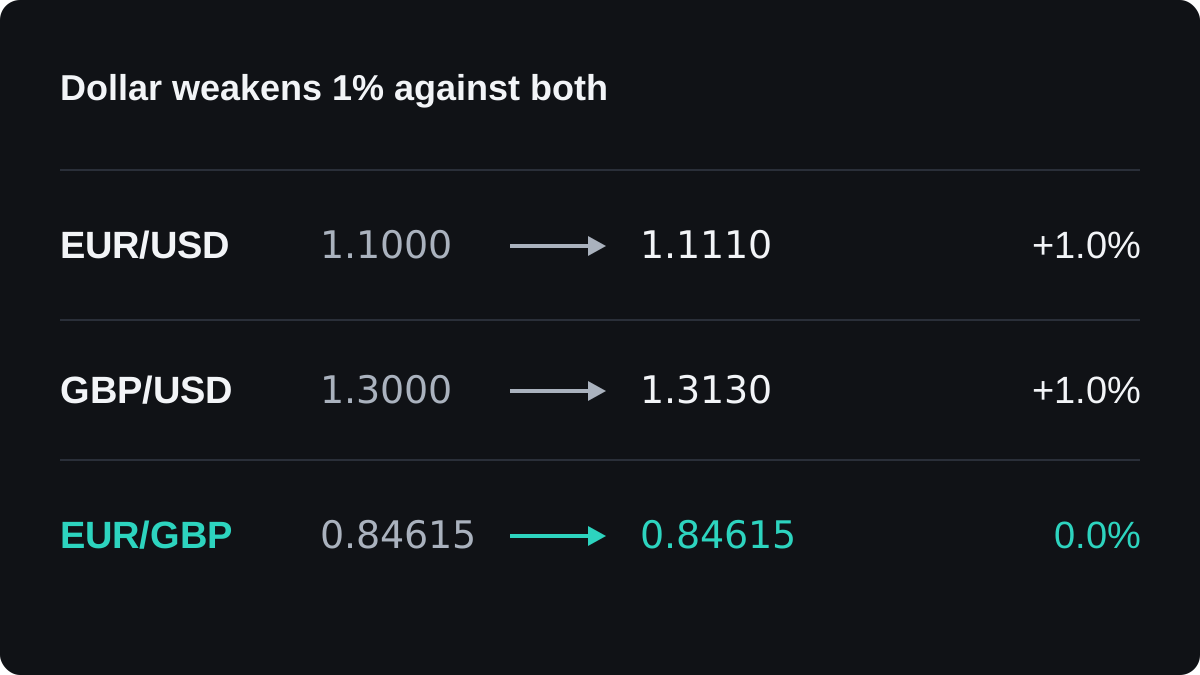
A move that came only from the dollar cancels out in the cross. Had the euro gained 1% while GBP/USD stayed at 1.3000, EUR/GBP would have risen to 1.1110 ÷ 1.3000 = 0.85462, a gain of about 85 pips.
Real quotes will not match the formula to the last digit, because each price carries its own spread. The relationship still holds closely, since a large gap would be an easy profit for dealers to remove.
Which market themes suit a cross?
A cross makes sense when your reason for a trade is about two currencies and says little about the dollar.
Diverging central banks are one case. If one bank is raising rates while the other holds, the gap in interest rate expectations is the story, and a cross of those two currencies prices it directly.
Risk appetite is another. The yen has often strengthened when markets turn fearful, while the Australian dollar has often weakened. AUD/JPY has therefore tended to fall in risk-off periods, though the link breaks at times.
A local event, such as an election or a budget in one country, is a further case. If the news is about the pound, EUR/GBP or GBP/JPY carries it without a large dollar component.
In each case the cross is a tool for a view you already hold. Choosing a cross does not give you an edge by itself.
Do crosses really trend more cleanly?
A common claim is that crosses trend more smoothly than majors because they avoid dollar noise. The evidence is weak: no well-known study shows that crosses as a group trend better, and the claim rests mostly on anecdote.
Some crosses behave the other way. Pairs of closely linked economies, such as EUR/GBP or AUD/NZD, have spent long stretches inside fairly narrow ranges. GBP/JPY, by contrast, has a reputation for large daily swings that can reach a stop quickly.
Judge each pair by measuring it. Look at its average daily range and how often it has trended on the timeframe you trade. The volatility lesson shows ways to do that.
What does a cross cost compared with a major?
Crosses usually have wider spreads than the majors, because fewer dealers make prices in them. The figures below are round illustrative spreads, not any broker's quotes, for one standard lot in a US dollar account.
- EUR/USD, spread 1.0 pip. A pip on one lot is $10, so the spread costs 1.0 × $10 = $10.00.
- EUR/GBP, spread 1.5 pips. A pip is 0.0001 × 100,000 euros = £10. At GBP/USD 1.3000 that is $13.00, so the spread costs 1.5 × $13.00 = $19.50.
- GBP/JPY, spread 3.0 pips. A pip is 0.01 × 100,000 pounds = ¥1,000, so the spread is ¥3,000. At USD/JPY 150.00 that is ¥3,000 ÷ 150.00 = $20.00.
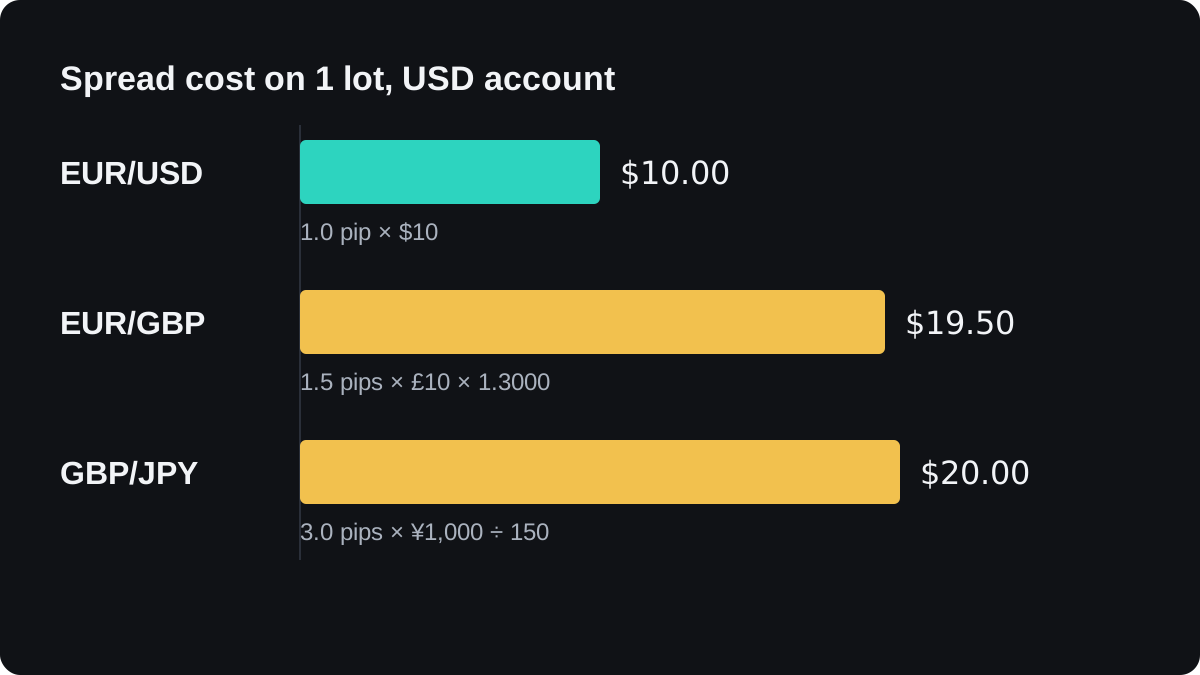
The pip value changes from pair to pair. On a cross it comes in a currency other than your US dollars, so it also drifts as conversion rates move. The pip value calculator does that conversion for any pair.
Cost per lot ignores how far a pair travels. A pair that moves more pips each day can carry a wider spread and still cost less for each pip of movement.
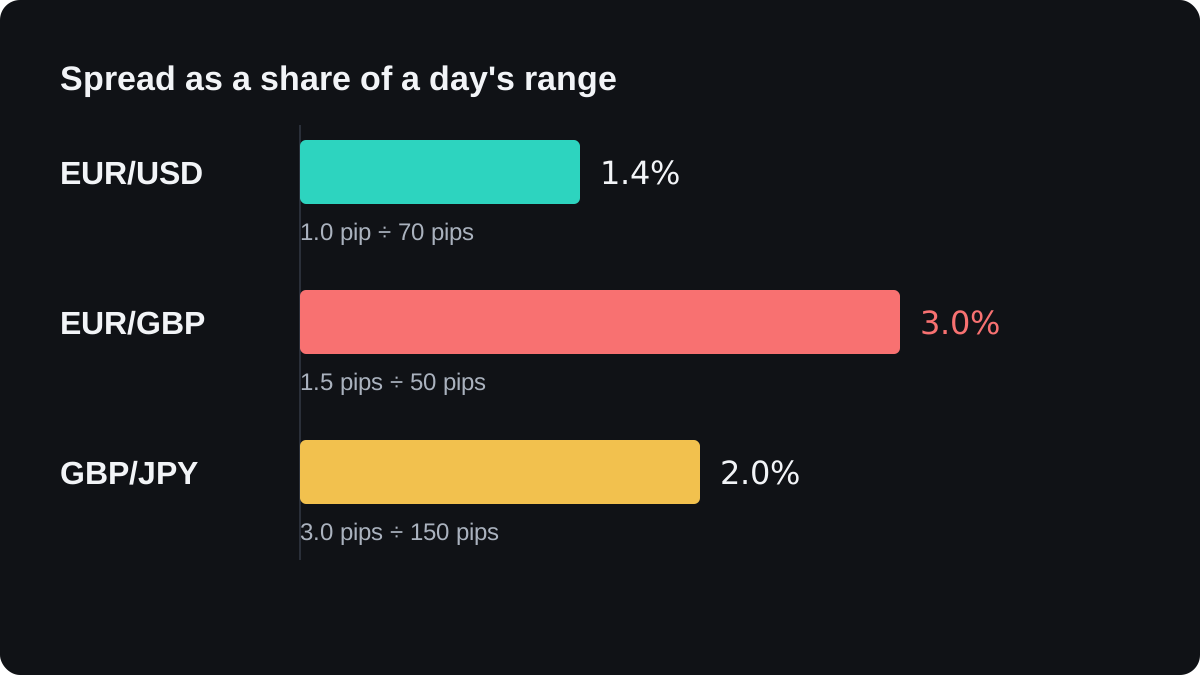
Suppose, again for illustration, that EUR/USD moves 70 pips in a typical day, EUR/GBP 50 and GBP/JPY 150. Divide each spread by that range:
| Pair | Spread | Daily range | Spread as share of range |
|---|---|---|---|
| EUR/USD | 1.0 pip | 70 pips | 1.4% |
| EUR/GBP | 1.5 pips | 50 pips | 3.0% |
| GBP/JPY | 3.0 pips | 150 pips | 2.0% |
On these numbers GBP/JPY costs slightly more per lot than EUR/GBP, yet less for each pip it moves. A quiet cross with a modest spread can be the most expensive pair to trade for short targets.
When in the day should you trade a cross?
Spreads on a cross tend to be tightest when the home markets of both currencies are open. EUR/GBP is busiest during the London session. AUD/JPY and NZD/JPY see more activity in Asian hours, when Sydney and Tokyo overlap.
Outside those hours fewer dealers quote the pair, and spreads can widen. This is most visible around the daily rollover, about 17:00 New York time, when spreads on many pairs widen for a while.
A cross also reacts to economic releases from both of its countries, so check two sets of dates on the calendar. The market hours tool shows which financial centres are open at any moment.
How can a cross add to risk you already hold?
A cross shares a currency with other pairs. If you are long EUR/USD and then buy EUR/GBP, you are long the euro twice, and a sharp euro drop would hit both trades at once.
Before adding a cross, list the currencies you are already long and short. The correlation and portfolio risk lesson explains how overlapping positions add up.
Size each trade in money rather than in lots. At the rates above, a 30 pip stop on one lot risks $300 on EUR/USD, 30 × $13.00 = $390 on EUR/GBP and ¥30,000 ÷ 150.00 = $200 on GBP/JPY.
Holding a cross overnight also brings swap, set largely by the interest gap between its two currencies. The carry trade lesson covers how that gap becomes a cost or a credit.
자주 묻는 질문
Are crosses harder to trade than major pairs?
Placing the order works the same way. Spreads are usually wider and some crosses swing sharply, so measure a pair's costs and daily range before you trade it.
Why is the spread wider on currency crosses?
Most crosses attract fewer dealers and less volume than the dollar majors, so prices are quoted with a wider gap. That gap often grows further in quiet hours.
Do crosses move with the US dollar?
A move that hits both currencies equally against the dollar cancels out in the cross. In practice dollar news can affect the two currencies differently, so a cross can still react to it.
What is a synthetic cross?
It is two dollar pair trades that together copy a cross, such as buying EUR/USD and selling GBP/USD in sizes chosen so the dollar amounts cancel. You pay two spreads, which can cost more than the cross's own spread.